Korean Question Words: 누구, 언제, 어디, 얼마나
Written and reviewed by Jun and Jin, native Korean speakers
Published · Updated · How we write & review
After this page, you can ask who, what, when, where, why and how much in Korean — and pick 누구 or 누가.
10-second answer
The short answer
Korean's core question words cover who, when, where, and how — 누구 (nugu, who), 언제 (eonje, when), 어디 (eodi, where), 얼마나 (eolmana, how much/how long) — plus 왜 (wae, why) and 뭐 (mwo, what), already covered on their own page. They slot directly into a sentence without changing word order the way English questions do.
Quick check — did that land?
1. How do you ask "Where is the bathroom?"
누구예요? 언제예요? 어디예요? 어떻게 해요? These mean who, when, where, and how.
The Core Set
| Korean | Meaning | Example |
|---|---|---|
| 누구 (nugu) | Who | 저 사람 누구예요? — Who is that person? |
| 언제 (eonje) | When | 언제 가요? — When are you going? |
| 어디 (eodi) | Where | 화장실이 어디예요? — Where is the bathroom? |
| 얼마나 (eolmana) | How much / how long | 얼마나 걸려요? — How long does it take? |
| 왜 (wae) | Why | See the dedicated 왜/뭐 page |
| 뭐 (mwo) | What | See the dedicated 왜/뭐 page |
See also: 왜/뭐 — why and what
No Word-Order Gymnastics Needed
English questions often invert word order ("You are going" → "Are you going?", "Where you are" → "Where are you?"). Korean just drops the question word into the same slot the answer would occupy — the sentence structure doesn't change.
학교에 가요.
I go to school. (statement)
어디에 가요?
Where do you go?
어디 slots in exactly where 학교 was — nothing else moves.
Asking the Way: 어디 and 얼마나
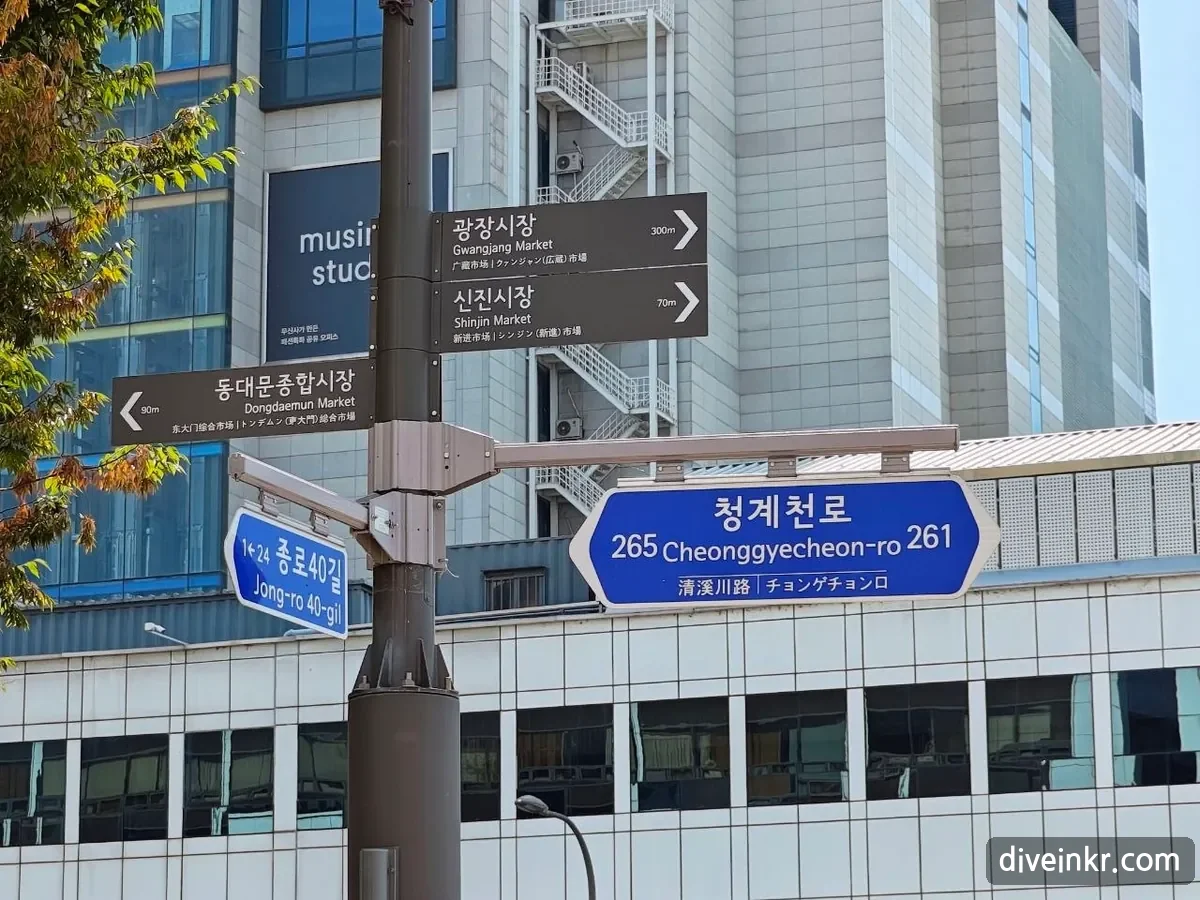
Downtown Seoul streets are well signposted, and boards like this one help a lot when you're finding your way. When you do need to ask, 어디 and 얼마나 cover almost everything — and the word order stays exactly as in a statement. Put the place first, then the question word: 광장시장이 어디예요? ("Where is Gwangjang Market?").
얼마나 on its own means "how much" of anything; the verb after it says what you're measuring. 얼마나 걸려요? asks how long it takes, and 얼마나 멀어요? asks how far. For a price you switch to a different word, 얼마 — see 얼마예요? (eolmayeyo?).
광장시장이 어디예요?
gwangjang sijang-i eodiyeyo?
Where is Gwangjang Market?
여기서 얼마나 걸려요?
yeogiseo eolmana geollyeoyo?
How long does it take from here?
신진시장은 얼마나 멀어요?
sinjin sijang-eun eolmana meoreoyo?
How far is Shinjin Market?
누구 vs 누가
누구 (who) combines with 이/가 (the subject marker) to become 누가 when "who" is the SUBJECT of the sentence — the same kind of contraction you'll see across Korean particles generally.
누가 왔어요?
nuga wasseoyo?
Who came?
누구 + 가 → 누가 (contracted).
누구를 만났어요?
nugureul mannasseoyo?
Who did you meet?
누구 + 를 (object marker) — no contraction here.
Common Mistakes
Mistake #1 — Trying to invert word order like English
Korean question words slot directly into the sentence — no rearranging needed.
Mistake #2 — Saying 누구가 instead of 누가
누구 + 이/가 contracts specifically to 누가, not the expected 누구가 — a small irregularity worth memorizing.
Mini Quiz
2 short questions — about 1 minute
2. What is 누구 + 이/가 contracted to?
3. How does Korean typically form a question compared to English?
Part of Korean Grammar Basics — Particles, Tense, and Negation
Related Knowledge
Learn Next
You've built up individual grammar patterns — this is the quick-reference chart tying all the polite endings together.
Will you remember this tomorrow?
Save it — your daily review brings it back right before you'd forget. No account needed.