Korean Future Tense: -(으)ㄹ 거예요 Explained
Written and reviewed by Jun and Jin, native Korean speakers
Published · Updated · How we write & review
After this page, you can use -(으)ㄹ 거예요 to talk about future plans and intentions.
10-second answer
How do you say -(으)ㄹ 거예요 in Korean?
-(으)ㄹ 거예요 (-(eu)l geoyeyo) attaches to a verb stem to express future plans or predictions — "will [verb]" or "going to [verb]." 가다 (gada, go) → 갈 거예요 (gal geoyeyo, "will go"). Whether you insert 으 (eu) before ㄹ depends on the same batchim rule you've already seen elsewhere on this site.
Quick check — did that land?
1. 가다 (go, vowel-ending stem) — what's the future tense?
내일 갈 거예요. 내일 갈 것 같아요. 둘 다 미래를 말하지만, 의미가 조금 달라요.
The Pattern
| Stem ends in… | Attach | Example |
|---|---|---|
| a vowel | -ㄹ 거예요 | 가다 → 가 + ㄹ 거예요 → 갈 거예요 |
| a consonant (batchim) | -을 거예요 | 먹다 → 먹 + 을 거예요 → 먹을 거예요 |
Same batchim logic as the particles you already know: vowel-ending stems get the lighter ㄹ-only form, consonant-ending stems need the extra 으 to connect smoothly.
See also: Korean Present Tense: -아요/-어요
Quick Examples
내일 학교에 갈 거예요.
naeil hakgyo-e gal geoyeyo.
I'll go to school tomorrow.
In speech the particles often go: 내일 학교 갈 거예요 (naeil hakgyo gal geoyeyo), 저녁 뭐 먹을 거예요? (jeonyeok mwo meogeul geoyeyo?), 비 올 거예요 (bi ol geoyeyo).
저녁에 뭐 먹을 거예요?
jeonyeoge mwo meogeul geoyeyo?
What are you going to eat for dinner?
비가 올 거예요.
biga ol geoyeyo.
It's going to rain.
Also works as a prediction, not just a personal plan.
Two Jobs: Plans and Predictions
This pattern covers both "I will do X" (intention) and "X will probably happen" (prediction) — English sometimes distinguishes these more sharply ("I will go" vs "it's probably going to rain"), but Korean's -(으)ㄹ 거예요 handles both naturally.
For a time word that goes with these promises, see 방금 vs 금방 (banggeum vs geumbang): 금방 갈게 (geumbang galge) means "I'll be there in no time."
Making Plans at a Bus Stop
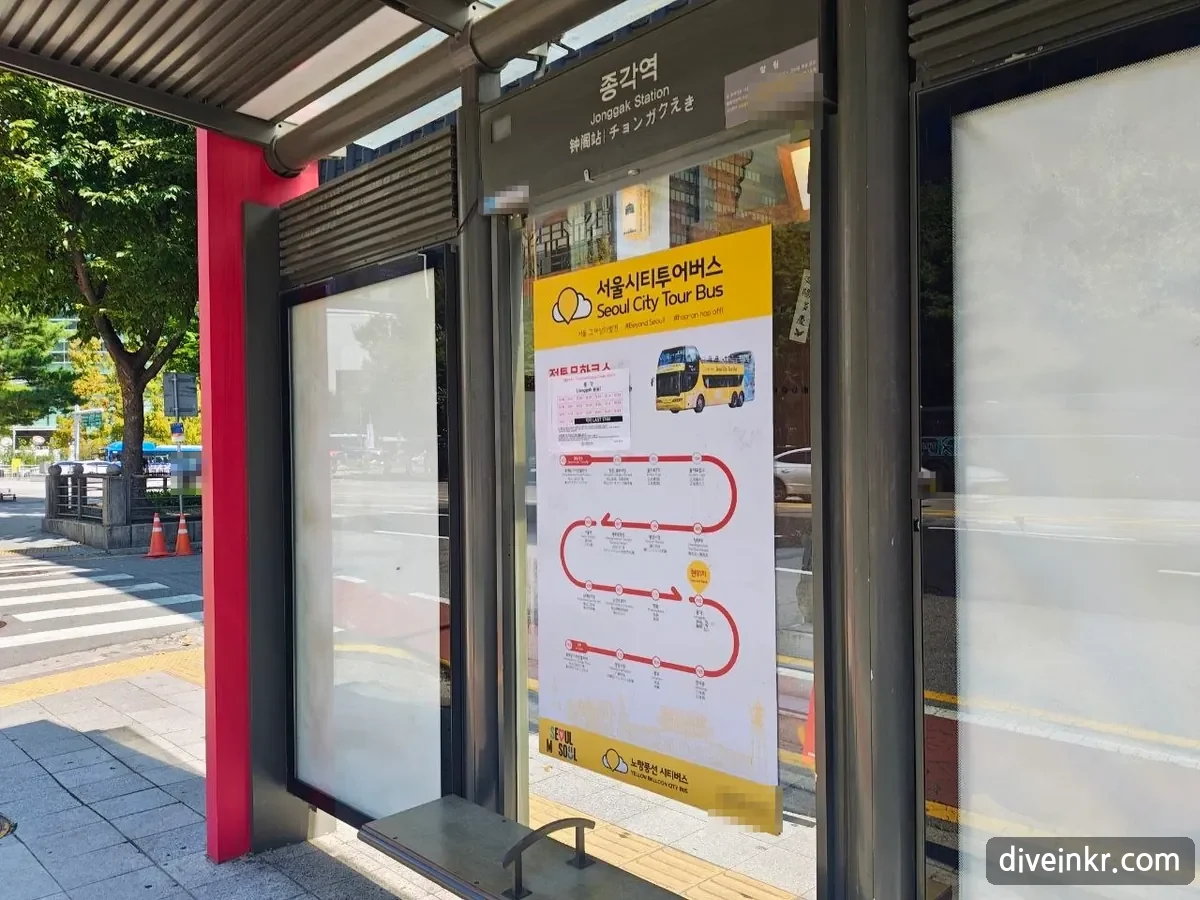
Travel plans are where you'll use -(으)ㄹ 거예요 most. The poster at this stop advertises the 서울시티투어버스 (seoul siti tueo beoseu), a hop-on, hop-off tour bus. Planning to ride it tomorrow? 내일 시티투어버스 탈 거예요 — 타다 (tada, to ride) has no batchim, so it takes ㄹ 거예요 and becomes 탈 거예요.
The same form makes predictions: 오늘은 사람이 많을 거예요 ("it'll probably be crowded today") — 많다 ends in a consonant, so it takes 을 거예요. And to ask about someone's plans, just raise your voice at the end: 어디에서 내릴 거예요? ("Where are you going to get off?"). Getting on and off regular city buses is covered in how to ride the bus in Seoul.
내일 시티투어버스 탈 거예요.
naeil siti tueo beoseu tal geoyeyo.
I'm going to ride the city tour bus tomorrow.
어디에서 내릴 거예요?
eodieseo naeril geoyeyo?
Where are you going to get off?
오늘은 사람이 많을 거예요.
oneureun sarami maneul geoyeyo.
It'll probably be crowded today.
The Casual and Formal Versions
| Level | Form | Example |
|---|---|---|
| Casual | -(으)ㄹ 거야 | 갈 거야 (will go) |
| Polite | -(으)ㄹ 거예요 | 갈 거예요 (will go) |
| Formal | -(으)ㄹ 겁니다 | 갈 겁니다 (will go) |
Common Mistakes
Mistake #1 — Forgetting the batchim rule
먹다 (consonant-ending stem) needs 을 거예요, not just ㄹ 거예요 attached directly.
Mistake #2 — Only using it for plans, not predictions
It works for both — don't reach for a separate structure just to express "it will probably…"
Mini Quiz
2 short questions — about 1 minute
2. 먹다 (eat, consonant-ending stem) — what's the future tense?
3. Can -(으)ㄹ 거예요 be used for weather predictions, not just personal plans?
Part of Korean Grammar Basics — Particles, Tense, and Negation
Related Knowledge
Learn Next
-세요: The Polite Command Form Explained
Tense is covered — polite commands and requests are the next essential verb-ending pattern.
Will you remember this tomorrow?
Save it — your daily review brings it back right before you'd forget. No account needed.