What Does 저기요 (Jeogiyo) Mean in Korean?
Written and reviewed by Jun and Jin, native Korean speakers
Published · Updated · How we write & review
After this page, you can get a server's or stranger's attention politely with 저기요 (jeogiyo).
10-second answer
What does Jeogiyo mean?
저기요 (jeogiyo) is Korea's all-purpose "excuse me!" — the polite way to get the attention of a stranger, waiter, or passerby. Literally "over there," it solves a real problem: Korean has no safe 'you' or universal title for strangers, so you point at the space instead. In restaurants, 여기요 (yeogiyo, "over here!") works the same way.
Quick check — did that land?
1. You need the waiter in a busy Seoul restaurant. You:
저기요. How do you get a stranger’s attention in Korea without sounding rude?
Quick Examples
저기요, 이거 얼마예요?
jeogiyo, igeo eolmayeyo?
Excuse me, how much is this?
여기요! 물 좀 주세요.
yeogiyo! mul jom juseyo.
Over here! Some water, please.
Calling a waiter — loud and normal in Korean restaurants.
저기요, 지갑 떨어뜨리셨어요!
jeogiyo, jigap tteoreotteurisyeosseoyo!
Excuse me, you dropped your wallet!
A note on spelling. The official romanization of 저기요 is jeogiyo, but you'll also see it written jogiyo or chogiyo. They're all the same word.
See also: 아줌마 — why titles are risky
Why Korean Needs This Word
You can't safely say 'you' (당신 can sound confrontational) or guess a title (아줌마 risks offense — see that page). 저기요 sidesteps every trap: no age guess, no relationship claim, just polite attention-getting.
| Calling… | Best word | Note |
|---|---|---|
| A stranger on the street | 저기요 | The universal safe choice |
| A waiter (from your table) | 여기요 / 저기요 | 'Over here!' — calling loudly is normal, not rude |
| Restaurant staff, warmly | 이모님/사장님 | Regulars' warmth — optional, learners can stay with 저기요 |
| Getting past someone | 잠시만요 | 'Just a moment' — the moving-through-a-crowd phrase |
Culture note: many Korean restaurants have a table call button (호출벨). If there's a bell, press it — no shouting needed at all.
Ordering From a Wall Menu
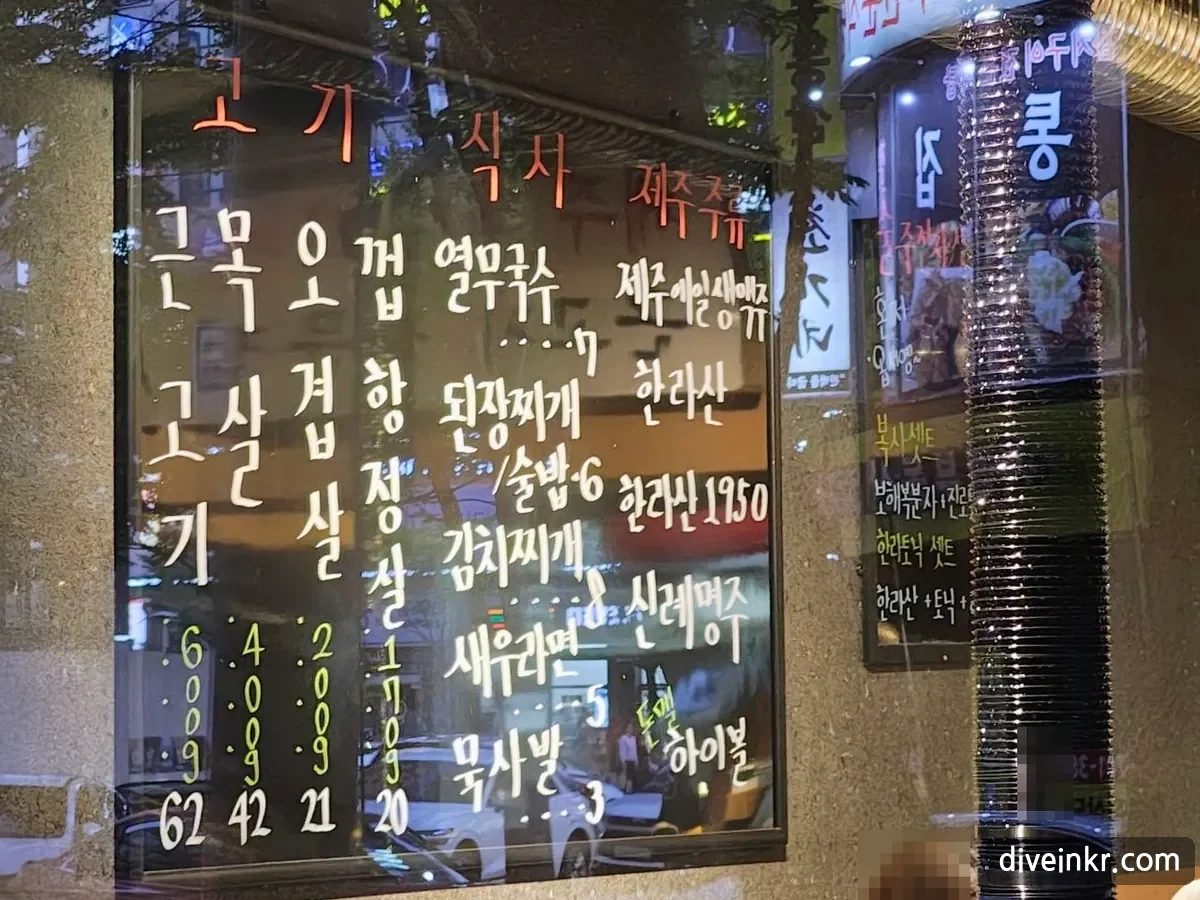
A wall menu like this is where 저기요 earns its keep. Decide what you want, catch a staff member's eye, and put the pieces together: 저기요 + the item + 주세요 (juseyo, "please"). You don't need a full sentence — the item name and 주세요 do all the work. More ordering phrases are in ordering food in Korean.
Before you even sit down, the first thing staff usually ask is 몇 분이세요? (myeot buniseyo?, "How many of you?"). The older question 몇 명이에요? (myeot myeongieyo?) is still correct, but restaurants and cafés now almost always use the more respectful 분 (bun) for customers. You answer with a plain number of people.
저기요, 목살 주세요.
jeogiyo, moksal juseyo.
Excuse me, pork neck, please.
저기요, 된장찌개 하나 주세요.
jeogiyo, doenjang-jjigae hana juseyo.
Excuse me, one doenjang stew, please.
몇 분이세요? — 두 명이요.
myeot buniseyo? — du myeongiyo.
How many of you? — Two.
Common Mistakes
Mistake #1 — Waiting silently for the waiter
Korean servers don't hover — they come when called. 여기요! isn't rude; whispering and waving vaguely just doesn't work.
Mistake #2 — Using 저기요 as 'sorry'
It gets attention; it doesn't apologize. Bumped into someone? That's 죄송합니다.
Mini Quiz
2 short questions — about 1 minute
2. Why is 저기요 safer than guessing a title like 아줌마?
3. You're squeezing past people on the subway. Best phrase?
Part of Korean Greetings & Everyday Politeness — The Survival Set
Related Knowledge
Learn Next
What Does 어서 오세요 (Eoseo Oseyo) Mean?
You've learned to call staff — now decode the phrase they shout at you the moment you walk in.
Will you remember this tomorrow?
Save it — your daily review brings it back right before you'd forget. No account needed.