Why Is 의 Pronounced Three Ways? Korean 의 (Ui) Pronunciation Rules
Written and reviewed by Jun and Jin, native Korean speakers
Published · How we write & review
After this page, you can read 의 as [ui], [i] or [e] in the right place, using the official pronunciation rule.
10-second answer
The short answer
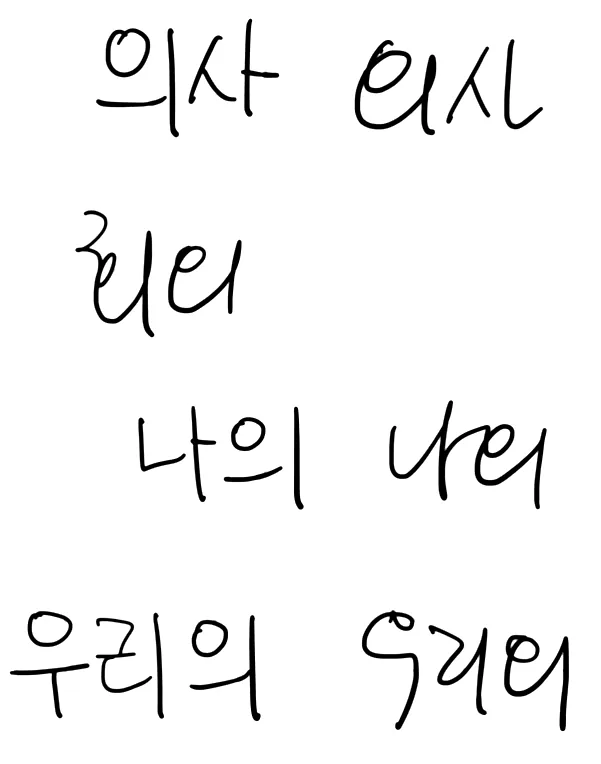
의 (ui) is read [ui] at the start of a word, as in 의사 (uisa). After another consonant it is read [i], as in 희망 (himang). In any later syllable, [i] is allowed too, and as the possessive particle, [e] is allowed: 우리의 (uriui) can be said 우리에 (urie).
Quick check — did that land?
1. How is 희망 (hope) pronounced?
의는 세 소리가 나요. 의사, 희망, 우리의. 위치가 소리를 정해요.
The Three Sounds at a Glance
The letter 의 is one of the most confusing in Korean because it is spelled one way but said several. You will hear it as [ui] (a quick "oo-ee" glide), as [i] (like the "ee" in "see"), and as [e] (like the "e" in "bed"). The good news is that these are not random: the official pronunciation rule spells out which one goes where, and it also marks which readings are merely allowed. Below, the romanization shows how the word actually sounds, with hyphens between syllables.
| Where 의 stands | Standard sound | Examples |
|---|---|---|
| First syllable of a word, with no consonant before it | [ui] | 의사 (ui-sa), 의미 (ui-mi) |
| After a consonant, in the same syllable (희, 늬, 틔 ...) | [i], required | 희망 (hi-mang), 무늬 (mu-ni) |
| A later syllable of a word (not the first) | [ui], and [i] is also allowed | 주의 (ju-ui / ju-i), 회의 (hoe-ui / hoe-i), 강의 (gang-ui / gang-i), 민주주의 (min-ju-ju-ui / min-ju-ju-i) |
| The possessive particle 의 ("of, 's") | [ui], and [e] is also allowed | 우리의 (u-ri-ui / u-ri-e), 나의 (na-ui / na-e) |
Required means the rule gives only that reading. Allowed means the rule accepts it alongside the main one. Only the second row (after a consonant) has no choice.
See also: 우리 (uri) meaning
The Official Rule, as the Document Says It
The rule is 제5항 (Article 5) of the 표준 발음법 (Standard Pronunciation Rules), published by the National Institute of Korean Language. The article lists ㅢ among the vowels pronounced as diphthongs. It then adds notes (다만, "however") for ㅢ:
- 다만 3 (note 3): ㅢ in a syllable that has a consonant as its first sound is pronounced [ㅣ]. The listed examples include 늴리리, 무늬, 띄어쓰기, 씌어, 틔어, 희어, 희떱다, 희망 and 유희.
- 다만 4 (note 4): ㅢ in any syllable other than the first syllable of a word is allowed to be pronounced [ㅣ], and the possessive particle 의 is allowed to be pronounced [ㅔ]. The listed examples are 주의 [주의/주이], 협의 [혀븨/혀비], 우리의 [우리의/우리에] and 강의의 [강ː의의/강ː이에].
Read the wording carefully. Note 3 says "is pronounced": it is not optional, so 희망 is [히망] and a reading with [ui] is not standard. Note 4 says "is allowed" (허용한다, heoyong handa): the first reading in each bracket, with 의 kept as [ui], is still the base reading, and the second is also accepted. So a speaker who says 우리에 (urie) is not making a mistake; neither is one who says 우리의 (uriui).
The official romanization system adds a twist: it writes ㅢ as ui even when it is read [i], so 광희문 is spelled Gwanghuimun, not Gwanghimun. That is a spelling convention for maps and signs. On this page, the romanization shows the sound, so you can hear the difference.
Same Letter, Different Sound: Examples
의사
ui-sa
doctor
의 is the first syllable and has no consonant before it, so it keeps its full [ui] sound.
의미
ui-mi
meaning
Same reason: first syllable, full [ui]. See also the 으 sound for a vowel that is often confused with the first half of 의.
희망
hi-mang
hope
희 has the consonant ㅎ in front, so ㅢ is read [i]: it is [히망], not [희망]. This is the required case from note 3.
회의
hoe-ui / hoe-i
meeting
The 의 is the second syllable, so [ui] is the base reading and [i] is allowed under note 4. Only the 의 part changes; the first syllable 회 is a separate matter.
강의
gang-ui / gang-i
lecture
Same note 4 pattern: second syllable, [ui] or [i]. The rule's own example 강의의 shows both 의 sounds in one word: [강ː의의] or [강ː이에].
민주주의
min-ju-ju-ui / min-ju-ju-i
democracy
The 의 is the last syllable, never the first, so the allowed [i] ending applies, just as in the rule's example 주의 [주의/주이].
우리의
u-ri-ui / u-ri-e
our, of us
The rule's own example for the possessive particle: [우리의] or [우리에]. 우리 is explained in 우리 (uri) meaning.
나의 → 내 and 우리의 → 우리: When the 의 Disappears
The possessive 의 has one more habit that native speakers confirm: it is often shortened away. 나의 (naui) becomes 내 (nae), a single syllable that already contains the "of me" idea, and 우리의 (uriui) becomes just 우리 (uri) with nothing added. In everyday Korean you will meet these shortened forms far more naturally than the full ones, because the particle disappears into the word before it.
| Full form | Shortened | Meaning |
|---|---|---|
| 나의 친구 (na-ui chin-gu) | 내 친구 (nae chin-gu) | my friend |
| 우리의 집 (u-ri-ui jip) | 우리 집 (u-ri jip) | our house |
A word of caution: this is a shortening, not another reading of 의. 내 (nae) is a different spelling from 나의, and it has no 의 left to pronounce. The [e] sound in the table at the top is something else: it is how the particle itself can be pronounced when it is spoken out loud, as in 나에 (na-e). Both happen, and both are about the same particle. For the possessive in general, see Korean particles.
Common Mistakes
Mistake #1 — Saying 희 as [hui]
희망 is [himang], not [huimang]. After a consonant, ㅢ is always [i]. The romanization on maps (Gwanghuimun) can make this look like it has a [u]; it does not.
Mistake #2 — Thinking [e] is wrong or slang
Reading the possessive 의 as [e] is allowed by the official rule. The principle is [ui], but 우리에 is a permitted reading, not a mistake.
Mistake #3 — Reading every 의 the same way
Check position first: first syllable, after a consonant, later syllable or particle. Four positions, three sounds.
Mini Quiz
3 short questions — about 2 minute
2. Which pronunciation of 우리의 does the official rule allow besides [우리의]?
3. Which word has 의 as the first syllable and keeps the full [ui] sound?
4. What is the common shortened form of 나의 in everyday speech?
Related Knowledge
1 more related
Learn Next
The possessive 의 is one of the core particles, and the map shows how it fits with the others.
Will you remember this tomorrow?
Save it — your daily review brings it back right before you'd forget. No account needed.