어 vs 오: The Vowel Sounds That Trip Up Learners
Written and reviewed by Jun and Jin, native Korean speakers
Published · Updated · How we write & review
After this page, you can hear and pronounce the difference between 어 (eo) and 오 (o) with minimal pairs and a simple lip trick.
10-second answer
The short answer
어 (eo) and 오 (o) are two completely different Korean vowel sounds that romanization makes look deceptively similar. 오 is a rounded "oh" sound, close to English "oh." 어 is unrounded and more open — closer to the "aw" in English "law" or the "u" in "cup," said with relaxed, unrounded lips.
Quick check — did that land?
1. What's the key difference in how 오 and 어 are pronounced?
You're saying 오빠 wrong.
Why Romanization Causes This Confusion
Standard romanization writes 오 as "o" and 어 as "eo" — reasonable as a written convention, but it doesn't tell your mouth what to actually do, and both can look like "just an o-sound" to an English-speaking eye. Reading Hangul directly instead of leaning on romanization is the fastest way past this specific trap.
| Letter | Romanization | Lip shape | Closest English sound |
|---|---|---|---|
| 오 | o | Rounded, pushed forward | "oh" as in "go" |
| 어 | eo | Relaxed, unrounded, open | "aw" as in "law" / "u" in "cup" |
See also: The Korean Alphabet (Hangul), Explained
Minimal Pairs You Can Hear the Difference In
오다 / 어다(x)
oda
to come
오 only — there's no real word 어다, but the syllable 오 vs 어 alone is the contrast to practice.
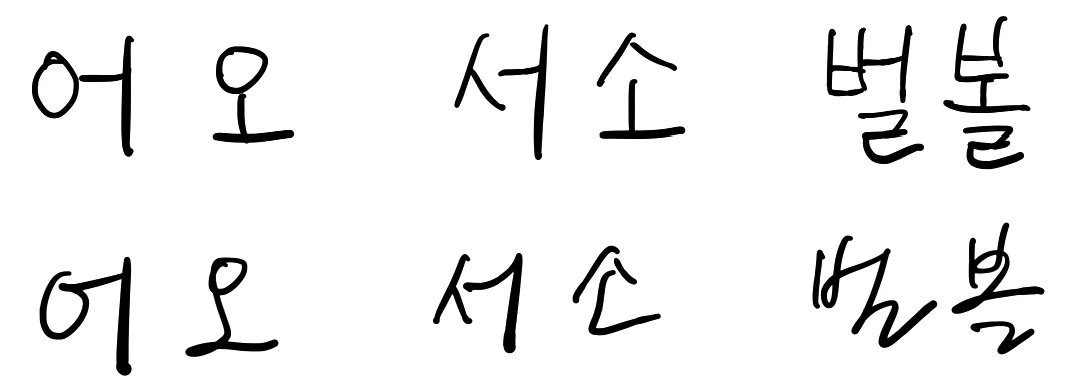
소 / 서
so / seo
cow / (a common syllable, e.g. in 저기서)
소 rounds the lips; 서 doesn't.
볼 / 벌
bol / beol
cheek / bee (or punishment)
A real minimal pair distinguished purely by 오 vs 어.
A Physical Trick
- For 오: round your lips like you're about to whistle, then say "oh"
- For 어: relax your lips completely — don't round them at all — and let the sound come from a more open, neutral mouth shape
- Say them back to back exaggeratedly (오-어-오-어) and feel your lips actively rounding and releasing
Why It Matters Beyond Just Sounding Natural
This pair shows up constantly in grammar you've already learned — 어요/아요 (present tense) partly depends on vowel quality, and words like 오빠 (oppa) vs a mispronounced "어빠" genuinely register as different, slightly odd-sounding words to native ears, not just an accent quirk.
Common Mistakes
Mistake #1 — Treating both as 'just an o sound'
They're distinct phonemes in Korean, not variants of the same sound — mixing them up can change or obscure the word.
Mistake #2 — Relying only on romanization to learn pronunciation
"Eo" doesn't intuitively signal "unrounded, open aw-sound" to an English reader — learning to read 어 directly as its own letter avoids the whole problem.
Free Worksheet: Read, Match and Trace
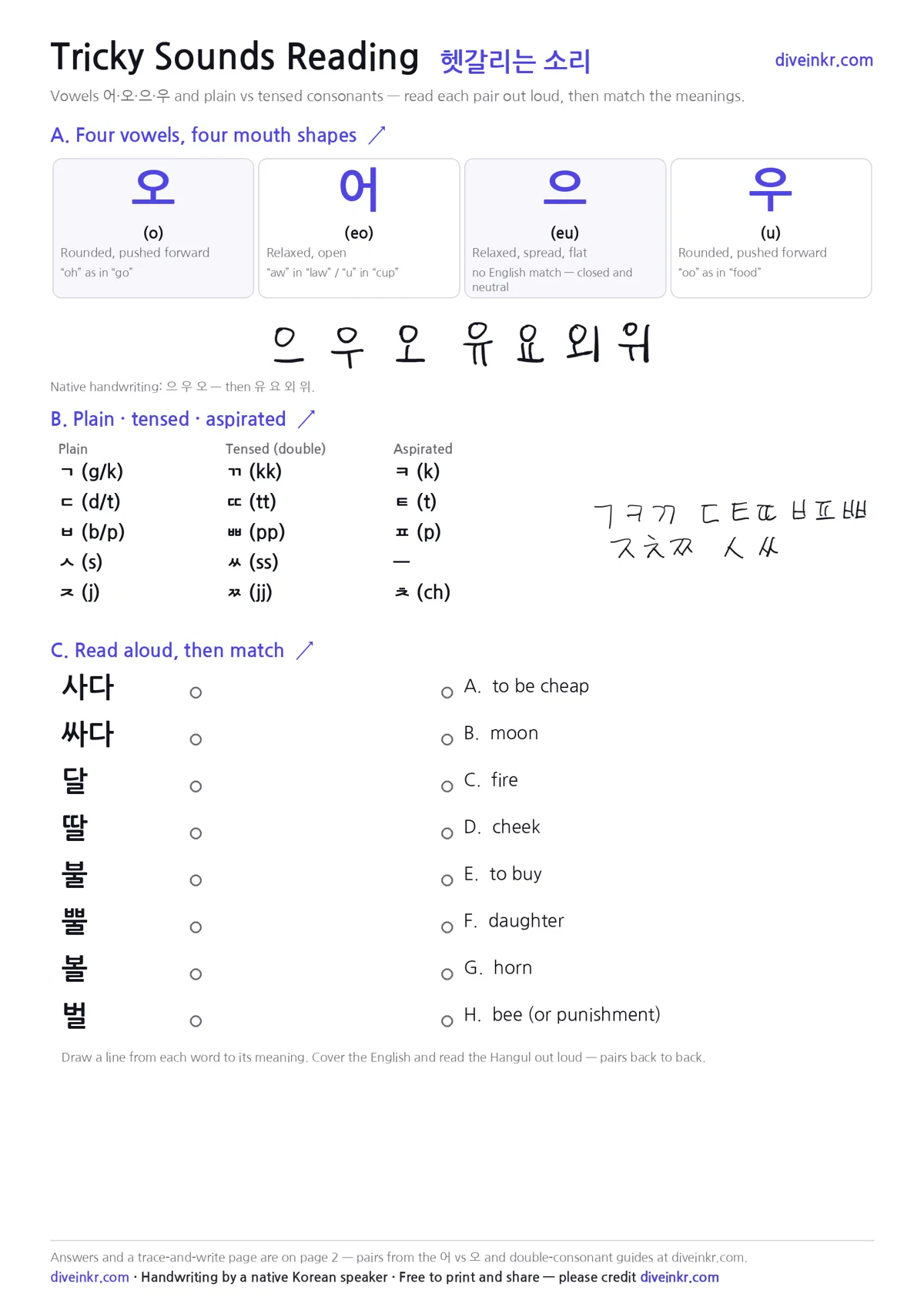
Free to print and share for personal and classroom use — please credit diveinkr.com.
- Page 1: the four vowels 오·어·으·우 with their mouth shapes, the plain / tensed / aspirated consonant table, and an 8-word matching game (사다 / 싸다, 달 / 딸, 불 / 뿔, 볼 / 벌).
- Page 2: the answers, plus trace-and-write rows for every word.
- Read each pair out loud, back to back, before you look at the English — the difference is in your mouth, not on the page.
Mini Quiz
2 short questions — about 1 minute
2. Which English sound is closest to 어?
3. Why can relying only on romanization cause trouble here?
More printables
- ← Before this: Korean batchim chart
- Whole set: Hangul: read it, then write it and every other sheet on the printables page.
- Start from the basics: Printable Hangul Chart with Native Handwriting · Hangul Tracing Worksheet with Native Handwriting
Related Knowledge
- The Korean Alphabet (Hangul), Explained
- The 으 Sound in Korean
- Korean Romanization Guide
- 몰라요 vs 잘 모르겠어요: Two Ways to Say "I Don't Know"
1 more related
Learn Next
Another vowel with no real English equivalent — and one of the most distinctively Korean sounds you'll learn.
Will you remember this tomorrow?
Save it — your daily review brings it back right before you'd forget. No account needed.