How to Ask for Directions in Korean
Written and reviewed by Jun and Jin, native Korean speakers
Published · Updated · How we write & review
After this page, you can ask where something is in Korean, follow the directions you get, and check how far it is.
10-second answer
How do you say asking for directions in Korean?
Asking for directions in Korean centers on one core question — "[place]이/가 어디예요?" (i/ga eodiyeyo, "Where is [place]?") — plus a small set of direction words (왼쪽 oenjjok, 오른쪽 oreunjjok, 직진 jikjin) to understand the answer. Showing a map on your phone alongside these phrases covers almost any situation.
Quick check — did that land?
1. How do you ask "Where is the subway station?"
You’ll hear this all the time in Korea, especially when getting directions, 직진.
Full Dialogue Walkthrough
Asking a stranger for directions, then confirming you understood. Try "Practice as You" and answer each line before checking.
저기요, 지하철역이 어디예요?
jeogiyo, jihacheollyeogi eodiyeyo?
Excuse me, where's the subway station?
이 길로 쭉 가세요.
i gillo jjuk gaseyo.
Go straight down this street.
감사합니다!
gamsahamnida!
Thank you!
여기서 멀어요?
yeogiseo meoreoyo?
Is it far from here?
아니요, 5분 정도 걸려요.
aniyo, obun jeongdo geollyeoyo.
No, it takes about 5 minutes.
왼쪽이에요, 오른쪽이에요?
oenjjogieyo, oreunjjogieyo?
Is it on the left or the right?
See also: -세요: The Polite Command Form
Asking Where Something Is
지하철역이 어디예요?
jihacheollyeog-i eodiyeyo?
Where is the subway station?
여기가 어디예요?
yeogiga eodiyeyo?
Where is this (on the map)?
Useful when you're lost and pointing at your own location.
이 근처에 화장실 있어요?
i geuncheo-e hwajangsil isseoyo?
Is there a bathroom nearby?
If the place is a shop or clinic, it helps to recognize the words on its sign — 약국 (pharmacy), 치과 (dentist), 편의점 (convenience store) — and how floors are written (3층, 3F, B1). See reading Korean street signs.
Understanding the Directions You're Given
| Korean | Meaning |
|---|---|
| 직진 | Go straight |
| 왼쪽 | Left |
| 오른쪽 | Right |
| 횡단보도 | Crosswalk |
| 건너편 | Across the street / on the other side |
| 모퉁이 | Corner |
직진하다가 왼쪽으로 가세요.
jikjinhadaga oenjjogeuro gaseyo.
Go straight, then turn left.
-세요, the polite command form covered on its own page.
건너편에 있어요.
geonneopyeon-e isseoyo.
It's across the street.
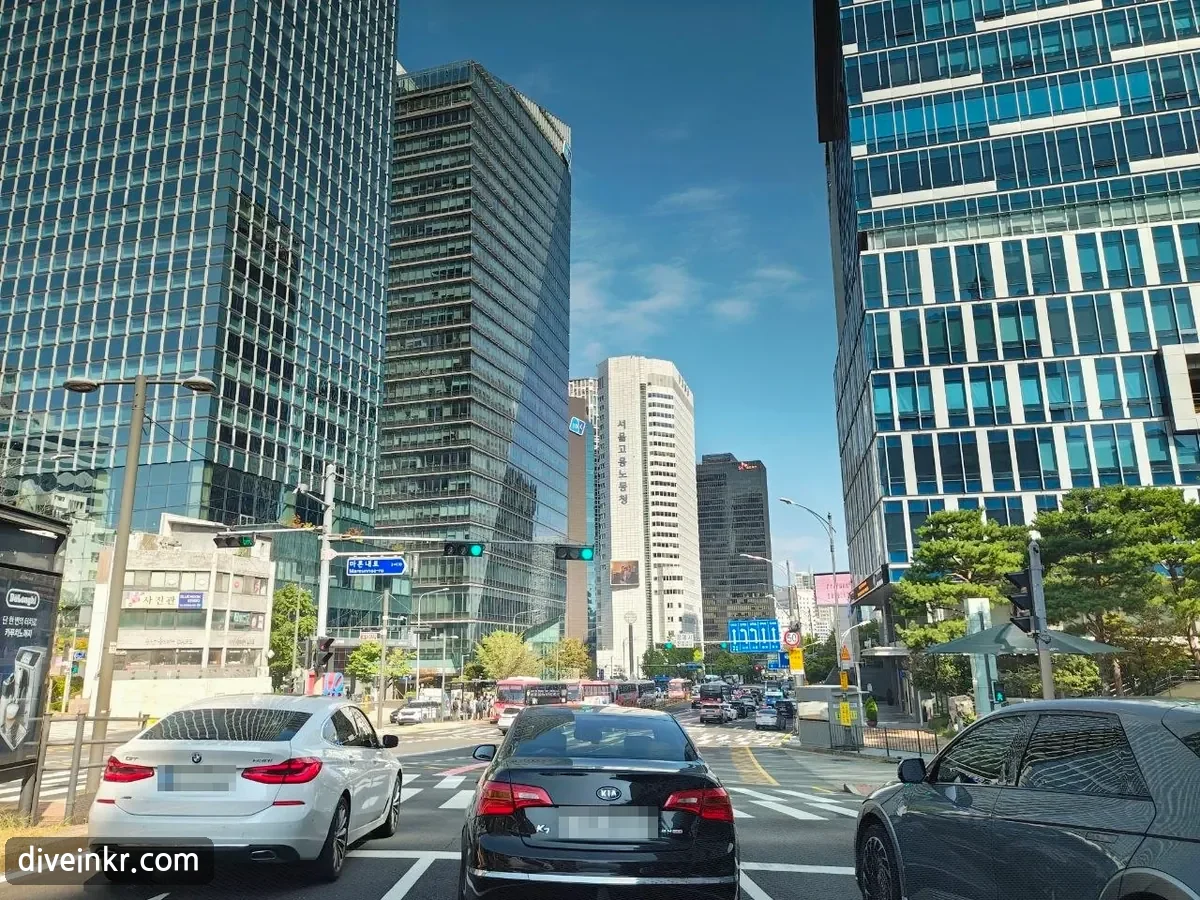
Two more words you'll hear constantly: 신호등 (sinhodeung, traffic light) and 사거리 (sageori, a four-way intersection). Koreans often give directions by counting them, and many landmarks and bus stops are even named after the nearest 사거리 — like 종로2가사거리 in the Seoul bus guide.
두 번째 사거리에서 왼쪽으로 가세요.
du beonjjae sageori-eseo oenjjogeuro gaseyo.
Turn left at the second intersection.
두 번째 = second — ordinals use native Korean numbers plus 번째, except "first," which is 첫 번째.
횡단보도 건너서 오른쪽에 있어요.
hoengdanbodo geonneoseo oreunjjoge isseoyo.
Cross at the crosswalk, and it's on the right.
신호등 앞에서 세워 주세요.
sinhodeung apeseo sewo juseyo.
Please stop in front of the traffic light.
What you'd say to a taxi driver.
Crossing the Street: Reading the Countdown Signals
Directions in Korea often include 횡단보도 건너서 — "cross at the crosswalk." Seoul's pedestrian lights help you time it, because many of them show a number under the light: how many seconds are left.
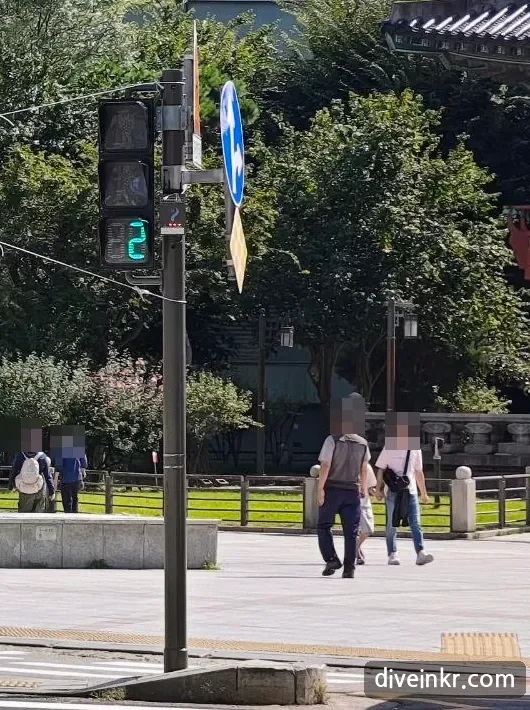
Under the green walking figure (Koreans call it 파란불, "blue light," even though it's green), the number counts down the seconds you have left to cross. If it's already in single digits and you haven't stepped off the curb, wait for the next one.
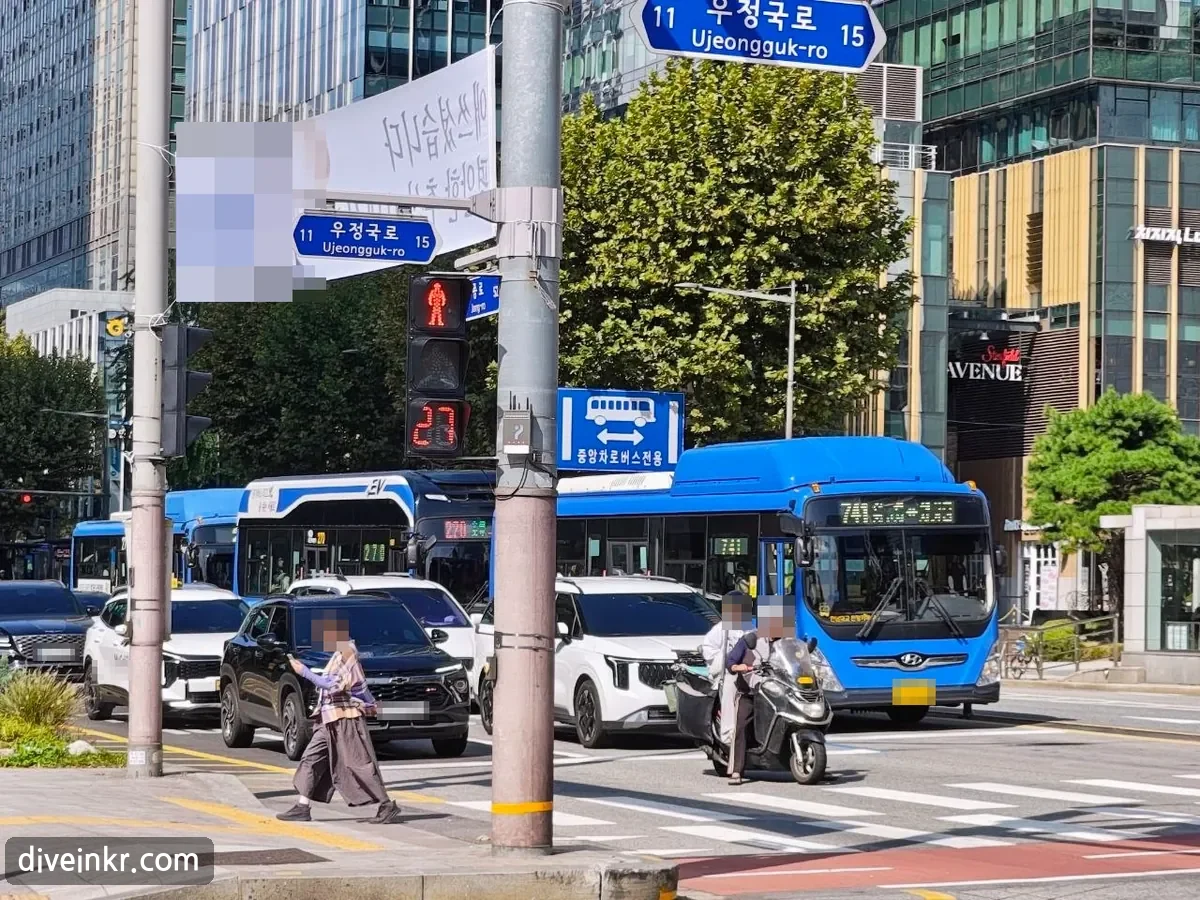
The red number is newer. Seoul began testing red-light countdowns in December 2023 — the first ones went up at spots like Seoul Plaza and in front of Gwanghwamun — expanded them to 350 crossings in 2024, and plans to reach 4,000 crosswalks on roads six lanes or wider by 2030. The number counts down to the green light, but it switches off when 6 seconds or fewer are left, so people don't start walking early. If the number disappears, the light is still red.
| Korean | Romanization | Meaning |
|---|---|---|
| 파란불 · 초록불 | paranbul · chorokbul | Green light ("blue light" is the everyday word) |
| 빨간불 | ppalganbul | Red light |
| 건너다 | geonneoda | To cross |
| 깜빡이다 | kkamppagida | To blink — the green figure blinks when time is running out |
파란불 됐어. 건너자.
paranbul dwaesseo. geonneoja.
The light's green. Let's cross.
빨간불이에요. 기다리세요.
ppalganbul-ieyo. gidariseyo.
It's red. Please wait.
Checking Distance and Time
여기서 멀어요?
yeogiseo meoreoyo?
Is it far from here?
걸어서 갈 수 있어요?
georeoseo gal su isseoyo?
Can I walk there?
얼마나 걸려요?
eolmana geollyeoyo?
How long does it take?
If the answer is "take the bus," how to ride a bus in Seoul covers paying, transferring and knowing when to get off.
Common Mistakes
Mistake #1 — Not having a backup for complex answers
Even fluent speakers sometimes get long, fast directions — showing your phone map and saying 여기로 어떻게 가요? ("how do I get here?") while pointing at a pin works well as a fallback.
Mistake #2 — Confusing 왼쪽/오른쪽
왼쪽 (left) and 오른쪽 (right) are easy to mix up under pressure — worth deliberately practicing the pair together.
Mini Quiz
2 short questions — about 1 minute
2. What does 직진 mean?
3. How do you ask "How long does it take?"
Part of Korean Phrases for Travelers
Related Knowledge
Learn Next
Taxi Korean Phrases You'll Actually Need
If directions get too complicated, a taxi is always the reliable fallback — here's how to use one.
Will you remember this tomorrow?
Save it — your daily review brings it back right before you'd forget. No account needed.