How Korean Honorifics Work
Written and reviewed by Jun and Jin, native Korean speakers
Published · Updated · How we write & review
After this page, you can see how Korean honorifics work in three layers — speech levels, subject honorifics and titles.
10-second answer
The short answer
Korean honorifics are a system baked into the language itself, not just polite word choices: verb endings change based on who you're speaking to and about, titles (님 nim, 씨 ssi) attach to names, and certain special honorific verbs exist purely to show respect. Getting them right (or at least trying) shows you understand the relationship — not just the words.
Quick check — did that land?
1. What does the honorific infix -시- do?
선생님이 오세요! It raises respect for the person being talked about.
Three Layers of Honorifics
| Layer | What it does | Example |
|---|---|---|
| Speech level (verb endings) | How formal/polite the sentence sounds overall | 가요 (polite) vs 간다 (casual) vs 갑니다 (formal) |
| Subject honorifics | Raises respect for the PERSON being talked about | 선생님이 가세요 (the teacher goes) — 세요 honors the teacher |
| Titles & address terms | How you name/call someone | 김 선생님, 민수 씨, 사장님 |
See also: The Korean age system
Speech Levels: The Verb Ending Ladder
The same idea — "go" — changes ending depending on how formal/polite the situation is:
| Ending | Level | Use with |
|---|---|---|
| 갑니다 (gamnida) | Formal | News, military, formal presentations |
| 가요 (gayo) | Polite | The everyday default with most people |
| 가 (ga) / 간다 (ganda) | Casual (반말) | Close friends, younger people |
When unsure which level to use, 요-endings (polite) are always a safe default — see the 반말 vs 존댓말 page for the full picture.
Subject Honorifics: Raising the Person, Not the Listener
This is the part that surprises learners most: you can honor someone even when talking ABOUT them to someone else, using the honorific infix -시-/-으시-.
선생님이 오세요.
seonsaengnim-i oseyo.
The teacher is coming.
오세요 (honorific) instead of plain 와요 — because the teacher deserves respect, regardless of who's listening.
할머니께서 진지 드세요.
halmeoni-kkeseo jinji deuseyo.
Grandmother is eating.
께서 (honorific subject marker), 진지 (honorific for 'meal'), 드세요 (honorific for 'eat') — three honorific layers stacked for a grandparent.
압존법: When the Listener Outranks the Person You're Talking About
Subject honorifics raise the person you're talking about. Traditionally, though, there's a twist called 압존법 (apjonbeop): if the person you're speaking to ranks even higher than the person you're talking about, you hold back the honorific for the middle person to match your listener. Talking to your grandfather about your father, the traditional form is 할아버지, 아버지가 진지 잡수시라고 하였습니다 (harabeoji, abeojiga jinji japsusirago hayeotseumnida, "Grandfather, Father says the meal is ready") — 아버지 gets no -시- in the last verb, because your grandfather outranks him. The same goes for an aunt: to your grandfather, your 고모 (gomo) is someone younger than him.
In real life this is applied loosely. The National Institute of Korean Language's etiquette guide also accepts raising your father even in front of your grandfather — 아버지가 진지 잡수시라고 하셨습니다 (abeojiga jinji japsusirago hasyeotseumnida) — and says 압존법 traditionally belongs to the family and to teacher–student relationships, not the workplace. At work you still raise your manager when talking to their boss, just more lightly: 과장님이 이 일을 하셨습니다 (gwajangnimi i ireul hasyeotseumnida), with 이 instead of the extra-honorific 께서.
How strict is it?
Not very. Most people don't follow 압존법 strictly in everyday family talk, just as honorifics in general aren't applied perfectly in casual speech. It's worth knowing so you can recognize it, and so you can be more careful in formal settings.
Titles: 님, 씨, and Role Names
| Title | Attaches to | Feel |
|---|---|---|
| 님 (nim) | Roles/names — 선생님, 사장님, 고객님 | Respectful, works on almost anyone in a role |
| 씨 (ssi) | Full names or first names — 민수 씨 | Polite-neutral, common at work between peers |
| Role only, no name | 기사님 (driver), 사장님 (owner) | The default way to address strangers in service roles |
씨 attached to just a surname (김 씨) can actually sound distant or even slightly rude — full name + 씨, or first name + 씨 among peers, is the safer pattern.
Quick-Reference List of Korean Honorifics
| Honorific | Type | Meaning / Use |
|---|---|---|
| -요 (-yo) | Speech level | Polite sentence ending - the everyday-safe default. |
| -ㅂ니다/습니다 (-mnida/-seumnida) | Speech level | Formal ending - news, presentations, customer service. |
| -시- (-si-) | Subject honorific | Infix that raises the person you are talking about, not the listener. |
| 님 (nim) | Title | Attaches to roles and names to show respect - 선생님, 사장님, 고객님. |
| 씨 (ssi) | Title | Neutral-polite, attaches to a full name or first name, not surname alone. |
| 께서 (kkeseo) | Subject marker | Honorific version of 이/가 - marks a respected person as the subject. |
| 드리다 (deurida) | Honorific verb | Humble to give - used when giving something to someone above you. |
| 계시다 (gyesida) | Honorific verb | Honorific to be/stay - replaces 있다 for a respected subject. |
This list covers the pieces that combine into everything above - a sentence can stack several at once (께서 plus -시- plus 드리다 plus -ㅂ니다 in one sentence is normal for addressing an elder formally).
Why It All Exists
The system encodes age, social rank, and closeness directly into grammar — the same logic behind 오빠/형/누나/언니 and 선배/후배. Language and social structure aren't separate in Korean; the honorific system IS how the structure gets expressed every time someone opens their mouth.
Common Mistakes
Mistake #1 — Thinking honorifics are optional politeness
They're closer to required grammar than to English 'sir/ma'am' — skipping them with the wrong person doesn't just sound informal, it can sound disrespectful.
Mistake #2 — Trying to master every rule before speaking
Native speakers forgive learner mistakes here easily. Defaulting to 요-endings and 님/씨 titles gets you 90% of the way safely.
This is the layer subtitles can't carry — see why K-drama subtitles sometimes get it wrong.
Free Worksheet: Speech Levels and Honorifics
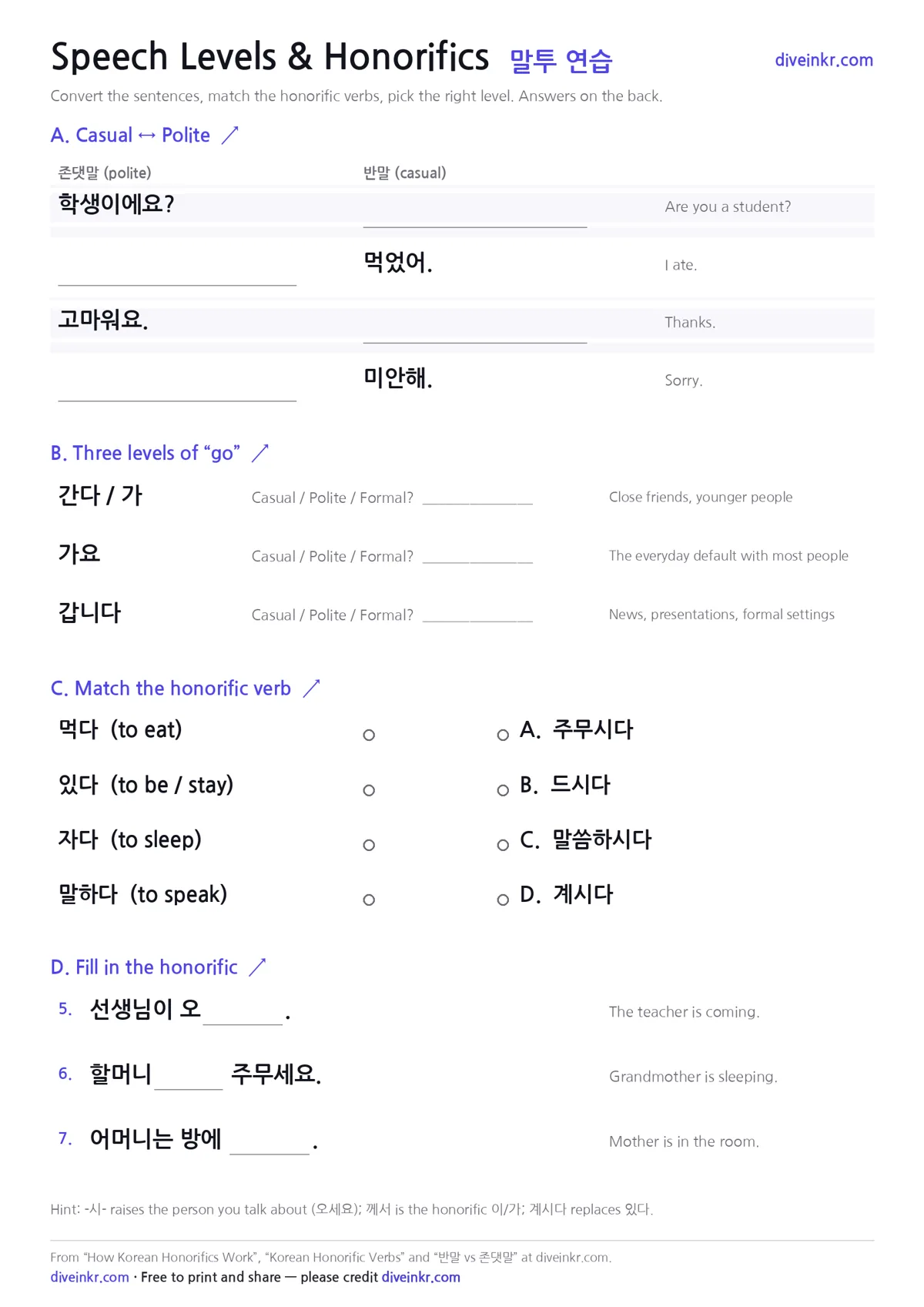
Free to print and share for personal and classroom use — please credit diveinkr.com.
- Convert casual and polite sentences (학생이에요? / 학생이야?), name the level of 간다, 가요 and 갑니다, and match plain verbs to their honorific forms (먹다 → 드시다).
- Three fill-in sentences that need -시- or 께서, with answers on page 2.
- Say every sentence aloud in both levels so the pattern sticks.
Mini Quiz
2 short questions — about 1 minute
2. You don't know someone's name but want to address a shop owner respectfully. You say:
3. What's the safest default speech level when you're unsure?
More printables
- ← Before this: Particles worksheet
- Whole set: Everyday phrases and grammar and every other sheet on the printables page.
- Start from the basics: Printable Hangul Chart with Native Handwriting · Hangul Tracing Worksheet with Native Handwriting
Related Knowledge
Learn Next
반말 vs 존댓말: What's the Difference?
Honorifics set the ceiling; 반말/존댓말 is the everyday casual-vs-polite choice you'll make in every conversation.
Will you remember this tomorrow?
Save it — your daily review brings it back right before you'd forget. No account needed.