Hangul Tracing Worksheet with Native Handwriting (Free PDF)
Written and reviewed by Jun and Jin, native Korean speakers
Published · How we write & review
After this page, you can print a Hangul tracing worksheet and practice writing every basic letter.
10-second answer
The short answer
This free two-page PDF is a Hangul tracing worksheet with a difference: the gray letters you trace are a native Korean speaker's real handwriting, not a font. Page 1 covers the 14 basic consonants; page 2 covers the 10 basic vowels and 5 double consonants. Each row has a model letter, three letters to trace and six empty guide squares to write on your own.
Quick check — did that land?
1. What does ㅇ sound like at the start of a syllable, as in 아?
Download the Worksheet
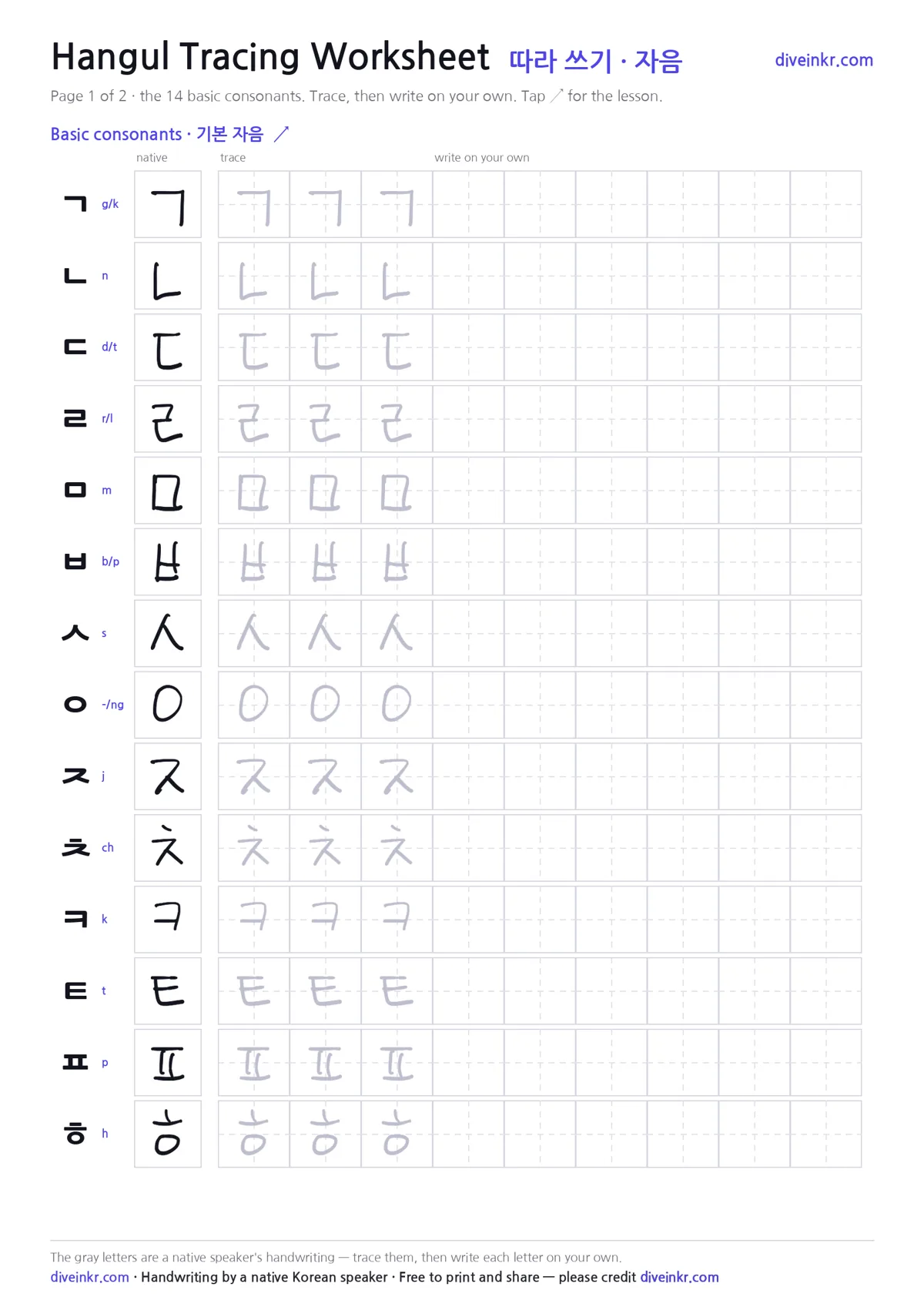
Free to print and share for personal and classroom use — please credit diveinkr.com.
This sheet goes up on October 9 — 한글날 (Hangul Day), the South Korean holiday that marks King Sejong's proclamation of 훈민정음 (Hunminjeongeum), Hangul's original name, in 1446. Writing the letters yourself is a fitting way to spend it.
See also: Printable Hangul chart
How to Use the Worksheet
- Print both pages on A4 (on US Letter, choose "fit to page") and use a pencil. To reuse one copy, slip it into a clear sheet protector and write with a dry-erase marker.
- Work across each row: look at the handwritten model in the "native" box, trace the three gray letters slowly, then write the letter six times on your own in the empty squares.
- Use the dashed cross in each square to keep the letter centered and the same size every time.
- Say the sound out loud each time you write — the romanization next to each printed letter tells you what it is.
- Keep it short and daily: page 1 one day, page 2 the next, 10–15 minutes each, for a week. Reading comes fast — how long it takes to learn Hangul — and writing locks it in.
- When the shapes feel easy, check your reading with Hangul Reading Practice and your typing with Hangul Typing Practice.
Why Trace Real Handwriting?
Printed Korean letters — especially the stand-alone consonants — are drawn flat and boxy in most fonts, which isn't how anyone writes them by hand. Tracing a native speaker's letters teaches the proportions you'll actually see on notes and whiteboards. Korean handwriting vs fonts shows the difference side by side. Want every letter on one page for your wall, with its print and handwritten forms side by side? Print the Hangul chart too.
Page 1: The 14 Basic Consonants
The consonants run in dictionary order, ㄱ to ㅎ. As you write them, look for families: Hangul's creators drew five basic shapes — ㄱ, ㄴ, ㅁ, ㅅ, ㅇ — and made stronger sounds by adding strokes. Tracing a letter and then its "stroke-added" partner helps both stick.
| Basic shape | One stroke added | Another stroke added |
|---|---|---|
| ㄱ (g/k) | ㅋ (k) | — |
| ㄴ (n) | ㄷ (d/t) | ㅌ (t) |
| ㅁ (m) | ㅂ (b/p) | ㅍ (p) |
| ㅅ (s) | ㅈ (j) | ㅊ (ch) |
| ㅇ (silent / ng) | (an old letter, no longer used) | ㅎ (h) |
ㄹ (r/l) stands on its own. And ㅇ is marked "–/ng" on the sheet because it does two jobs: at the start of a syllable it's silent and simply holds the spot in a syllable that begins with a vowel; at the bottom of a syllable, as a batchim, it's "ng." The Korean alphabet page explains how letters stack into blocks.
아이
ai
child
ㅇ at the start of each syllable: silent.
강
gang
river
ㅇ at the bottom: "ng."
Page 2: Vowels and Double Consonants
The 10 vowels are built from just three pieces: a short stroke, a flat line (ㅡ) and an upright line (ㅣ). Adding a second short stroke adds a y-sound: ㅏ (a) becomes ㅑ (ya), ㅗ (o) becomes ㅛ (yo). Where the vowel sits depends on its shape. Upright vowels — ㅏ ㅑ ㅓ ㅕ ㅣ — go to the right of the consonant, as in 가. Flat vowels — ㅗ ㅛ ㅜ ㅠ ㅡ — go under it, as in 고.
The last five rows are the double consonants ㄲ, ㄸ, ㅃ, ㅉ and ㅆ: two copies of a plain letter squeezed into one square, so each half is drawn narrower. They sound tense, not long — see double consonants.
아빠
appa
dad
토끼
tokki
rabbit
싸다
ssada
to be cheap
Compare 사다 (sada), "to buy."
After the Sheet: Your First Words
Once single letters feel easy, use the empty squares for whole syllables — one block per square. These words use only letters from the two pages:
우유
uyu
milk
나무
namu
tree
바다
bada
sea
오이
oi
cucumber
Common Learner Mistakes
- Writing a vowel on its own. A written syllable can't start with a bare vowel, so "a" is written 아, with the silent ㅇ in front — never just ㅏ.
- Forgetting that ㅇ changes job. The same circle is silent at the start of a syllable (아) and "ng" at the bottom (강).
- Mixing up ㅓ and ㅗ. The short stroke of ㅓ (eo) points left from an upright line; the short stroke of ㅗ (o) sits on top of a flat line. They're different sounds too — see 어 vs 오.
- Putting a flat vowel beside the consonant. 고 has ㅗ underneath, not to the right.
- Treating double consonants as "longer." ㄲ isn't a stretched ㄱ; it's a tense sound, and it changes the word.
- Copying the font instead of the handwriting. Use the handwritten model, not the flat printed letter, as your guide.
This worksheet doesn't show stroke order. Focus on getting each shape and its proportions right first — the letters themselves are explained on the Korean alphabet page.
Mini Quiz
2. Which vowel is written under the consonant, not beside it?
3. How many double consonants are on page 2?
4. How is ㄲ different from ㄱ?
Related Knowledge
Learn Next
See how the letters you just traced look when a native speaker writes them fast.
Will you remember this tomorrow?
Save it — your daily review brings it back right before you'd forget. No account needed.