What Does 괜찮아 (Gwaenchana) Mean in Korean?
Written and reviewed by Jun and Jin, native Korean speakers
Published · Updated · How we write & review
After this page, you can use 괜찮아 (gwaenchana) to mean "I'm fine," "it's OK" or "no thanks" — and tell which one someone means.
10-second answer
What does Gwaenchana mean?
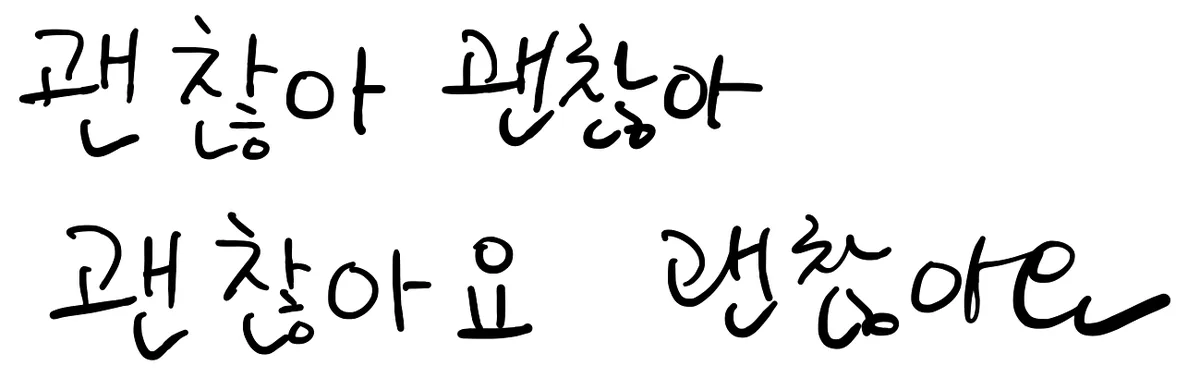
괜찮아 (gwaenchana) is one of Korean's hardest-working words: "I'm okay," "It's okay / don't worry," "No, thanks," and — with rising intonation — "Are you okay?" The polite form is 괜찮아요 (gwaenchanayo). Which meaning applies depends entirely on the situation.
Quick check — did that land?
1. Cashier: 봉투 필요하세요? (Do you need a bag?) You: 괜찮아요. What did you just say?
괜찮아? 괜찮아요. 괜찮습니다. 친한 사이와 격식 있는 상황에서 다르게 써요.
Quick Examples — Four Jobs, One Word
괜찮아?
gwaenchana?
Are you okay?
Rising intonation turns it into the question.
나 괜찮아.
na gwaenchana.
I'm okay / I'm fine.
늦어서 미안해. — 괜찮아.
neujeoseo mianhae. — gwaenchana.
Sorry I'm late. — It's okay.
Forgiving/reassuring use.
커피 더 드릴까요? — 괜찮아요.
keopi deo deurilkkayo? — gwaenchanayo.
More coffee? — I'm fine, thanks.
POLITE REFUSAL — this one surprises learners. 괜찮아요 here means 'no, thank you.'
A note on spelling. The official romanization of 괜찮아 is gwaenchana, but you'll see the word written many ways: gwenchana, gwechana, kwenchana, gwaenchanha or kwaenchana. They're all the same word.
괜찮아 is the usual answer to 미안해 (mianhae).
See also: 진짜 (jinjja) — really?
The Refusal Trap
The biggest pitfall: when offered something, 괜찮아요 usually means "no, thanks" — not "yes, that's fine." English speakers hear "it's okay (so yes)"; Koreans mean "I'm okay (without it)."
| Offer | Reply | Meaning |
|---|---|---|
| 봉투 필요하세요? (Need a bag?) | 괜찮아요 | No, thanks |
| 하나 더 먹을래? (Want one more?) | 괜찮아 (flat tone) | I'm good — no |
| 같이 갈까? (Shall I come along?) | 아니야, 괜찮아 | No need, I'm fine |
To ACCEPT an offer, say 네, 주세요 (yes, please) or 좋아요 (sounds good) — not 괜찮아요.
Another everyday word that can close a topic depending on tone is 됐어요 (dwaesseoyo), which can mean either "it worked out" or "enough."
Register
| Form | Politeness |
|---|---|
| 괜찮아 (gwaenchana) | Casual — friends, younger people |
| 괜찮아요 (gwaenchanayo) | Polite — default with most adults |
| 괜찮습니다 (gwaenchanseumnida) | Formal — work, announcements |
When It's Genuinely Ambiguous
Even Koreans sometimes have to double-check which 괜찮아 they're hearing, because tone and delivery carry real information the word alone doesn't. A flat, quick 괜찮아요 after an offer reads as a clear decline. But a hesitant, drawn-out 괜찮아요...? with rising uncertainty at the end can actually mean "I don't want to be a bother, but if you're offering, maybe" — Korean politeness culture often expects the other person to offer twice before you accept. That's why hosts frequently insist a second time ("정말요? 드세요!" — "Really? Have some!") rather than taking a first 괜찮아요 at face value. If you're ever unsure, asking 진짜 괜찮아요? ("are you sure you're okay / sure you don't want it?") is a completely normal way to check.
Common Mistakes
Mistake #1 — Hearing 괜찮아요 as 'yes'
In reply to an offer it's almost always a soft no. Watch for the accompanying small head shake or raised palm.
Mistake #2 — Missing the question form
Same word, rising tone = 'Are you okay?' K-dramas run on this line — someone falls, someone rushes over: 괜찮아?!
Mini Quiz
2 short questions — about 1 minute
2. How does 괜찮아 become 'Are you okay?'
3. You DO want the extra coffee being offered. What should you say?
Related Knowledge
Learn Next
What Does 사랑해 (Saranghae) Mean?
You've got the drama essentials — time for the most famous Korean sentence of all.
Will you remember this tomorrow?
Save it — your daily review brings it back right before you'd forget. No account needed.