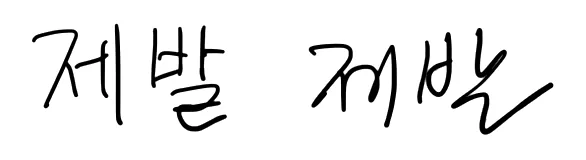
What Does 제발 (Jebal) Mean in Korean?
Written and reviewed by Jun and Jin, native Korean speakers
Published · Updated · How we write & review
After this page, you can save 제발 (jebal) for real begging, and use 주세요 for everyday polite requests.
10-second answer
What does Jebal mean?
제발 (jebal) means "please" — but only the desperate, pleading kind: "please, I'm begging you." It is NOT the polite please of ordering coffee. For everyday polite requests Korean uses verb endings like 주세요 (juseyo); 제발 comes out when you're begging, praying, or exasperated.
Quick check — did that land?
1. How do you politely ask for water at a restaurant?
물 주세요! 제발 도와주세요! 주세요는 정중한 요청, 제발은 간절한 부탁에 써요.
Quick Examples
제발 도와주세요.
jebal dowajuseyo.
Please, help me (I beg you).
제발 한 번만!
jebal han beon-man!
Please, just this once!
제발 좀 조용히 해.
jebal jom joyonghi hae.
PLEASE just be quiet.
Exasperated — 제발 좀 adds a 'for heaven's sake' flavor.
제발 붙게 해 주세요...
jebal butge hae juseyo...
Please let me pass (the exam)...
Praying/wishing usage.
A note on spelling. The official romanization of 제발 is jebal, but you'll also see it written jaebal or chebal. They're all the same word.
See also: 괜찮아 (gwaenchana) — it's okay
Why 'Please' Is a Trap for English Speakers
English uses one word — please — for both politeness and begging. Korean splits them:
| You want to… | Korean uses | Example |
|---|---|---|
| Make a polite request | -아/어 주세요 ending | 물 주세요 — Water, please |
| Beg / plead / pray | 제발 (+ 주세요) | 제발 살려 주세요 — Please, save me |
| Exasperatedly demand | 제발 좀 | 제발 좀 그만해 — For heaven's sake, stop |
So 커피 제발 ("coffee, please") at a café sounds like you're begging the barista for mercy. Just say 커피 주세요.
Where You'll Hear It
- K-drama confessions and crises: 제발 가지 마 — please don't go
- Fans on social media: 제발 컴백 — please come back
- Exam season prayers, sports fans mid-match, and anyone begging a friend for a favor
Turning Up the Intensity
Plain 제발 is already pleading, but Korean has ways to push it further. Doubling it — 제발제발 — is the texting/social-media version of clasping your hands together; you'll see it under K-pop comeback announcements and exam-result posts. Adding 정말 or 진짜 ("really/seriously") in front — 진짜 제발 — sharpens it into "I am seriously begging you," often used right before naming the actual thing you want, like 진짜 제발 전화 좀 받아 ("seriously, please just answer the phone"). And 제발 부탁이야 ("please, it's a favor/request") leans more formal-desperate, the kind of line a K-drama character says on their knees.
The physical gesture matches the word
Just like English speakers might clasp their hands when begging, 제발 is often said (or typed 🙏) alongside that same praying-hands gesture — it's not just a word, it's paired with real pleading body language.
제발 often comes with 진짜 for emphasis — see 진짜 (jinjja).
제발 vs 부디 vs 좀 vs 꼭: Four Words Near "Please"
제발 isn't the only word that sits where English puts "please." The Standard Korean Language Dictionary defines 제발 simply as wishing earnestly, and 부디 as the word that shows an earnest wish when you ask something of someone. The difference is who you're talking to and how desperate you sound:
| Word | Feel | Example |
|---|---|---|
| 제발 (jebal) | Begging, praying, exasperated — emotional | 제발 전화 좀 받아. (jebal jeonhwa jom bada.) — Please, just pick up the phone. |
| 부디 (budi) | A heartfelt wish, often in cards, letters and speeches — a formal cousin of take care | 부디 건강하세요. (budi geonganghaseyo.) — Please, stay well. |
| 좀 (jom) | A small softener inside ordinary requests — the everyday "please" | 물 좀 주세요. (mul jom juseyo.) — Some water, please. |
| 꼭 (kkok) | "Be sure to" — a firm, friendly request | 꼭 연락해. (kkok yeollakae.) — Make sure you get in touch. |
좀 also turns up inside the 제발 examples on this page: 제발 좀 is the exasperated combo, while 좀 on its own is just polite cushioning. Either way, the politeness in 물 좀 주세요 comes from the 주세요 ending — 제발 never adds politeness, only urgency.
Exam season: 화이팅 before, 제발 after
Before a friend's exam you cheer 화이팅. Once it's over and you're waiting for results, 제발 제발 🙏 is the hopeful message — praying, not cheering.
Common Mistakes
Mistake #1 — Using 제발 as everyday 'please'
Ordering food, asking directions, shopping: no 제발. The politeness lives in the verb ending 주세요/-세요.
Mistake #2 — Missing the sarcasm
제발 좀 among friends is often theatrical exasperation, not real begging — 'pleeease, I'm begging you, stop being embarrassing.'
Mini Quiz
2 short questions — about 1 minute
2. What feeling does 제발 가지 마 express?
3. What does 제발 좀 add?
Related Knowledge
Learn Next
제발 and 어떡해 are the two pillars of K-drama desperation — complete the set.
Will you remember this tomorrow?
Save it — your daily review brings it back right before you'd forget. No account needed.