What Does 전 (Jeon) Mean? Korea's All-Purpose Savory Pancake
Written and reviewed by Jun and Jin, native Korean speakers
Published · How we write & review
After this page, you can recognize 전 on a menu or holiday table and name the common types.
10-second answer
What Does 전 (Jeon) Mean?
전 (jeon) is a general term for ingredients — meat, fish, vegetables, sliced or minced — coated in flour and egg (or mixed into a batter) and pan-fried in oil. It's closely related to 부침개 (buchimgae): in careful usage, 전 pieces are smaller and simpler, while buchimgae is more of a spread-out batter pancake, though everyday speech uses the words loosely. Once a feast-day food, 전 is now a Chuseok and Seollal fixture, an everyday banchan, and a rainy-day favorite.
Quick check — did that land?
1. What does 전 (jeon) most specifically describe?
전 vs 부침개: What's the Difference?
The two words overlap so much that Koreans use them interchangeably in daily speech, but there's a real distinction underneath. 전 usually means smaller pieces made with fewer ingredients — a slice of fish, a round meat patty, a few things skewered together — each piece coated in egg and fried individually. 부침개 (buchimgae) leans toward a batter mixed with its ingredients and spread out into one larger pancake, like 파전 (scallion pancake) or 김치전 (kimchi pancake).
In practice, don't overthink it — 파전 and 김치전 get called both 전 and 부침개 constantly, even by native speakers, and the Standard Korean Dictionary itself defines 부침개 broadly as any food of this pan-fried kind. Knowing the general idea (coated or battered, pan-fried, savory) covers you in almost any conversation.
The 전 in the food name is written 煎, a character for frying or simmering. It has nothing to do with the 전 of 電 ("electricity") in 전화 (phone) or 전철 (the subway) — that one has its own page. You'll also hear 지짐 or 지짐이, other words for the same kind of pan-fried food.
See also: What Is Seollal? Korean Lunar New Year
A Real 모듬전 Plate
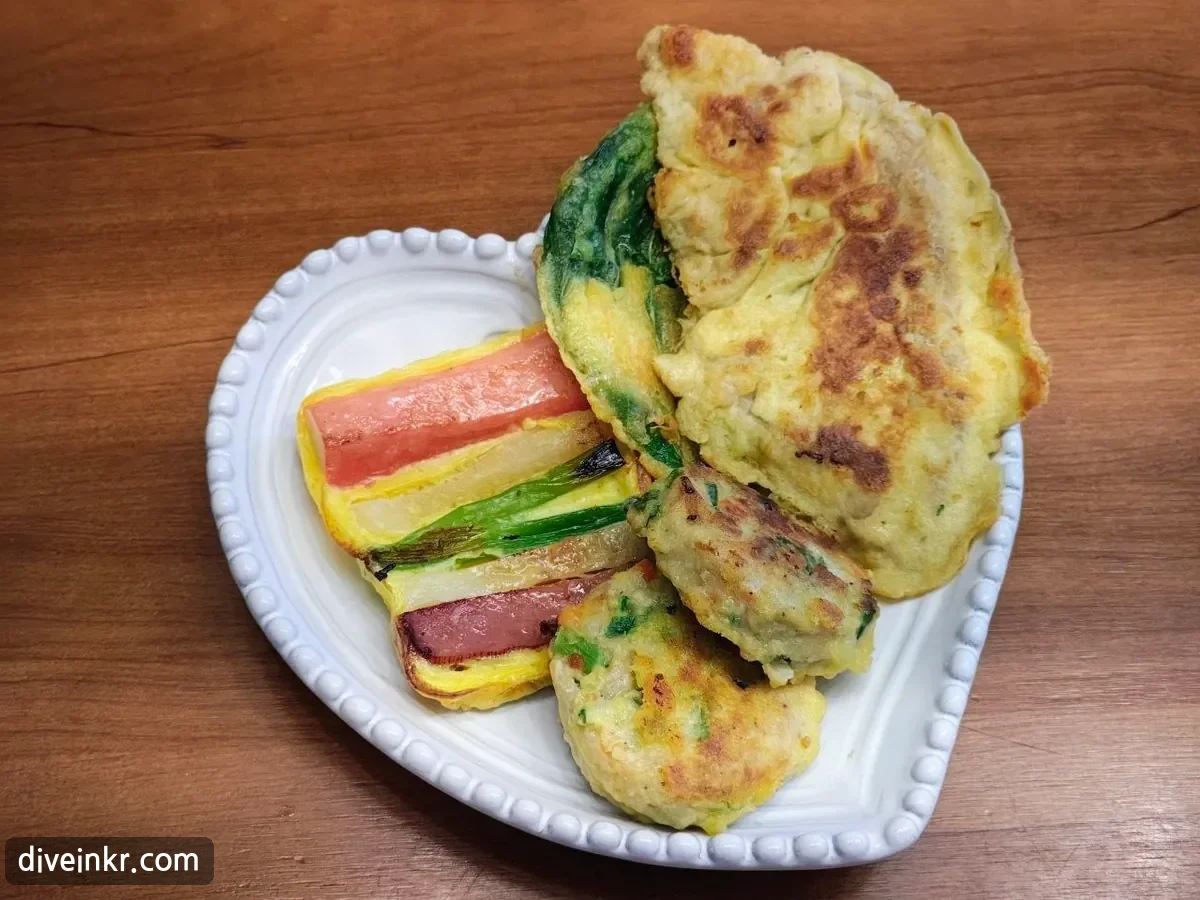
- The striped slices on the left are what most families call 산적 (sanjeok) or simply 꼬치 (kkochi, "skewer") — crab stick, pickled radish (단무지), scallion and ham skewered together in that order, coated in egg and pan-fried, so slicing across the skewer shows the layers. (Strictly by the dictionary, egg-coated skewers are 누름적 and 산적 means seasoned beef skewered and grilled — but at the table, 산적 and 꼬치 are what you'll hear.)
- The large piece at the top right is 육전 (yukjeon) — thin-sliced beef, coated in flour and egg and pan-fried.
- Tucked just under it is 깻잎전 (kkaennipjeon) — a perilla leaf folded in half around a filling similar to mandu filling (minced meat, tofu, vegetables), then egg-battered and fried.
- The two round patties are 동그랑땡 (donggeurangttaeng) — minced pork and vegetables formed into a disc and pan-fried. The dictionary also lists 돈저냐, and you may see 육원전, but almost everyone just says 동그랑땡.
- One spelling note: menus almost always write 모듬전, but the standard spelling, according to the National Institute of Korean Language, is 모둠전.
Other Types You'll Run Into
| Type | What's in it |
|---|---|
| 파전 (pajeon) | A scallion-heavy batter pancake. Busan's 동래파전 (Dongnae pajeon) adds plenty of seafood and a rice-flour batter, and Busan named it its first local specialty food in 1999. |
| 김치전 (kimchi-jeon) | Sliced kimchi mixed into a flour batter, pan-fried |
| 감자전 (gamja-jeon) | Grated potato, pan-fried into a pancake — a Gangwon Province favorite, along with buckwheat 메밀전 |
| 빈대떡 (bindaetteok) / 녹두전 | Ground mung beans pan-fried into a thick pancake — the dictionary treats the two names as the same dish |
| 호박전 (hobak-jeon) | Rounds of Korean zucchini (애호박), coated in flour and egg |
| 생선전 / 동태전 (saengseon-jeon / dongtae-jeon) | Thin fillets of white fish — often frozen pollack (동태) — coated in flour and egg |
| 고추전 · 표고전 (gochu-jeon · pyogo-jeon) | Green chili peppers or shiitake caps stuffed with seasoned minced meat, then fried |
| 동그랑땡 (donggeurangttaeng) | Minced pork and vegetables, formed into a round patty |
| 화전 (hwajeon) | Glutinous rice dough with flower petals pressed on top, pan-fried and sweetened — officially a kind of 떡 (rice cake), not a savory jeon |
Because it's fried in plenty of oil, jeon is one of the Korean dishes people do call 느끼하다 — greasy, too rich. That's one job of the kimchi and other banchan on the table: something sharp or sour to cut through the oil between bites.
Why Jeon Used to Be Feast Food
Today you can buy jeon at any market, but for most of Korean history it was hard to have on an ordinary day. Families weren't well off, and above all, cooking oil was scarce. In the Joseon era there was no way to press soybean oil at scale, so jeon was fried in sesame oil or, later, animal fat such as pork lard — both too precious to pour into a pan every day. Flour was precious too: wheat flour was valuable enough to be called 진말 (眞末, "true flour").
So jeon belonged to 잔치 — feast days. The classic occasions were:
- 생신 잔치 — a birthday feast for an elder of the family (생신 is the honorific word for an elder's birthday).
- Weddings, which used to happen at home: relatives and neighbors gathered, cooked together and shared the food as part of the ceremony. Today most couples marry in a 결혼식장 (a dedicated wedding hall), a cathedral, a church or a hotel banquet hall.
- 차례 and 제사 — the ancestral rites on holidays and on the anniversaries of a family member's death.
In 1971 Korea got its first large-scale soybean oil plant, and as bottled cooking oil became cheap and common, jeon gradually moved from feast food to everyday food.
Jeon on the Holiday Table
Jeon is still a standard dish for Chuseok and Seollal, and making enough for a big family gathering is famously hard work: in holiday-stress surveys, preparing the ancestral-rite table and all the cooking regularly rank near the top of the complaints. Jeon made for an ancestral rite even has its own old name, 간납 (ganap). Scholars of the 18th and 19th centuries explained it as 간남 (肝南), "south of the liver" — the dish sat just south of the grilled liver on the rite table — and the sound later shifted to 간납.
Here's the twist: in September 2022, just before Chuseok, the ritual committee of 성균관 (Sungkyunkwan), Korea's leading Confucian institution, published a simplified standard table and said that food fried in oil doesn't have to be on it at all. It pointed to a Joseon-era ritual text that called offering oily foods in rites improper.
Rainy-Day Comfort Food
Outside of holidays, jeon (especially 파전 and 빈대떡) has its own everyday association: rain. A popular explanation is that the sizzle of batter hitting a hot, oiled pan sounds like rain. Another points to Korea's farming past: rain meant no work in the fields, so people stayed in, cooked and ate together. Neither is proven, but the habit shows up in the numbers: KB Kookmin Card found that card payments at bindaetteok restaurants in Seoul rose by roughly 34–46% on summer days with 10 mm or more of rain compared with dry days, in analyses from 2019 to 2023. The summer monsoon, 장마, is covered on our weather small talk page.
And the drink that goes with it is 막걸리 (makgeolli), Korea's milky rice wine. "비 오는 날엔 파전에 막걸리" — pajeon and makgeolli on a rainy day — is something Koreans say all the time, and some people really do head out for it when it starts to pour. Nobody has to, of course. But for anyone who likes a drink, rain makes a very convenient excuse.
비 오는데 파전에 막걸리 한잔할까?
bi oneunde pajeone makgeolli hanjanhalkka?
It's raining — how about some pajeon and a glass of makgeolli?
한잔하다 ("have a drink") is written as one word — it means a drink or two, not exactly one glass. When you really count one glass, it's spaced: 막걸리 한 잔 주세요 ("one glass of makgeolli, please"). More on drinking snacks in anju.
Fun Facts About Jeon
- The 돈 in 동그랑땡's dictionary name, 돈저냐, means coin, not pork: it's 돈 in the old sense of 엽전, because the patty is coin-sized. Linguist Han Seong-u explains 동그랑 as the round shape and 땡 as the ringing of a coin hitting the floor.
- You 부치다 jeon, never 붙이다. The verb for making jeon is 부치다 (전을 부치다); 붙이다, pronounced the same, means "to stick" — a spelling mistake even Koreans make.
- Old cookbooks went wild with it: a 1924 Korean cookbook, 조선무쌍신식요리제법, lists some 30 kinds of 전유어 (jeon's older name), including 비빔밥전유어 — bibimbap shaped into flat rounds, egg-coated and fried.
- Gwangju's 육전 is a local signature: in 2019 the city named it one of its seven representative foods (광주 7미). Restaurants there fry it in front of you, and the local style uses glutinous rice flour instead of wheat flour.
Common Mistakes
Mistake #1 — Assuming 전 is always vegetarian
Beef, pork and fish versions (육전, 동그랑땡, 생선전) are just as common as vegetable ones — 전 describes the cooking method (egg-coated, pan-fried), not a specific ingredient.
Mistake #2 — Treating 전 and 부침개 as strictly different dishes
They overlap enough in everyday speech that native speakers mix the terms freely — don't stress over drawing a hard line.
Mini Quiz
2. 동그랑땡 is made from what?
3. What's a popular explanation for why Koreans crave jeon on rainy days?
4. Why was jeon mostly a feast-day food in the past?
5. Which spelling is correct for "to make jeon"?
Related Knowledge
Learn Next
What Is Chuseok? Korea's Harvest Holiday
Jeon is one of the standard dishes on the Chuseok table — see the holiday it's most associated with.
Will you remember this tomorrow?
Save it — your daily review brings it back right before you'd forget. No account needed.