What Does 오랜만 (Oraenman) Mean in Korean? "Long Time No See" and More
Written and reviewed by Jun and Jin, native Korean speakers
Published · How we write & review
After this page, you can greet someone you have not seen in a long time with 오랜만이에요 or 오랜만이야, and build sentences with 오랜만에 meaning "for the first time in a while".
10-second answer
What Does 오랜만 (Oraenman) Mean in Korean?
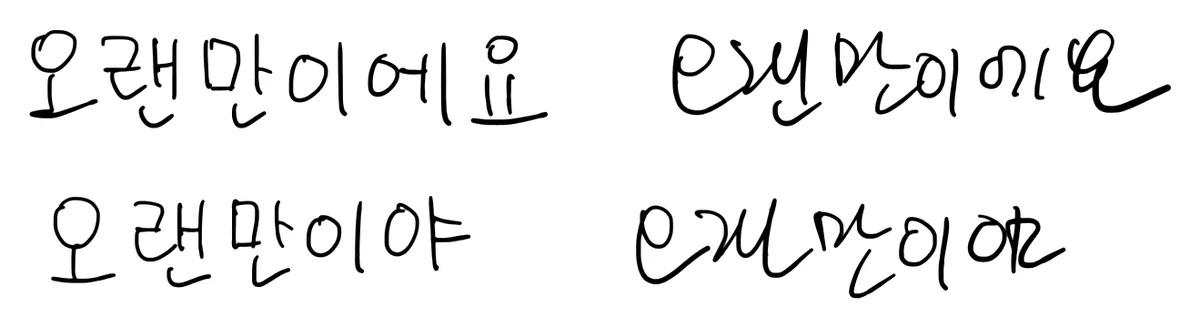
오랜만이에요 (oraenmanieyo) means "long time no see": it is what you say to someone you have not seen for a while. The casual version is 오랜만이야 (oraenmaniya). Add 에 (e) and a verb, as in 오랜만에 만났다 (oraenmane mannatda), and it means "I did it for the first time in a while."
Quick check — did that land?
1. Which sentence do you say to an older person you have not seen in a while?
오랜만이에요! 오래 못 본 사람에게 하는 인사예요. 오랜만이야는 친한 사이에서 써요. 다이브인 코리안에서 더 배워보세요.
Where 오랜만 Comes From
오랜만 (oraenman) is a noun for the stretch of time that has passed since something last happened. The official dictionary lists it as a shortened form of 오래간만 (oraeganman), whose definition is, in plain English, "the time after a long time has passed since something happened." So 오래간만 and 오랜만 are the same word: the longer form is fuller, and the shorter one is the form you will hear and type most easily.
The contraction is easy to see when you romanize it: the two syllables 래간 (raegan) shrink into the single syllable 랜 (raen), so oraeganman becomes oraenman. Nothing about the meaning changes. Whichever spelling you meet, you are reading the same idea: "after a long gap."
This page does not rank 오랜만 against 오래간만 by how often each is used. The dictionary tells us they are the same word, one short and one long, and that is all we claim.
See also: 안녕하세요 (annyeonghaseyo)
Saying It to a Person: Polite or Casual
As a greeting, 오랜만 turns into a full sentence by adding a copula, the "to be" ending. Which ending you choose depends on who you are talking to, exactly like the rest of Korean. If the choice between polite and casual is new to you, read 반말 vs 존댓말 first; the same split applies here.
| Form | Romanization | Level | Use it with |
|---|---|---|---|
| 오랜만이야 | oraenmaniya | Casual (반말) | Friends and people your age or younger |
| 정말 오랜만이다 | jeongmal oraenmanida | Casual, said as a remark | Friends, or to yourself: "it has really been a while" |
| 오랜만이에요 | oraenmanieyo | Polite (존댓말) | People you are not close to, or older people you know |
| 오랜만입니다 | oraenmanimnida | Formal polite | Work and formal settings |
Native speakers say 오랜만이야 (oraenmaniya) and 정말 오랜만이다 (jeongmal oraenmanida) as the everyday casual versions. The polite pair 오랜만이에요 and 오랜만입니다 are the standard polite and formal endings placed on the same word; they follow the same system as the greeting 안녕하세요, which also steps up from casual to polite to formal.
Which one should you use?
When in doubt, use 오랜만이에요. It is polite without being stiff, and it works with almost anyone. Switch to 오랜만이야 only when you are already on casual terms with the person.
오랜만에 + Verb: "For the First Time in a While"
Native speakers use 오랜만 for more than greetings. The form you will meet most in real sentences is 오랜만에 + a verb: 에 (e) is a particle, and the whole phrase means "after a long gap, I did this." In English it is "for the first time in a while." The sentences below all come from our native-speaker notes; each one marks a thing that had been missing from the speaker's routine for some time.
The most common short patterns, in the order a native speaker listed them, are 오랜만이야 (oraenmaniya), 오랜만에 본다 (oraenmane bonda, "long time no see," said when you spot someone), 오랜만에 운동했다 (oraenmane undonghaetda, "I exercised for the first time in a while"), 오랜만에 만났다 (oraenmane mannatda, "we met for the first time in a while") and 정말 오랜만이다 (jeongmal oraenmanida, "it has really been a while"). Notice that most of them are "오랜만에 + something I did."
오랜만에 고향 친구들을 만나서 밤새 수다를 떨었다.
oraenmane gohyang chingudeureul mannaseo bamsae sudareul tteoreotda.
I met my hometown friends for the first time in a while and we chatted all night.
고향 (gohyang) is "hometown" and 수다를 떨다 (sudareul tteolda) is "to chatter." This sentence ends in -었다 / -았다, the plain past form used in diaries and writing.
주말에 오랜만에 늦잠을 잤더니 피로가 싹 풀리는 것 같다.
jumare oraenmane neutjameul jatdeoni pirona ssak pullineun geot gatda.
I slept in for the first time in a while on the weekend, and it feels like all my tiredness has gone away.
늦잠을 자다 (neutjameul jada) is "to sleep in."
오늘 저녁은 오랜만에 가족들과 외식을 하기로 했다.
oneul jeonyeogeun oraenmane gajokdeulgwa oesigeul hagiro haetda.
For dinner tonight we decided to eat out with the family for the first time in a while.
외식 (oesik) is "eating out," and -기로 했다 (-giro haetda) means "decided to."
미세먼지가 걷히고 오랜만에 파란 하늘을 보니 기분이 좋다.
misemeonjiga geotigo oraenmane paran haneureul boni gibuni jota.
The fine dust has cleared, and seeing a blue sky for the first time in a while puts me in a good mood.
미세먼지 (misemeonji) is "fine dust," a common weather topic in Korea.
고등학교 졸업 이후 오랜만에 모교를 방문했다.
godeunghakgyo joreop ihu oraenmane mogyoreul bangmunhaetda.
For the first time in a while since high school graduation, I visited my old school.
모교 (mogyo) is "one's alma mater." The sentence gives the time frame in the first half and 오랜만에 right before the verb phrase.
오랜만에 운동을 했더니 온몸의 근육이 뭉쳤다.
oraenmane undongeul haetdeoni onmomui geunyugi mungchyeotda.
I exercised for the first time in a while, and the muscles all over my body knotted up.
-했더니 (-haetdeoni) links a past action to its result.
할머니께서는 오랜만에 찾아온 손주를 안아주며 눈물을 흘리셨다.
halmeonikkeseoneun oraenmane chajaon sonjureul anajumyeo nunmureul heullisyeotda.
Grandmother hugged the grandchild who had come to visit after such a long time, and shed tears.
Here 오랜만에 sits inside the clause describing the grandchild: the visit itself came after a long gap. 께서는 and -시- are the honorific forms for a grandmother.
오랜만에 고향 음식을 먹으니 옛날 생각이 난다.
oraenmane gohyang eumsigeul meogeuni yetnal saenggagi nanda.
Eating hometown food for the first time in a while brings back memories of the old days.
옛날 생각이 나다 (yetnal saenggagi nada) is "to be reminded of old times."
Look at where 오랜만에 sits: usually right before the verb phrase or the object it describes, and in a few of the sentences above straight after the time or place that sets the scene. It is a plain time marker, so it moves around the way English "for the first time in a while" does. For how 에 and other small markers work, see Korean particles.
What Usually Comes Next
Once the greeting is out, the usual follow-up is a question about how the other person has been. The standard patterns are 잘 지냈어요? (jal jinaesseoyo?, "Have you been well?") in polite speech and 잘 지냈어? (jal jinaesseo?) among friends. Think of 오랜만이에요 as the door opening and 잘 지냈어요 as the first step through it.
오랜만이야! 잘 지냈어?
oraenmaniya! jal jinaesseo?
Long time no see! Have you been well?
Casual, between friends.
오랜만이에요! 잘 지내셨어요?
oraenmanieyo! jal jinaesyeosseoyo?
Long time no see! Have you been well?
Polite. The -시- in 지내셨어요 is the honorific, for someone older or senior; for a peer you are polite with, 잘 지냈어요? is enough.
After that, you are into small talk, and the rest of the conversation can go anywhere. If you are parting rather than meeting, a different set of phrases applies; see goodbye in Korean.
Common Mistakes
Mistake #1 — Using 오랜만 for a long duration
오랜만 is not "a long time" in the sense of "it took a long time." It measures the gap since the last time. So 오랜만에 운동했다 does not mean "I exercised for a long time"; it means "I exercised, and it had been a while since the last time."
Mistake #2 — Using 오랜만이야 with someone you must be polite to
Greeting a boss, a teacher or an older person with 오랜만이야 sounds rude. Use 오랜만이에요 or 오랜만입니다. Ending a greeting with 요 is the quickest way to stay safe.
Mistake #3 — Saying it to someone you saw yesterday
오랜만 needs a real gap. It is a statement that time has passed, so it would sound odd to people you meet every day.
Mini Quiz
3 short questions — about 2 minute
2. What is 오랜만 in the dictionary?
3. What does 오랜만에 운동했다 mean?
4. Which phrase is the usual follow-up question after the greeting?
Part of Korean Greetings & Everyday Politeness — The Survival Set
Related Knowledge
1 more related
Learn Next
After a long time apart, the next thing you may want to say is how much you missed the person.
Will you remember this tomorrow?
Save it — your daily review brings it back right before you'd forget. No account needed.