6 Ways to Say See You Later in Korean
Written and reviewed by Jun and Jin, native Korean speakers
Published · Updated · How we write & review
After this page, you can pick the right way to say “See You Later” depending on formality and how soon you'll meet again.
10-second answer
How do you say see you later in Korean?
See you later in Korean is 이따 봐 (itta bwa) when you'll meet again later the same day, and 나중에 봐 (najunge bwa) or 다음에 봐 (daeume bwa) when the next meeting is open. Add 요 (yo) to be polite; with someone senior use the humble form 다음에 또 뵐게요 (daeume tto boelgeyo). 또 봐 (tto bwa) works for both.
Quick check — did that land?
1. When should you use 이따 봐(요) instead of 다음에 봐(요)?
In Korean, see you later depends on when.
The Full Spectrum
| Phrase | Formality / Timing | When to use |
|---|---|---|
| 다음에 또 뵐게요 (daeume tto boelgeyo) | Formal, humble | To someone senior or a formal contact — "I'll see you again next time" |
| 나중에 봬요 (najunge bwaeyo) | Formal-polite | "See you later" using the honorific 뵈다 ("to see," humble form of 보다) |
| 이따 봬요 (itta bwaeyo) | Polite + humble, same-day | Meeting again later today, said politely and humbly — to someone senior |
| 다음에 봐요 (daeume bwayo) | Polite-casual | "See you next time" — no set timeframe, works for friendly acquaintances |
| 이따 봐 (itta bwa) | Casual (반말), same-day | "See you in a bit" to close friends, family, or a partner — meeting again today |
| 다음에 봐 (daeume bwa) | Casual (반말) | "See you next time" among close friends — no specific date implied |
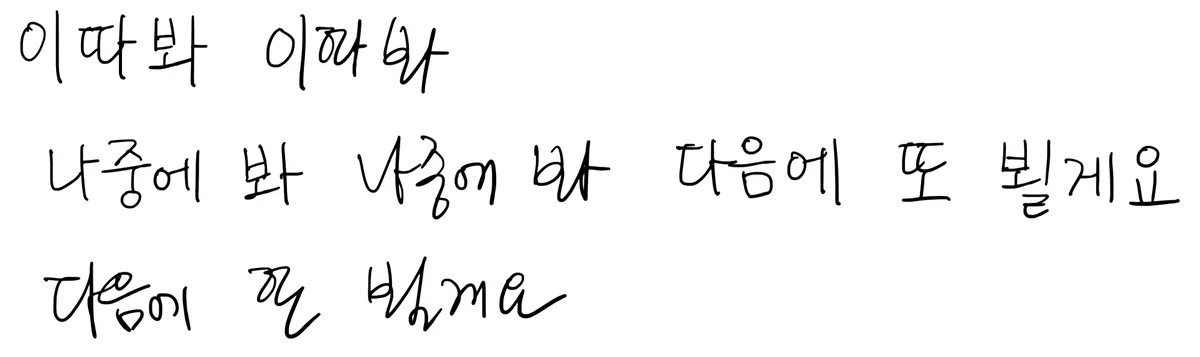
See also: 반말 vs 존댓말
The One Rule That Matters Most
이따 (itta) only works when you'll meet again later the same day, at a time and place you've both already agreed on — using it for "see you next week" sounds wrong. Without a set plan, use 나중에, 또 or 다음에 instead. Formality still follows the usual 반말 vs 존댓말 split on top of that timing choice.
이따 봐 vs 나중에 · 또 · 다음에 봐: Which "See You Later"?
For casual goodbyes, the real dividing line is between 이따 봐 and everything else.
| Phrase | When to use it |
|---|---|
| 이따 봐 | Only when you're parting for a short while and will meet again at a time and place you've both already agreed on — later today |
| 나중에 봐 · 또 봐 · 다음에 봐 | Everything else. The three are largely interchangeable: a friendly "see you" with no fixed plan |
So 이따 봐 is a promise with a time and place attached. If there isn't one — or you're not sure when you'll meet next — any of the other three works, and native speakers switch between them freely. Like 밥 한번 먹자 ("let's grab a meal sometime"), they don't have to mean an actual plan.
나 점심 먹고 카페 가 있을게. 너도 과제 끝나면 이따 봐!
na jeomsim meokgo kape ga isseulge. neodo gwaje kkeunnamyeon itta bwa!
I'll grab lunch and wait at the café. See you there when you're done with your assignment!
이번 주말은 좀 바쁘네. 주중에 연락할 테니까 나중에 봐.
ibeon jumareun jom bappeune. jujunge yeollakal tenikka najunge bwa.
This weekend's a bit busy. I'll text you during the week — see you later.
오늘 진짜 재밌었어! 조심히 들어가고 또 봐!
oneul jinjja jaemisseosseo! josimhi deureogago tto bwa!
Today was so fun! Get home safe — see you again!
오늘 반가웠어요. 바쁘시다니 어쩔 수 없죠. 다음에 봐요.
oneul bangawosseoyo. bappeusidani eojjeol su eopjyo. daeume bwayo.
Nice seeing you today. If you're busy, it can't be helped — see you next time.
When the time is already set
이따 (itta) means the near future — later today, soon — and it only works when both of you already know when. 나중에 봐 (najunge bwa) has no date attached, so it can be an open-ended goodbye. If you have actually fixed a time to meet, native speakers say 그때 봐 (geuttae bwa, "see you then") rather than 나중에 봐.
Quick Examples
저녁에 이따 봐!
jeonyeoge itta bwa!
See you tonight!
이따 confirms it's a same-day plan, casual 반말 for a close friend.
오늘 즐거웠어요, 다음에 또 뵐게요.
oneul jeulgeowosseoyo, daeume tto boelgeyo.
Today was great, I'll see you again next time.
Formal-humble closing line, common after a business meeting or formal meetup.
For the opposite moment, when you meet again after a long gap, see 오랜만이에요 and 오랜만에 (oraenman).
Common Mistakes
Mistake #1 — Using 이따 봐 for a meeting next week
이따 strictly means "later today" — for any future date beyond today, use 다음에 봐(요) instead.
Mistake #2 — Forgetting 뵙다/뵈다 is the humble form of 보다
뵐게요/봬요 aren't separate words to memorize from scratch — they're the honorific version of 보다 ("to see"), used when addressing someone senior.
Mini Quiz
2 short questions — about 1 minute
2. What is 뵐게요/봬요 built from?
3. Which is the most casual way to say "see you next time"?
Part of Korean Greetings & Everyday Politeness — The Survival Set
Related Knowledge
Learn Next
10 Ways to Say Goodbye in Korean
See you later and goodbye cover the same moment from two angles — the natural next phrase set.
Will you remember this tomorrow?
Save it — your daily review brings it back right before you'd forget. No account needed.