6 Ways to Say You're Welcome in Korean
Written and reviewed by Jun and Jin, native Korean speakers
Published · Updated · How we write & review
After this page, you can answer thanks naturally in Korean — usually with 아니에요 (anieyo) rather than 천만에요.
10-second answer
How do you say you're welcome in Korean?
천만에요 (cheonmaneyo) is the textbook "you're welcome," but Koreans respond to thanks far more often with 아니에요 (anieyo, "no, [it was nothing]") — deflecting the thanks rather than formally accepting it. Which one you pick again depends on formality and how much you want to downplay the favor.
Quick check — did that land?
1. Which reply do Koreans actually use most often after being thanked?
천만에요? 잘 안 써요. 대부분 아니에요라고 해요.
The Full Spectrum
| Phrase | Formality | When to use |
|---|---|---|
| 천만에요 (cheonmaneyo) | Formal, textbook | The dictionary answer to 감사합니다 — understood everywhere, if slightly stiff in daily talk |
| 아니에요 (anieyo) | Polite, the real default | "No, [it's nothing]" — the phrase Koreans actually use most to deflect thanks politely |
| 별말씀을요 (byeolmalsseumeuryo) | Polite and humble, a little formal | "Don't mention it" — a humble, slightly formal way to deflect thanks |
| 괜찮아요 (gwaenchanayo) | Polite-casual | "It's fine/no worries" — used when the favor was small, works with coworkers or acquaintances |
| 아니야 (aniya) | Casual (반말) | Same deflection as 아니에요, just dropped to casual speech with close friends |
| 괜찮아 (gwaenchana) | Casual (반말) | "No worries" among close friends — the most common casual reply after helping someone out |
Which thank-you you heard decides which reply fits — see 감사합니다 vs 고마워.
See also: 10 Ways to Say Thank You in Korean
The One Rule That Matters Most
Don't over-rely on 천만에요 — it's correct but sounds textbook-formal in real conversation. Natives usually respond to 감사합니다/고마워 with a quick 아니에요 or 괜찮아(요), deflecting rather than formally "accepting" the thanks the way English "you're welcome" does.
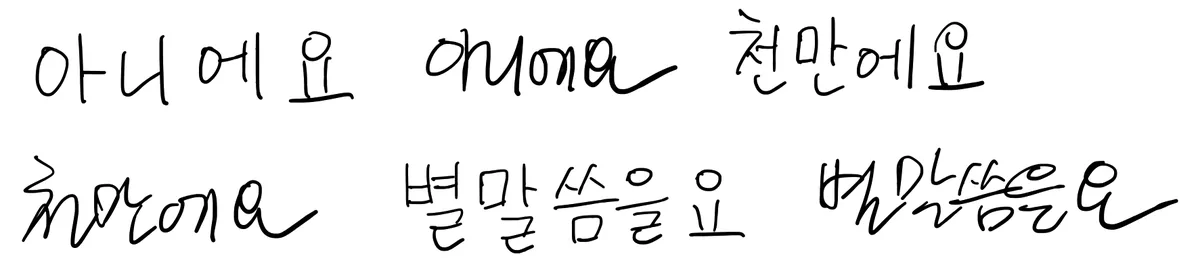
Two Replies Textbooks Skip: A Simple 네, or Thanks Right Back
The table above covers the classic replies, but two of the most common responses aren't "you're welcome" phrases at all. Sometimes the whole answer is just 네 or 예 — a quick "yes," acknowledging the thanks without making anything of it. And depending on the situation, Koreans often answer 감사합니다 with 감사합니다, or 고맙습니다 with 고맙습니다: both people thanking each other instead of one accepting the thanks.
On 천만에요 (cheonmaneyo): native speakers almost never say it. It belongs to written Korean — you'll meet it in textbooks and formal writing, not in a reply across a counter. Say 아니에요 (anieyo) instead.
A: 감사합니다. B: 네.
A: gamsahamnida. B: ne.
A: Thank you. B: Mm-hm. (with a small nod)
Short and completely polite — usually with a small nod (see below).
A: 고맙습니다. B: 저도 고맙습니다.
A: gomapseumnida. B: jeodo gomapseumnida.
A: Thank you. B: Thank you too.
Thanking back works when both sides did something for each other. Plain 고맙습니다 with no 저도 is common too.
직원: 감사합니다. 손님: 감사합니다.
jigwon: gamsahamnida. sonnim: gamsahamnida.
Clerk: Thank you. Customer: Thank you.
The everyday version of thanking back: at a shop counter, both sides say 감사합니다 as the customer takes the bag.
Don't Forget the Nod: 목례
Whatever words you choose, the reply in Korea usually comes with 목례 (mongnye) — a light greeting with the eyes and a slight dip of the head, not a deep bow. (The 목 here is 目, "eye," not the Korean word for neck.) It's expected with any greeting or exchange of thanks, and it matters most with people older than you or senior to you at work: with them, make a point of never skipping it.
You don't strictly have to nod — but a nod with your words sounds more natural and warmer, especially with someone senior. A polite phrase said without it can feel a little flat; a nod with a simple 네 is already a complete, polite reply.
Quick Examples
A: 정말 감사해요! B: 아니에요, 별거 아니에요.
A: jeongmal gamsahaeyo! B: anieyo, byeolgeo anieyo.
A: Thank you so much! B: No worries, it was nothing.
별거 아니에요 ("it's no big deal") often tags along after 아니에요.
괜찮아, 다음에 또 도와줄게.
gwaenchana, daeume tto dowajulge.
No worries, I'll help you again next time.
Casual reply between friends, softening the exchange with a future offer.
Common Mistakes
Mistake #1 — Always answering with 천만에요
It's not wrong, but real conversations lean on 아니에요/괜찮아(요) far more often — 천만에요 can sound like it's straight out of a textbook.
Mistake #2 — Treating 괜찮아요 as only meaning "I'm okay"
괜찮아요 doubles as a warm, casual "you're welcome / no worries" reply — context (right after thanks) makes the meaning clear.
Quick Answers
Is 천만에요 (cheonmaneyo) the normal way to say you're welcome?
It is correct and understood everywhere, but it sounds textbook-formal in real conversation. Koreans more often answer with 아니에요 (anieyo) or 괜찮아요 (gwaenchanayo).
Why do Koreans answer thanks with “no” (아니에요, anieyo)?
It deflects the thanks instead of formally accepting it, roughly “no, it was nothing.” That downplays the favor, which is the polite move.
Can I just say 네 (ne) after someone thanks me?
Yes. Sometimes the whole reply is a quick 네 (ne) or 예 (ye), which acknowledges the thanks without making a big deal of it. It is often paired with a light nod (목례, mongnye).
Mini Quiz
2 short questions — about 1 minute
2. What does 괜찮아요 mean when said right after someone thanks you?
3. Which phrase is the most formal, dictionary-style "you're welcome"?
Part of Korean Greetings & Everyday Politeness — The Survival Set
Related Knowledge
Learn Next
10 Ways to Say Goodbye in Korean
Thanks and its reply are covered — goodbye is the next phrase pair every beginner needs at the same formality granularity.
Will you remember this tomorrow?
Save it — your daily review brings it back right before you'd forget. No account needed.