Korean Phrases You'll Hear at Home: What Parents and Siblings Actually Say
Written and reviewed by Jun and Jin, native Korean speakers
Published · How we write & review
After this page, you can recognize the everyday lines Korean parents and siblings say at home — from fridge nagging to "come eat some fruit" — and answer them in natural 반말.
10-second answer
The short answer
Inside a Korean home, almost everything is said in 반말 (banmal, casual speech), and parents give orders with the firm -어라/-아라 (eora/ara) ending: 빨리 먹어라 (ppalli meogeora, "eat it soon"), 문 똑바로 닫아라 (mun ttokbaro dadara, "shut the door properly"). The lines are small and repeat every day: 나 나갔다 올게 (na nagatda olge, "I'm heading out") and the warm one, 과일 깎아 놨다 (gwail kkakka nwatda), 나와서 먹어라 (nawaseo meogeora, "I cut some fruit — come out and eat").
Quick check — did that land?
1. After dinner, Mom calls out 과일 깎아 놨다, 나와서 먹어라. What does she want?
Scene 1: Heading Out the Door
Leaving the house is a small ritual. Whoever is going announces it — often with an offer to shop on the way, after a quick look at what's run out, like milk or eggs. And at the front door, a parent says the same safety line every single time.
나 나갔다 올게, 뭐 사 올까?
na nagatda olge, mwo sa olkka?
I'm popping out — want me to pick anything up?
나갔다 here isn't the past tense "went out" — it's short for 나갔다가, "go out and then," so 나갔다 오다 = go out and come back. The -(으)ㄹ게 ending (올게) announces what you're about to do, with a hint of promise: "I'll be back."
외출할 때 불이랑 가스 꼭 확인해!
oechulhal ttae burirang gaseu kkok hwaginhae!
Check the lights and the gas before you leave!
꼭 means "make sure, without fail." 확인해 is a plain 반말 command — the same form as "check it" between friends.
내일 아침에 나 좀 일찍 깨워 줘.
naeil achime na jom iljjik kkaewo jwo.
Can you wake me up early tomorrow?
The night before an exam, an important appointment or an early shift, when you don't trust your alarm. -어 줘 = "do it for me"; 좀 isn't "a little" here — it just softens the request, like "could you."
See also: 엄마 and 아빠 — Mom and Dad in Korean
Scene 2: The Fridge
The fridge is the family noticeboard. It's where old side dishes get discovered, where the door gets left open, and where sticky notes do the talking when nobody is home at dinnertime. Many of these lines are said out loud and written on a note.
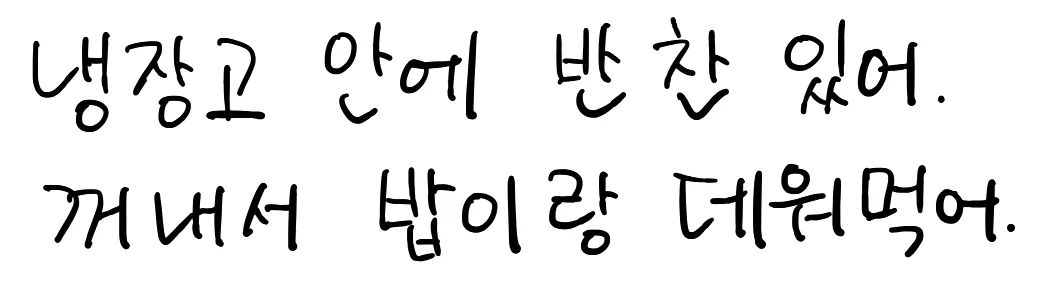
Read the note slowly: 냉장고 안에 반찬 있어 ("there are side dishes in the fridge" — notice there's no particle after 반찬; speech and quick notes drop it). Then 꺼내서, from 꺼내다 + -어서, "take them out, and then…," and 밥이랑 데워 먹어 ("heat them up and eat them with rice"). Handwriting often runs words together, but 데우다 and 먹다 are two separate verbs, so standard spacing is 데워 먹어. The whole note is the written cousin of 밥 먹었어? — care expressed as instructions about food.
이거 상하겠다, 빨리 먹어라.
igeo sanghagetda, ppalli meogeora.
This is about to go bad — eat it soon.
Said about a forgotten side dish or leftover delivery food at the back of the fridge. -겠다 = "it looks like it will…"
냉장고 문 똑바로 닫아라, 소리 난다.
naengjanggo mun ttokbaro dadara, sori nanda.
Shut the fridge door properly — it's beeping.
The door isn't quite closed and the alarm starts. A classic on fridge notes, too.
이거 언제 산 거야? 먹어도 돼?
igeo eonje san geoya? meogeodo dwae?
When did you buy this? Is it okay if I eat it?
You find someone else's drink or snack and check whether it's spoken for. -어도 돼? asks permission.
다 먹은 그릇은 물에 담가 놔라.
da meogeun geureuseun mure damga nwara.
Leave the dishes you've finished with soaking in water.
For the family member who comes home late and eats alone — and a sticky-note regular. 그릇 is a bowl or plate, so 다 먹은 그릇 means the dishes you've just eaten from. You'll also hear 설거지는 물에 담가 놔라: dictionaries define 설거지 as the job of washing up, but at home it also stands for the whole pile of dirty dishes waiting for that job. 담가 comes from 담그다 (to soak), and -아 놓다 means "do it and leave it that way."
Scene 3: Siblings — Mine vs. Yours
With brothers and sisters, the arguments are about property: a hidden snack, a favorite piece of clothing, and packages. If you're the younger one, you're the 동생. Here are the lines that fly back and forth.
내 거 건드리지 마! / 내 거 왜 먹었어?
nae geo geondeuriji ma! / nae geo wae meogeosseo?
Don't touch my stuff! / Why did you eat mine?
The snack or drink you were saving has vanished. -지 마 is the casual "don't."
너 또 옷 몰래 입고 나갔지?
neo tto ot mollae ipgo nagatji?
You snuck out wearing my clothes again, didn't you?
Sent by text the moment the favorite top is missing, or said the second they walk in. -지? expects a yes — it's an accusation, not a question.
택배 왔다! 네 거 먼저 까 봐.
taekbae watda! ne geo meonjeo kka bwa.
A package came! Open yours first — let's see.
Whoever gets home first carries the boxes in from the front door, and everyone wants to know what the others ordered. 까다 is casual for unwrapping; 택배 is a delivered parcel. Swap in 내 거 (mine) for your own box.
Scene 4: Lights, Heating and Socks
Then there's the nagging — 잔소리 — that every Korean kid can recite. Most of it is about wasted energy and laundry.
누가 불 켜 놓고 그냥 가래?
nuga bul kyeo noko geunyang garae?
Who told you to leave the light on and just walk off?
The bathroom or bedroom light is still on. -래 is short for -라고 해 ("tells you to…"): 가라고 해 → 가래. As a question, 누가 … 가래? is a rhetorical "who told you to…?" — nobody did. More contractions like this in Korean indirect speech.
보일러 온도 좀 맞춰라.
boilleo ondo jom matchwora.
Keep the heating at a sensible temperature.
Said right after a parent opens the heating or electricity bill. 보일러 is the home heating system; in summer it becomes 에어컨 온도 좀 맞춰라.
양말 좀 뒤집어서 벗어 놓지 마!
yangmal jom dwijibeoseo beoseo nochi ma!
Stop leaving your socks inside out!
Mom finds the inside-out socks again. This is the moment right before the 등짝 스매싱 — see below.
누구 전화야? 왜 안 받아?
nugu jeonhwaya? wae an bada?
Whose phone is that? Why aren't you picking up?
Called toward a family member who's in their room, absorbed in their phone, and hasn't heard the ringing out in the living room.
What is 등짝 스매싱?
등짝 is a blunt, slangy word for someone's back (the dictionary marks it as a coarse way of saying 등), and 스매싱 is borrowed from the English "smash(ing)," as in a tennis smash. Together it's a running joke about the flat-palm swat on the back a Korean mom gives when you've really tested her patience — inside-out socks being a prime trigger. People use it humorously, the way English speakers joke about "the look" from their mother.
Scene 5: The Warm Ones
Not everything at home is a complaint. After dinner, a parent peels apples or pears, sets them on a plate, and calls toward the closed bedroom doors. It doesn't contain the word "love," but everyone understands it that way.
과일 깎아 놨다, 나와서 먹어라.
gwail kkakka nwatda, nawaseo meogeora.
I've cut some fruit — come out and have some.
깎다 means peeling with a knife; -아 놓다 (놨다) means it's done and waiting for you.
Why It's All 반말 — and the Parental -어라
Family is the most intimate circle there is, so siblings and parents talking to children use 반말 — no -요, no -습니다. How children speak to parents varies more by family: many kids use 반말 with 엄마 and 아빠, while some households expect polite speech. If you're a guest in a Korean home, stay polite with the parents.
The ending that sounds most "parent" is -어라/-아라, the plain command form. It attaches like the -아요/-어요 ending: 먹다 → 먹어라, 닫다 → 닫아라, 맞추다 → 맞춰라, 놓다 → 놔라, 하다 → 해라. Compared with the soft 반말 command (먹어), it's firmer and more decisive, which is why it fits a parent — and why it's also common on written notes.
| Form | Example | Who uses it at home |
|---|---|---|
| -어라 / -아라 (firm command) | 빨리 먹어라 | Parents to children |
| -어 / -아 (casual command) | 불 확인해 | Anyone in the family, including siblings |
| -지 마 (don't) | 내 거 건드리지 마 | Siblings, parents |
| -(으)ㄹ게 (I'll…) | 나갔다 올게 | Anyone announcing what they'll do |
Don't send -어라 back up
Children don't answer parents with -어라. If Mom says 불 꼭 확인해, the natural reply is 응, 알았어 or 알았어, 확인할게 — never 확인해라. Outside the family, commands to elders go through -세요.
Answering at Home: 응, 네 and 알았어(요)
Parents speak 반말 to their children in every family. What changes from home to home is the other direction: some children talk to their parents in 반말, others in 존댓말. Here are the same household moments both ways. Two switches do most of the work: 나 becomes 저 (나 vs 저), and the sentence gets -요 or -세요.
| Moment | 반말 (casual family) | 존댓말 (to parents, polite family) |
|---|---|---|
| Heading out | 나 나갔다 올게. | 저 나갔다 올게요. |
| Offering to shop | 뭐 사 올까? | 뭐 사 올까요? |
| Asking to eat something | 이거 먹어도 돼? | 이거 먹어도 돼요? |
| Wake-up request | 내일 아침에 나 좀 일찍 깨워 줘. | 내일 아침에 저 좀 일찍 깨워 주세요. |
| Answering "불이랑 가스 꼭 확인해!" | 응, 알았어. | 네, 알았어요. |
| Answering "과일 깎아 놨다, 나와서 먹어라" | 응, 갈게! | 네, 갈게요! |
The yes-words follow the same split: 응 (or the even shorter 어) is the casual yes, 네 is the polite one, and 알았어 / 알았어요 means "got it" — the standard reply to any reminder. The full ladder is in 네 vs 응.
- Mixing levels in one sentence: 나 좀 깨워 주세요 sounds off. If the verb is polite, the "I" is 저: 저 좀 깨워 주세요.
- Reading 나갔다 올게 as past tense because of 갔다. It's a plan, not a report — the 올게 at the end tells you it hasn't happened yet.
- Answering a friend's parent with 응. In someone else's home, it's 네 and -요, even if your friend uses 반말 with them.
- Translating 좀 as "a little." In requests like 불 좀 꺼 or 온도 좀 맞춰라, it just makes the request sound less abrupt.
Practice: Two Scenes at Home
You're the child in both scenes. Pick the line that fits.
엄마, 나 나갔다 올게. 뭐 사 올까?
eomma, na nagatda olge. mwo sa olkka?
Mom, I'm popping out. Want me to pick anything up?
우유랑 달걀.
uyurang dalgyal.
Milk and eggs.
응, 알았어.
eung, arasseo.
Okay, got it.
외출할 때 불이랑 가스 꼭 확인해!
oechulhal ttae burirang gaseu kkok hwaginhae!
Check the lights and the gas before you go!
알았어, 확인할게.
arasseo, hwaginhalge.
Okay, I'll check.
이거 언제 산 거야? 먹어도 돼?
igeo eonje san geoya? meogeodo dwae?
When did you buy this? Can I eat it?
내 거 건드리지 마!
nae geo geondeuriji ma!
Hands off, that's mine!
냉장고 문 똑바로 닫아라, 소리 난다.
naengjanggo mun ttokbaro dadara, sori nanda.
Shut the fridge door properly — it's beeping.
응, 알았어.
eung, arasseo.
Okay, okay.
이거 상하겠다, 빨리 먹어라.
igeo sanghagetda, ppalli meogeora.
This one's about to go bad — eat it soon.
Mini Quiz
2. You're leaving the house. Which line fits best?
3. Mom says 불이랑 가스 꼭 확인해! What's the most natural reply?
4. What is 등짝 스매싱?
Related Knowledge
Learn Next
반말 vs 존댓말: Casual vs Polite Korean Speech
Every line on this page is 반말. Learn exactly where the line between casual and polite falls — inside the family and outside it.
Will you remember this tomorrow?
Save it — your daily review brings it back right before you'd forget. No account needed.