Korean Counters: 개, 명, 마리 and Friends
Written and reviewed by Jun and Jin, native Korean speakers
Published · Updated · How we write & review
After this page, you can count people, things, animals and drinks with the right counter word in the right order.
10-second answer
The short answer
Korean doesn't say "two coffees" — it says "coffee two CUPS" (커피 두 잔, keopi du jan). Between a number and the thing counted, Korean inserts a counter word matched to the category: 개 (gae) for objects, 명 (myeong) for people, 마리 (mari) for animals, 잔 for drinks. The pattern is always NOUN + NUMBER + COUNTER, using native Korean numbers in their shortened forms (한/두/세/네, han/du/se/ne).
Quick check — did that land?
1. What's the correct word order for "two coffees, please"?
커피 두 잔! 사람 세 명! 고양이 두 마리! Korean uses different counters for cups, people, and animals.
The Core Counter Set
| Counter | Counts | Example |
|---|---|---|
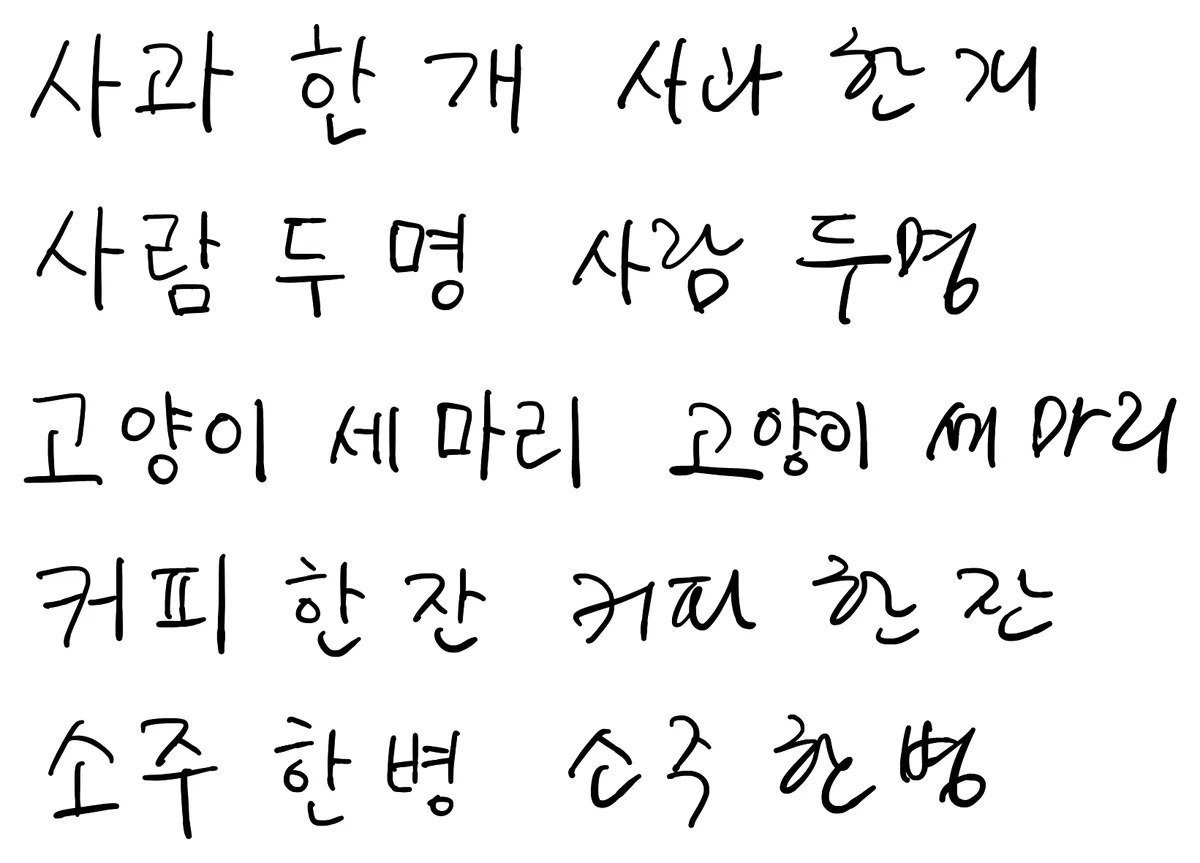
| 개 (gae) | Things, objects (the general default) | 사과 두 개 — two apples |
| 명 (myeong) | People | 친구 세 명 — three friends |
| 분 (bun) | People (honorific) | 손님 두 분 — two guests (respectful) |
| 마리 (mari) | Animals | 고양이 한 마리 — one cat |
| 잔 (jan) | Cups, glasses of drinks | 커피 두 잔 — two coffees |
| 병 (byeong) | Bottles | 물 한 병 — one bottle of water |
| 권 (gwon) | Books | 책 네 권 — four books |
| 대 (dae) | Machines, vehicles | 차 한 대 — one car |
| 번 (beon) | Times, occurrences | 한 번 더 — one more time |
| 살 (sal) | Years of age | 스무 살 — twenty years old |
Don't panic at the list — 개 is the safety net. If you don't know the right counter for an object, 개 will be understood (though 명/마리 for people/animals are worth learning early, since 개 there sounds odd).
Umbrellas: no special counter
Umbrellas don't have a counter of their own — you simply count them with the plain native numbers: 우산 하나, 둘, 셋 (usan hana, dul, set).

See also: Korean Numbers 1 to 10
The Word Order
The pattern is NOUN + NUMBER + COUNTER — the reverse of English's "two cups of coffee." The numbers are native Korean, and 하나/둘/셋/넷 shorten to 한/두/세/네 before a counter, exactly as covered on the numbers drill page.
맥주 두 병 주세요.
maekju du byeong juseyo.
Two bottles of beer, please.
Noun (맥주) + number (두) + counter (병) + 주세요.
몇 명이에요?
myeot myeong-ieyo?
How many people?
몇 + counter asks "how many." At a restaurant door, staff used to ask 몇 명인가요? (myeot myeongingayo?), but today they almost always ask 몇 분이세요? (myeot buniseyo?) — using 분, the honorific counter for people, in step with the trend toward extra-polite service language. Correct, but restaurant and café staff usually ask more politely: 몇 분이세요? (myeot buniseyo?) or 몇 명이서 오셨어요? (myeot myeongiseo osyeosseoyo?). 몇 명 is what you hear when people count heads elsewhere — booking a table for a work dinner (참석자 몇 명이에요?, chamseokja myeot myeongieyo?) or checking who's arrived in a group (지금 몇 명 왔어?, jigeum myeot myeong wasseo?).
Korean rarely marks plurals — 친구 세 명 already says 'three friends' — which is why 들 (deul) is optional.
Sino-Korean Counters
A smaller group of counters uses Sino-Korean numbers instead: 인분 (servings — 삼겹살 이 인분), 원 (won, money), 분 (minutes), 층 (floors — 삼 층). As a rough rule, measurements, money, and anything felt as a "unit on a scale" lean Sino-Korean.
Common Mistakes
Mistake #1 — Counting without any counter
커피 둘 주세요 is understood but unnatural — 커피 두 잔 주세요 is the real pattern.
Mistake #2 — Using full 하나/둘/셋/넷 before counters
They must shorten: 한 개, 두 명, 세 마리, 네 권 — never 하나 개.
Free Worksheet: Counters Practice
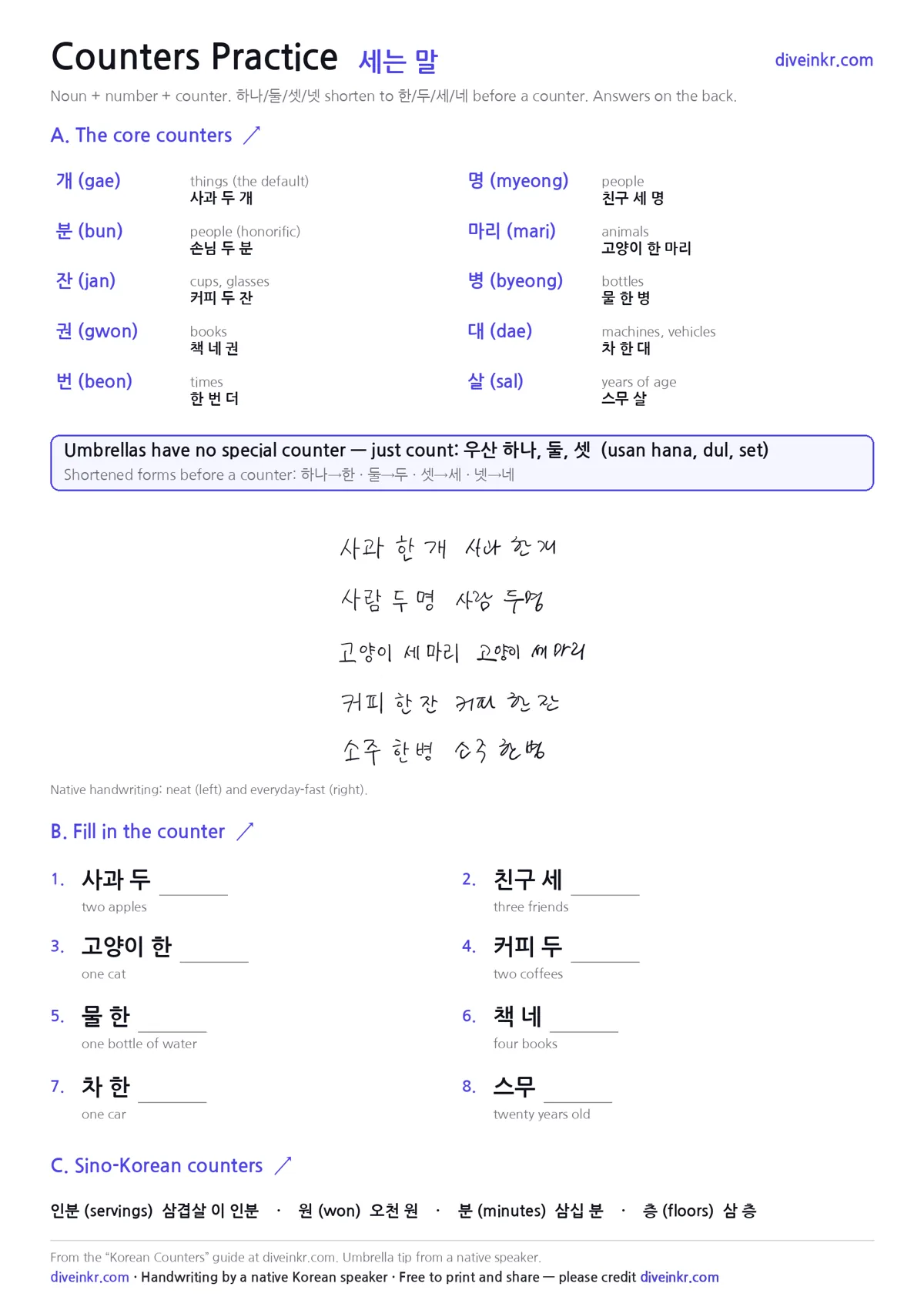
Free to print and share for personal and classroom use — please credit diveinkr.com.
- The ten core counters with an example each, the shortened numbers 한·두·세·네, and the umbrella tip: 우산 하나, 둘, 셋.
- Eight fill-in-the-counter items (사과 두 __, 친구 세 __ …) with answers on page 2.
- Say each full phrase out loud once you have filled it in.
Mini Quiz
2 short questions — about 1 minute
2. Which counter counts animals?
3. If you don't know the right counter for an object, which is the safest fallback?
More printables
- ← Before this: Days and months chart
- Whole set: Numbers, dates and counting and every other sheet on the printables page.
- Start from the basics: Printable Hangul Chart with Native Handwriting · Hangul Tracing Worksheet with Native Handwriting
Part of Korean Grammar Basics — Particles, Tense, and Negation
Part of Essential Korean Vocabulary: Numbers, Days, Months & Colors
Related Knowledge
Learn Next
Counters handle "how many" — next, the vocabulary for "when": the seven days and the planets hiding inside them.
Will you remember this tomorrow?
Save it — your daily review brings it back right before you'd forget. No account needed.