Korean Days and Months Chart (Free PDF)
Written and reviewed by Jun and Jin, native Korean speakers
Published · How we write & review
After this page, you can print a one-page chart of Korean days, months and date phrases and read any date aloud.
10-second answer
The short answer
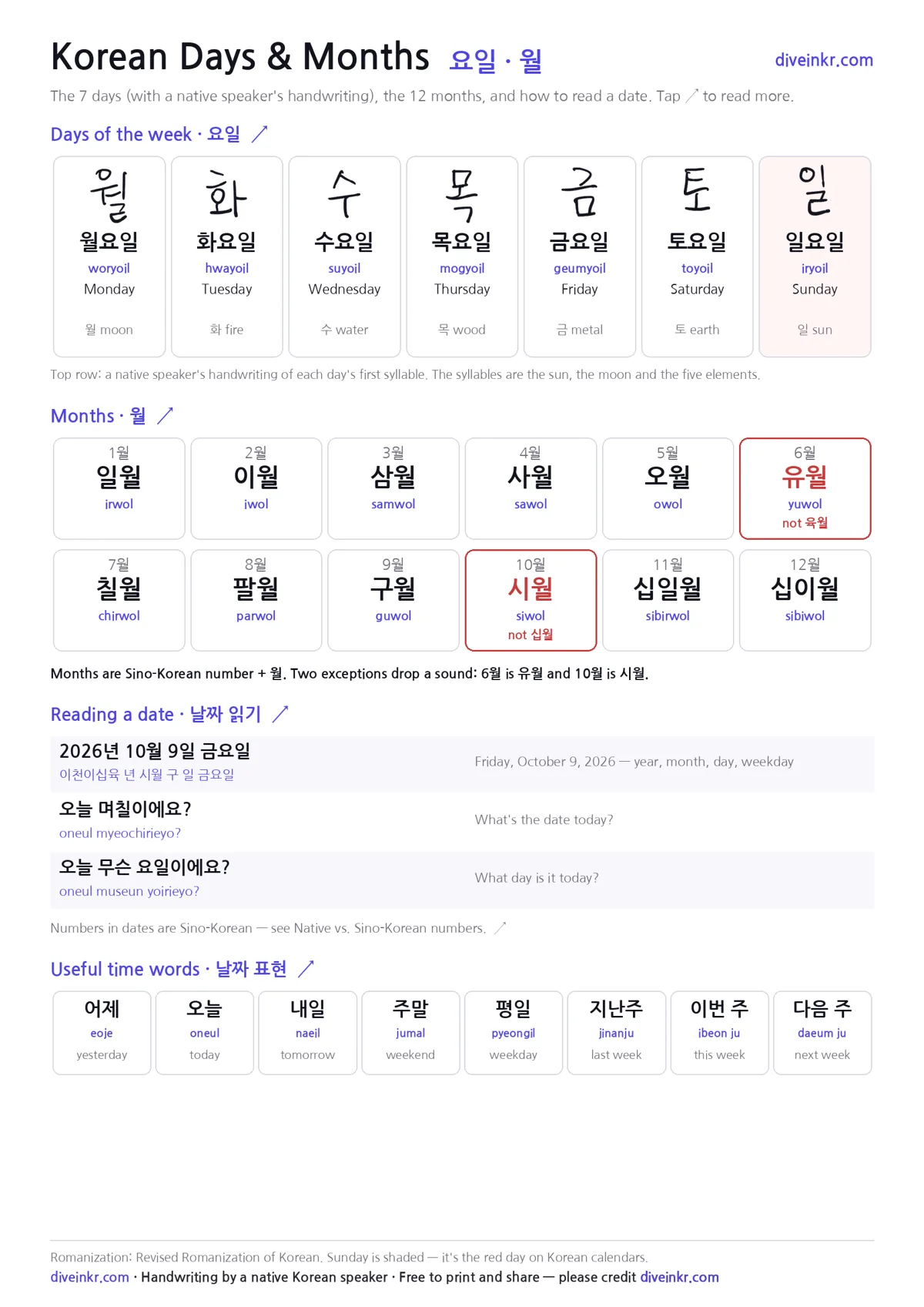
This free one-page PDF covers the Korean calendar: the seven days of the week (월요일 (woryoil) to 일요일 (iryoil)) with a native speaker's handwriting and what each first syllable means, all twelve months — with the two that break the pattern, 유월 (yuwol, June) and 시월 (siwol, October), marked in red — how to read a full date aloud, and everyday time words like 어제 (eoje), 오늘 (oneul), 내일 (naeil) and 다음 주 (daeum ju).
Quick check — did that land?
1. How do you say June in Korean?
Download the Chart
Free to print and share for personal and classroom use — please credit diveinkr.com.
See also: Korean days of the week
How to Use the Chart
- Print it on one A4 sheet (on US Letter, choose "fit to page") and put it next to your calendar or desk, where you'll glance at it every day.
- Make it a 20-second morning habit: say today's full date and weekday out loud, then check yourself against the chart. On the day this page went up, that was 오늘은 10월 5일 월요일이에요.
- Cover the Korean on the month cards and read 1월 to 12월 aloud from the numbers alone. Slow down at the two red cards — that's where learners slip.
- Once a week, write next week's plans in Korean with the time words at the bottom: 다음 주 월요일에…, 주말에….
- Keep the PDF on your phone too: every blue heading links to the full lesson.
오늘은 10월 5일 월요일이에요.
Oneureun siwol oil woryoirieyo.
Today is Monday, October 5.
Read 10월 as 시월 — the calendar prints the number, you say the exception.
Walking Through the Chart
Days of the week. Every day ends in 요일 (yoil, "day of the week"), so the only part you really learn is the first syllable — and that's the one a native speaker wrote by hand at the top of each card. The seven syllables are the sun, the moon and the five elements: 월 moon, 화 fire, 수 water, 목 wood, 금 metal, 토 earth, 일 sun. They come from the traditional East Asian "seven luminaries" (칠요, chiryo): the sun, the moon and the five planets visible to the naked eye, which carry the element names in Korean — 화성 (Mars) is the "fire star," 금성 (Venus) the "metal star." More on Korean days of the week.
Two syllables pull double duty. 월 means both moon and month, which is why it sits in 월요일 and in every month name. 일 means both sun and day, so it ends 일요일 and every date: 9일 is "the 9th."
월요일에 시험이 있어요.
Woryoire siheomi isseoyo.
I have a test on Monday.
토요일에 뭐 해요?
Toyoire mwo haeyo?
What are you doing on Saturday?
Months. A month is a Sino-Korean number plus 월: 일월, 이월, 삼월… up to 십이월. Two break the pattern and are boxed in red. June is 유월, not 육월, and October is 시월, not 십월 — these traditional pronunciations drop the final ㄱ and ㅂ, and Korean spelling follows the sound (Korean Spelling Rules, Article 52). Calendars print 6월 and 10월, so the numbers never warn you. See Korean months and dates.
Reading a date. Korean goes from big to small — year, month, day, then weekday — and every number is Sino-Korean. Year is 년, month is 월, day is 일:
Said aloud, that's 이천이십육 년 시월 구 일 금요일 (icheon isimnyuk nyeon siwol gu il geumyoil). For the numbers themselves, the Korean numbers chart has both systems and when to use each.
몇 월 며칠이에요?
Myeodwol myeochirieyo?
What's the date? (month and day)
제 생일은 6월 17일이에요.
Je saengireun yuwol sipchiririeyo.
My birthday is June 17.
10월 9일은 한글날이에요.
Siwol guireun hangeullarieyo.
October 9 is Hangul Day.
Time words. The bottom row gives eight words you'll use daily: 어제 (yesterday), 오늘 (today), 내일 (tomorrow), 주말 (weekend), 평일 (weekday), 지난주 (last week), 이번 주 (this week) and 다음 주 (next week). Two more worth adding in the margin: 그저께 (geujeokke, the day before yesterday) and 모레 (more, the day after tomorrow).
다음 주 수요일에 시간 있어요?
Daeum ju suyoire sigan isseoyo?
Are you free next Wednesday?
지난주 금요일에 친구를 만났어요.
Jinanju geumyoire chingureul mannasseoyo.
I met a friend last Friday.
평일에는 바빠서 주말에 운동해요.
Pyeongireneun bappaseo jumare undonghaeyo.
I'm busy on weekdays, so I work out on weekends.
Sunday is shaded on the chart for a reason: on Korean calendars, Sundays and public holidays are printed in red — which is why people call a holiday a 빨간 날 ("red day"). The year's red days are listed in Korean public holidays.
Common Learner Mistakes
- 육월 and 십월. The months are 유월 and 시월. But the exception is only for the month names: the 6th of a month is 육 일 (yugil) and the 10th is 십 일 (sibil).
- Writing 몇 일 for "what date." The standard spelling is 며칠, because it's pronounced [며칠], not [며딜] (Korean Spelling Rules, Article 27). 몇 월 is fine, so the full question is 몇 월 며칠이에요?
- Native numbers in dates. Dates always take Sino-Korean numbers: 삼월, not 셋월; 오 일, not 다섯 일.
- English order. "Friday, October 9" becomes 10월 9일 금요일 — weekday last.
- Adding 에 to 오늘, 내일 and 어제. Days and 주말 take 에 (월요일에, 주말에), but these three normally stand alone: 내일 만나요, not 내일에 만나요.
- Spacing. 지난주 is one word, but 이번 주 and 다음 주 are written with a space.
Mini Quiz
1. How do you say June in Korean?
2. What does the 수 in 수요일 (Wednesday) mean?
3. Which is the correct way to write "what date"?
4. In what order do Koreans write a date?
Related Knowledge
Learn Next
The chart shows the months — this page explains the two traps and how to say full dates in conversation.
Will you remember this tomorrow?
Save it — your daily review brings it back right before you'd forget. No account needed.