안 vs 못: Two Ways to Say 'Not' in Korean
Written and reviewed by Jun and Jin, native Korean speakers
Published · Updated · How we write & review
After this page, you can say "I won't" with 안 (an) and "I can't" with 못 (mot), and put each in the right spot — even with 하다 verbs.
10-second answer
The short answer
안 (an) negates a verb as a choice — "don't/doesn't/won't." 못 (mot) negates a verb as an inability — "can't." Both go right before the verb. 안 가요 (an gayo) = "I'm not going (I don't want to)." 못 가요 (mot gayo) = "I can't go (something prevents me)."
Quick check — did that land?
1. You simply don't like spicy food and choose not to eat it. You say:
안 가요는 가지 않는다는 뜻, 못 가요는 갈 수 없다는 뜻이에요.
Side by Side
| Sentence | Meaning | Why |
|---|---|---|
| 안 가요. | I'm not going. | Choice — just don't want to |
| 못 가요. | I can't go. | Inability — sick, busy, blocked, etc. |
| 안 먹어요. | I don't eat (it) / I'm not eating. | Choice — diet, preference, refusal |
| 못 먹어요. | I can't eat (it). | Inability — allergy, too spicy, no time |
See also: What Does 도 Mean in Korean?
Quick Examples
저는 매운 음식을 안 먹어요.
jeoneun maeun eumsigeul an meogeoyo.
I don't eat spicy food.
Personal choice/preference.
저는 매운 음식을 못 먹어요.
jeoneun maeun eumsigeul mot meogeoyo.
I can't eat spicy food.
Physical inability — it's too spicy for them.
오늘 술 안 마셔요.
I'm not drinking today.
Choosing not to.
저 운전 못 해요.
I can't drive.
Doesn't have the skill/license.
안 마셔요 or 못 마셔요? The Non-Alcoholic Beer Test
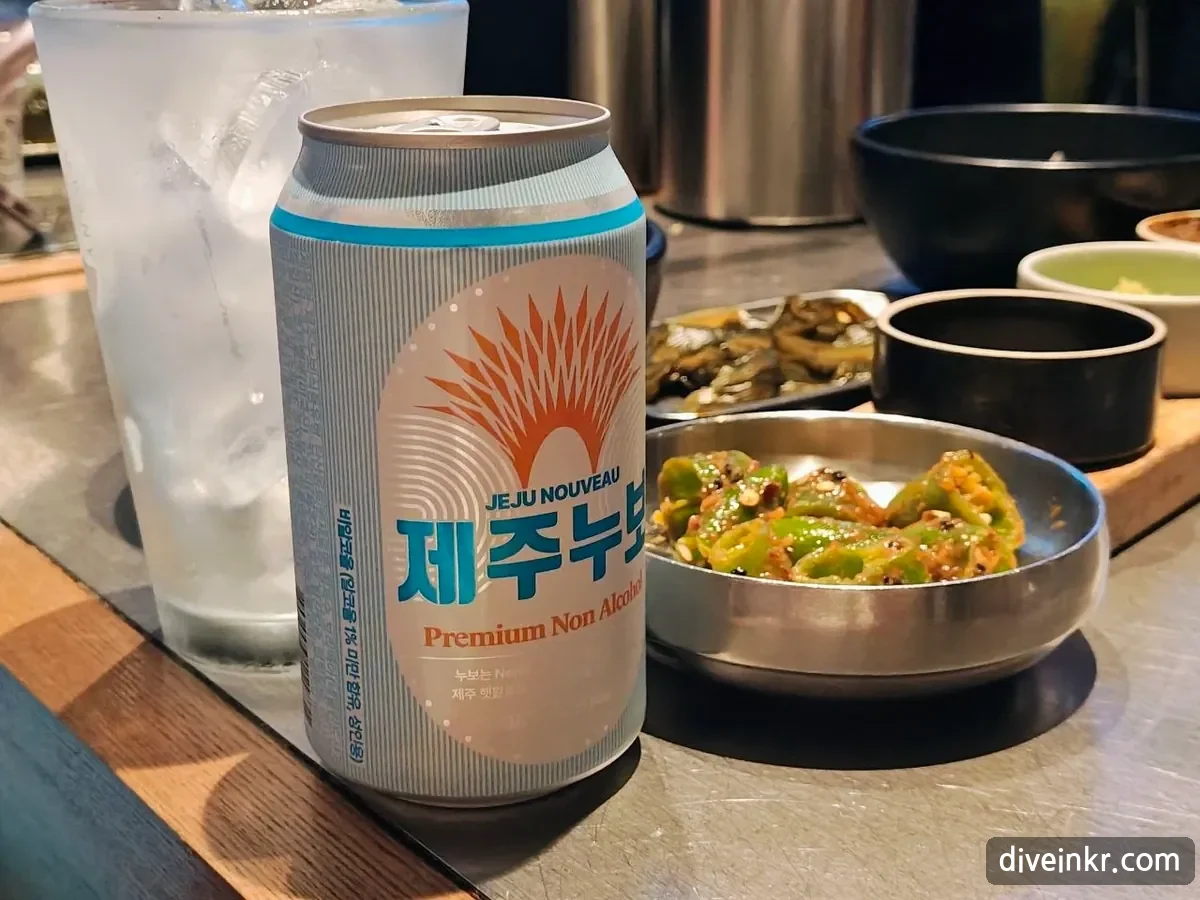
These days many people in Korea choose drinks with very little or no alcohol, like the can in the photo, served at a barbecue restaurant. So when someone pours or offers a drink, the reason you give is what decides between 안 and 못.
안 마셔요 (an masyeoyo) says it's your choice: "I don't drink." 못 마셔요 (mot masyeoyo) says something stops you — you're driving, you're on medication, or alcohol just doesn't agree with you. Either way, you can still join the table: say which one you'll have instead. More on how drinks are shared is in Korean drinking etiquette.
저는 술을 안 마셔요.
jeoneun sureul an masyeoyo.
I don't drink. (my choice)
오늘 운전해야 돼서 못 마셔요.
oneul unjeonhaeya dwaeseo mot masyeoyo.
I have to drive today, so I can't drink.
저는 무알콜 맥주로 할게요.
jeoneun mualkol maekjuro halgeyo.
I'll have a non-alcoholic beer.
In speech most people say 무알콜 맥주 (mualkol maekju). The standard spelling is 무알코올, and on labels 무알코올 and 비알코올 mean different alcohol levels — see Korean drinking etiquette.
Two Positions for Each
Both 안 and 못 have a short form (before the verb) and a long form (attached to the verb stem with -지 않다 / -지 못하다). The short form is far more common in speech.
| Short form | Long form | Meaning |
|---|---|---|
| 안 가요 | 가지 않아요 | not going (choice) |
| 못 가요 | 가지 못해요 | can't go (inability) |
The 하다-Verb Exception
For verbs built on 하다 (to do) + a noun, 안/못 usually slot BETWEEN the noun and 하다, not before the whole verb:
공부 안 해요.
I'm not studying.
NOT 안 공부해요 — 안 goes between 공부 and 해요.
운동 못 해요.
I can't exercise.
Same pattern: noun + 못 + 해요.
Common Mistakes
Mistake #1 — Using 안 when you mean inability
안 결혼해요 ("I'm not getting married" — choice) vs 못 결혼해요 ("I can't get married" — circumstances prevent it). Mixing these changes the whole implied story.
Mistake #2 — Placing 안/못 before a 하다-verb noun compound
안 공부해요 sounds off to natives; 공부 안 해요 is standard.
Mini Quiz
2 short questions — about 1 minute
2. You're allergic to shellfish and physically cannot eat it. You say:
3. How do you say "I'm not studying" (공부하다 = to study)?
Part of Korean Grammar Basics — Particles, Tense, and Negation
Related Knowledge
Learn Next
입니다 vs 이에요: Which 'To Be' Should You Use?
Negation done — next up is the other verb every beginner mixes up: the two faces of 'to be.'
Will you remember this tomorrow?
Save it — your daily review brings it back right before you'd forget. No account needed.