Korean Batchim Chart: The 7 Final Consonant Sounds (Free PDF)
Written and reviewed by Jun and Jin, native Korean speakers
Published · How we write & review
After this page, you can print a one-page chart of the 7 batchim sounds and pronounce any final consonant, single or double, correctly.
10-second answer
The short answer
Korean can write 27 different final consonants (받침, batchim), but at the end of a word or before another consonant they're pronounced as only seven sounds: ㄱ (k), ㄴ (n), ㄷ (t), ㄹ (l), ㅁ (m), ㅂ (p) and ㅇ (ng). So 옷 (ot, "clothes") ends in a t sound and 값 (gap, "price") in a p sound. This free one-page PDF sorts every batchim letter under its sound, with examples, the official exceptions and liaison (연음, yeoneum).
Quick check — did that land?
1. How is 앞 ("front") pronounced on its own?
옷은 [옫], 옷이 [오시]! 꽃은 [꼳], 꽃을 [꼬츨]!
Download the Chart
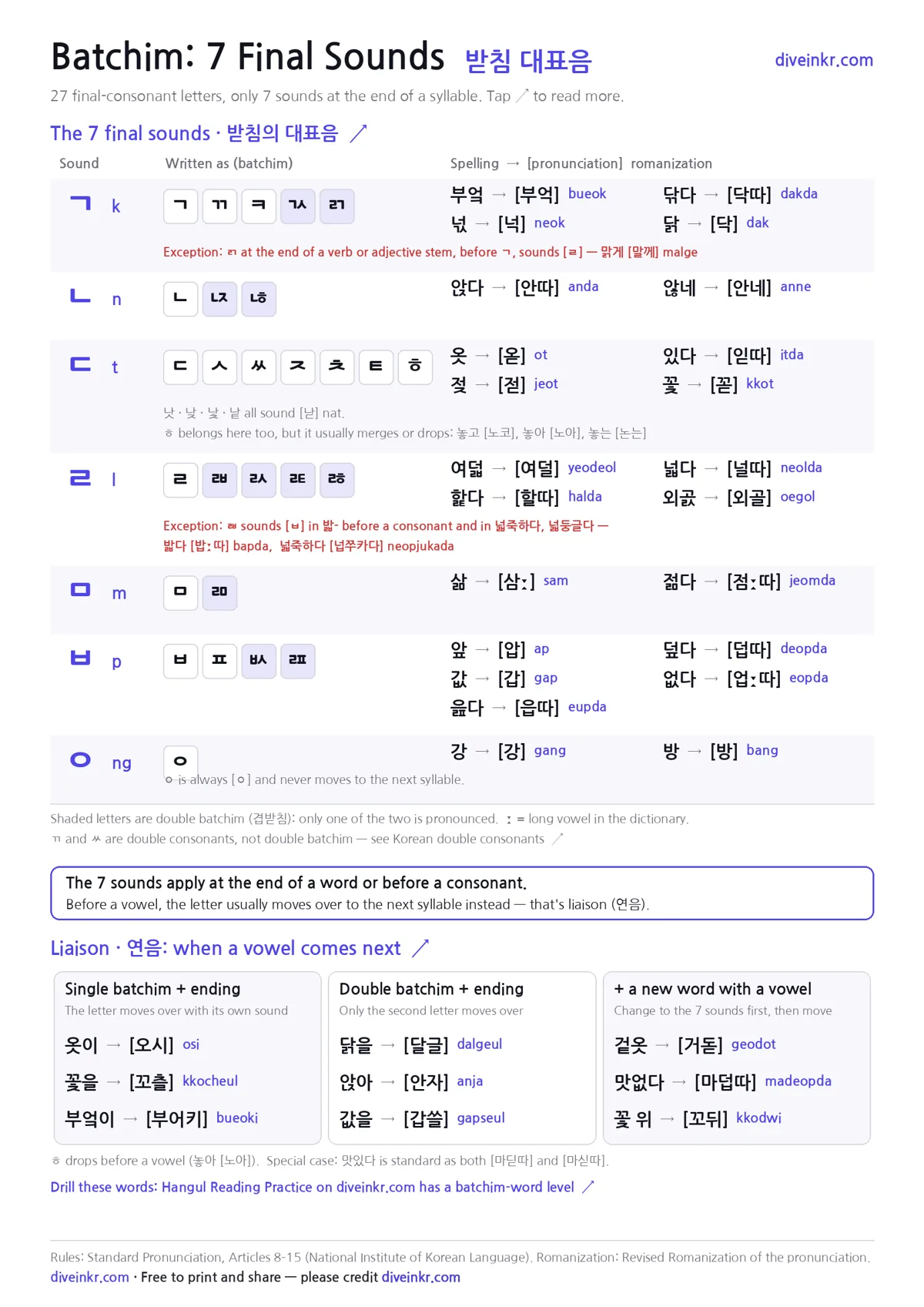
Free to print and share for personal and classroom use — please credit diveinkr.com.
See also: What is 받침 (batchim)?
How to Use the Chart
- Print it on one A4 sheet (on US Letter, choose "fit to page") and keep it next to whatever you're reading.
- Find the batchim letter in the middle column; the big letter at the left of that row is the sound you actually say.
- Cover the [pronunciation] column, read each example aloud, then check. Shaded boxes are double batchim — start with the white ones.
- If a vowel comes right after the batchim, use the liaison section at the bottom instead.
- Drill the same sounds with the batchim-word level of Hangul Reading Practice. New to the idea of a final consonant? Read what batchim is first.
Seven Sounds, 27 Letters
Korean's standard pronunciation rules say it plainly: only ㄱ, ㄴ, ㄷ, ㄹ, ㅁ, ㅂ and ㅇ can be pronounced as a final sound. Any other letter in the batchim slot changes into one of those seven at the end of a word or before a consonant. That's why 낫, 낮, 낯 and 낱 — four different words — all sound the same on their own: [낟].
| Sound | Written as | Examples (spelling → pronunciation) |
|---|---|---|
| ㄱ (k) | ㄱ ㄲ ㅋ ㄳ ㄺ | 부엌 → [부억] (bueok), 닦다 → [닥따] (dakda), 넋 → [넉] (neok), 닭 → [닥] (dak) |
| ㄴ (n) | ㄴ ㄵ ㄶ | 앉다 → [안따] (anda), 않네 → [안네] (anne) |
| ㄷ (t) | ㄷ ㅅ ㅆ ㅈ ㅊ ㅌ ㅎ | 옷 → [옫] (ot), 있다 → [읻따] (itda), 젖 → [젇] (jeot), 꽃 → [꼳] (kkot), 솥 → [솓] (sot) |
| ㄹ (l) | ㄹ ㄼ ㄽ ㄾ ㅀ | 여덟 → [여덜] (yeodeol), 넓다 → [널따] (neolda), 외곬 → [외골] (oegol), 핥다 → [할따] (halda) |
| ㅁ (m) | ㅁ ㄻ | 삶 → [삼ː] (sam), 젊다 → [점ː따] (jeomda) |
| ㅂ (p) | ㅂ ㅍ ㅄ ㄿ | 앞 → [압] (ap), 덮다 → [덥따] (deopda), 값 → [갑] (gap), 없다 → [업ː따] (eopda), 읊다 → [읍따] (eupda) |
| ㅇ (ng) | ㅇ | 강 (gang), 방 (bang) — no change |
The ː marks a long vowel in the dictionary; you can ignore it for now. Romanization follows the pronunciation, not the spelling — 앉다 is anda.
Double batchim (겹받침): eleven batchim combine two different letters — ㄳ ㄵ ㄶ ㄺ ㄻ ㄼ ㄽ ㄾ ㄿ ㅀ ㅄ. At the end of a word or before a consonant, only one of the two is pronounced. For ㄳ, ㄵ, ㄼ, ㄽ, ㄾ and ㅄ you keep the first letter (값 → [갑]); for ㄺ, ㄻ and ㄿ you keep the second (닭 → [닥], 삶 → [삼ː]). In ㄶ and ㅀ the ㄴ or ㄹ stays, and the ㅎ behaves as described next. ㄲ and ㅆ look doubled, but each counts as one letter (a double consonant), not a pair — see Korean double consonants.
ㅎ belongs to the ㄷ group, but you'll rarely hear it that way: next to ㄱ, ㄷ or ㅈ it merges into an aspirated sound (놓고 → [노코], noko), before ㄴ it becomes [ㄴ] (놓는 → [논는], nonneun), and before a vowel it drops (놓아 → [노아], noa).
The two official exceptions
ㄺ at the end of a verb or adjective stem sounds [ㄹ] before ㄱ: 맑다 → [막따] (makda), but 맑게 → [말께] (malge). ㄼ normally keeps ㄹ, but 밟- sounds [밥] before a consonant — 밟다 → [밥ː따] (bapda) — and 넓- sounds [넙] in 넓죽하다 → [넙쭈카다] (neopjukada) and 넓둥글다 → [넙뚱글다] (neopdunggeulda).
When a Vowel Comes Next: Liaison (연음)
The seven sounds apply only at the end of a word or before a consonant. When a particle or ending that starts with a vowel follows — 이, 을, 에, 아/어 — the batchim moves over to fill the empty ㅇ slot and keeps its own sound. This is liaison, and it's the reason 옷 is [옫] but 옷이 is [오시], not [오디].
| What follows | What happens | Examples |
|---|---|---|
| Single batchim + particle or ending | The letter moves over with its own sound | 옷이 → [오시] (osi), 꽃을 → [꼬츨] (kkocheul), 부엌이 → [부어키] (bueoki) |
| Double batchim + particle or ending | The first letter stays; only the second moves over | 닭을 → [달글] (dalgeul), 앉아 → [안자] (anja), 값을 → [갑쓸] (gapseul) |
| A separate word that starts with a vowel | Change to one of the 7 sounds first, then move over | 겉옷 → [거돋] (geodot), 맛없다 → [마덥따] (madeopda), 꽃 위 → [꼬뒤] (kkodwi) |
When the second letter of a double batchim is ㅅ, it moves over as a tense [ㅆ] — hence 값을 [갑쓸]. One common word gets special treatment: 맛있다 ("tasty") is officially correct as both [마딛따] and [마싣따] (maditda / masitda), and [마싣따] is the one you'll hear most. Its opposite, 맛없다, has only one standard pronunciation: [마덥따].
Common Learner Mistakes
- Pronouncing the letter as written at the end of a word. 옷 is not "os" and 꽃 is not "kkoch" — both end in a clipped t: [옫], [꼳].
- Forgetting liaison. The 7-sound rule is for word ends; with a vowel particle the letter moves over. 꽃을 is [꼬츨], not [꼬슬], and 부엌이 is [부어키], not [부어기] — the official rules single out these exact errors.
- Dropping half of a double batchim before a vowel. 닭이 is [달기] and 여덟이 is [여덜비] — both letters are heard. [다기] and [여더리] are officially wrong.
- Guessing which half of a double batchim survives. Learn it by group — ㄺ, ㄻ and ㄿ keep the second letter — and learn the exceptions (맑게, 밟다) as whole words.
- Moving ㅇ across. 강이 stays [강이] — an ㅇ sound can't begin a syllable, so it never moves over.
Pair this printout with the printable Hangul chart, or review every letter in the Korean alphabet.
Mini Quiz
4 short questions — about 2 minute
2. How is 닭 ("chicken") pronounced on its own?
3. How is 옷이 pronounced?
4. Which word is an official exception to the usual double-batchim rule?
5. How is 값을 pronounced?
More printables
- ← Before this: Hangul tracing worksheet
- → Next step: Tricky Sounds worksheet
- Whole set: Hangul: read it, then write it and every other sheet on the printables page.
- Start from the basics: Printable Hangul Chart with Native Handwriting · Hangul Tracing Worksheet with Native Handwriting
Related Knowledge
Learn Next
Korean Double Consonants (ㄲㄸㅃㅆㅉ) Explained
You've seen tense sounds like [안따] and [갑쓸] on the chart — this page explains what those doubled sounds are and how to make them.
Will you remember this tomorrow?
Save it — your daily review brings it back right before you'd forget. No account needed.