많이 먹어 vs 잘 먹어 vs 맛있게 먹어: Three Ways to Say "Enjoy Your Meal"
Written and reviewed by Jun and Jin, native Korean speakers
Published · How we write & review
After this page, you can understand what Koreans really mean by 많이 먹어, 잘 먹어 and 맛있게 먹어 — and answer them politely at the table.
10-second answer
The short answer
많이 먹어 (mani meogeo, "eat a lot"), 잘 먹어 (jal meogeo, "eat well") and 맛있게 먹어 (masitge meogeo, "eat deliciously") look different word for word, but in practice all three mean the same thing: "enjoy your meal." To someone older, the verb changes: 많이 드세요 (mani deuseyo), 맛있게 드세요 (masitge deuseyo). The polite answer, when someone you know has made or served the meal, is 잘 먹겠습니다 (jal meokgetseumnida, "I'll eat well") — said clearly enough for them to hear.
Quick check — did that land?
1. A grandmother puts more food on your plate and says 많이 먹어. What does she mean?
What the Words Say vs. What They Mean
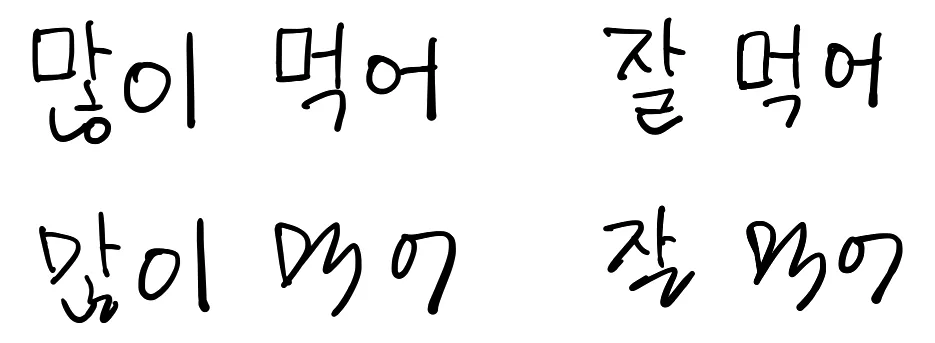
| Phrase | Word for word | What it actually means |
|---|---|---|
| 많이 먹어 (mani meogeo) | Eat a lot | Enjoy your meal — not an instruction about quantity |
| 잘 먹어 (jal meogeo) | Eat well / eat without trouble | Enjoy your meal — the most common of the three |
| 맛있게 먹어 (masitge meogeo) | Eat deliciously | Enjoy your meal |
Taken literally, 많이 먹어 sounds like someone is telling you to eat a large amount. That's not how it lands: to a Korean ear it's the same warm wish as 잘 먹어 or 맛있게 먹어, and any of the three can be read as any of the others. Nobody is measuring how much you eat. The 잘 here is the same "well" you'll meet in 잘 먹겠습니다 and 잘 자 (sleep well) — a word that turns up in so many set phrases that it's worth learning early.
If this reminds you of 밥 먹었어? — "did you eat?" used as a greeting — that's no accident. Both use words about food to show care: they point at the meal, but they're really about the person.
Who Says Which
- 잘 먹어 — the everyday default, and the one you'll hear most.
- 많이 먹어 — heard especially from older people, such as grandparents and older relatives.
- 맛있게 먹어 — just as natural; like the other two, it simply wishes you a good meal.
All three are 반말 (casual speech), so they go to someone younger or someone close: a parent to a child, an older relative to a niece or nephew, one friend to another. For how that line between casual and polite works in general, see 반말 vs 존댓말.
Raising the Politeness: From 먹어 to 잡수세요
Here's the part learners often miss. Adding 요 makes a sentence polite, but eating has its own honorific verb, 드시다, so when you're speaking to someone older the verb itself should change. That's a grammar rule rather than a matter of taste, and it's why the grown-up version of these wishes looks so different.
| Form | Speech level | Who you'd say it to |
|---|---|---|
| 많이 먹어 / 맛있게 먹어 | 반말 (casual) | A child, a younger sibling, a close friend |
| 많이 먹어요 / 맛있게 먹어요 | Polite 요, plain verb 먹다 | Someone around your age you're polite with — not an elder |
| 많이 드세요 / 맛있게 드세요 (mani deuseyo / masitge deuseyo) | Polite 요 + honorific verb 드시다 | Anyone older, a guest, a customer |
| 많이 잡수세요 (mani japsuseyo) | Honorific verb 잡수시다 | An elder you want to show extra respect to |
드세요 is 드시다 in the polite -세요 form (see the -세요 ending), and it isn't only for food: 드시다 is also the honorific for drinking, so 커피 드세요 ("please have some coffee") works too. 잡수시다 is the more deferential of the two honorific verbs for eating. There's even an honorific noun for "meal," 진지, which replaces plain 밥 when you talk to or about an elder — 진지 드세요. The full set of special verbs like this is on Korean honorific verbs.
할머니, 많이 드세요.
halmeoni, mani deuseyo.
Grandma, enjoy your meal.
To an elder, 먹어 becomes 드세요.
맛있게 드세요.
masitge deuseyo.
Enjoy your meal.
Polite and safe with anyone you don't talk casually to.
Your Side: Before and After the Meal
The phrases above are what the person serving you says. Your line comes before you eat: 잘 먹겠습니다 ("I'll eat well") or 맛있게 먹겠습니다 ("I'll eat deliciously") — both work as "thank you for the meal." Once you've finished, the same words go into the past tense.
| When | Polite | Casual (to a friend) |
|---|---|---|
| Before eating | 잘 먹겠습니다 (jal meokgetseumnida) / 맛있게 먹겠습니다 | 잘 먹을게 (jal meogeulge) |
| After eating | 잘 먹었습니다 (jal meogeotseumnida) | 잘 먹었어 (jal meogeosseo) |
The only difference is -겠- ("will") before the meal and -었- ("did") after it — the same past-tense marker explained in Korean past tense.
When it's said matters. You don't say it at a restaurant to the staff. But when it's clear who made or provided the meal, and it's someone you know — or the family or friend of someone you know — the polite thing is to say it clearly and loudly enough for that person to hear. A mumbled 잘 먹겠습니다 into your bowl misses the point; it's meant for them. For the other unwritten rules of the table, see Korean dining etiquette.
Three Scenes at the Table
A: 많이 먹어. B: 네, 잘 먹겠습니다!
A: mani meogeo. B: ne, jal meokgetseumnida!
A: Enjoy your meal. B: Thank you, I will!
At a friend's home, to their parent who cooked. The parent can use 반말 to their child's friend; you answer politely.
A: 맛있게 먹어. B: 잘 먹을게요!
A: masitge meogeo. B: jal meogeulgeyo!
A: Enjoy your meal. B: Thanks, I will!
A parent and a grown child at home: casual from the parent, 요 from the child.
잘 먹었습니다. 정말 맛있었어요.
jal meogeotseumnida. jeongmal masisseosseoyo.
Thank you for the meal. It was really delicious.
After the meal, to the person who cooked.
Common Mistakes
Mistake #1 — Taking 많이 먹어 literally
It's not pressure to finish a big portion. It means "enjoy your meal," exactly like 잘 먹어.
Mistake #2 — Saying 잘 먹겠습니다 too quietly
When someone you know has cooked or provided the meal, say it so they hear it. The phrase is a thank-you addressed to them, not a private ritual.
Mistake #3 — Saying 많이 먹어 (or 먹어요) to someone older
먹어 is casual, and even 먹어요 keeps the plain verb. To an older person, use 많이 드세요 or 맛있게 드세요.
Mistake #4 — Swapping 먹겠습니다 and 먹었습니다
먹겠습니다 ("will eat") opens the meal; 먹었습니다 ("ate") closes it. Saying 잘 먹었습니다 before the first bite sounds like you're already done.
Mini Quiz
1. A grandmother puts more food on your plate and says 많이 먹어. What does she mean?
2. Which of the three phrases do Koreans use most often?
3. Your friend's mother has cooked dinner for you. What should you do before eating?
4. You want to wish your grandfather a good meal. Which is right?
5. You've just finished dinner at a friend's house. What do you say to their parent who cooked?
Related Knowledge
Learn Next
What Does 잘 먹겠습니다 (Jal Meokgetseumnida) Mean?
Now you know what the host says — here's the full story of your reply, before and after the meal.
Will you remember this tomorrow?
Save it — your daily review brings it back right before you'd forget. No account needed.