Batchim Tracing Worksheet: Write Final Consonants (Free PDF)
Written and reviewed by Jun and Jin, native Korean speakers
Published · How we write & review
After this page, you can print a worksheet and practice writing syllables with a final consonant (받침) in a native speaker's handwriting.
10-second answer
The short answer
This free two-page PDF lets you trace and write 받침 (batchim), the final consonant at the bottom of a Korean syllable, in a native speaker's real handwriting. It has 25 syllables grouped by the seven final sounds [k], [n], [t], [l], [m], [p] and [ng], plus a last row where four different final letters all sound like [t]. Each row has a model syllable, three gray ones to trace and empty squares to write on your own.
Quick check — did that land?
1. Where is the batchim written in a syllable?
받침은 글자 아래쪽 받침 소리예요!
Download the Worksheet
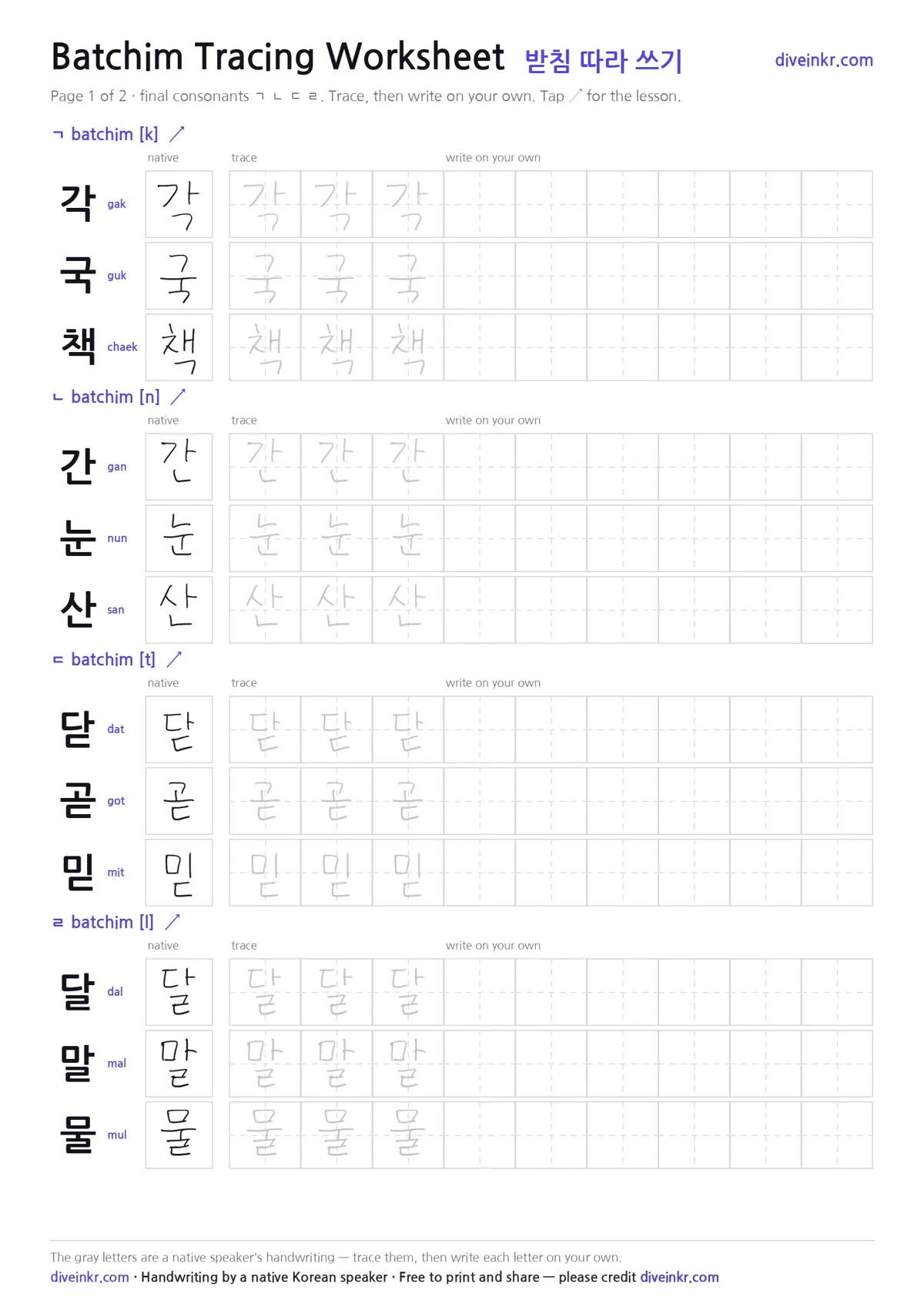
Free to print and share for personal and classroom use — please credit diveinkr.com.
See also: Batchim (받침)
How to Use the Worksheet
- Print both pages on A4 (on US Letter, choose "fit to page") and use a pencil. For repeated practice, slip a copy into a clear sheet protector and write with a dry-erase marker.
- Work across each row: look at the handwritten model in the "native" box, trace the three gray syllables slowly, then write the syllable on your own in the empty squares. Say the sound out loud each time.
- Notice where the batchim sits: it goes in the bottom of the syllable block, under the consonant and vowel — 각, 간, 달 — never beside them.
- Do one group of rows a day, then come back and check yourself with the batchim chart.
Page 1: ㄱ, ㄴ, ㄷ, ㄹ
Page 1 covers four of the seven final sounds. ㄱ is [k] as in 책 (chaek, "book") and 국 (guk, "soup"); ㄴ is [n] as in 산 (san, "mountain") and 눈 (nun, "eye" or "snow"); ㄷ is [t] as in 닫 (dat, from 닫다, "to close"), 곧 (got, "soon") and 믿 (mit, from 믿다, "to believe"); ㄹ is [l] as in 달 (dal, "moon"), 말 (mal, "horse" or "speech") and 물 (mul, "water").
책
chaek
book
ㄱ at the bottom: [k], with the mouth closed and no air released.
물
mul
water
ㄹ at the bottom: the tongue stays on the roof of the mouth.
Page 2: ㅁ, ㅂ, ㅇ and the Other [t] Endings
Page 2 finishes the seven sounds: ㅁ [m] in 감 (gam), 밤 (bam, "night" or "chestnut") and 봄 (bom, "spring"); ㅂ [p] in 갑 (gap), 밥 (bap, "rice" or "meal") and 집 (jip, "house"); and ㅇ [ng] in 강 (gang, "river"), 공 (gong, "ball") and 방 (bang, "room").
The last row is the one to remember. 옷 (ot, "clothes"), 낮 (nat, "daytime"), 꽃 (kkot, "flower") and 밭 (bat, "field") are written with ㅅ, ㅈ, ㅊ and ㅌ at the bottom, but all four sound like [t]. When a syllable ends in one of these, you hear the same closed [t]. See batchim for the full rule.
| Written | Example | Sounds like |
|---|---|---|
| ㄷ | 닫, 곧, 믿 | [t] |
| ㅅ | 옷 | [t] |
| ㅈ | 낮 | [t] |
| ㅊ | 꽃 | [t] |
| ㅌ | 밭 | [t] |
After the Sheet: Try Whole Words
Use the empty squares to write whole words with the same syllables. These words use only syllables from the sheet:
책
chaek
book
물
mul
water
밥
bap
rice, meal
집
jip
house
Common Learner Mistakes
- Writing the batchim beside the vowel. It goes under the consonant and vowel, in the bottom of the block.
- Pronouncing every final consonant by its letter name. ㅅ, ㅈ, ㅊ and ㅌ at the end of a syllable are all [t], not [s], [j], [ch] or [t-h].
- Expecting the same sound before a vowel. The final consonant can move to the next syllable: 옷이 (osi, "clothes" + subject marker) is read [오시], not [옫이]. Tracing the syllables on this sheet is only the first step.
This worksheet doesn't show stroke order. Focus on getting each syllable's shape and proportions right first — the sounds are explained on the batchim page.
Mini Quiz
2 short questions — about 1 minute
2. Which sound do ㅅ, ㅈ, ㅊ and ㅌ make at the end of a syllable?
3. What does 책 (chaek) mean?
More printables
- ← Before this: Korean batchim chart
- → Next step: Double consonant tracing worksheet
- Whole set: Hangul: read it, then write it and every other sheet on the printables page.
- Start from the basics: Printable Hangul Chart with Native Handwriting · Hangul Tracing Worksheet with Native Handwriting
Related Knowledge
Learn Next
Check all seven sounds, with every final consonant sorted under them, on one page.
Will you remember this tomorrow?
Save it — your daily review brings it back right before you'd forget. No account needed.