Double Consonant Tracing Worksheet: ㄲ ㄸ ㅃ ㅆ ㅉ (Free PDF)
Written and reviewed by Jun and Jin, native Korean speakers
Published · How we write & review
After this page, you can print a worksheet and practice writing plain, aspirated and double consonant syllables in a native speaker's handwriting.
10-second answer
The short answer
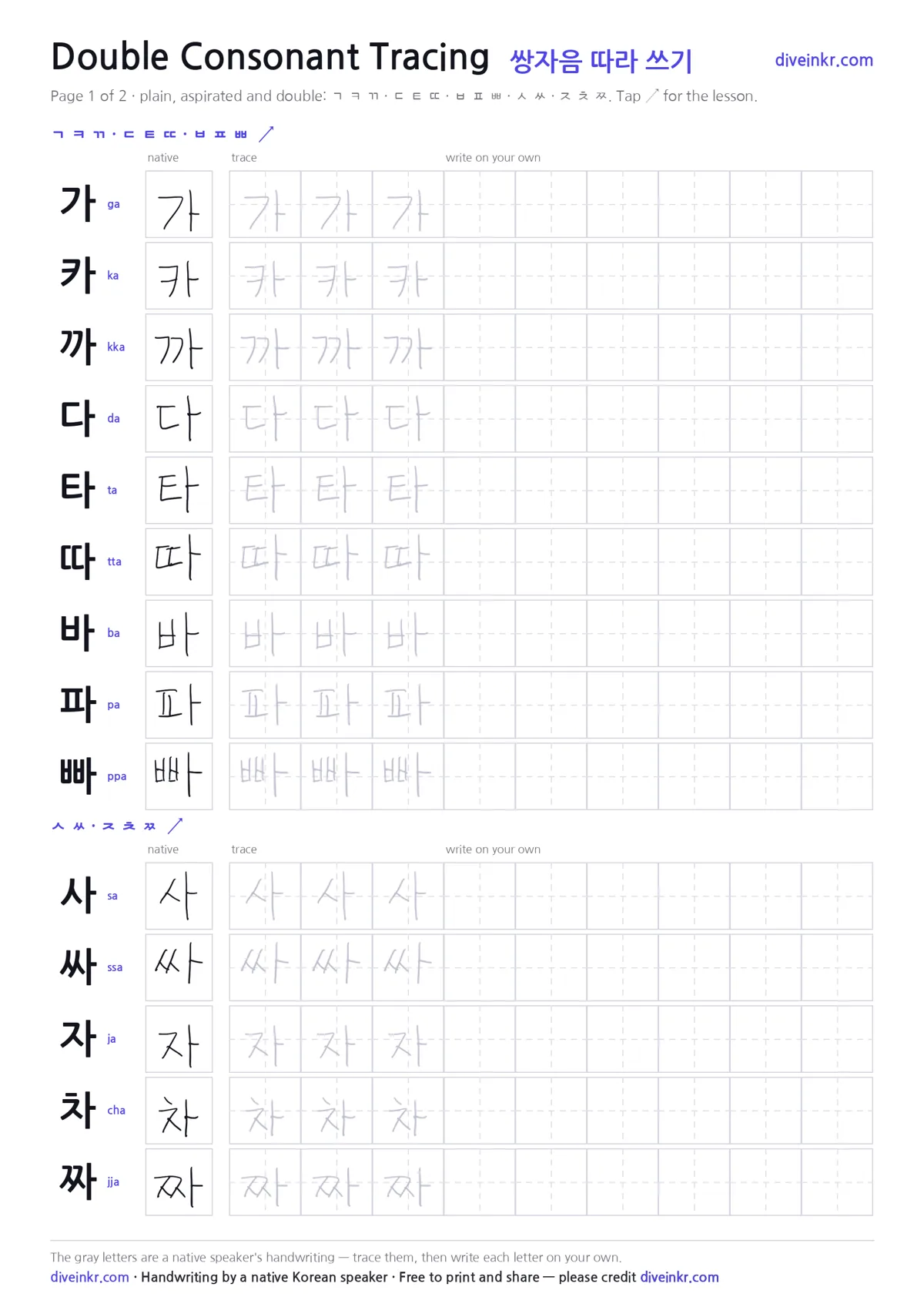
This free two-page PDF lets you trace the Korean double consonants in a native speaker's real handwriting. Page 1 puts each double consonant next to its plain and aspirated partners: 가 카 까, 다 타 따, 바 파 빠, 사 싸 and 자 차 짜. Page 2 has four words to write: 까치, 오빠, 아빠 and 쓰기. Each row has a model, three gray copies to trace and empty squares to write on your own.
Quick check — did that land?
1. Which row has only two syllables because ㅅ has no aspirated partner?
가 카 까, 다 타 따! 쌍자음 따라 쓰기.
Download the Worksheet
Free to print and share for personal and classroom use — please credit diveinkr.com.
See also: Double consonants
How to Use the Worksheet
- Print both pages on A4 (on US Letter, choose "fit to page") and use a pencil. For repeated practice, slip a copy into a clear sheet protector and write with a dry-erase marker.
- Read each group of three together: the plain syllable (가), the aspirated one (카) and the double one (까). Say them out loud. The double one has no puff of air and a tight throat.
- Trace the gray copies, then write each syllable on your own in the empty squares.
- Then move to page 2 and write the four words.
Page 1: Plain, Aspirated, Double
The sheet groups consonants in threes: ㄱ ㅋ ㄲ, ㄷ ㅌ ㄸ, ㅂ ㅍ ㅃ and ㅈ ㅊ ㅉ. ㅅ is the exception: it has a double partner ㅆ but no aspirated one, so that row has two. A double consonant is two copies of the plain letter written side by side in one square, so each half is drawn narrower.
| Plain | Aspirated | Double |
|---|---|---|
| 가 (ga) | 카 (ka) | 까 (kka) |
| 다 (da) | 타 (ta) | 따 (tta) |
| 바 (ba) | 파 (pa) | 빠 (ppa) |
| 사 (sa) | — | 싸 (ssa) |
| 자 (ja) | 차 (cha) | 짜 (jja) |
Double consonants sound tense, not long: the throat tightens and no puff of air follows. The difference changes meaning: 사다 (sada) is "to buy" and 싸다 (ssada) is "to be cheap." See double consonants for how to say them.
Page 2: Four Words
까치
kkachi
magpie
아빠
appa
dad
쓰기
sseugi
writing
The noun of 쓰다, "to write."
Common Learner Mistakes
- Pronouncing the double consonant as a long sound. It is tense — tight throat, no puff of air — not longer.
- Mixing up the aspirated and double sounds. 카 has a strong puff of air; 까 has none.
- Writing the two halves at full width. Draw each half narrower so both fit in one square.
This worksheet doesn't show stroke order. Focus on getting each syllable's shape and proportions right first.
Mini Quiz
2 short questions — about 1 minute
2. What is the difference between 사다 and 싸다?
3. How is the double consonant in 까 pronounced?
More printables
- ← Before this: Batchim tracing worksheet
- → Next step: Tricky Sounds worksheet
- Whole set: Hangul: read it, then write it and every other sheet on the printables page.
- Start from the basics: Printable Hangul Chart with Native Handwriting · Hangul Tracing Worksheet with Native Handwriting
Related Knowledge
Learn Next
Next, practice the final consonants at the bottom of a syllable.
Will you remember this tomorrow?
Save it — your daily review brings it back right before you'd forget. No account needed.