Korean Greetings Tracing Worksheet: 12 Everyday Phrases (Free PDF)
Written and reviewed by Jun and Jin, native Korean speakers
Published · How we write & review
After this page, you can print a worksheet and practice writing 12 everyday Korean greetings and polite phrases in a native speaker's handwriting.
10-second answer
The short answer
This free two-page PDF lets you trace and write 12 everyday Korean phrases in a native speaker's real handwriting: 안녕하세요 (annyeonghaseyo), 감사합니다 (gamsahamnida), 미안해요 (mianhaeyo), 잘 부탁드립니다 (jal butakdeurimnida) and more. Each phrase has a handwritten model, a gray copy to trace twice and a line to write on your own.
Quick check — did that land?
1. What do you say to someone who is leaving?
인사말, 이 대화 그대로 따라 해 보세요!
Download the Worksheet
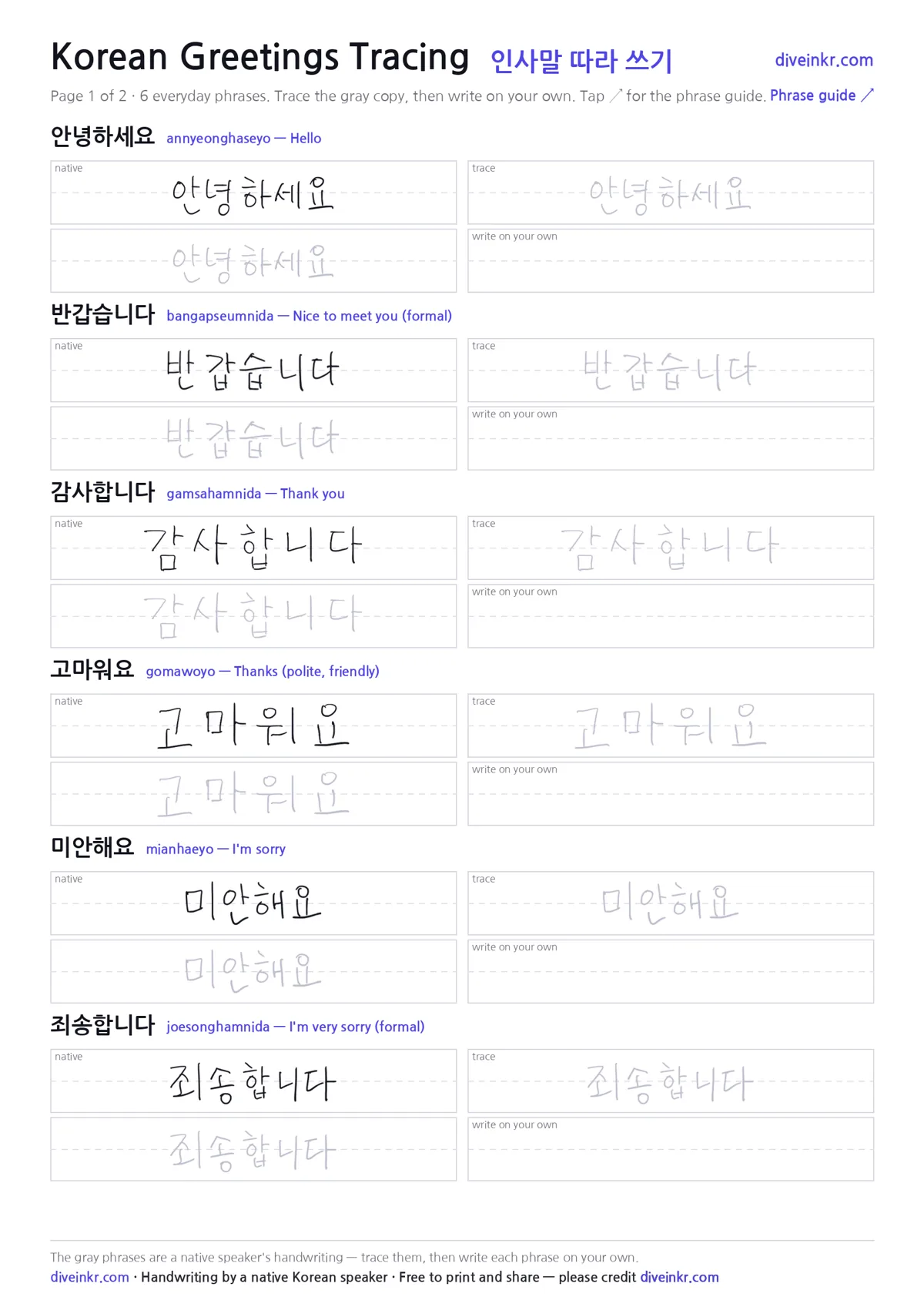
Free to print and share for personal and classroom use — please credit diveinkr.com.
See also: 안녕하세요
How to Use the Worksheet
- Print both pages on A4 (on US Letter, choose "fit to page") and use a pencil. For repeated practice, slip a copy into a clear sheet protector and write with a dry-erase marker.
- For each phrase: read the handwritten model, say it out loud, trace the gray copies, then write the phrase on your own in the empty line.
- Write one syllable block at a time. Keep the blocks the same size and leave a small gap between words, as in 잘 부탁드립니다.
- Check what each phrase means and when to use it in our greetings cheat sheet.
Page 1: Meeting, Thanking, Apologizing
Page 1 has the phrases you need on the first day: 안녕하세요 (hello), 반갑습니다 (nice to meet you), 감사합니다 and 고마워요 (thank you), and 미안해요 and 죄송합니다 (sorry). The endings show how polite each phrase is: -습니다/-ㅂ니다 is the most formal, -요 is polite and friendly. See 안녕하세요 and thank you in Korean for when to use each.
안녕하세요.
annyeonghaseyo.
Hello.
Works at any time of day.
감사합니다.
gamsahamnida.
Thank you.
Safe with anyone.
Page 2: Asking, Welcoming, Saying Goodbye
Page 2 has 잘 부탁드립니다 (jal butakdeurimnida), a set phrase for the end of a self-introduction, 어서 오세요 (welcome), 안녕히 가세요 and 안녕히 계세요 (goodbye), 아니에요 (it's nothing) and 이따 봐 (see you later). The two goodbyes depend on who leaves: 안녕히 가세요 is said to the person who is leaving, and 안녕히 계세요 to the person who stays.
| Phrase | Said to | Meaning |
|---|---|---|
| 안녕히 가세요 | The person leaving | Goodbye |
| 안녕히 계세요 | The person staying | Goodbye |
| 이따 봐 | A close friend | See you later |
Common Learner Mistakes
- Using the casual form with strangers. 고마워 and 미안해 are for close friends; use 고마워요, 감사합니다, 미안해요 or 죄송합니다 with everyone else.
- Mixing up the two goodbyes. Use 가세요 for the person leaving and 계세요 for the person staying.
- Writing the syllables too far apart. Each syllable is one block; keep a clear gap only between words.
This worksheet doesn't show stroke order. Focus on getting each syllable's shape and proportions right first.
Mini Quiz
2 short questions — about 1 minute
2. Which phrase is the most formal way to say "thank you"?
3. Which phrase usually ends a self-introduction?
More printables
- ← Before this: Korean greetings cheat sheet
- → Next step: Korean menu words chart
- Whole set: Everyday phrases and grammar and every other sheet on the printables page.
- Start from the basics: Printable Hangul Chart with Native Handwriting · Hangul Tracing Worksheet with Native Handwriting
Related Knowledge
Learn Next
See every greeting with its formal, polite and casual versions on one page.
Will you remember this tomorrow?
Save it — your daily review brings it back right before you'd forget. No account needed.