Korean Greetings Cheat Sheet: Formal, Polite and Casual (Free PDF)
Written and reviewed by Jun and Jin, native Korean speakers
Published · How we write & review
After this page, you can print a two-page sheet of everyday Korean greetings and pick the right one for the person and the moment.
10-second answer
The short answer
This free two-page PDF puts everyday Korean greetings on one sheet, sorted by situation and by level: formal, polite and casual (반말, banmal). It covers hello (안녕하세요, annyeonghaseyo), goodbye (안녕히 가세요, annyeonghi gaseyo, to someone leaving; 안녕히 계세요, annyeonghi gyeseyo, to someone staying), thank you, sorry, see you later, good night, good luck and Happy New Year — each with romanization and a note on who to say it to.
Quick check — did that land?
1. You're leaving a shop. What do you say to the staff?
Download the Cheat Sheet
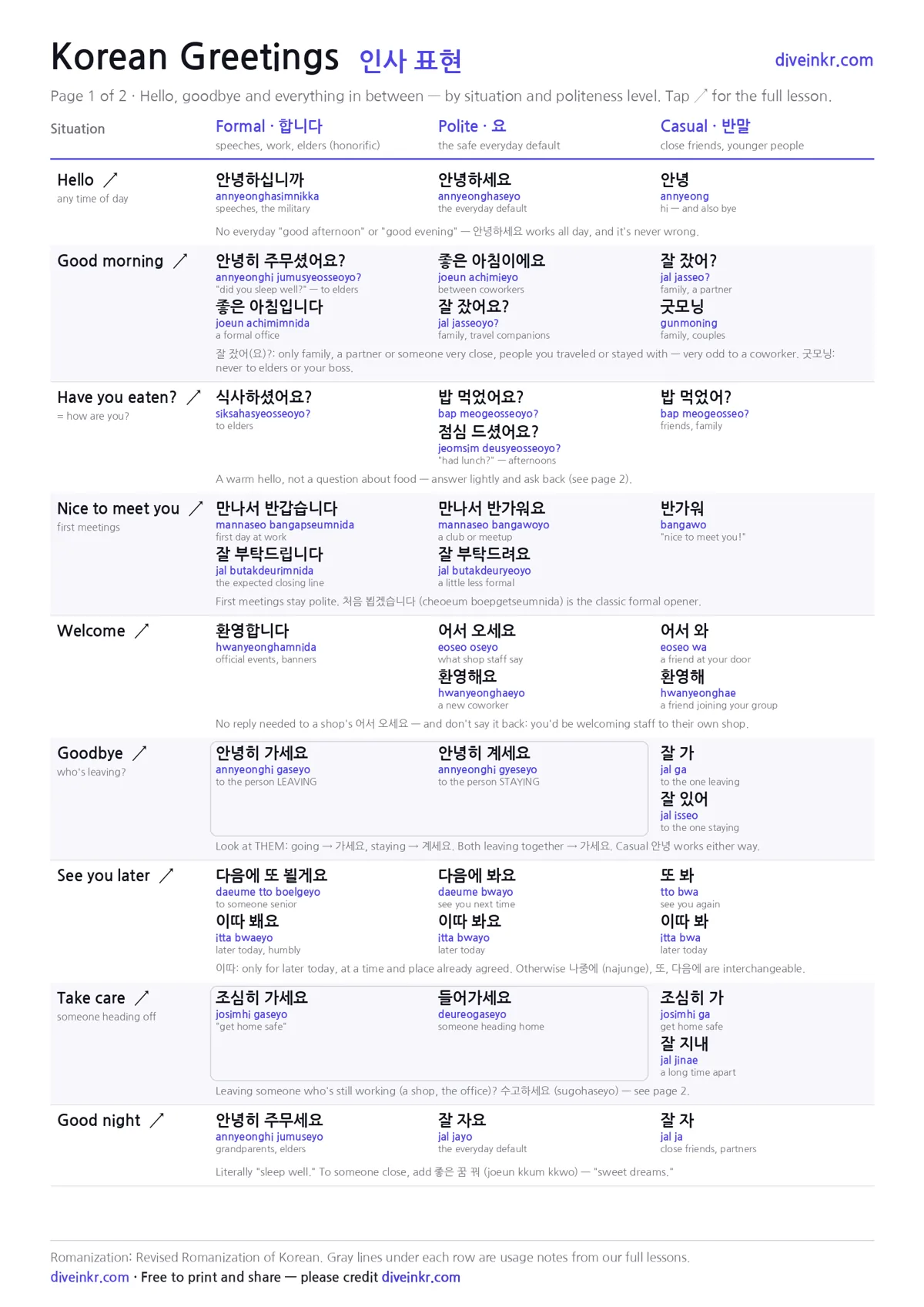
Free to print and share for personal and classroom use — please credit diveinkr.com.
See also: 안녕하세요 (annyeonghaseyo)
How to Use the Cheat Sheet
- Print both pages on A4 (on US Letter, choose "fit to page"). Page 1 is meeting and parting; page 2 is thanks, apologies, wishes and how to answer.
- Read across a row: the same greeting changes with the person you're talking to. The gray line under each row is the rule that decides it.
- Start with the middle column — the polite 요 (yo) forms are the safe default with anyone you don't know well.
- Tap a situation's name in the PDF to open its full lesson.
Three Columns: Formal, Polite, Casual
Korean scales a greeting by relationship, so every row has three versions. The split is the one explained on 반말 vs 존댓말: polite speech usually adds 요 (yo) or a formal ending that casual speech drops.
| Column | What it sounds like | Who gets it |
|---|---|---|
| Formal | -ㅂ니다 / -습니다 (-mnida / -seumnida) endings and honorific verbs such as 주무시다 (jumusida, to sleep) | Speeches, formal workplaces, customers, grandparents and other elders |
| Polite | -요 (-yo) endings: 안녕하세요 (annyeonghaseyo), 고마워요 (gomawoyo) | The safe default: strangers, staff, coworkers, anyone older |
| Casual (반말, banmal) | No 요: 안녕 (annyeong), 고마워 (gomawo) | Close friends your age, younger people, children |
When unsure, go one level more polite. Overshooting never offends; undershooting — 고마워 (gomawo) to a taxi driver — is the direction that stings. More on this in 감사합니다 vs 고마워.
Page 1: Meeting and Parting
Korean greets the person, not the clock. 안녕하세요 (annyeonghaseyo) covers morning, afternoon and evening, so there's no "good evening" row; good afternoon explains why 좋은 오후 되세요 (joeun ohu doeseyo) is a sign-off, not a hello. The formal 안녕하십니까 (annyeonghasimnikka) belongs to speeches and the military, and casual 안녕 (annyeong) means both hi and bye.
Mornings are trickier. 좋은 아침이에요 (joeun achimieyo) works between coworkers, and children greet parents with 안녕히 주무셨어요? (annyeonghi jumusyeosseoyo?). But 잘 잤어요? (jal jasseoyo?, "did you sleep well?") is only for family, a partner or someone very close, or people you've traveled or stayed with — to a coworker it sounds very odd (good morning in Korean).
| Situation | Safe polite choice | Watch out for |
|---|---|---|
| Have you eaten? | 밥 먹었어요? (bap meogeosseoyo?) | Means "how are you?" — answer lightly, ask back (밥 먹었어?) |
| Nice to meet you | 만나서 반가워요 (mannaseo bangawoyo) | Casual: 반가워 (bangawo). At work, 만나서 반갑습니다 (mannaseo bangapseumnida) and 잘 부탁드립니다 (jal butakdeurimnida) — see introducing yourself |
| Welcome (shop staff) | 어서 오세요 (eoseo oseyo) | No reply needed (어서 오세요); 환영합니다 (hwanyeonghamnida) is for official events and banners (welcome) |
| See you later | 다음에 봐요 (daeume bwayo) | 이따 봐요 (itta bwayo) only for later today, at an agreed time and place (see you later) |
| Take care | 조심히 가세요 (josimhi gaseyo) | Said to the person going home (take care) |
| Good night | 잘 자요 (jal jayo) | To grandparents: 안녕히 주무세요 (annyeonghi jumuseyo) (good night) |
The goodbye row gets its own box because the choice isn't about politeness. Look at the other person: if they're leaving, say 안녕히 가세요 (annyeonghi gaseyo, "go in peace"); if they're staying, say 안녕히 계세요 (annyeonghi gyeseyo, "stay in peace"). Both leaving together? 안녕히 가세요. The full rule is on 안녕히 가세요 vs 안녕히 계세요, and more ways to part are in goodbye in Korean.
Page 2: Thanks, Apologies and Wishes
Thank you and sorry run on the same ladder: 감사합니다 (gamsahamnida) and 죄송합니다 (joesonghamnida) at the top, 고마워요 (gomawoyo) and 미안해요 (mianhaeyo) in the middle, and 고마워 (gomawo) and 미안해 (mianhae) for close friends. For replies, 천만에요 (cheonmaneyo) is correct but textbook-stiff — natives mostly say 아니에요 (anieyo) (you're welcome).
The wishes depend on timing. Before an exam or interview, Koreans cheer the effort with 화이팅 (hwaiting); 행운을 빕니다 (haenguneul bimnida, "I wish you luck") is for writing and real chance (good luck in Korean). After the work, 수고했어요 (sugohaesseoyo) thanks the effort itself. After a result, name the occasion and add 축하해요 (chukhahaeyo) — see congratulations. And for the new year, it's 새해 복 많이 받으세요 (saehae bok mani badeuseyo), said on January 1 and again at Seollal.
도와주셔서 감사합니다.
dowajusyeoseo gamsahamnida.
Thank you for helping me.
The formal thank-you as a full sentence.
늦어서 죄송합니다.
neujeoseo joesonghamnida.
I'm sorry for being late.
Work or formal — often with a bow.
저 먼저 갈게요. 수고하세요.
jeo meonjeo galgeyo. sugohaseyo.
I'm heading out first. Take care (keep up the good work).
Leaving people who are still working.
Page 2 ends with how to answer six common greetings. Whatever you say, a light nod (목례, mongnye) makes it sound warmer, especially with anyone older or senior.
Common Learner Mistakes
- 안녕히 가세요 to shop staff as you walk out. They're staying, so it's 안녕히 계세요.
- 잘 잤어요? to a coworker. Use 안녕하세요 or 좋은 아침이에요 instead.
- Saying 어서 오세요 back to the staff — it welcomes them to their own shop.
- 고마워 or 미안해 to a stranger, boss or elder. Casual thanks and apologies aimed upward read as rude, not warm.
- 이따 봐요 for next week. 이따 means later today; otherwise it's 다음에 봐요.
- 저는 잘 주무셨어요 (jeoneun jal jumusyeosseoyo). The honorific 주무시다 is never for your own sleep — answer 잘 잤어요.
- 행복한 새해 (haengbokan saehae) for "Happy New Year." The set phrase is 새해 복 많이 받으세요.
Next printout: the Korean numbers chart, for prices, ages and times.
Mini Quiz
3 short questions — about 2 minute
2. Which greeting works at any time of day?
3. Who can you naturally ask 잘 잤어요? in the morning?
4. A friend has an exam tomorrow. What's the most natural cheer?
More printables
- → Next step: Korean menu words chart
- Whole set: Everyday phrases and grammar and every other sheet on the printables page.
- Start from the basics: Printable Hangul Chart with Native Handwriting · Hangul Tracing Worksheet with Native Handwriting
Part of Korean Greetings & Everyday Politeness — The Survival Set
Related Knowledge
2 more related
Learn Next
반말 vs 존댓말: Casual vs Polite Korean
Every row on the sheet changes with the politeness level — this page explains who gets which level, and when it's okay to switch.
Will you remember this tomorrow?
Save it — your daily review brings it back right before you'd forget. No account needed.