Korean Menu Words: 70 Words from Real Menus and Food Signs (Free PDF)
Written and reviewed by Jun and Jin, native Korean speakers
Published · How we write & review
After this page, you can read the headings, sizes, cooking words, drinks and price labels on a real Korean menu.
10-second answer
The short answer
This free two-page PDF collects 70 words you meet on real Korean menus and food signs. Page one covers menu headings and sizes, such as 곱빼기 (gopppaegi, a double portion) and 인분 (inbun, servings), plus cooking words like 구이 (gui, grilled) and 볶음 (bokkeum, stir-fried). Page two lists common dishes, drinks and price labels such as 원산지 (wonsanji, place of origin) and 품절 (pumjeol, sold out). Every word comes with romanization and a short English meaning.
Quick check — did that land?
1. What does 곱빼기 on a menu mean?
곱빼기 주세요! 2인분 주세요! Learn portion sizes, servings, and sold-out signs.
Download the Chart
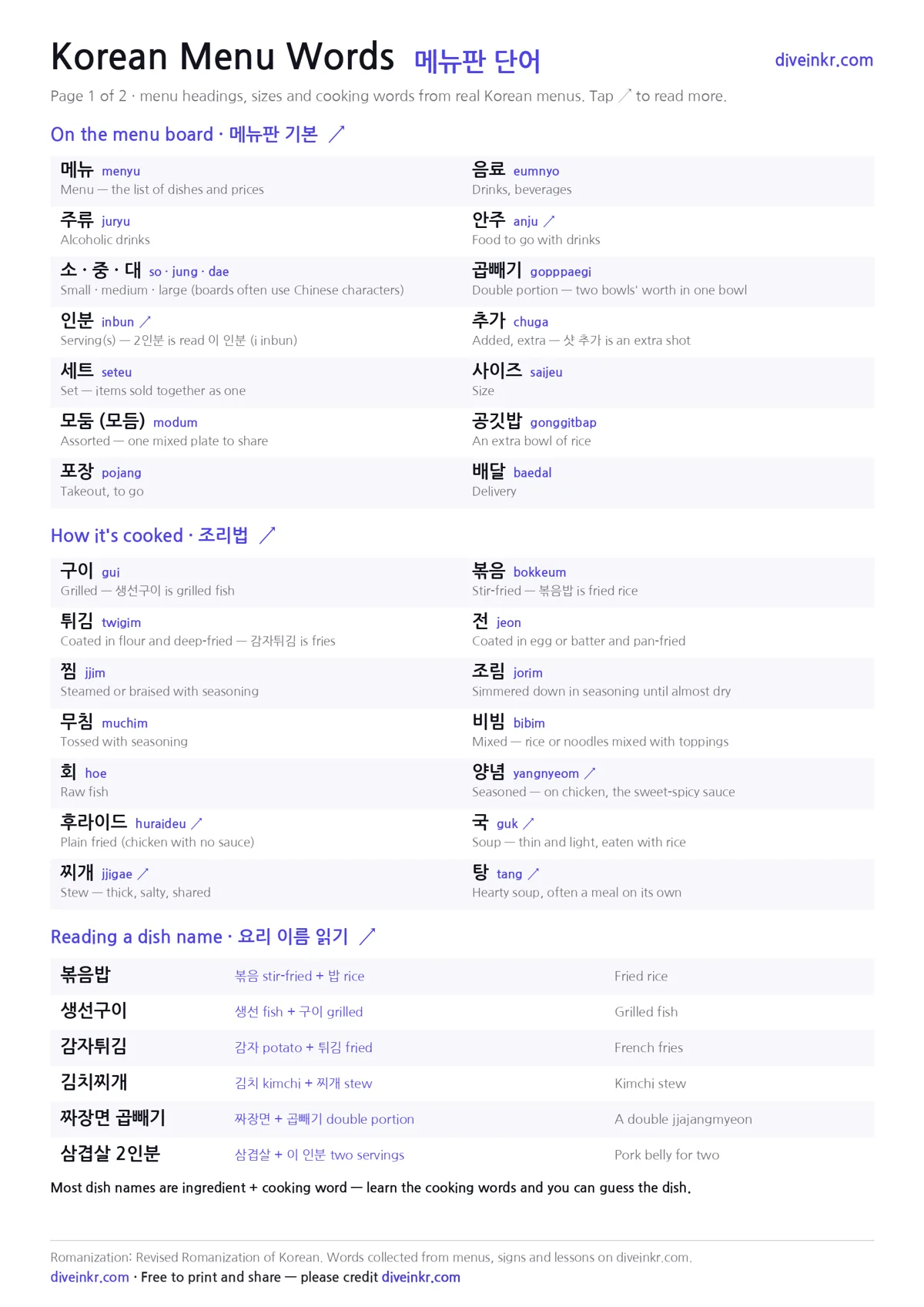
Free to print and share for personal and classroom use — please credit diveinkr.com.
See also: How to order coffee in Korean
How to Use the Chart
- Print both pages on A4 (on US Letter, choose "fit to page"). If you only print one, make it page 1: the size and cooking words turn up on almost every menu, whatever the restaurant sells.
- Before you go out, cover the English column and test yourself on the cooking words. They're the part of a dish name you can reuse everywhere.
- At the restaurant, find one word from the chart on the menu board before you order. Then order with the lines at the bottom of page 2, and point if you need to — ordering food in Korean has the full routine.
- Keep page 2 for cafés and bars: the drinks block pairs with how to order coffee in Korean.
Menu Headings and Sizes
The top of page 1 is the vocabulary around the dishes rather than the dishes themselves: how much you get, whether it's to go, and which part of the menu you're looking at. Look for section headings like 음료 (eumnyo, drinks) and 주류 (juryu, alcoholic drinks); a bar will also have a long 안주 (anju) section — food meant to go with the drinks.
| Word | Romanization | What it tells you |
|---|---|---|
| 소 · 중 · 대 | so · jung · dae | Small, medium, large. Chinese-style restaurants often print them as 小 · 中 · 大, read the same way |
| 곱빼기 | gopppaegi | A double portion served in one bowl, usually for noodle and rice dishes |
| 인분 | inbun | Servings — 삼겹살 2인분 is two servings of pork belly |
| 추가 | chuga | Something added — 샷 추가 is an extra espresso shot |
| 공깃밥 | gonggitbap | An extra bowl of rice |
| 포장 · 배달 | pojang · baedal | Takeout · delivery |
인분 is counted with Sino-Korean numbers, so 2인분 is read 이 인분 (i inbun), not 두 인분 — see Korean counters. On delivery apps, 곱빼기 usually costs 1,000–2,000 won more; ordering food delivery in Korea has the rest of the app vocabulary.
삼겹살 이 인분 주세요.
samgyeopsal i inbun juseyo.
Two servings of samgyeopsal, please.
The standard order at a grill restaurant. More on the dish in 삼겹살 (samgyeopsal).
짜장면 곱빼기 하나 주세요.
jjajangmyeon gopppaegi hana juseyo.
One large jjajangmyeon, please.
샷 추가해 주세요.
syat chugahae juseyo.
Please add an extra shot.
Cooking Words: Read the End of the Dish Name
Most Korean dish names are built from an ingredient followed by how it's cooked. Once you know the cooking word, you can guess dishes you've never seen: anything ending in 구이 (gui) is grilled, anything ending in 볶음 (bokkeum) is stir-fried. Our anju page takes apart a whole pub menu this way.
| On the menu | The pieces | What you get |
|---|---|---|
| 볶음밥 (bokkeumbap) | 볶음 stir-fried + 밥 rice | Fried rice |
| 생선구이 (saengseon-gui) | 생선 fish + 구이 grilled | Grilled fish |
| 감자튀김 (gamja-twigim) | 감자 potato + 튀김 coated and deep-fried | French fries |
| 골뱅이무침 (golbaengi-muchim) | 골뱅이 sea snail + 무침 tossed with seasoning | Spicy sea-snail salad |
| 김치찌개 (gimchi-jjigae) | 김치 kimchi + 찌개 stew | Kimchi stew |
Two cooking words on the chart are less obvious. 찜 (jjim) is seasoned meat or vegetables steamed, or simmered with only a little broth. 조림 (jorim) is food simmered in seasoning until almost no liquid is left, as in 장조림 (jangjorim), beef simmered down in soy sauce. On chicken menus, 양념 (yangnyeom) means the sweet-spicy sauced chicken and 후라이드 (huraideu) the plain fried one — more in 치맥 (chimaek).
The three soup words mean different things at the table: 국 (guk) is a light soup that goes with rice, 찌개 (jjigae) a thick, salty stew for sharing, and 탕 (tang) a hearty soup that's often a meal by itself. See 찌개 vs 국 vs 탕.
Drinks: Iced, Hot and by the Glass
At a café, the first choice is temperature: 아이스 (aiseu, iced) or 따뜻한 (ttatteutan, hot — literally "warm"). Korean cafés generally expect you to say which, and the short forms 아아 (a-a) and 뜨아 (tteu-a) are understood everywhere. At a bar, drinks are counted with 잔 (jan) for glasses and 병 (byeong) for bottles.
아이스 아메리카노 한 잔이요.
aiseu amerikano han janiyo.
One iced Americano, please.
생맥주 두 잔 주세요.
saengmaekju du jan juseyo.
Two draft beers, please.
소주 한 병 주세요.
soju han byeong juseyo.
One bottle of soju, please.
Everything about the drink itself is on 소주 (soju).
Prices and Labels
The last block on page 2 is the small print. 가격 (gagyeok) is price, and prices are in 원 (won), read with Sino-Korean numbers; if there's no price, ask with 얼마예요? (eolmayeyo?). Many restaurants also post a board of 원산지 (wonsanji), where the ingredients come from: 국내산 (gungnaesan) or 국산 (guksan) means domestic, and country names add 산 — 미국산 (miguksan) from the U.S., 중국산 (jungguksan) from China. You'll also hear 외국산 (oeguksan, "foreign-made") and 수입산 (suipsan, "imported"), but on a restaurant's origin board those words alone aren't enough: the law requires the actual country, so an imported ingredient reads like 돼지고기(미국산), and a mix like 국내산과 미국산 섞음 ("domestic and U.S., mixed").
Watch for 품절 (pumjeol), sold out, stuck over an item; 추천 (chucheon), recommended; and 신메뉴 (sinmenyu), a new item. On a sign outside, 전문점 (jeonmunjeom) means a place that specializes in one thing — more in reading Korean street signs.
Common Learner Mistakes
- Counting portions with 명. 명 counts people and 인분 counts servings: 삼겹살 이 인분, not 삼겹살 두 명.
- Reading 2인분 with a native number. 인분 takes Sino-Korean numbers: 이 인분, 삼 인분.
- Ordering 곱빼기 when you want two dishes. It's one bowl holding a double portion — for two separate bowls, say 두 개.
- Thinking 모듬 and 모둠 are different dishes. Menus usually write 모듬, but the standard spelling is 모둠; both mean an assorted plate.
- Saying just "아메리카노" and expecting it hot. Say 아이스 or 따뜻한, or staff will ask.
- Mixing up 치맥 and 소맥. 치맥 (chimaek) is chicken with beer; 소맥 (somaek) is soju mixed with beer.
Once you can read the menu, the table has its own manners — Korean dining etiquette covers what happens after the food arrives.
Mini Quiz
3 short questions — about 2 minute
2. How do you read 삼겹살 2인분?
3. A dish ends in 구이. How is it cooked?
4. A sign next to a dish says 품절. What does it mean?
More printables
- ← Before this: Korean greetings cheat sheet
- → Next step: Self-Introduction Card
- Whole set: Everyday phrases and grammar and every other sheet on the printables page.
- Start from the basics: Printable Hangul Chart with Native Handwriting · Hangul Tracing Worksheet with Native Handwriting
Part of Korean Phrases for Travelers
Related Knowledge
1 more related
Learn Next
The chart helps you read the menu — this page gives you the lines to order from it, from getting a table to paying.
Will you remember this tomorrow?
Save it — your daily review brings it back right before you'd forget. No account needed.