Korean Numbers Tracing Worksheet: 1–10 in Both Systems (Free PDF)
Written and reviewed by Jun and Jin, native Korean speakers
Published · How we write & review
After this page, you can print a worksheet and practice writing the Korean numbers 1–10 in both systems, in a native speaker's handwriting.
10-second answer
The short answer
This free two-page PDF lets you trace and write the Korean numbers 1–10 in a native speaker's real handwriting. Page 1 has the native numbers, 하나 (hana), 둘 (dul), 셋 (set) up to 열 (yeol), used for counting things, age and hours. Page 2 has the Sino-Korean numbers, 일 (il), 이 (i), 삼 (sam) up to 십 (sip), used for dates, money, phone numbers and minutes.
Quick check — did that land?
1. Which system do you use to say your age?
한국 숫자는 두 가지 체계가 있어요.
Download the Worksheet
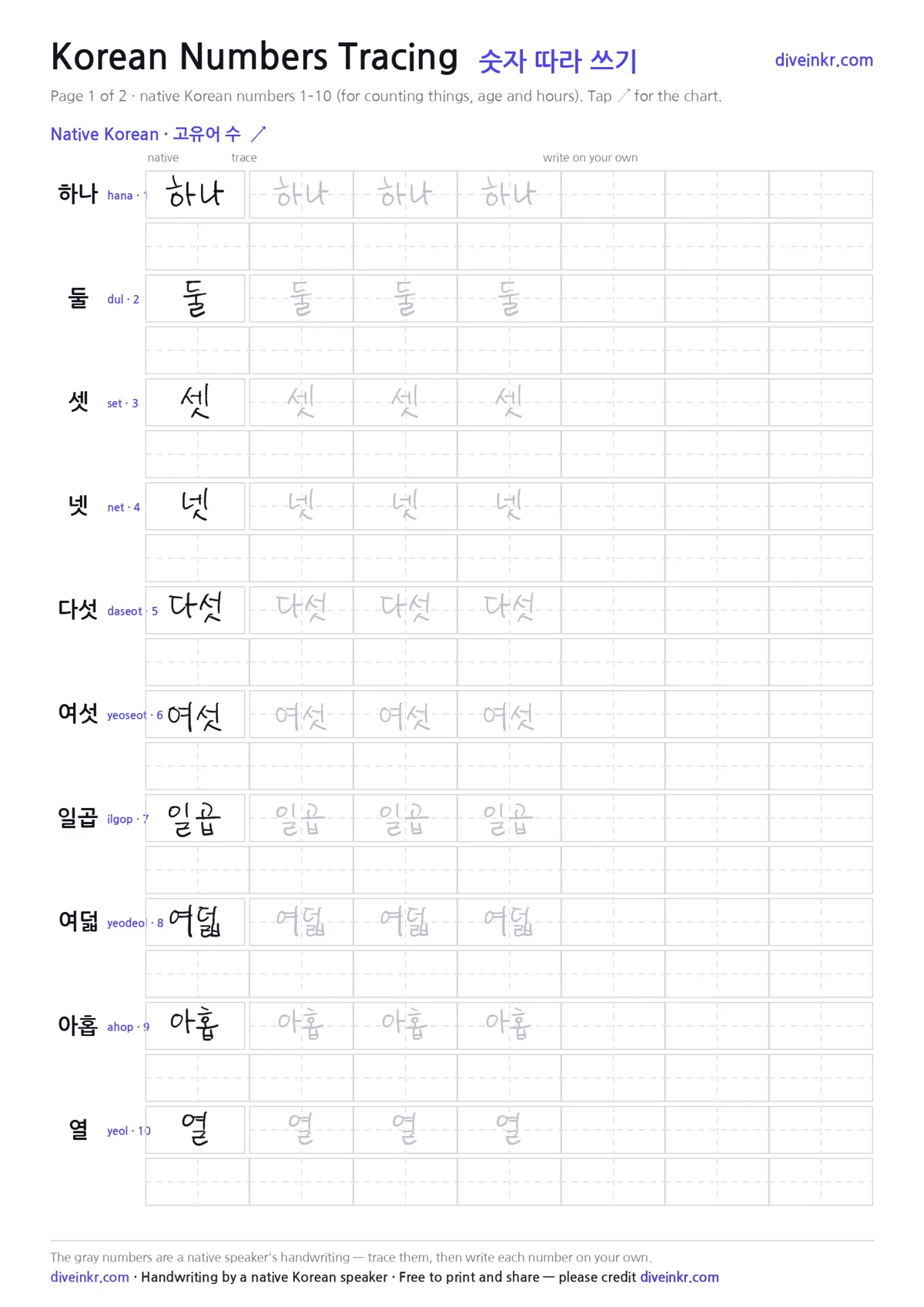
Free to print and share for personal and classroom use — please credit diveinkr.com.
See also: Korean numbers chart
How to Use the Worksheet
- Print both pages on A4 (on US Letter, choose "fit to page") and use a pencil. For repeated practice, slip a copy into a clear sheet protector and write with a dry-erase marker.
- Work down the page: look at the handwritten model, trace the gray copies on the first line, then write the number again and again on the empty line below. Say it out loud each time.
- Do page 1 first. Native numbers are written with more letters, so they take longer to write — and they are the ones you need to count objects and say your age.
- Then check which system fits what you want to say with the native vs Sino-Korean guide.
Page 1: Native Korean Numbers, 1–10
The native numbers go 하나, 둘, 셋, 넷, 다섯, 여섯, 일곱, 여덟, 아홉, 열 (hana, dul, set, net, daseot, yeoseot, ilgop, yeodeol, ahop, yeol). You use them to count things and people, to say age and to say the hour. Before a counter, four of them change shape: 하나 becomes 한, 둘 becomes 두, 셋 becomes 세 and 넷 becomes 네, as in 커피 두 잔 (keopi du jan, "two cups of coffee").
커피 두 잔 주세요.
keopi du jan juseyo.
Two coffees, please.
두 is the form of 둘 before a counter.
저는 스물다섯 살이에요.
jeoneun seumul-daseot sariyeyo.
I'm 25 years old.
Age uses native numbers.
Page 2: Sino-Korean Numbers, 1–10
The Sino-Korean numbers go 일, 이, 삼, 사, 오, 육, 칠, 팔, 구, 십 (il, i, sam, sa, o, yuk, chil, pal, gu, sip). Each one is a single syllable, so they are quick to write. You use them for dates, money, phone numbers and minutes: 이 월 (i wol, "February"), 오천 원 (ocheon won, "5,000 won").
| Native | Sino-Korean | Used for |
|---|---|---|
| 하나, 둘, 셋… | 일, 이, 삼… | — |
| Counting things and people | Dates, months, money | Native: 세 개 (three items) · Sino: 삼 월 (March) |
| Age, hours | Phone numbers, minutes | Native: 두 시 (2 o'clock) · Sino: 십 분 (10 minutes) |
Common Learner Mistakes
- Using the wrong system. Age and counting things use native numbers: 스물다섯 살, not 이십오 살.
- Forgetting that 하나, 둘, 셋 and 넷 change before a counter: 두 잔, not 둘 잔.
- Mixing the two inside one phrase. The hour and the minutes use different systems: 세 시 십 분 (3:10).
This worksheet doesn't show stroke order. Focus on getting each number's shape and proportions right first.
Mini Quiz
2 short questions — about 1 minute
2. How do you say "two cups of coffee"?
3. Which number is Sino-Korean?
More printables
- ← Before this: Korean numbers chart
- → Next step: Number Systems worksheet
- Whole set: Numbers, dates and counting and every other sheet on the printables page.
- Start from the basics: Printable Hangul Chart with Native Handwriting · Hangul Tracing Worksheet with Native Handwriting
Related Knowledge
Learn Next
Learn which system to use for age, time, money and counting.
Will you remember this tomorrow?
Save it — your daily review brings it back right before you'd forget. No account needed.