Korean Numbers Chart: Native and Sino-Korean Numbers (Free PDF)
Written and reviewed by Jun and Jin, native Korean speakers
Published · How we write & review
After this page, you can print a one-page chart of both Korean number systems and know which one to use.
10-second answer
The short answer
Korean has two sets of numbers, and this free one-page PDF puts both side by side: native Korean (하나 (hana), 둘 (dul), 셋 (set)…) and Sino-Korean (일 (il), 이 (i), 삼 (sam)…), 1 to 10, each in print and in a native speaker's handwriting. It also lists the tens up to 90 and a quick guide to which system to use for age, time, money, dates and counting.
Quick check — did that land?
1. Which system do you use for someone's age?
Download the Chart
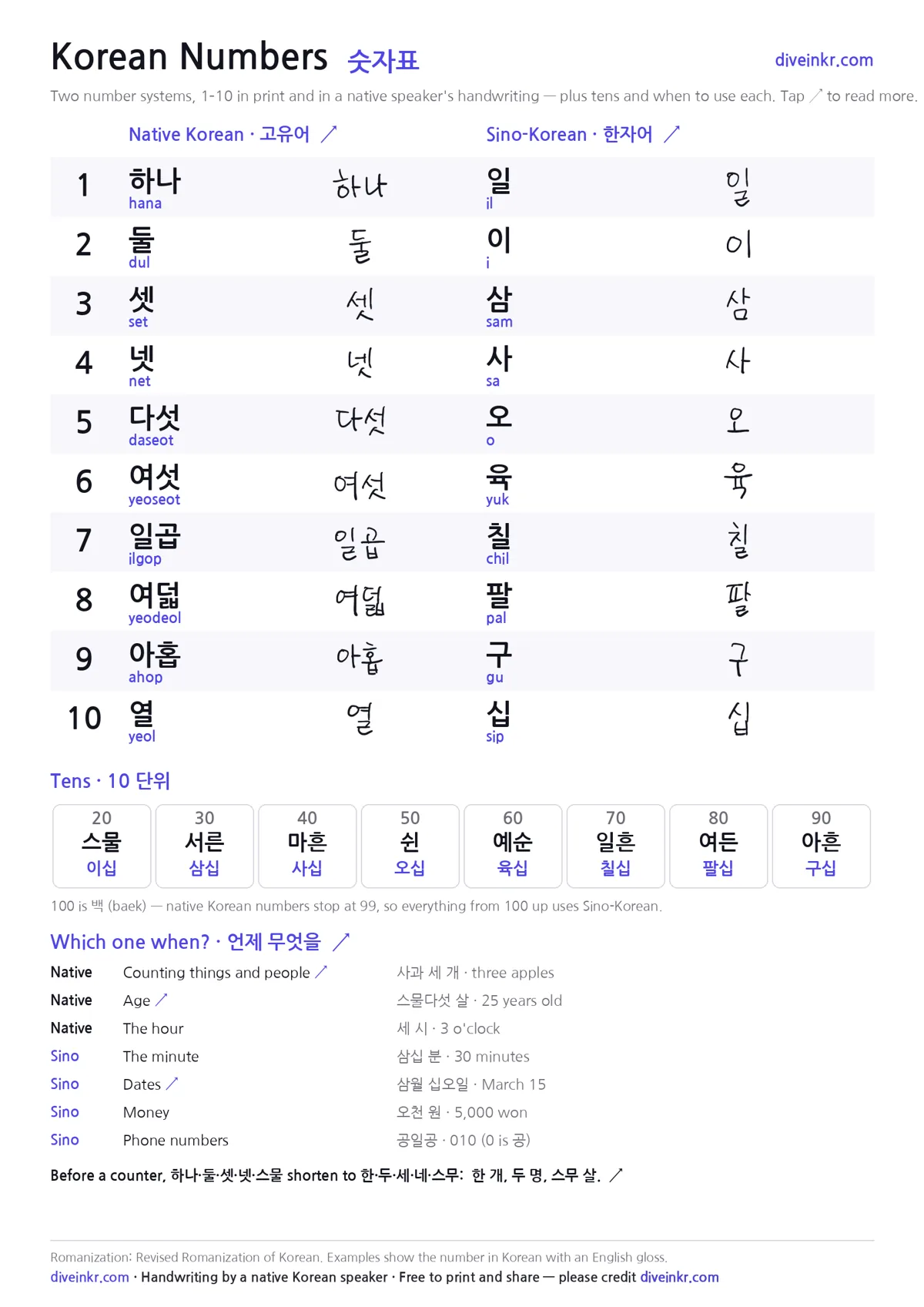
Free to print and share for personal and classroom use — please credit diveinkr.com.
See also: Counting from 1 to 10
How to Use the Chart
- Print it on one A4 sheet (on US Letter, choose "fit to page") and put it somewhere you'll see it every day — numbers only become automatic with daily repetition.
- Cover one column and recite the other: native 하나 to 열, then Sino-Korean 일 to 십. When that's easy, cover the printed words and read only the handwritten ones.
- Practice each system where it belongs: count the things on your desk in native Korean (한 개, 두 개…), read the prices on a receipt in Sino-Korean, and say the time every time you look at your phone.
- Drill the basics on Korean numbers 1 to 10.
Two Systems, One Page
Native Korean numbers are used for counting things, people and age, and for the hour; Sino-Korean numbers cover minutes, dates, money and phone numbers. The full breakdown is on native vs Sino-Korean numbers.
| You're saying… | System | Example |
|---|---|---|
| How many apples | Native | 사과 세 개 |
| Your age | Native | 스물다섯 살 |
| The hour | Native | 세 시 |
| The minutes | Sino-Korean | 삼십 분 |
| A date | Sino-Korean | 삼월 십오일 |
| A price | Sino-Korean | 오천 원 |
| A phone number | Sino-Korean | 공일공 (010) |
Native numbers stop at 99 — from 100 up, everything is Sino-Korean (백, 천, 만). And before a counter, 하나·둘·셋·넷·스물 shorten to 한·두·세·네·스무: 한 개, 두 명, 스무 살. See Korean counters.
Walking Through the Chart
1 to 10. Each row shows the number in both systems: the printed word, its romanization and a native speaker's handwritten version. Numbers written by hand — on a note, a whiteboard or a price tag — don't always look like print; Korean handwriting vs fonts shows why they can look different from print. Two pronunciation notes: 여덟 (8) is pronounced 여덜, with the ㅂ silent, and 여섯, 다섯 and 셋 end in a clipped t sound, which is why they're romanized with a final t.
The tens. Native tens are separate words you simply have to learn — 스물 (20), 서른 (30), 마흔 (40), 쉰 (50), 예순 (60), 일흔 (70), 여든 (80), 아흔 (90). Sino-Korean tens are built like a calculator: 이십 is "two ten," 삼십 is "three ten." In both systems you add the ones after the tens.
| Number | Native Korean | Sino-Korean |
|---|---|---|
| 25 | 스물다섯 (seumuldaseot) | 이십오 (isibo) |
| 32 | 서른둘 (seoreundul) | 삼십이 (samsibi) |
| 45 | 마흔다섯 (maheundaseot) | 사십오 (sasibo) |
| 99 | 아흔아홉 (aheunahop) | 구십구 (gusipgu) |
100 and up. Past 99 there's only Sino-Korean: 백 (baek, 100), 천 (cheon, 1,000) and 만 (man, 10,000). You don't put 일 ("one") in front of them — it's 백 원, 천 원, 만 원. Korean groups big numbers by 만, so 50,000 won is 오만 원, "five 만."
Which one when? The bottom of the chart matches each situation to its system. Here they are in full sentences:
사과 세 개 주세요.
Sagwa se gae juseyo.
Three apples, please.
Counting things: native number + counter.
저는 스물다섯 살이에요.
Jeoneun seumuldaseot sarieyo.
I'm 25 years old.
Age: native number + 살. More on the Korean age system.
지금 세 시 삼십 분이에요.
Jigeum se si samsip bunieyo.
It's 3:30 now.
The hour is native, the minutes are Sino-Korean — both systems in one sentence.
제 생일은 삼월 십오일이에요.
Je saengireun samwol siboirieyo.
My birthday is March 15.
Dates: Sino-Korean + 월 (month) and 일 (day). See Korean months and dates.
커피 두 잔에 만 원이에요.
Keopi du jane man wonieyo.
Two coffees come to 10,000 won.
Native for the cups (두 잔), Sino-Korean for the price (만 원). Asking the price is covered in 얼마예요.
Phone numbers are read digit by digit in Sino-Korean, and 0 is 공 (gong), so the 010 that starts Korean mobile numbers is 공일공. You'll also hear 영 (yeong) for zero in other places, such as decimals: 0.5 is 영 점 오.
Common Learner Mistakes
- 삼 살 for "three years old." Age takes native numbers: 세 살.
- 하나 개 or 둘 명. Before a counter, the short forms are required: 한 개, 두 명, 세 마리, 네 권.
- 스물 살 for "20 years old." 스물 shortens to 스무 only when it's exactly 20 before a counter — 스무 살, but 스물한 살 (21).
- 일 시 for "1 o'clock." Hours are native: 한 시, 두 시 … 열두 시.
- Mixing up 십 분 and 열 분. 십 분 is ten minutes; 열 분 is ten people, counted politely with the honorific counter 분.
- 육월 and 십월. June and October drop a consonant: 유월 and 시월.
Numbers also show up in family talk — ages, birth order and how many siblings you have. The Korean family tree chart is a good next printout to pair with this one.
Mini Quiz
1. Which system do you use for someone's age?
2. How do you say 3 o'clock?
3. How high do native Korean numbers go?
4. How do you say "20 years old"?
Related Knowledge
Learn Next
The chart gives you the rules at a glance — this page walks through each one with examples.
Will you remember this tomorrow?
Save it — your daily review brings it back right before you'd forget. No account needed.