How to Say "I Didn't Catch That" in Korean: 네?, 뭐라고요?, and More
Written and reviewed by Jun and Jin, native Korean speakers
Published · How we write & review
After this page, you can ask someone in Korean to repeat what they said, at the right politeness level for a boss, a colleague or a friend.
10-second answer
How do you say "I didn't catch that" in Korean?
Start with a short, softly rising 네 (ne), like "Sorry?". Then ask what was said: 뭐라고 하셨어요 (mworago hasyeosseoyo) with colleagues. In formal moments or loud places, use 다시 한 번만 말씀해 주시겠어요 (dasi han beonman malsseumhae jusigesseoyo) or 잘 못 들었어요 (jal mot deureosseoyo, "I didn't catch it"). With friends, 응 (eung) or 뭐라고 (mworago) works. Give a reason if you can.
Quick check — did that land?
1. You are in a noisy meeting and need your boss to repeat something. Which is the best?
뭐라고 하셨어요? 못 알아들었을 때 쓰는 말.
Three Steps, From Reflex to Request
When you miss what someone said, Korean speakers usually move through three steps, each a little more deliberate and polite than the last. You do not need all three every time: stop at the step that gets you the answer.
| Step | What you say | What it does |
|---|---|---|
| 1. Instinctive reaction | 네? (ne?) | The shortest, most automatic signal that you did not catch it. |
| 2. A specific question | 뭐라고요? (mworagoyo?) / 뭐라고 하셨어요? (mworago hasyeosseoyo?) | Asks directly what was said. For people you are fairly familiar with, such as colleagues and friends. |
| 3. A polite request | 다시 한 번만 말씀해 주시겠어요? (dasi han beonman malsseumhae jusigesseoyo?) / 잘 못 들었어요. (jal mot deureosseoyo.) | The formal, well-mannered version. Best when the room is noisy or the content is hard. |
The order is a guide, not a rule. A reflexive 네? often comes out first, and the other person usually just repeats themselves before you need step 2 or 3.
See also: 네 vs 응: how to say yes
Step 1: 네? and the Way You Say It
네? (ne?) is the shortest and most intuitive reaction. It is not perfectly polite Korean, but it comes out reflexively to people older and younger than you alike. (The same 네 also means "yes"; the question mark and the rising tone are what turn it into "Sorry?" See 네 vs 응 for how the word works as an answer.)
Tone matters more than the word. If you cut the end off short and hard, it can sound irritated. Lift the end slightly and soften it, and it sounds like a normal, polite request to repeat.
네?
ne?
Sorry? / Pardon?
Rising and soft: a genuine "I didn't catch that."
네!
ne!
Yes!
A short, hard, falling 네 can sound annoyed. Keep the question rising.
Step 2: Asking What Was Said
The next step is a concrete question. 뭐라고요? (mworagoyo?) and 뭐라고 하셨어요? (mworago hasyeosseoyo?) both mean "What did you say?" The second is longer and a little more careful, because 하셨어요 (hasyeosseoyo) uses the honorific -시- (-si-) for the person you are talking to; see Korean honorifics. Both suit people you know reasonably well, such as colleagues and friends.
뭐라고요?
mworagoyo?
What did you say?
뭐라고 하셨어요?
mworago hasyeosseoyo?
What did you say? (more polite)
Add a reason to soften it: see the next sections.
Step 3: The Polite Request
When the setting is formal, or the cause is noise or difficult content, switch to a full request. 다시 한 번만 말씀해 주시겠어요? (dasi han beonman malsseumhae jusigesseoyo?) means "Could you say that once more, please?" Here 다시 is "again," 한 번만 is "just once," and 말씀해 주시다 is the honorific way to say "to tell (me)." The pattern of asking someone to do something for you is covered in -세요 and -아/어 주세요. The plain statement 잘 못 들었어요 (jal mot deureosseoyo, "I couldn't hear it well") is the other polite choice.
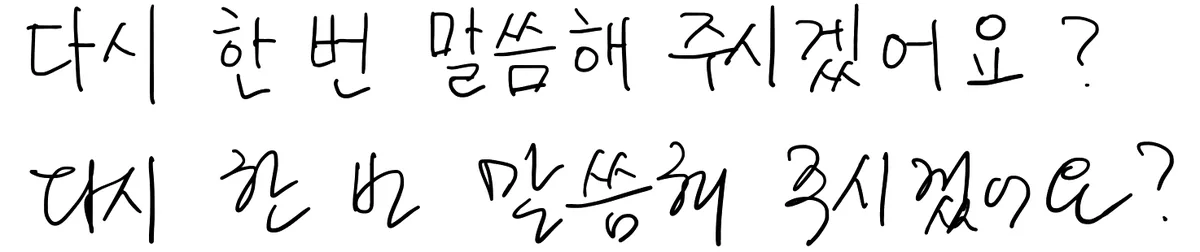
다시 한 번만 말씀해 주시겠어요?
dasi han beonman malsseumhae jusigesseoyo?
Could you say that one more time, please?
잘 못 들었어요.
jal mot deureosseoyo.
I didn't catch that well.
What to Say to Whom
The same need, "say that again," has three different sound levels. Match it to the person, using the speech-level system explained in 반말 vs 존댓말 and the ending tables in the 존댓말 endings guide.
| Who | Sample lines | Feel |
|---|---|---|
| Superiors and business | 죄송하지만, 잘 못 들었습니다. 다시 한 번만 말씀해 주시겠습니까? (joesonghajiman, jal mot deureotseumnida. dasi han beonman malsseumhae jusigetseumnikka?) | Most formal. Apology first, formal -ㅂ니다 endings. |
| Superiors and business | 소음 때문에 그러는데, 한 번만 더 설명해 주실 수 있으실까요? (soeum ttaemune geureoneunde, han beonman deo seolmyeonghae jusil su isseusilkkayo?) | Gives the reason, noise, and asks for an explanation again. |
| Superiors and business | 제가 잠시 놓쳤는데, 방금 말씀하신 부분이 ~가 맞나요? (jega jamsi nochyeonneunde, banggeum malsseumhasin bubuni ~ga mannayo?) | Admits missing a moment, then checks your understanding of the part you heard. |
| Colleagues, or a bit of distance | 네? 죄송해요, 제가 딴생각을 하느라 잘 못 들었어요. (ne? joesonghaeyo, jega ttansaenggageul haneura jal mot deureosseoyo.) | Polite -요 style with an apology and a reason. |
| Colleagues, or a bit of distance | 뭐라고 하셨어요? 목소리가 작아서 잘 안 들렸어요. (mworago hasyeosseoyo? moksoriga jagaseo jal an deullyeosseoyo.) | Direct question plus the reason. |
| Colleagues, or a bit of distance | 다시 한 번만요! (dasi han beonmanyo!) | Short and friendly. |
| Friends and juniors (banmal) | 어? (eo?) / 응? (eung?) | The casual reflex. |
| Friends and juniors (banmal) | 뭐라고? (mworago?) / 뭐라 그랬냐? (mwora geuraennyeo?) | "What?" / "What did you say?" |
| Friends and juniors (banmal) | 다시 말해봐. (dasi malhaebwa.) / 못 들었음, 다시. (mot deureosseum, dasi.) | "Say it again." The last is a quick, text-message style. |
With superiors and in business, 네? and 뭐라고요? can sound rude or careless, so go straight to a full sentence like the ones in the first rows. A casual 응? or 뭐라고? is fine with friends, but would be too blunt with a boss.
Give the Reason
The manner tip that matters most is to add why you did not catch it. A bare 네? can feel abrupt, as if you are not listening or are complaining about how they spoke. A short reason makes it clear that the problem is the situation, not the speaker, and the other person is less likely to feel offended.
죄송한데 주변이 시끄러워서 잘 못 들었어요.
joesonghande jubyeoni sikkeureowoseo jal mot deureosseoyo.
Sorry, it's noisy around here so I couldn't hear well.
"It's loud around me" is the reason; 죄송한데 (joesonghande) is the soft apology that opens the sentence. For the family of apologies, see 죄송합니다.
목소리가 작아서 잘 안 들렸어요.
moksoriga jagaseo jal an deullyeosseoyo.
Your voice was quiet, so I couldn't hear it well.
A reason that is about volume, not about the person's speech. Works with colleagues.
Quick formula
Apology or reaction + reason + request. For example: 죄송한데 (sorry) + 주변이 시끄러워서 (it's noisy) + 다시 한 번만 말씀해 주시겠어요? (could you say it once more?).
Common Mistakes
Mistake #1: Using 뭐라고요? with a boss
It is a normal question between colleagues and friends, but to a superior or in business it can sound rude or careless. Use the formal request.
Mistake #2: A short, hard 네?
An abrupt, clipped ending reads as irritation. Soften it and lift the end.
Mistake #3: Using friend phrases outside friend circles
응?, 뭐라고? and 다시 말해봐 are banmal. They are great among friends and too casual for anyone you owe politeness.
Mini Quiz
3 short questions — about 2 minute
2. What is the easiest way to soften a plain 네? when you didn't hear?
3. Which phrase is for a friend, in banmal?
4. How should 네? sound when you did not catch what was said?
Part of Everyday Korean: Phone Calls, Plans, Weather & Health
- Korean Phone Call Phrases: 여보세요 and Beyond
- Making Plans in Korean: 약속 and How to Move It
- Korean Weather Small Talk: 날씨 Phrases That Break the Ice
- At the Korean Hospital or Pharmacy: Saying Where It Hurts
- How to Introduce Yourself in Korean
- Why Do Koreans Ask 밥 먹었어? (Did You Eat?)
- Opening a Bank Account in Korea: What to Bring and Say
- Getting a Korean SIM Card: 유심 vs 요금제
- Korean Phrases You'll Hear at Home: What Parents and Siblings Actually Say
- Korean Phrases for Daily Life: Cafés, Taxis, Shops, Pharmacies and More
Related Knowledge
1 more related
Learn Next
The 말씀해 주시다 and 하셨어요 forms in this page come from the honorific system.
Will you remember this tomorrow?
Save it — your daily review brings it back right before you'd forget. No account needed.