How to Rent a Seoul Bike (따릉이, Ddareungi): 24 Hours for 1,000 Won
Written and reviewed by Jun and Jin, native Korean speakers
Published · How we write & review
After this page, you can rent and return a Seoul Bike (따릉이, Ddareungi), Seoul's public bike, on your own — pick a pass, unlock it with the app, use the temporary lock, and return it at a station.
10-second answer
The short answer
따릉이 (Ddareungi, also spelled Ttareungi) is Seoul's public bike, officially Seoul Bike. 1,000 won buys a one-day pass on the 1-hour plan, valid 24 hours from your first rental: dock within the hour and rent again as often as you like. Going over costs 200 won per extra 5 minutes. Staying longer? Season passes cost far less than daily ones (7 days: 3,000 won).
Quick check — did that land?
1. You will ride a Seoul Bike once a day for a week and you can register as a member. What is cheapest?
따릉이! 서울 공공자전거예요. 1일권은 1,000원이에요. 1시간 안에 반납하면 다시 탈 수 있어요.
따릉이: Seoul's Public Bike
The name comes from 따르릉 (ttareureung), the ring of a bicycle bell. The city has run the service since October 2015, and the bikes all look the same: white frame, green wheels, a basket in front. They're ordinary pedal bikes, not electric.
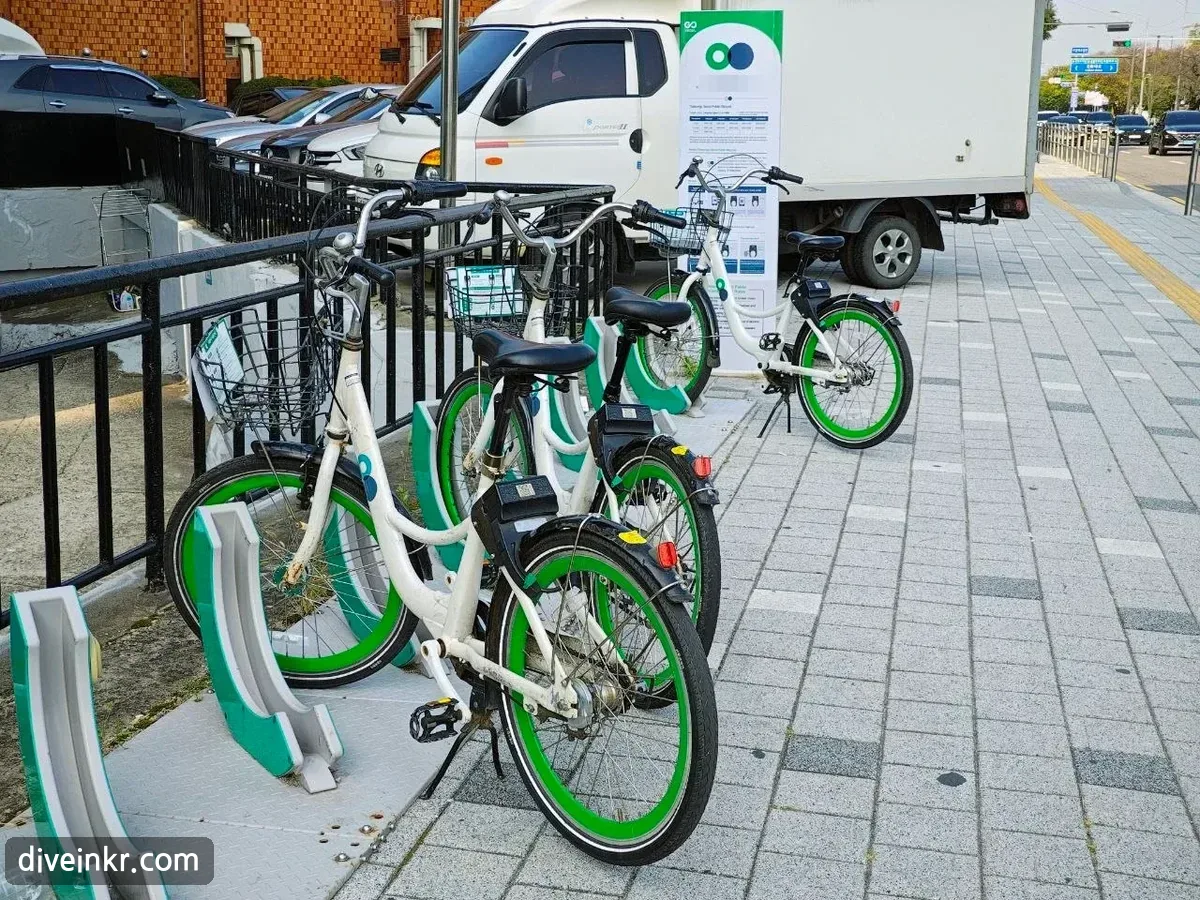
The one rule that surprises people: a 따릉이 has to go back to a 따릉이 station. You can't leave it on any sidewalk the way you can with the private e-bikes you'll also see around Seoul. Stations are everywhere in the city, though, and the app's map shows how many bikes each one has right now.
See also: A walk through Jongno
Fares: Reading the Sign
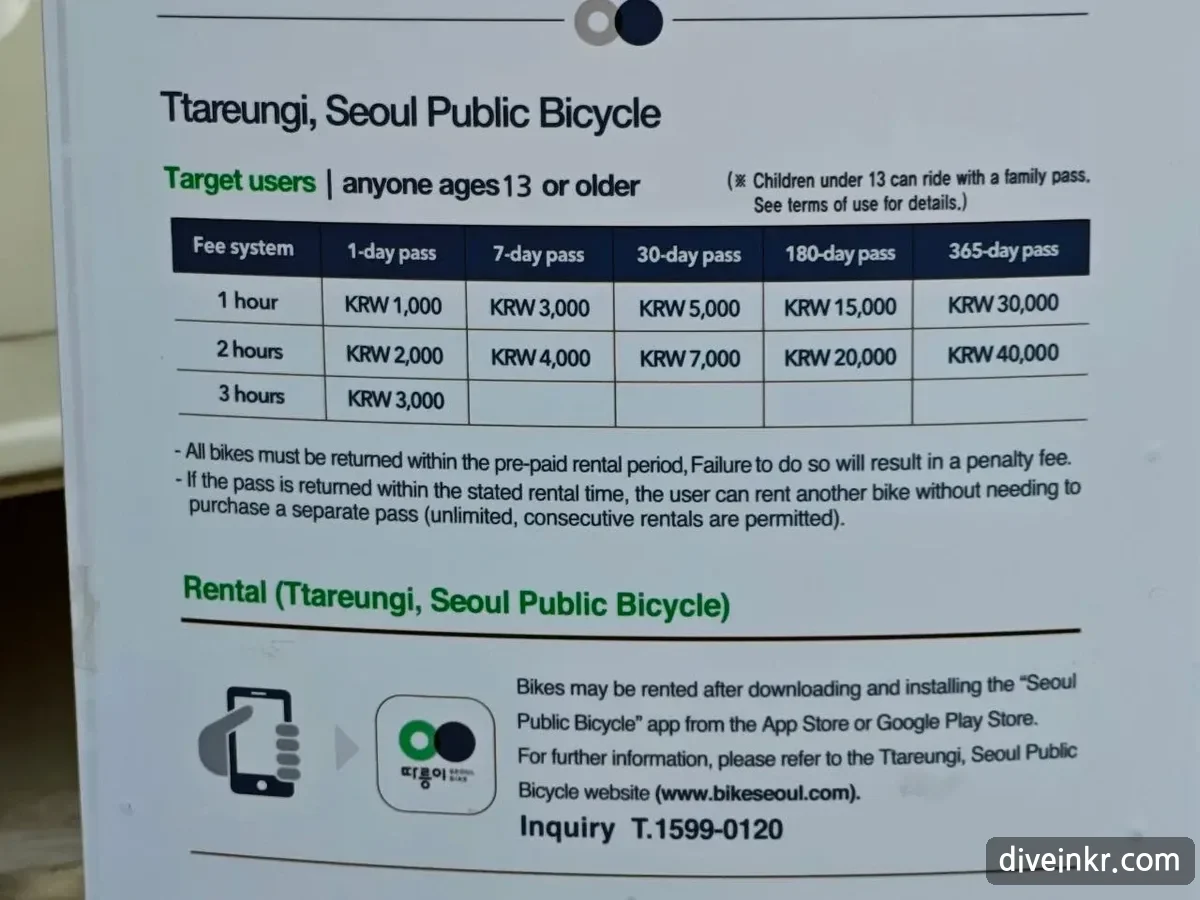
| Pass | 1-hour plan | 2-hour plan |
|---|---|---|
| 1일권 (1-day) | 1,000 won | 2,000 won (3-hour plan: 3,000 won) |
| 7일권 (7-day) | 3,000 won | 4,000 won |
| 30일권 (30-day) | 5,000 won | 7,000 won |
| 180일권 (180-day) | 15,000 won | 20,000 won |
| 365일권 (365-day) | 30,000 won | 40,000 won |
The day pass is the one visitors want, and the small print on the sign is the best part: "If the pass is returned within the stated rental time, the user can rent another bike without needing to purchase a separate pass." A one-day pass counts 24 hours from your first rental. So on the 1-hour plan, ride for 50 minutes, dock the bike, grab a coffee, and take another bike — all on the same 1,000 won.
The one fee to watch
If you keep a bike past your plan's limit, you pay 200 won for every extra 5 minutes (up to 30,000 won per rental). Watch the timer in the app, and dock before the hour is up — then rent again. Do not keep a regular-pass bike past 4 hours: the system then treats it as lost or stolen.
Passes of 7 days and longer are for members, which means signing up with a Korean phone number. Without an account you can buy only the one-day pass (1-hour, 2-hour or 3-hour plan), which is all most short-stay visitors need. If you live in Seoul, or can register as a member, read the next section before buying day passes again and again.
How the 24 hours work: you pick a 1-hour or 2-hour plan when you buy. Start a ride, and if you return the bike within that time, the ride costs nothing extra and you can rent another bike straight away. The pass counts 24 hours from the start of your first rental, and inside those 24 hours the number of rentals is unlimited, as long as each one is returned within the plan. So for 1,000 won you can hop on a bike a few times over a whole day: ride 50 minutes, dock, have lunch, ride again.
Day Pass or Season Pass? Do the Math
| Pass (1-hour plan) | Price | Same days bought as day passes | You save | Saving |
|---|---|---|---|---|
| 7일권 (7-day) | 3,000 won | 7 × 1,000 = 7,000 won | 4,000 won | 57% |
| 30일권 (30-day) | 5,000 won | 30 × 1,000 = 30,000 won | 25,000 won | 83% |
| 180일권 (180-day) | 15,000 won | 180 × 1,000 = 180,000 won | 165,000 won | 92% |
| 365일권 (365-day) | 30,000 won | 365 × 1,000 = 365,000 won | 335,000 won | 92% |
The season passes are very cheap. If you will ride often during a long stay, or you live in Seoul, buying a pass is far cheaper than paying day by day: a 7-day pass costs less than three day passes, and a 30-day pass costs about the price of five. The 2-hour plans cost a little more (7 days: 4,000 won; 30 days: 7,000 won; 180 days: 20,000 won; 365 days: 40,000 won) and suit longer rides along the Han River. The last two columns are simple arithmetic from the official price list, not quoted figures. Put the other way round, a 365-day pass means paying only about 8% of what a year of day passes would cost, roughly 82 won a day.
Who can buy one
Passes of 7 days or more need a membership, which means registering with a Korean phone number. Non-members can only buy the one-day pass. If you are staying for weeks or months, ask your phone shop or Korean friend to help you sign up. Prices were checked against the Seoul city and Seoul Facilities Corporation pages in October 2026 (city page last updated 10 March 2026) and can change, so look at the app before you pay.
Renting in Three Steps
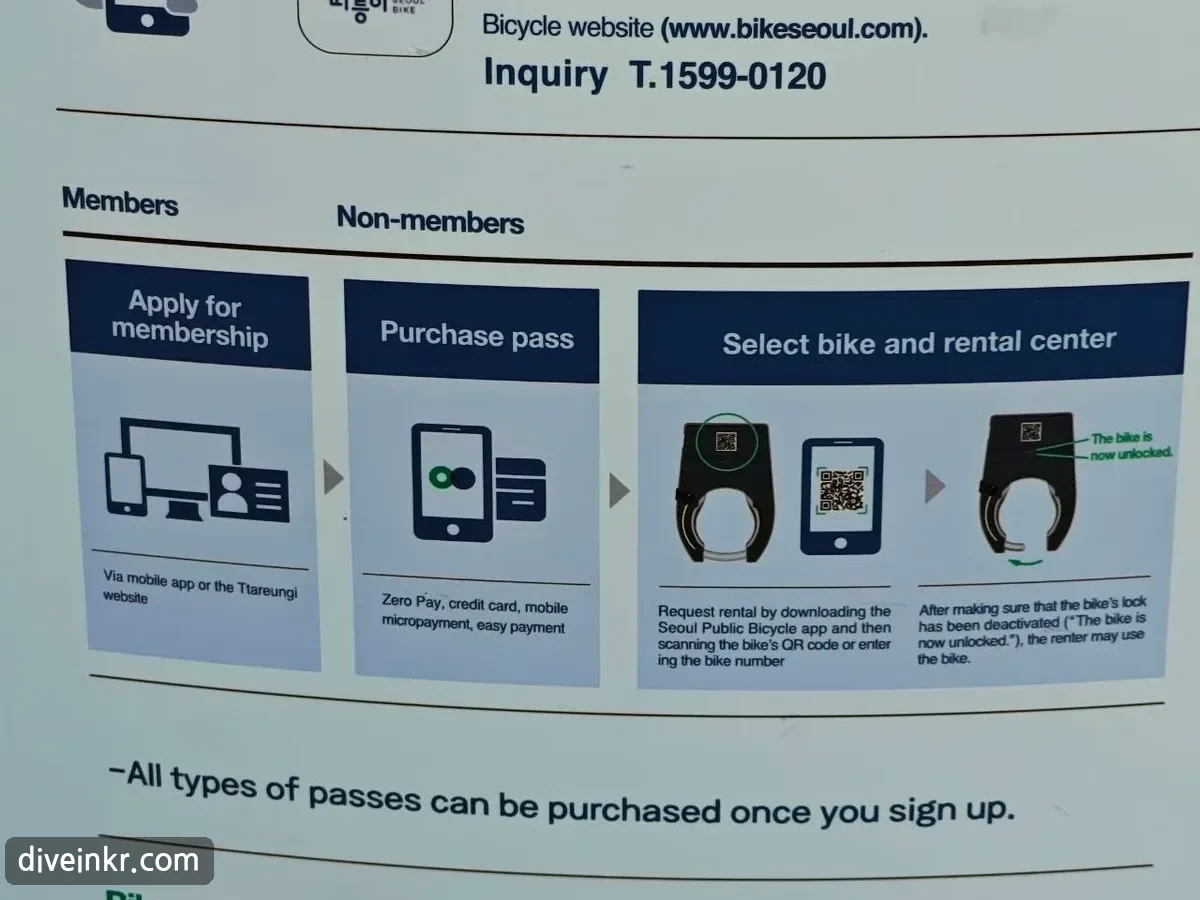
- Install the app — it's called 따릉이 ("Seoul Public Bicycle" on the sign). On the first screen, tap "Foreigner" for English menus.
- Buy a pass. In the Foreigner menu only credit cards issued outside Korea are accepted.
- Scan the QR code on the lock (or type in the bike number). When the lock opens and the app says the bike is unlocked, it's yours for the hour.
Check the bike before you ride off — brakes, tires, the chain, the seat height. If something's wrong, dock it again right away and take another one.
Returning, and the Temporary Lock
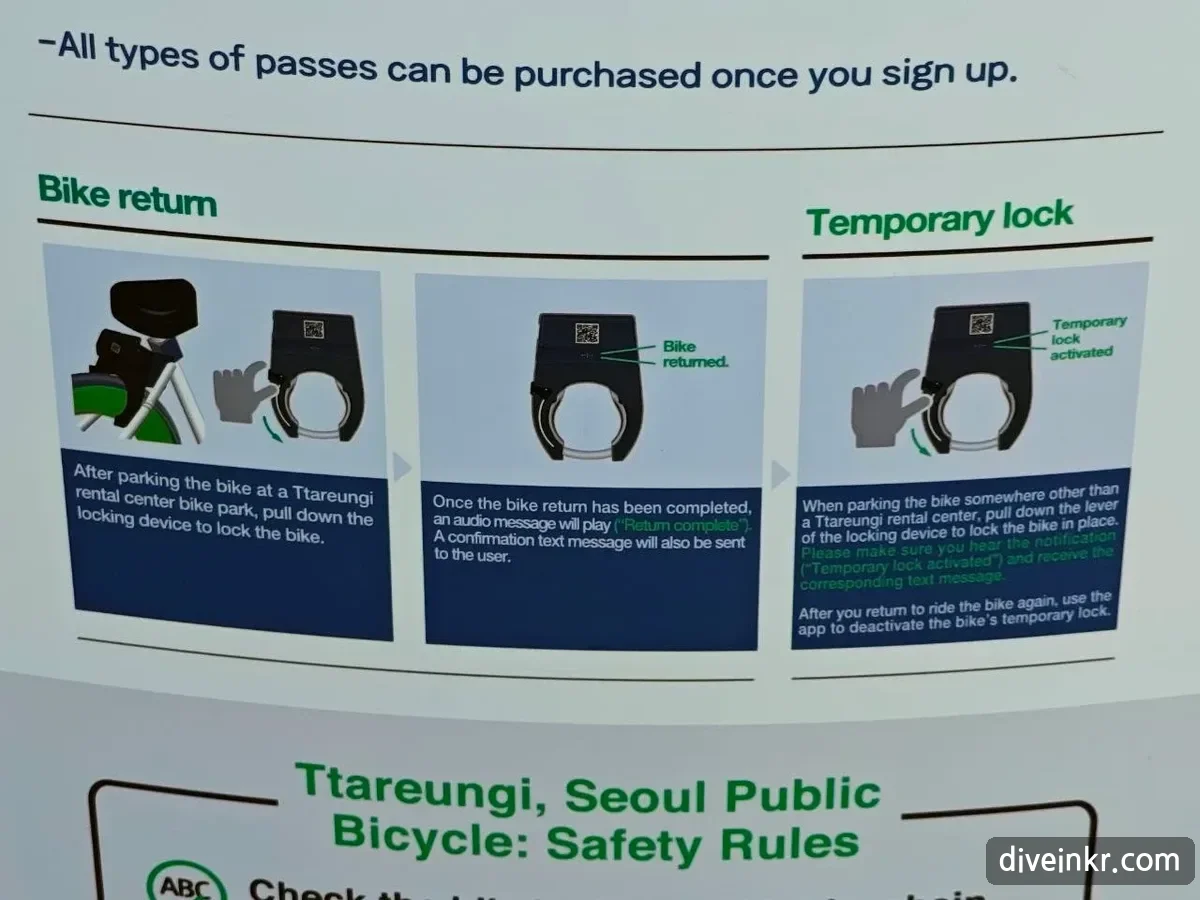
To return, park the bike at a 따릉이 station and pull the locking lever down. You'll hear "Return complete" (반납이 완료되었습니다) and get a text message. No sound, no message? Then it hasn't been returned — lock it again or try another spot at the station.
Stopping somewhere that isn't a station — a shop, a toilet, a riverside bench? Use the temporary lock (임시잠금, imsi jamgeum): pull the same lever down away from a station and wait for "Temporary lock activated." When you come back, release it in the app. A temporary lock doesn't end your rental, so your plan's time keeps counting.
Riding by the Han River
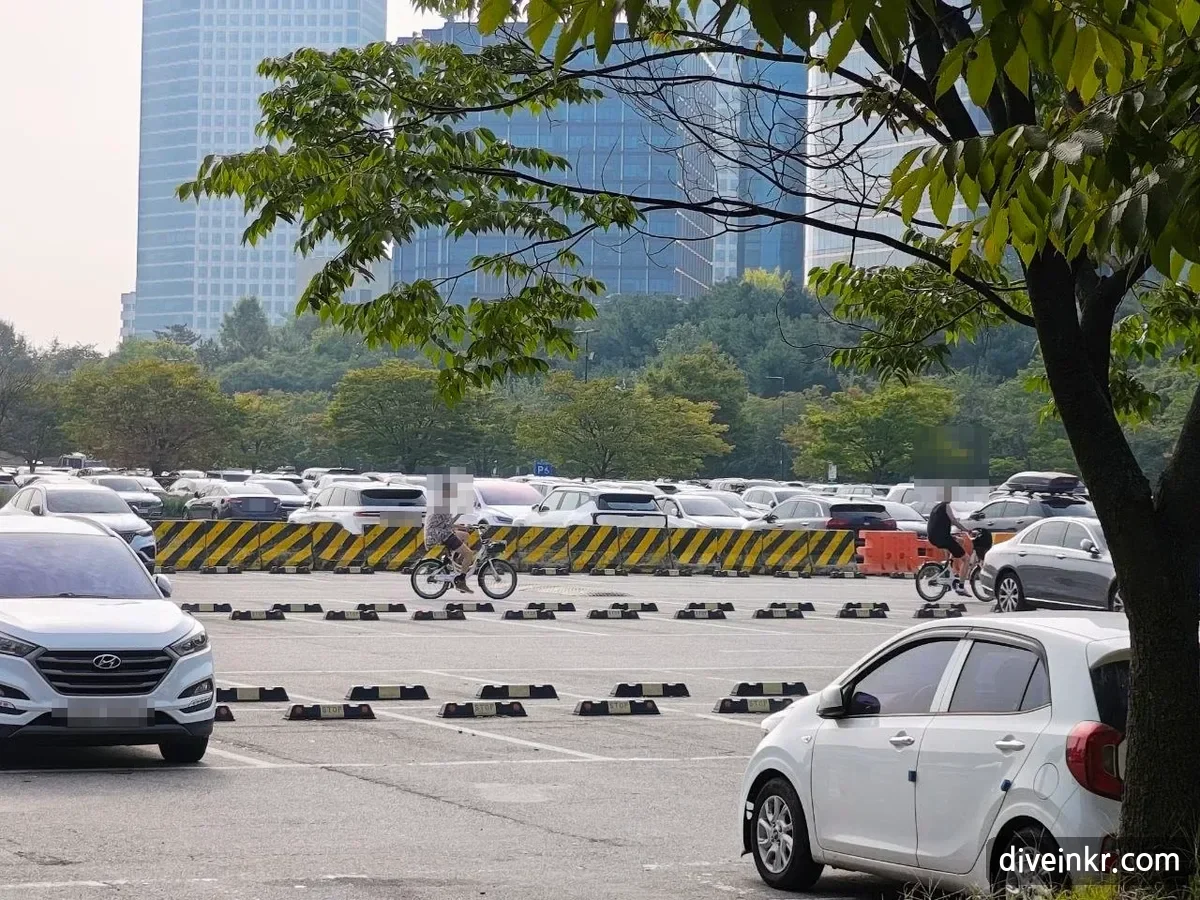
The most popular 따릉이 ride is along the Han River (한강), where the riverside parks have long bike paths on both banks. Paths are shared with runners and walkers, so ride on the side marked for bikes, keep right, and slow down at crossings.
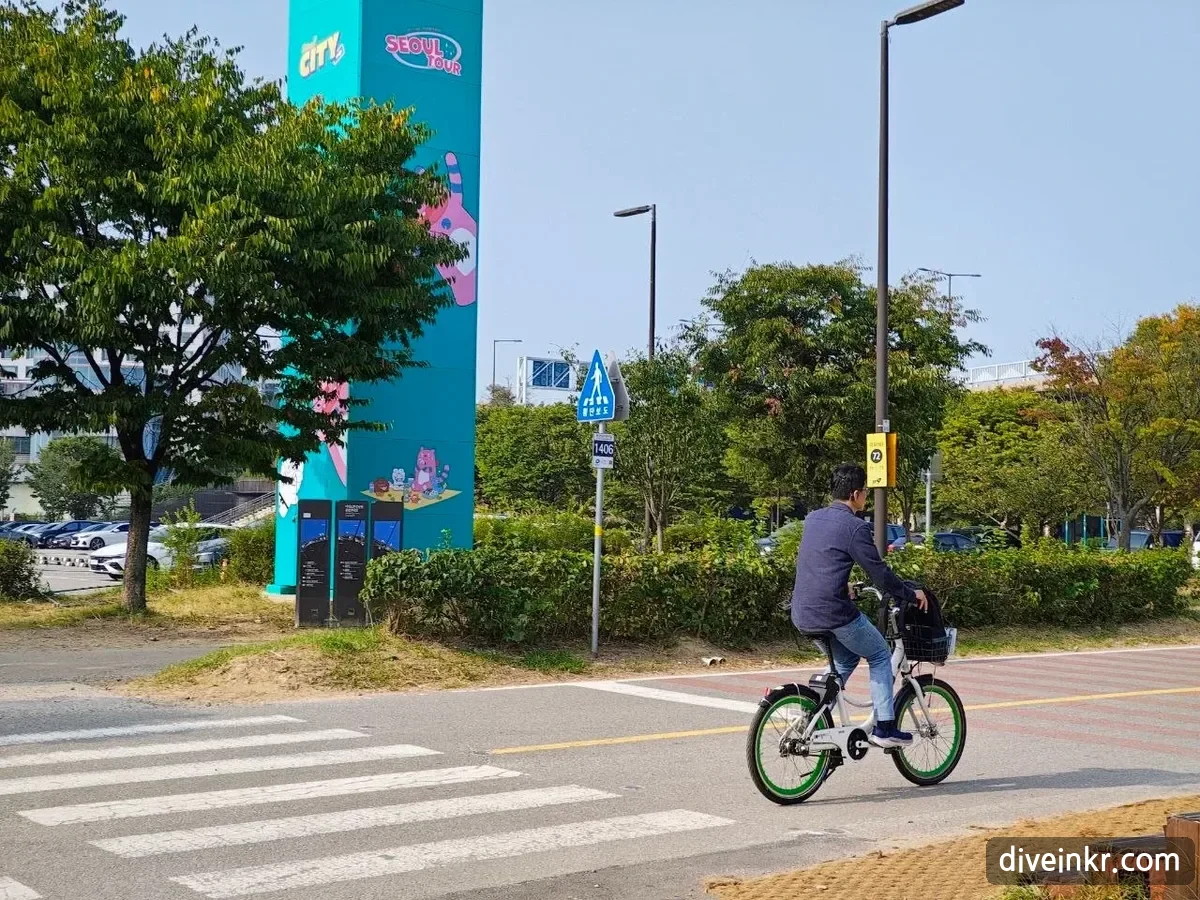
Korean law requires cyclists to wear a helmet, but there's no fine for skipping it, and most 따릉이 riders don't have one. Riders must be 13 or older; the sign notes that younger children can ride under a family pass, as set out in the terms of use.
따릉이 vs Kakao T Bike
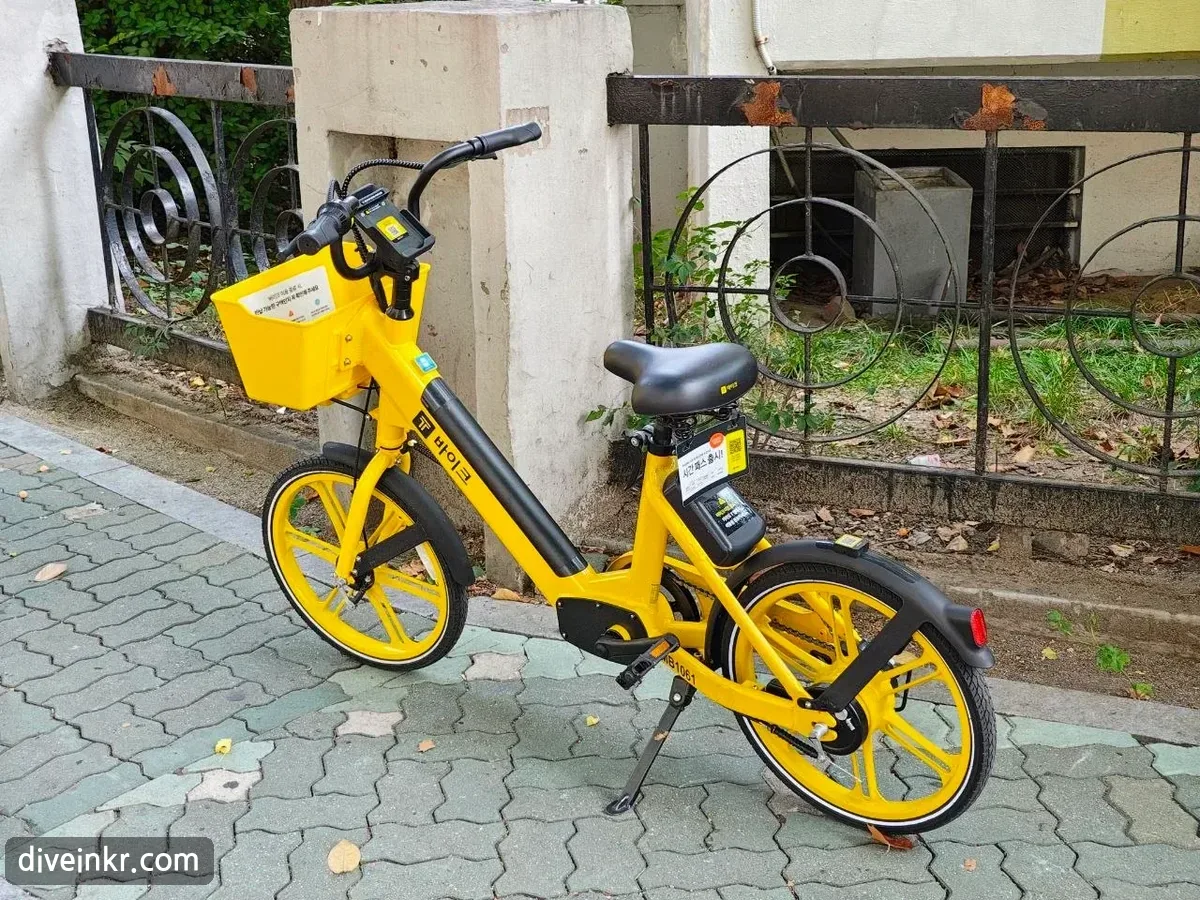
You'll also see electric bikes from private companies, like Kakao T Bike. The motor helps you pedal, and you can leave them anywhere inside the service area instead of at a station. They cost much more: a 2024 comparison put an hour on a Kakao T Bike at about 5,500 won, against 1,000 won for 따릉이. They also need their own app and account. Fares change, so check in the app — but for a visitor, 따릉이 is the easy, cheap choice.
Korean for the Bike Station
따릉이 대여소 어디 있어요?
ttareungi daeyeoso eodi isseoyo?
Where's a 따릉이 station?
따릉이 타고 한강 가자!
ttareungi tago hangang gaja!
Let's ride 따릉이 to the Han River!
Koreans say 따릉이를 타다 (to ride a 따릉이) just like 자전거를 타다.
잠금이 안 풀려요.
jamgeumi an pullyeoyo.
The lock won't open.
풀리다 = to come undone. Useful when the QR scan doesn't work.
반납했어요.
bannaphaesseoyo.
I've returned it.
반납 is returning something you borrowed — books, rented bikes, rental cars.
| Korean | Romanization | Meaning |
|---|---|---|
| 대여소 | daeyeoso | Rental station |
| 대여 / 반납 | daeyeo / bannap | Rental / return |
| 이용권 | iyonggwon | Pass (ticket to use a service) |
| 일일권 | irilgwon | One-day pass |
| 임시잠금 | imsi jamgeum | Temporary lock |
| 초과 요금 | chogwa yogeum | Overtime fee |
| 자전거도로 | jajeongeo-doro | Bike path |
Sources
Mini Quiz
3 short questions — about 2 minute
2. You have a 1-hour day pass. You ride for 40 minutes and return the bike. What happens if you want another bike?
3. What does 반납 mean?
4. You want to stop at a café that isn't next to a 따릉이 station. What should you use?
Part of Korean Phrases for Travelers
Part of Life in Korea: Practical Guides for Foreign Residents
Related Knowledge
- A walk through Jongno
- How to ride a bus in Seoul
- How to ride the Seoul subway
- Asking for directions in Korean
1 more related
Learn Next
For longer trips across Seoul, the subway is the next step — with the announcements explained.
Will you remember this tomorrow?
Save it — your daily review brings it back right before you'd forget. No account needed.