How to Ride the Seoul Subway (and Understand the Announcements)
Written and reviewed by Jun and Jin, native Korean speakers
Published · How we write & review
After this page, you can ride the Seoul subway on your own — pay, change lines, get off on the right side, and follow the Korean announcements.
10-second answer
The short answer
Tap a transit card (or a single-journey ticket) at the gate going in and again going out. Doors open automatically at every station, and before each stop the announcement tells you the station name and which side the doors open on — 내리실 문은 오른쪽입니다 (naerisil muneun oreunjjogimnida) means "the doors are on your right." The base fare is 1,550 won by card, and transfers to other lines or buses within 30 minutes are discounted automatically.
Quick check — did that land?
1. The announcement says 내리실 문은 왼쪽입니다. What should you do?
출구, 환승, 지하철, 승강장, 역무실, 종착역, 방향, 입구, 교통카드, 막차.
Paying: Card, Single Ticket, or Tourist Pass
The easiest way is a transit card such as T-money, which you can buy and top up at convenience stores — the same card works on buses and in taxis. You tap it at the gate when you enter and again when you leave, because the fare depends on how far you travel.
| How you pay | Adult fare | Notes |
|---|---|---|
| Transit card (T-money etc.) | 1,550 won for the first 10 km | +100 won per extra 5 km (per 8 km beyond 50 km). Transfers to buses and other lines are discounted automatically. |
| Single-journey ticket (1회용 교통카드) | 1,650 won + 500-won deposit | Buy it at the station machine; get the 500 won back at the deposit refund machine (보증금 환급기) after your ride. Subway only — it can't be used on buses. |
| Climate Card tourist pass (기후동행카드 단기권) | 5,000–20,000 won for 1–7 days (+3,000 won card) | Unlimited subway within Seoul and Seoul city buses; the days count from the day you load it. Not valid on the Shinbundang Line, red express (광역) buses or airport buses. |
Fares are as of September 2026 (the last increase was June 2025). You still can't tap a foreign Visa or Mastercard at the gates — Seoul plans to add card readers to the gates on Lines 1–8 in 2027. Since March 2026, though, 440 ticket machines at 273 stations on Lines 1–8 accept foreign credit cards for single tickets, tourist passes and card top-ups, with a fee of about 3.7%. The tourist pass is sold at those machines and at convenience stores near stations.
How the transfer discount works
Tap out, then tap into the next subway or bus within 30 minutes (60 minutes between 9 p.m. and 7 a.m.) and you pay only the extra distance, not a new base fare. It works for up to four transfers — five rides in all. On buses you must tap when you get off too, or the chain breaks. Cash fares get no discount.
See also: Asking for directions in Korean
Finding Your Way: Lines, Numbers and Exits
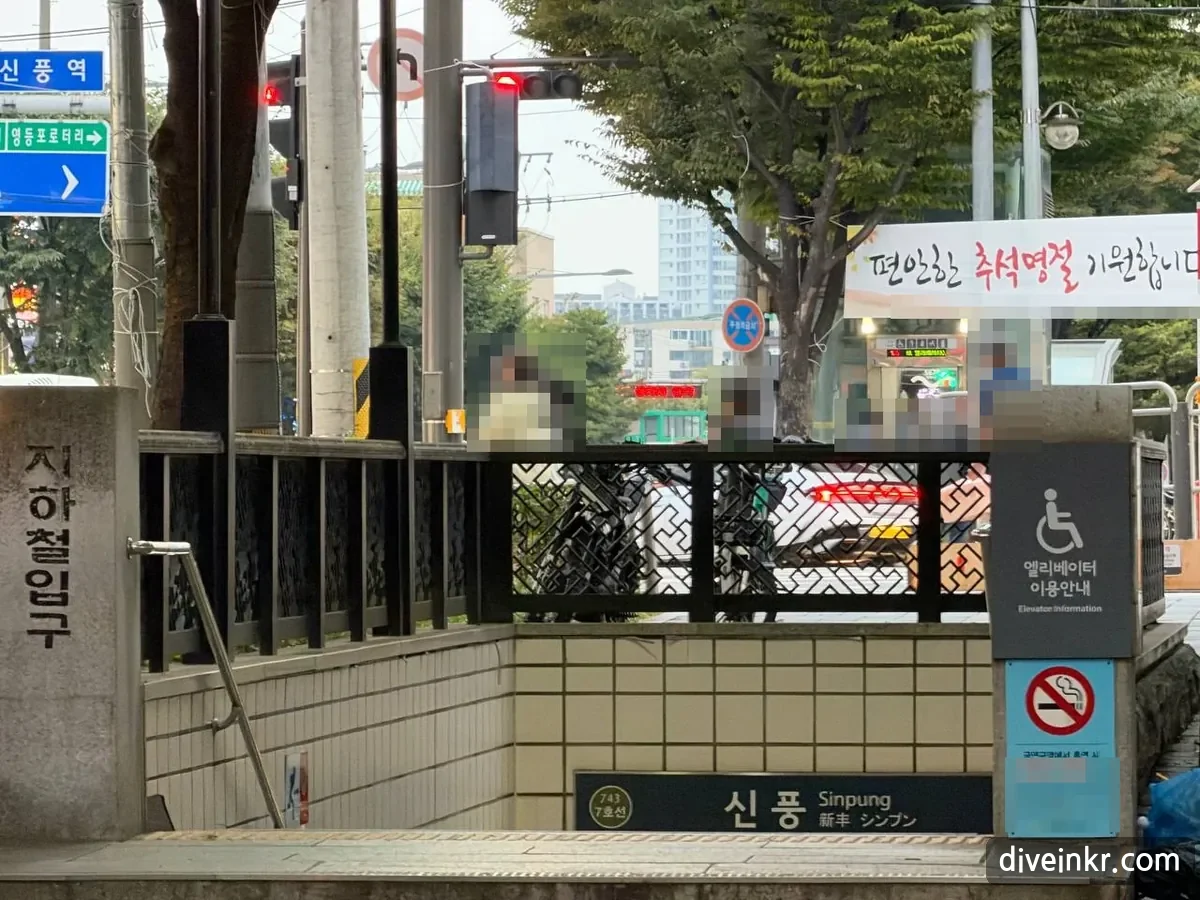
Reading a station number
Station numbers follow a rule. On Lines 1–9 the first digit is the line and the last two digits are the station's place along that line — so 743 (신풍, in the photo) is Line 7, stop 43. Numbers count up from one end of the line, but they don't always start at 01: some lines left the first few numbers free so future extensions could slot in (Line 3 starts at 309). A transfer station has one number per line — City Hall (시청) is 132 on Line 1 and 201 on Line 2 (it's the starting point of our City Hall to Namdaemun Market walk).
| Number looks like | Meaning | Example |
|---|---|---|
| 743 | Line 7, 43rd position along the line | 신풍 Sinpung |
| 201 | Line 2, position 01 | 시청 City Hall |
| 211-1 | A station on a branch line that splits off at station 211 | Line 2's Seongsu branch |
| K110 | K = a line run by Korail; the digits after it identify the line and the stop | 용산 Yongsan (Gyeongui–Jungang Line) |
| A01, D07 | Letters for other operators: A = Airport Railroad (AREX), D = Shinbundang Line | 서울역 Seoul Station (A01) |
Why bother with numbers? If you can't read a station name yet, the number on the map, the platform sign and the entrance is the same everywhere — matching 743 is easier than matching 신풍.
Every line has a color and a number (1호선 is Line 1, 2호선 is Line 2), and every station has a station number shown on the signs. You'll hear the subway called both 지하철 and 전철 — the 전 in 전철 is "electric" (電, the electricity root). Big stations have many numbered exits (출구) that can come out blocks apart, so the exit number matters as much as the station: directions in Korea are given as "종각역 4번 출구" (Jonggak Station, exit 4), like the start of our Jongno walk. Some station names also carry a landmark in brackets, such as 광화문(세종문화회관) at Gwanghwamun Square. Naver Map and KakaoMap tell you the best exit for your destination; that's what most people in Korea use.
Changing lines inside a station usually doesn't need a new tap — you follow the transfer signs (갈아타는 곳) to the other platform and tap only when you finally leave. The exception is a few transfers between lines run by different operators, which have a transfer gate where you tap once more.
| Sign / word | Romanization | Meaning |
|---|---|---|
| 타는 곳 | taneun got | To the trains / platforms (literally "the place where you board") |
| 나가는 곳 | naganeun got | Way out (literally "the place where you go out") |
| 갈아타는 곳 | garataneun got | Transfer (literally "the place where you change") |
| ○번 출구 | ○beon chulgu | Exit ○ |
| 승강장 | seunggangjang | Platform |
| 환승 | hwanseung | Transfer — the formal word, as in 환승역 (transfer station) and 환승 할인 (transfer discount) |
| 교통카드 · 충전 | gyotongkadeu · chungjeon | Transit card · topping up |
| 첫차 · 막차 | cheotcha · makcha | First train · last train |
The signs use plain words — 타는 곳, 나가는 곳, 갈아타는 곳 — while announcements and fare notices use the formal Sino-Korean ones like 승강장 and 환승. It's worth knowing both.
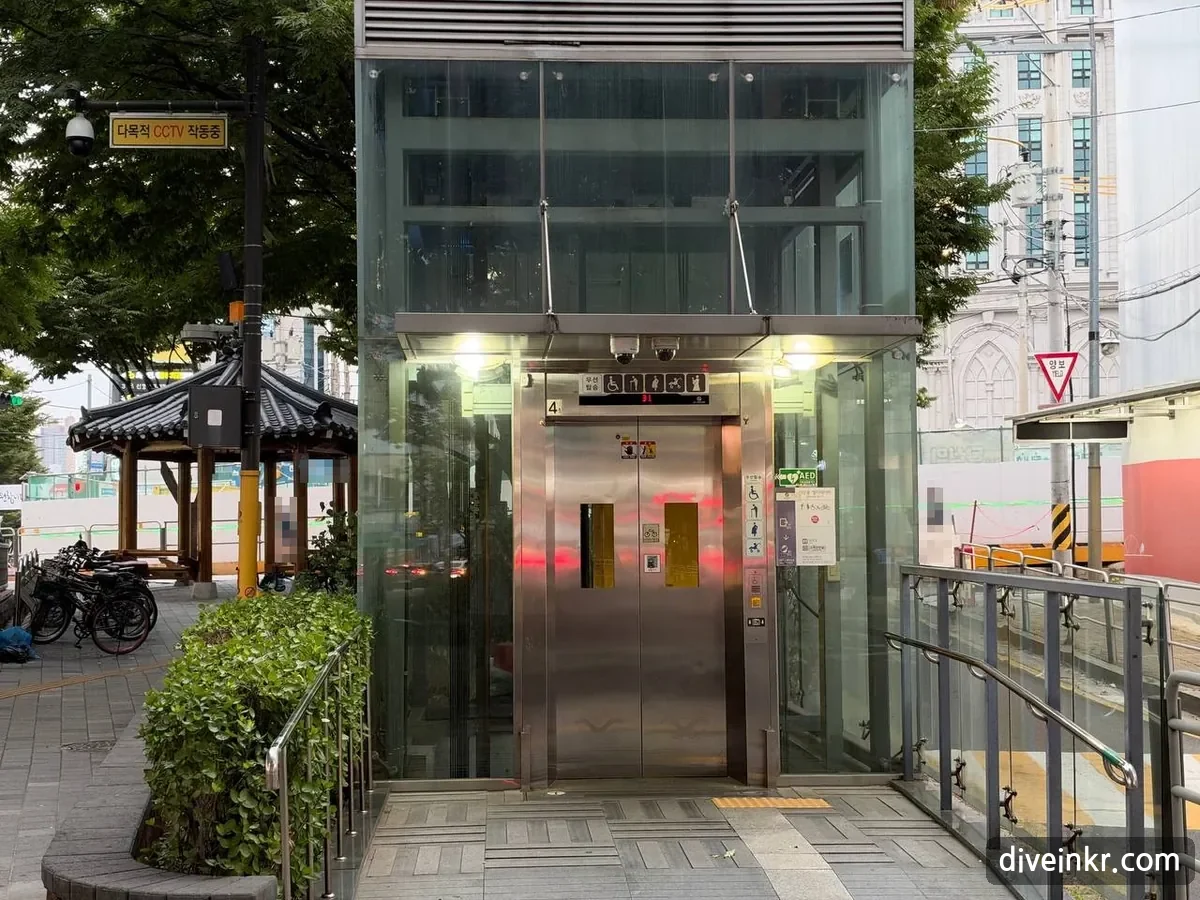
Not every exit has an escalator, and stairs can be long. More and more stations are adding street-level elevators like the one above for people who have trouble with stairs, so it's worth looking for the elevator sign (엘리베이터) — map apps usually mark which exit has one.
On the Train: Doors and Announcements
Doors open by themselves at every station — there's no button to press, unlike some trains in other countries. What changes from station to station is the side: sometimes the doors on your left open, sometimes the right. Before each stop, the announcement gives the station name and the door side, in Korean and then English (major stations add Chinese and Japanese).
이번 역은 ○○, ○○역입니다.
ibeon yeogeun ○○, ○○yeogimnida.
This stop is ○○.
The station name is said twice — once on its own, once with 역 (station).
내리실 문은 오른쪽입니다.
naerisil muneun oreunjjogimnida.
The doors are on your right.
왼쪽 = left, 오른쪽 = right.
△△ 방면으로 가실 고객께서는 이번 역에서 ○호선으로 갈아타시기 바랍니다.
△△ bangmyeoneuro gasil gogaekkkeseoneun ibeon yeogeseo ○hoseoneuro garatasigi baramnida.
Passengers heading toward △△, please change to Line ○ at this station.
방면 means "direction" — the line is named by where it's headed.
이번 역은 우리 열차의 종착역인 ○○역입니다.
ibeon yeogeun uri yeolchaui jongchagyeogin ○○yeogimnida.
This stop is ○○, the last stop for this train.
종착역 = terminus. Everyone gets off here.
출입문 닫겠습니다.
churimmun datgetseumnida.
The doors are closing.
출입문 = door (literally "exit-entrance door"). Don't run for it.
Listen for the music
Transfer stations play a short jingle before the announcement — music you never hear at ordinary stations. The tune depends on the line you're riding, but the rule is the same: if unfamiliar music starts playing, you're pulling into a transfer station.
Seats to Leave Empty
- 교통약자석 — the seats at both ends of each car are for older people, people with disabilities, and others who need them. They're usually left empty. Nobody will tell you off for sitting there, but you may get looks.
- 임산부 배려석 — the pink seats, two per car at the ends of the long middle benches, are for pregnant passengers. Seoul runs a campaign asking riders to keep them empty, even when the train is busy.
- Drinking water or a drink on the train is fine. From bread, sandwiches or gimbap onward — anything that counts as eating — you may get looks.
Useful Things to Say
○○역 어떻게 가요?
○○yeok eotteoke gayo?
How do I get to ○○ Station?
몇 번 출구로 나가야 돼요?
myeot beon chulguro nagaya dwaeyo?
Which exit number should I take?
여기서 2호선으로 갈아탈 수 있어요?
yeogiseo i-hoseoneuro garatal su isseoyo?
Can I change to Line 2 here?
For the rest of the trip, see how to ride a bus in Seoul, asking for directions, and — if you've missed the last train — taxi phrases. Last trains finish around 1 a.m. on weekdays and around midnight on weekends and holidays, but the last one from your station can leave well before that, so check the app. Careful with the word "subway" itself: in Korean it's 지하철, while 서브웨이 is the sandwich chain.
Mini Quiz
4 short questions — about 2 minute
2. You're changing from Line 2 to Line 4 inside the same station. Do you need to tap your card again?
3. What are the pink seats in the middle of a Seoul subway car for?
4. Which word means the Seoul subway itself?
5. You want the way out of the station. Which sign do you follow?
Part of Korean Phrases for Travelers
Part of Life in Korea: Practical Guides for Foreign Residents
Related Knowledge
- How to ride a bus in Seoul
- Asking for directions in Korean
- Taxi Korean phrases for after the last train
- Subway the sandwich chain — not the train
1 more related
Learn Next
Subway and buses share one fare system — the bus guide shows how transfers between them work.
Will you remember this tomorrow?
Save it — your daily review brings it back right before you'd forget. No account needed.