Korean In-Law Titles Chart: What to Call Your Spouse's Family (Free PDF)
Written and reviewed by Jun and Jin, native Korean speakers
Published · How we write & review
After this page, you can print a chart of Korean in-law titles and know which ones people really use.
10-second answer
The short answer
Marriage brings a whole new set of Korean family words, and this free one-page PDF lays them out: what to call your siblings' spouses, what a wife calls her husband's family (시댁, sidaek), and what a husband calls his wife's family (처가, cheoga). It also flags the dictionary terms you'll rarely hear in real life.
Quick check — did that land?
1. What does a woman call her older sister's husband?
Download the Chart
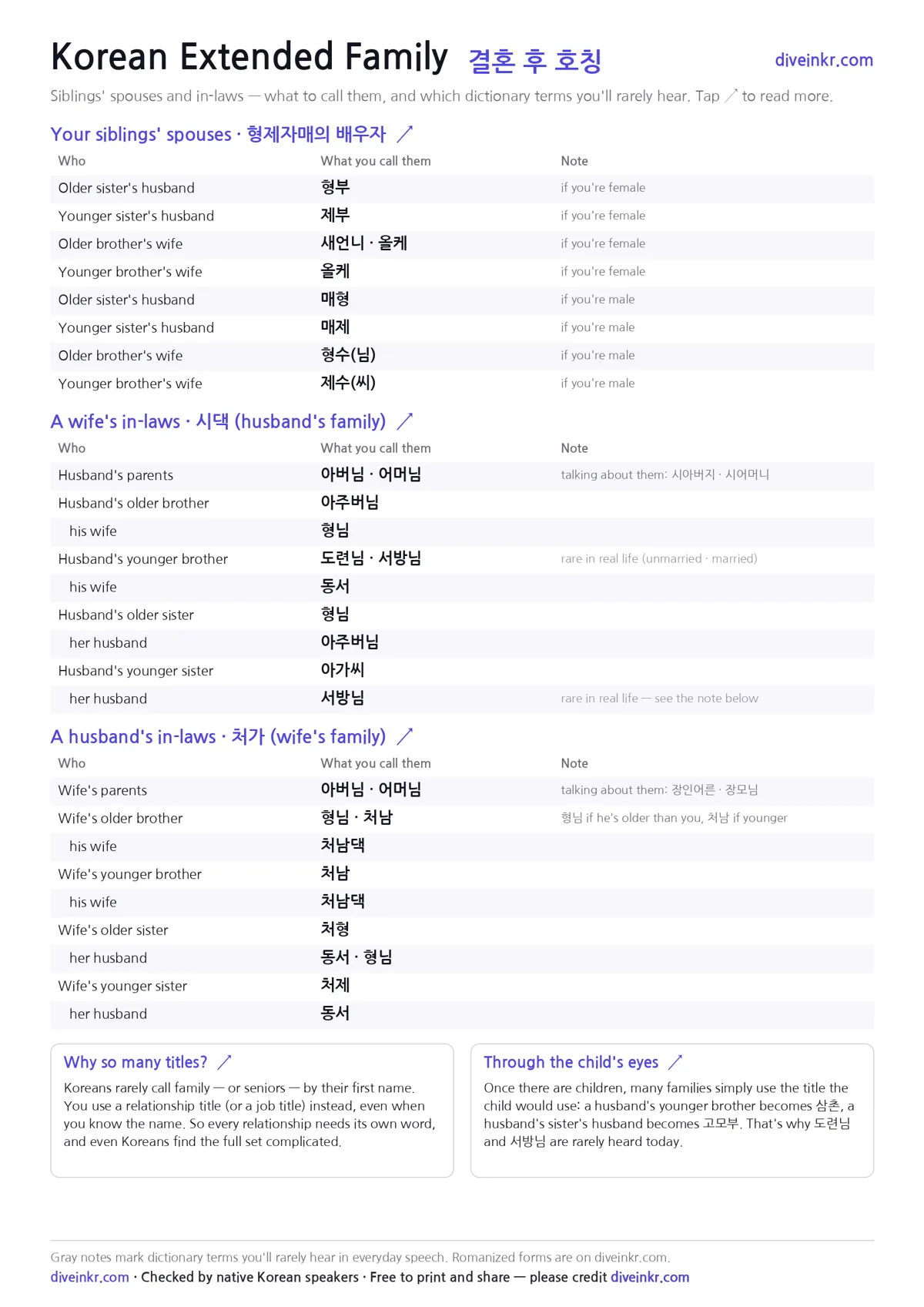
Free to print and share for personal and classroom use — please credit diveinkr.com.
See also: Korean family titles beyond Mom and Dad
How to Use the Chart
- Find your own rows first. The first table depends on whether you're a man or a woman; the second is for wives, the third for husbands. Highlight the rows that apply to you and ignore the rest for now.
- To fit on one page, the PDF leaves out romanization — you'll find every term romanized in the tables below.
- Gray notes on the chart mark dictionary titles you'll rarely hear. Learn to recognize them, but don't worry about using them.
- Review it before a family gathering, such as a Chuseok or Seollal visit, when the whole family is in one room.
- If you haven't learned the basic family words yet, start with the Korean family tree chart — this chart builds on it.
Why Every Relationship Has Its Own Word
Koreans rarely call family members — or anyone senior — by their first name, even when they know it. Instead they use a relationship title, or a job title at work. That's why every relationship needs its own word, and why even Koreans find the full set of in-law titles complicated. More on the habit behind it: why Koreans avoid using names.
The chart's headings link to Korean family titles beyond Mom and Dad for the wider family.
Table 1: Your Siblings' Spouses
Just like 오빠 vs 형 and 언니 vs 누나, the word depends on your own gender as well as theirs.
| Who | If you're female | If you're male |
|---|---|---|
| Older sister's husband | 형부 (hyeongbu) | 매형 (maehyeong) |
| Younger sister's husband | 제부 (jebu) | 매제 (maeje) |
| Older brother's wife | 새언니 (saeeonni) · 올케 (olke) | 형수님 (hyeongsunim) |
| Younger brother's wife | 올케 (olke) | 제수씨 (jesussi) |
형부, 언제 오세요?
Hyeongbu, eonje oseyo?
When are you coming over?
A woman speaking to her older sister's husband — the title replaces "you."
형수님, 잘 먹겠습니다.
Hyeongsunim, jal meokgetseumnida.
Thank you for the meal.
A man to his older brother's wife before eating. See 잘 먹겠습니다.
Table 2: A Wife's In-Laws (시댁)
시댁 (sidaek) is the husband's family. A wife addresses her parents-in-law as 아버님 (abeonim) and 어머님 (eomeonim); when she talks about them, they're 시아버지 (siabeoji) and 시어머니 (sieomeoni).
| Who | What she calls them | Note |
|---|---|---|
| Husband's parents | 아버님 (abeonim) · 어머님 (eomeonim) | Talking about them: 시아버지 · 시어머니 |
| Husband's older brother | 아주버님 (ajubeonim) | |
| his wife | 형님 (hyeongnim) | |
| Husband's younger brother | 도련님 (doryeonnim) · 서방님 (seobangnim) | Rare in real life (unmarried · married) |
| his wife | 동서 (dongseo) | |
| Husband's older sister | 형님 (hyeongnim) | |
| her husband | 아주버님 (ajubeonim) | |
| Husband's younger sister | 아가씨 (agassi) | |
| her husband | 서방님 (seobangnim) | Rare in real life |
어머님, 저녁 드셨어요?
Eomeonim, jeonyeok deusyeosseoyo?
Have you had dinner, Mother?
A daughter-in-law to her mother-in-law. 드시다 is the honorific form of 먹다.
형님, 제가 도와드릴게요.
Hyeongnim, jega dowadeurilgeyo.
Let me help you.
A wife to her husband's older sister, or to the wife of her husband's older brother. Yes — women say 형님 too.
Table 3: A Husband's In-Laws (처가)
처가 (cheoga) is the wife's family. A husband also addresses his parents-in-law as 아버님 and 어머님, and refers to them as 장인어른 (jangineoreun) and 장모님 (jangmonim).
| Who | What he calls them | Note |
|---|---|---|
| Wife's parents | 아버님 (abeonim) · 어머님 (eomeonim) | Talking about them: 장인어른 · 장모님 |
| Wife's older brother | 형님 (hyeongnim) · 처남 (cheonam) | 형님 if he's older than you, 처남 if younger |
| his wife | 처남댁 (cheonamdaek) | |
| Wife's younger brother | 처남 (cheonam) | |
| his wife | 처남댁 (cheonamdaek) | |
| Wife's older sister | 처형 (cheohyeong) | |
| her husband | 동서 (dongseo) · 형님 (hyeongnim) | |
| Wife's younger sister | 처제 (cheoje) | |
| her husband | 동서 (dongseo) |
이번 주말에 장인어른 생신이라서 처가에 가요.
Ibeon jumare jangineoreun saengsiniraseo cheogae gayo.
It's my father-in-law's birthday this weekend, so we're visiting my wife's family.
생신 is the honorific word for an elder's birthday — see happy birthday in Korean.
처제가 다음 달에 결혼해요.
Cheojega daeum dare gyeolhonhaeyo.
My wife's younger sister is getting married next month.
동서 (dongseo) shows up in both tables because it names people who married into the same family alongside you: a wife uses it for the wife of her husband's younger brother, and a husband uses it for the husbands of his wife's sisters.
Dictionary Titles vs. Real Life
Some titles survive mostly in dictionaries. 도련님 (a husband's younger brother) and 서방님 (a husband's married younger brother, or a husband's younger sister's husband) are rarely heard in everyday speech today.
Common Learner Mistakes
- Addressing a parent-in-law as 시어머니 or 장모님. On the chart, those are the words for talking about them; face to face, it's 어머님 and 아버님.
- Thinking 형님 is only for men. A wife calls her husband's older sister 형님, and the wife of her husband's older brother too.
- Reading 아가씨 as "young lady" here. It does mean that elsewhere, but in a wife's family vocabulary it's her husband's younger sister.
- Calling every brother-in-law 처남. If your wife's older brother is older than you, call him 형님.
- Mixing the female and male sets: a woman's older sister's husband is 형부, a man's is 매형.
Mini Quiz
1. What does a woman call her older sister's husband?
2. Why does Korean have so many family titles?
3. Once there are children, what might a wife call her husband's younger brother?
4. A husband's wife has a younger sister. What does he call her?
Related Knowledge
Learn Next
The habit behind every title on this chart — and how it works outside the family too.
Will you remember this tomorrow?
Save it — your daily review brings it back right before you'd forget. No account needed.