Myeongdong: Seoul's Shopping Street, Its Red-Hat Guides and the Cathedral on the Hill
Written and reviewed by Jun and Jin, native Korean speakers
Published · How we write & review
After this page, you can find your way around Myeongdong — the car-free shopping streets, the roaming tourist guides, Daiso and Myeongdong Cathedral — read the signs, and ask for help, sizes, tax refunds and street food in simple Korean.
10-second answer
The short answer
명동 (Myeongdong) is central Seoul's busiest shopping district for visitors: cosmetics, fashion, street food and signs in several languages, on main streets that are car-free from 10:00 to 23:00 every day. If you're lost, look for the guides in red hats and shirts — they speak English, Chinese and Japanese. At the top of the hill stands 명동성당 (Myeongdong Seongdang), Korea's first brick church, built in Gothic style, and N Seoul Tower rises just to the south.
Quick check — did that land?
1. How do you spot Seoul's roaming tourist guides?
A Street Built for Visitors
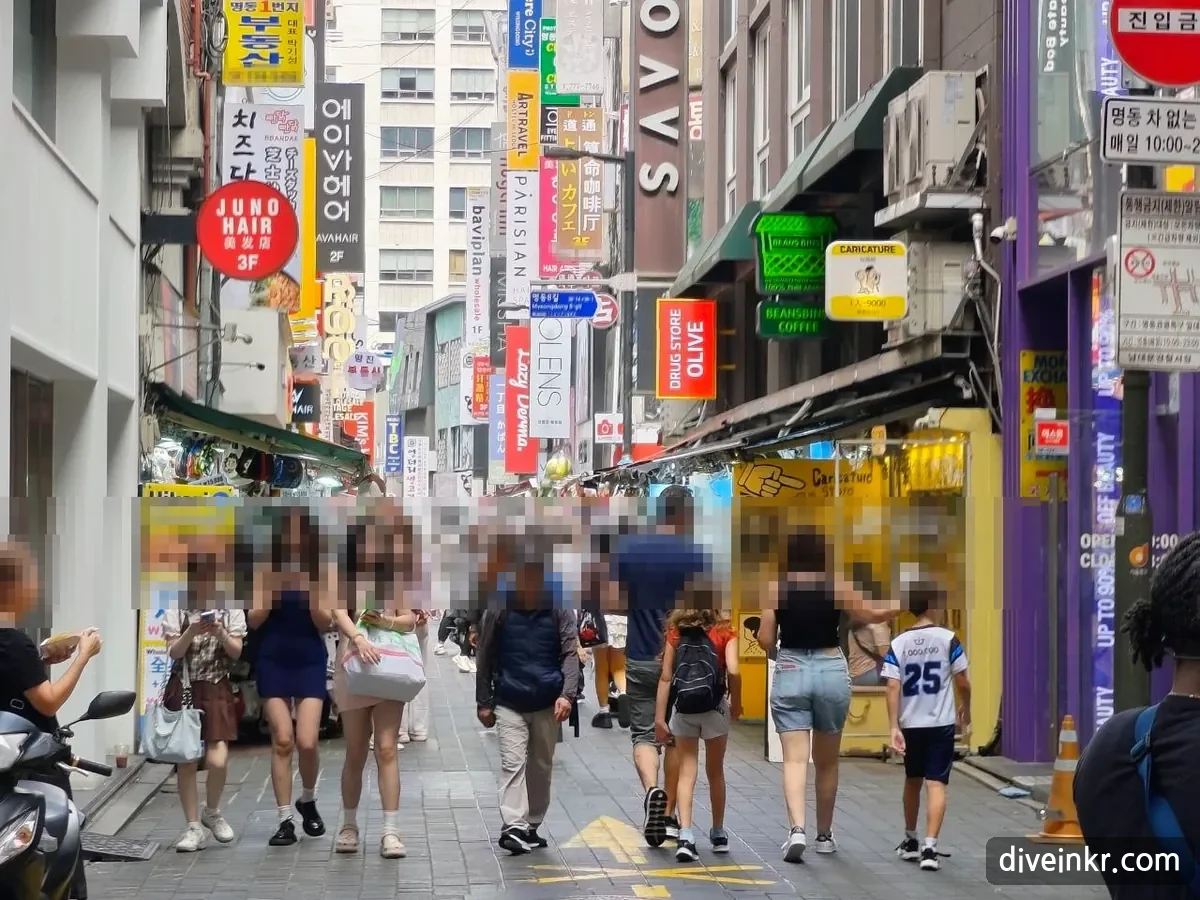
Myeongdong is the part of Seoul that speaks to visitors first. Cosmetics shops line the main streets, stalls sell street food, and signs switch between Korean, English, Chinese and Japanese — we decode some of them in reading Korean street signs. It's busy, a little loud, and easy to get around on foot: look at the top right of the photo. The red sign says 진입금지 ("no entry") and the one below it 명동 차 없는 거리, 매일 10:00~23:00 — "Myeongdong car-free street, every day 10:00–23:00." From mid-morning until late at night, the main streets belong to pedestrians.
The small blue signs on the corners are street names. Korean road names come in three sizes: 대로 (daero) for wide boulevards, 로 (ro) for ordinary roads and 길 (gil) for smaller streets. A 길 usually borrows the name of a bigger road and adds a number that shows roughly where along it the side street branches off — so 명동8길 is "Myeongdong street 8." In a full address, the street name is followed by a building number, and that's what you type into a map app or show a taxi driver.
| On the sign | Romanization | Meaning |
|---|---|---|
| 차 없는 거리 | cha eomneun geori | Car-free street (literally "street without cars") |
| 진입금지 | jinipgeumji | No entry (for vehicles) |
| 매일 | maeil | Every day |
| 길 | gil | Street, small road — as in 명동8길 |
| 로 · 대로 | ro · daero | Road · boulevard |
See also: From City Hall to Namdaemun Market
The Guides in Red Hats
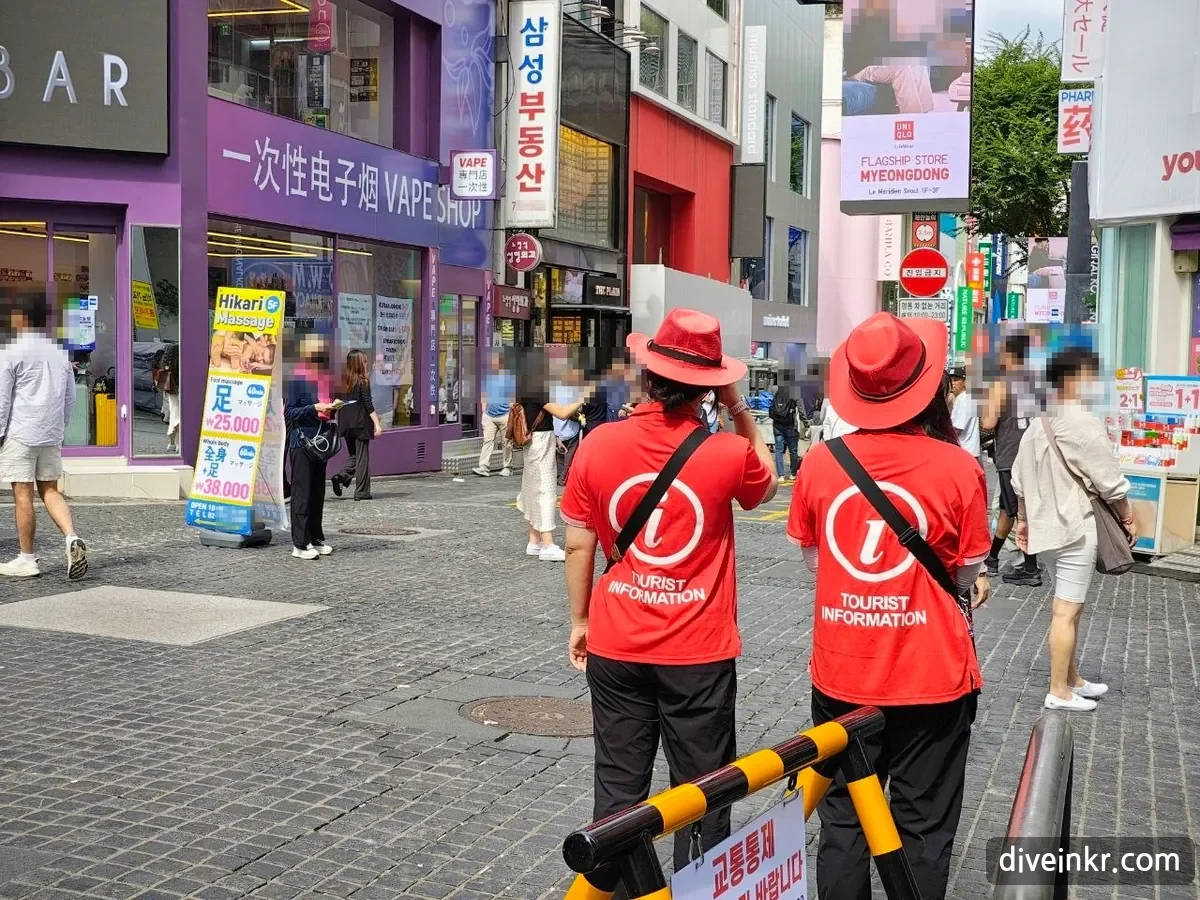
If you see people in red hats and red shirts with a big i on the back, walk up to them. They're Seoul's roaming tourist guides — officially 움직이는 관광안내사, "moving tourist guides," and nicknamed 레드엔젤 (Red Angels). Run by the Seoul Tourism Association for the city since 2009, they work in the busiest tourist areas, such as Myeongdong and Namdaemun Market, and often in pairs. They speak English, Chinese and Japanese, and they're there to answer exactly the questions visitors have: where's this shop, which exit, which bus.
They'll happily answer in English, but a few words of Korean are a nice way to start — and the same lines work with anyone on the street. More in asking for directions in Korean.
실례합니다. 영어 하세요?
sillyehamnida. yeongeo haseyo?
Excuse me. Do you speak English?
명동역이 어디예요?
myeongdongyeogi eodiyeyo?
Where is Myeongdong Station?
명동성당 어떻게 가요?
myeongdongseongdang eotteoke gayo?
How do I get to Myeongdong Cathedral?
이 근처에 환전소 있어요?
i geuncheoe hwanjeonso isseoyo?
Is there a currency exchange near here?
지도 있어요?
jido isseoyo?
Do you have a map?
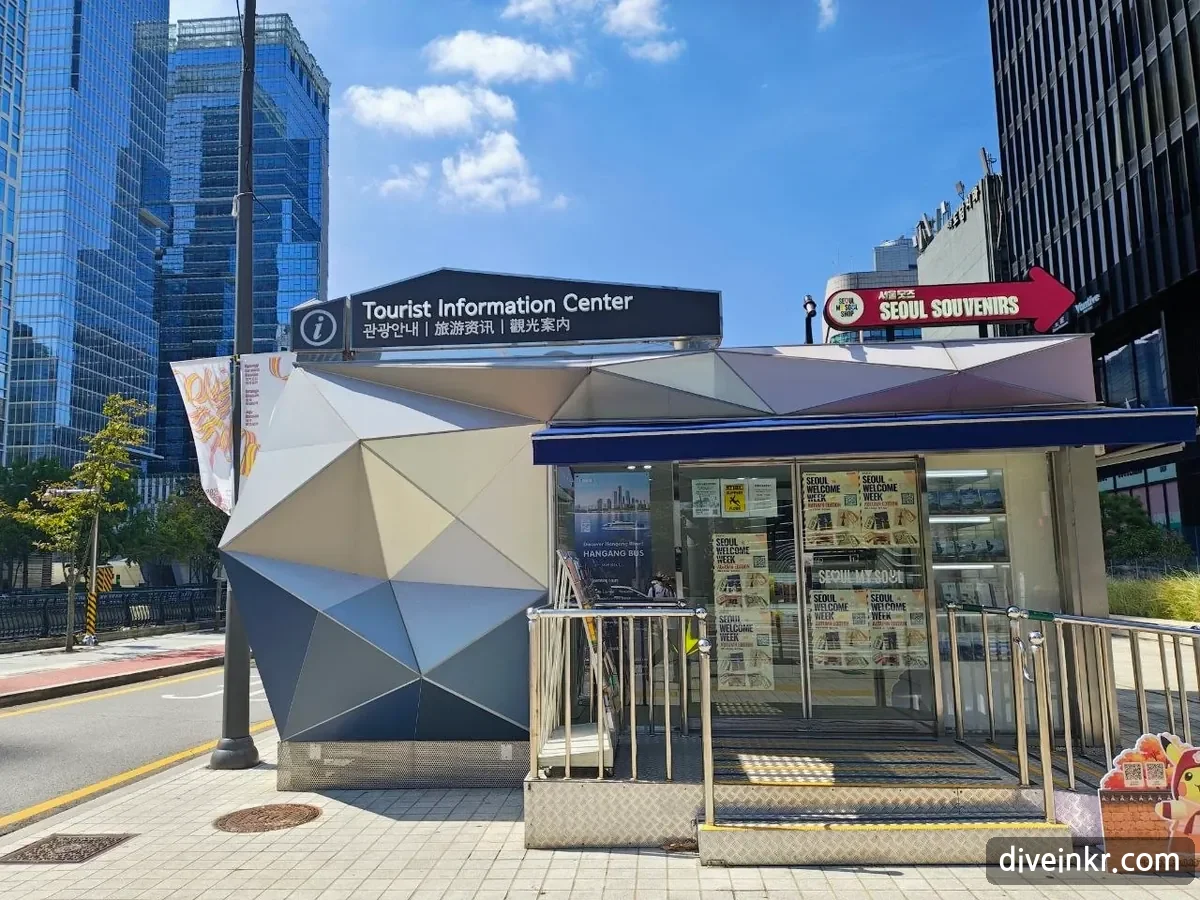
For a sit-down question or a map, there are fixed tourist information centers too, like the booth above beside Cheonggyecheon. Seoul's big visitor center, the Seoul Tourism Plaza (서울관광플라자), is also on the Cheonggyecheon side, at Cheonggyecheon-ro 85, with a tourist information desk and a souvenir shop on the first floor.
다이소: A Whole Building, Nothing Over 5,000 Won
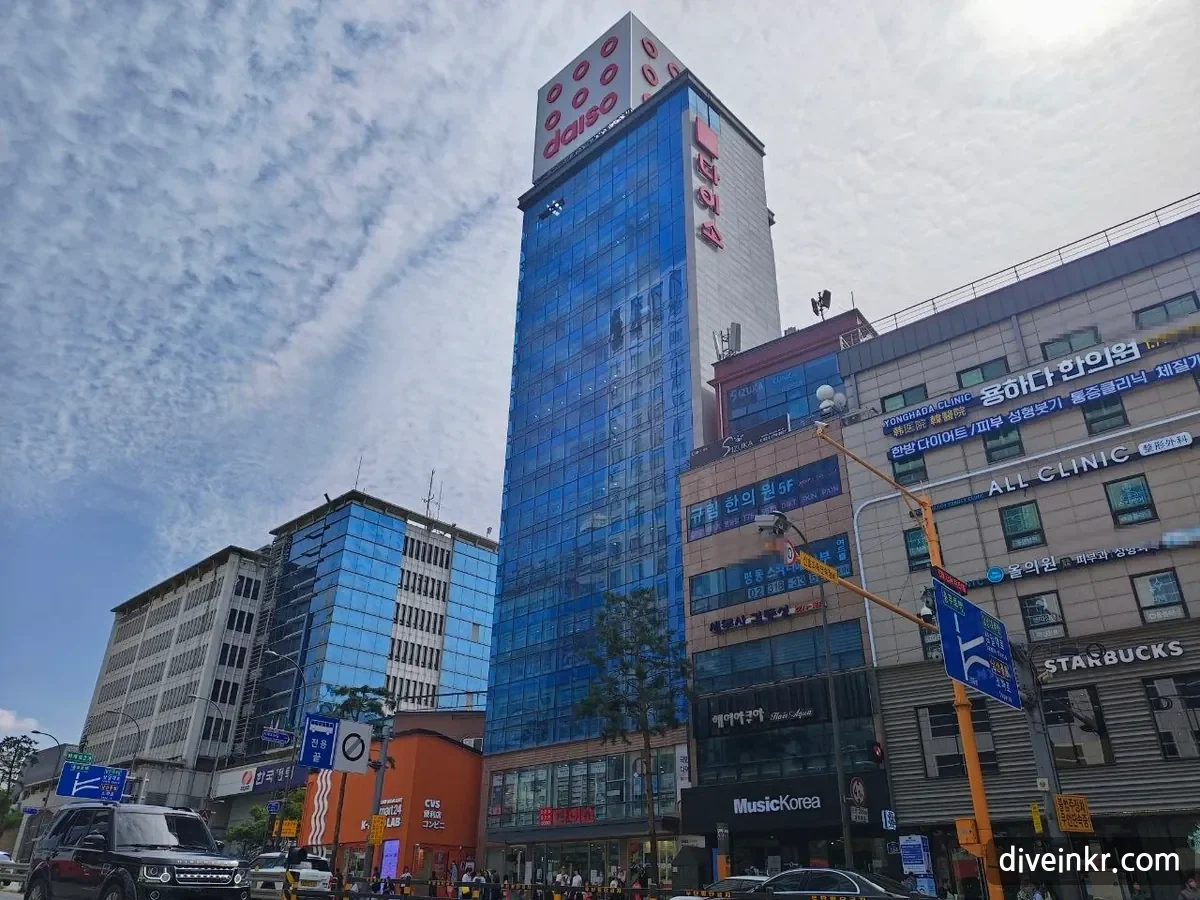
The tall blue tower with the red logo is 다이소 (Daiso), a Korean chain of budget household goods — and a favorite with visitors for cheap snacks, stationery, cosmetics and souvenirs. Every item comes in one of six prices: 500, 1,000, 1,500, 2,000, 3,000 or 5,000 won, and nothing costs more. When the Myeongdong Station store reopened in 2023, it took over the entire building, floors 1 to 12, with beauty, stationery, kitchenware, bathroom and hobby goods on separate floors.
Those six prices are also a quick drill in reading won out loud. Notice that 1,000 is just 천, not 일천 — see how to ask the price:
| Price | Said as | Romanization |
|---|---|---|
| 500원 | 오백 원 | obaek won |
| 1,000원 | 천 원 | cheon won |
| 1,500원 | 천오백 원 | cheonobaek won |
| 2,000원 | 이천 원 | icheon won |
| 3,000원 | 삼천 원 | samcheon won |
| 5,000원 | 오천 원 | ocheon won |
이거 몇 층에 있어요?
igeo myeot cheunge isseoyo?
Which floor is this on?
Floors use Sino-Korean numbers: 삼 층, 오 층 — see floor signs.
계산은 어디서 해요?
gyesaneun eodiseo haeyo?
Where do I pay?
Shopping in Myeongdong: Sizes, Testers and Tax Refunds
Most of Myeongdong's shops are chain stores with fixed prices, so the Korean you need is less about bargaining and more about asking: for another size, a tester, a card payment or a tax refund. Look for TAX FREE or TAX REFUND signs. At those shops, foreign visitors can get back the tax included in the price on purchases of 15,000 won or more — have your passport ready at the till.
다른 사이즈 있어요?
dareun saijeu isseoyo?
Do you have another size?
더 작은 거 있어요?
deo jageun geo isseoyo?
Do you have a smaller one?
Swap 작은 (smaller) for 큰 (bigger): 더 큰 거 있어요?
이거 테스트해 봐도 돼요?
igeo teseuteuhae bwado dwaeyo?
Can I try this (tester)?
택스 리펀드 돼요?
taekseu ripeondeu dwaeyo?
Can I get a tax refund?
여권 여기 있어요.
yeogwon yeogi isseoyo.
Here's my passport.
카드 돼요?
kadeu dwaeyo?
Do you take cards?
좀 깎아 주세요.
jom kkakka juseyo.
Could you give me a discount?
Works at street stalls and markets, not at chain stores with fixed prices.
If bargaining is what you're after, a traditional market is the place: Namdaemun Market is a short walk west, and our walk from City Hall to Namdaemun Market shows how to read its hand-written sale signs. For more lines like these, see shopping phrases in Korean.
Street Food Korean
Food stalls are part of the Myeongdong scene. What's on offer changes with the season and the stall, but these are classic Korean street foods you'll see on signs all over the country:
| Korean | Romanization | What it is |
|---|---|---|
| 떡볶이 | tteokbokki | Rice cakes in a sweet-spicy red sauce |
| 어묵 | eomuk | Fish cake, often on a skewer in hot broth |
| 순대 | sundae | Korean blood sausage, usually filled with glass noodles |
| 호떡 | hotteok | A pan-fried pancake with a sweet filling |
| 계란빵 | gyeranppang | Egg bread — a small sweet loaf baked with a whole egg on top |
| 닭꼬치 | dakkkochi | Chicken skewer (닭 chicken + 꼬치 skewer) |
이거 하나 주세요.
igeo hana juseyo.
One of these, please.
Counting items uses native Korean numbers: 하나, 둘, 셋 — 두 개 주세요 is "two, please."
하나에 얼마예요?
hana-e eolmayeyo?
How much for one?
많이 매워요?
mani maewoyo?
Is it very spicy?
안 맵게 해 주세요.
an maepge hae juseyo.
Please make it not spicy.
For sit-down meals, the lines in ordering food in Korean work in any Myeongdong restaurant.
명동성당: The Cathedral on the Hill
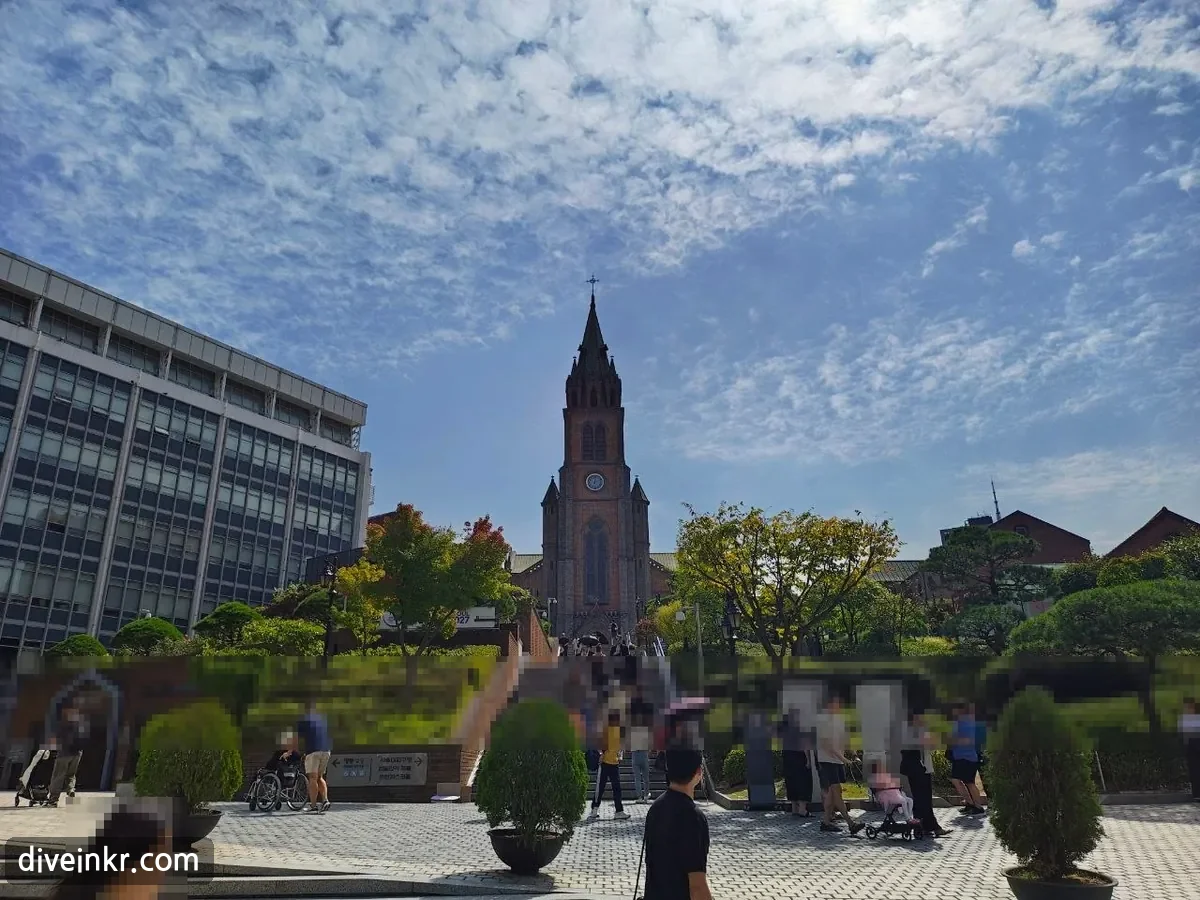
At the top of the hill is 명동성당 (Myeongdong Cathedral), the cathedral of the Catholic Archdiocese of Seoul. It was designed by the French missionary priest Eugène Coste; the foundation stone was laid in 1892, and after Coste died in 1896, Father Poisnel finished the work. Completed on May 29, 1898, it was the first brick church in Korea and is a rare example of pure Gothic brick architecture here; it has been a Historic Site since 1977.
It also has a place in Korea's democratic history: during the June Democratic Struggle of 1987, protesters held a sit-in on its grounds from June 10 to June 15. It's still a working church with regular Masses, so keep your voice down inside.
| Korean | Romanization | Meaning |
|---|---|---|
| 성당 | seongdang | Catholic church |
| 교회 | gyohoe | Protestant church |
| 절 | jeol | Buddhist temple |
| 미사 | misa | Mass |
Looking Up: N Seoul Tower
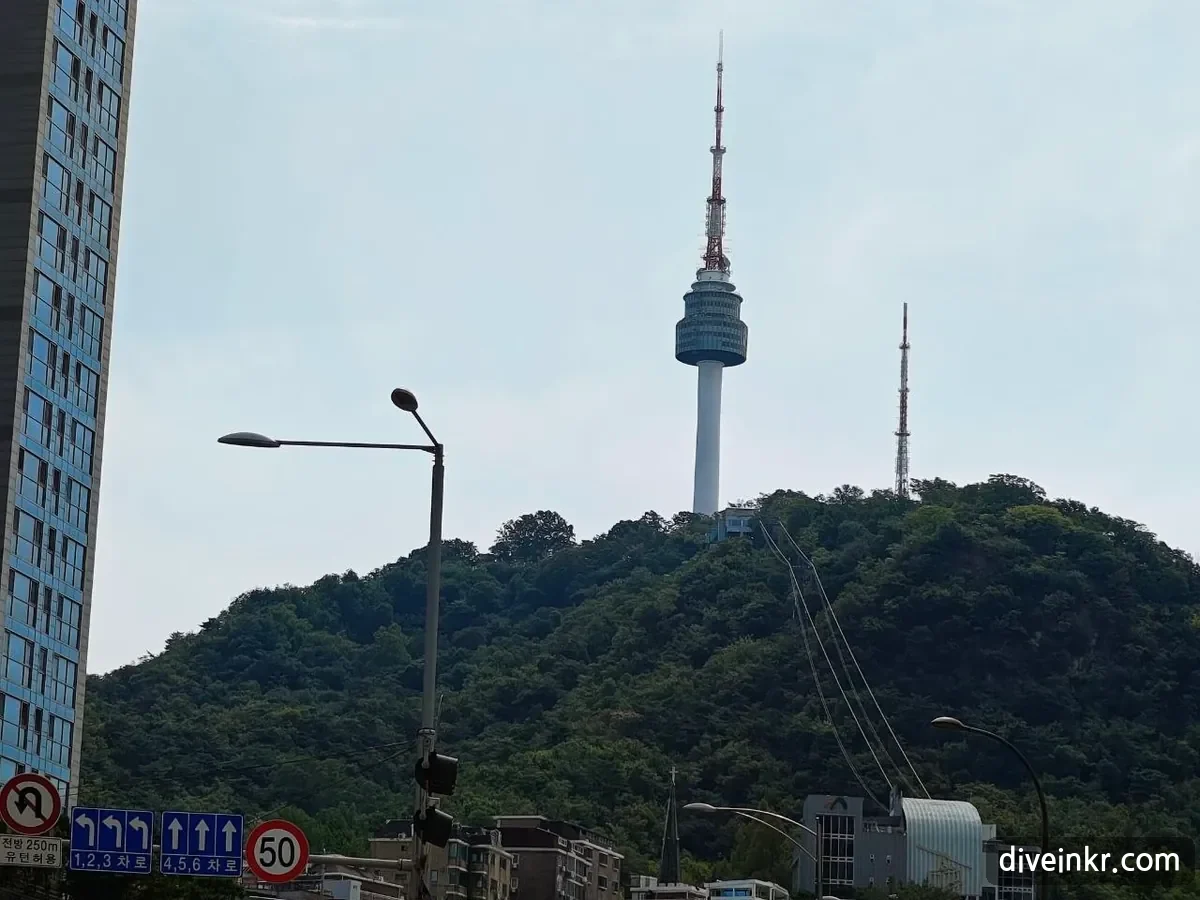
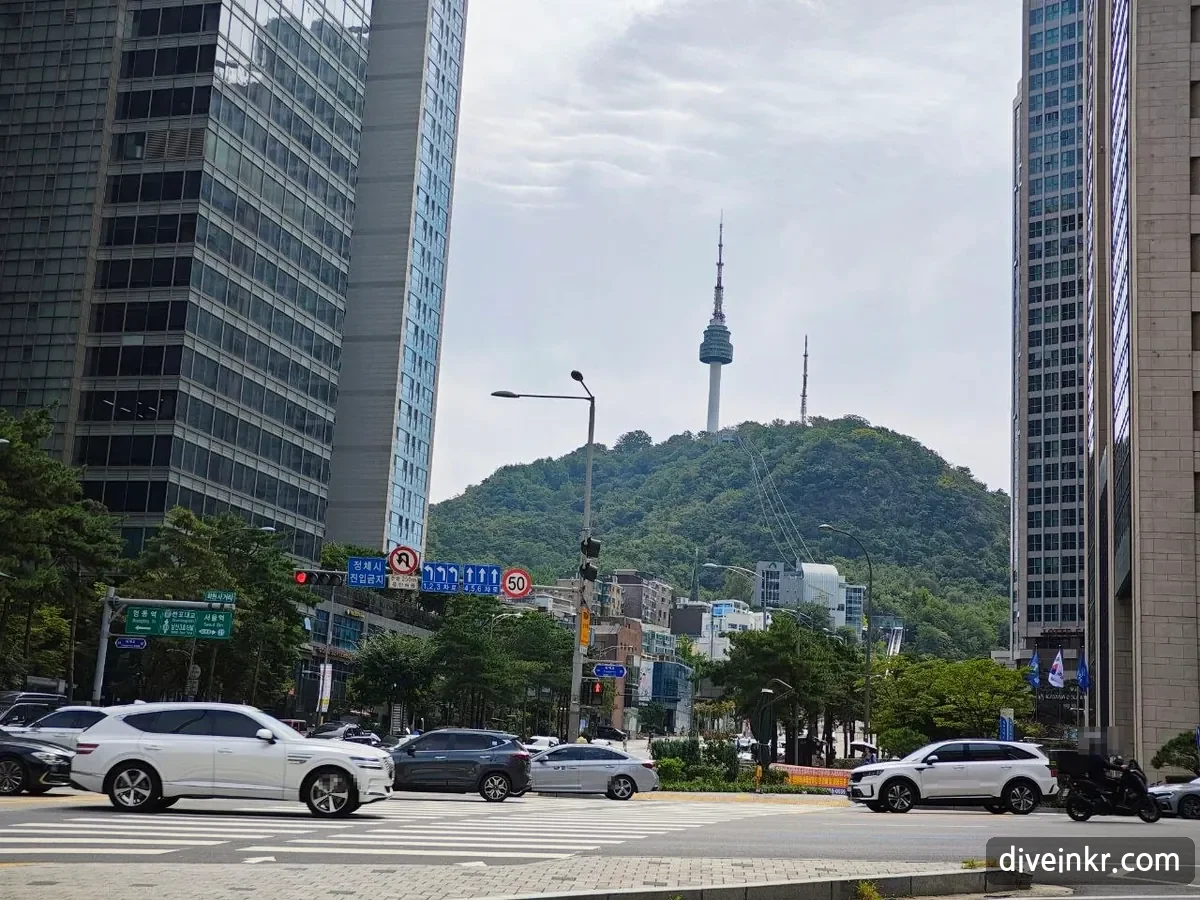
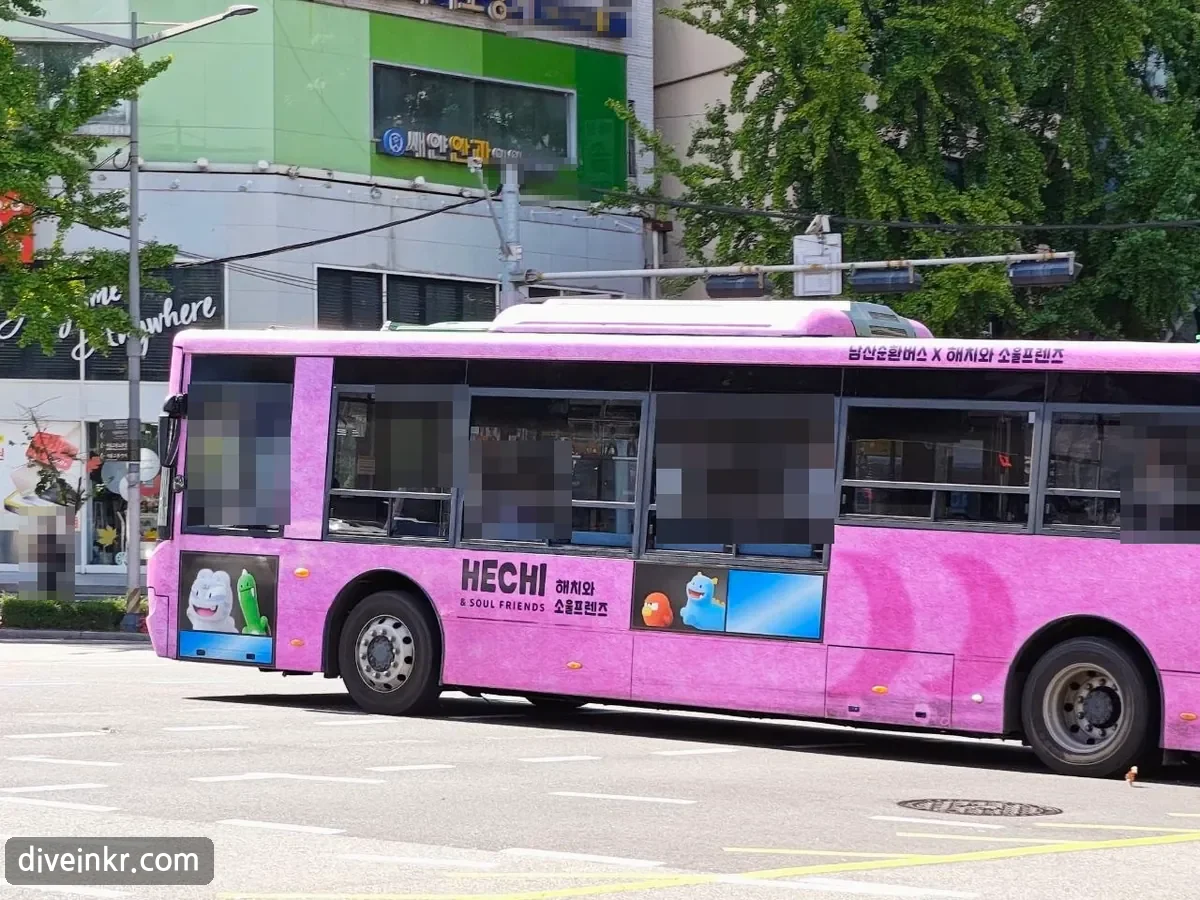
Myeongdong sits at the foot of 남산 (Namsan), and N Seoul Tower rises above the streets to the south — our Jongno walk has the tower's height and history. Road signs around here are good reading practice too: 사거리 (sageori) is a four-way intersection, 전방 (jeonbang) means "ahead," and 차로 (charo) is a traffic lane.
Mini Quiz
1. How do you spot Seoul's roaming tourist guides?
2. A sign says 명동 차 없는 거리. What does it mean?
3. What's the most expensive price at Daiso?
4. What does 성당 mean?
5. What is 명동8길?
Related Knowledge
Learn Next
Myeongdong's signs switch between four languages — this guide shows how to read them.
Will you remember this tomorrow?
Save it — your daily review brings it back right before you'd forget. No account needed.