Dive in Korean

Seoul in Photos: A Gallery of Central Seoul and the Korean You'll See

Written and reviewed by Jun and Jin, native Korean speakers

Published · How we write & review

After this page, you can recognize central Seoul's best-known places from their photos and read one Korean word on each — gate, station, market, street and more.

10-second answer

The short answer

This gallery walks through central Seoul area by area — 광화문 (Gwanghwamun), 종로 (Jongno), 시청 (sicheong, City Hall) and 남대문 (Namdaemun), 명동 (Myeongdong) and 남산 (Namsan), 인사동 (Insadong), 광장시장 (Gwangjang Sijang) and 동대문 (Dongdaemun). Every photo teaches one Korean word you can see in it, like 문 (mun, gate), 역 (yeok, station) or 시장 (sijang, market), and links to the full walk where the place is explained.

Quick check — did that land?

  1. 1. Which word appears in 광화문, 대한문 and 남대문, and what does it mean?

광화문, 남대문, 동대문! 이름 끝의 문은 출입문이에요. Spot Korean words on real Seoul signs.

How to Use This Gallery

Central Seoul is small enough to walk, and almost every corner has something to read. These photos come from our Seoul walk guides, grouped by area from west to east. Each caption teaches one Korean word in the photo; the link under each area leads to the full guide.

For the island across the river — the Seoul Dal balloon, Yeouido Park and the 63 Building — see our Yeouido walk.

See also: A walk through Jongno

광화문광장: Gwanghwamun Square

The wide plaza in front of 광화문 (Gwanghwamun), the main gate of Gyeongbokgung Palace, with Admiral Yi Sun-sin and King Sejong along the way.
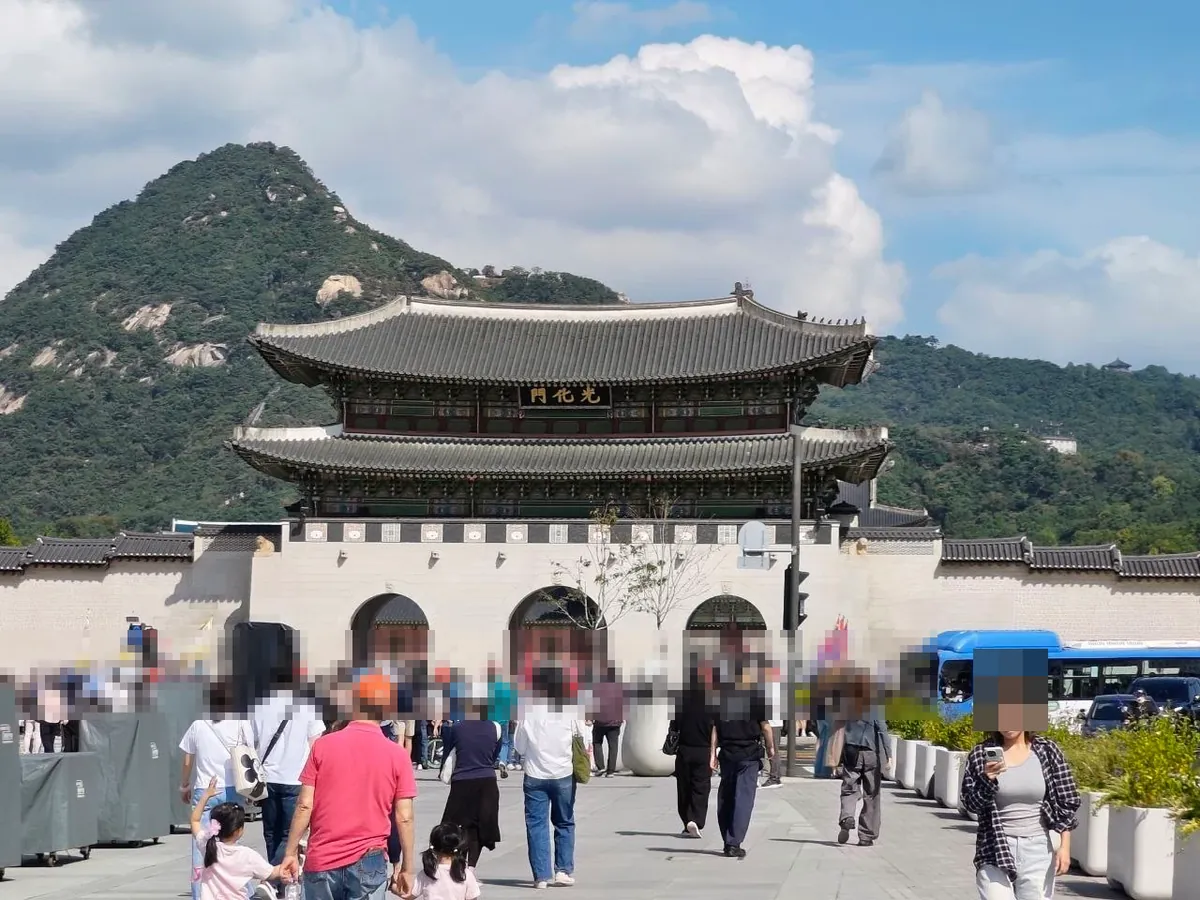
Gwanghwamun, the main gate of Gyeongbokgung Palace: a two-story wooden gate tower with a curved tiled roof and a black name board with gold characters 光化門, on a stone base with three arched openings, crowds of visitors in front and Bugaksan behind (faces blurred)
광화문 (Gwanghwamun). The name board reads 光化門; the last character is 문 (mun), "gate" — as in 동대문 (Dongdaemun) and 남대문 (Namdaemun).
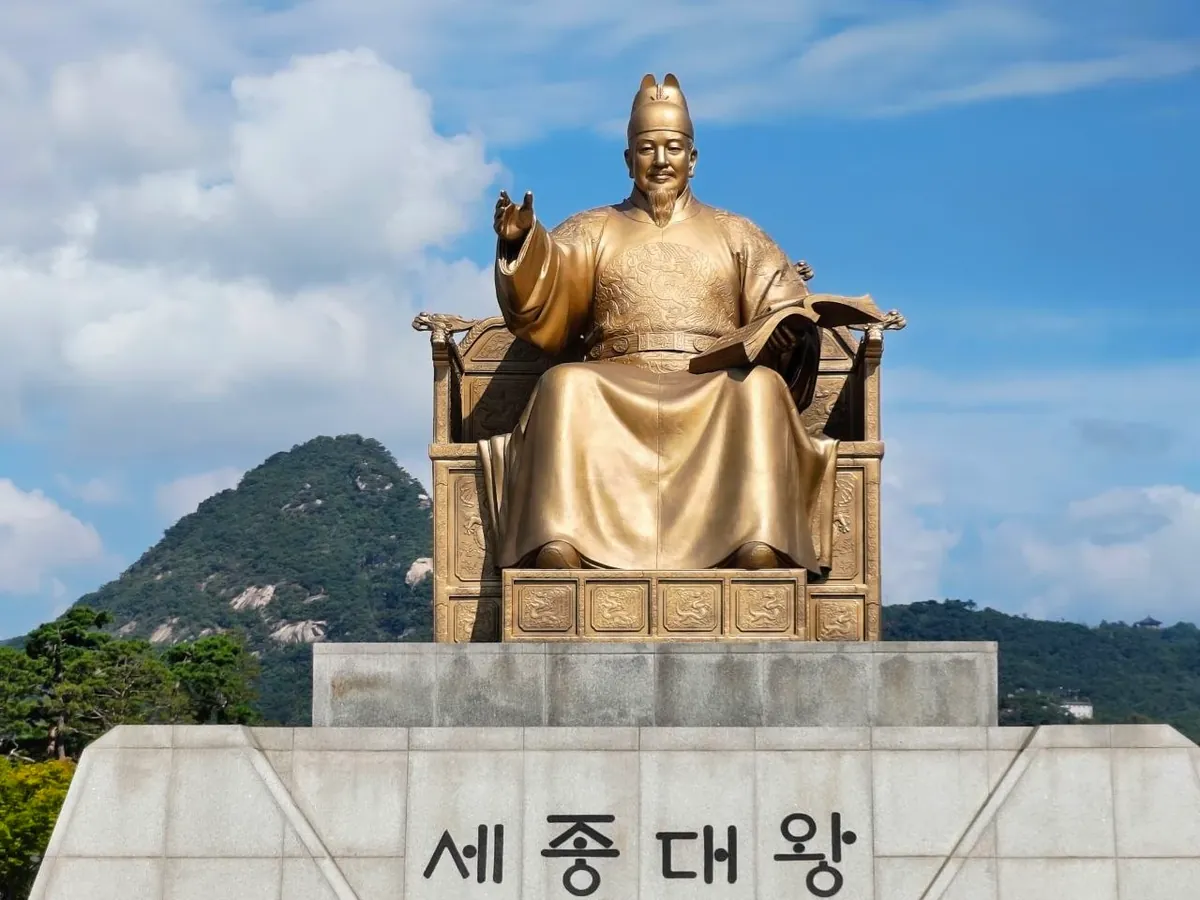
The golden bronze statue of King Sejong seated on a throne, holding an open book in his left hand and raising his right hand, on a stone pedestal engraved 세종대왕 in Hangul, with a green mountain behind
세종대왕 (Sejong Daewang), King Sejong the Great, who created Hangul. His name on the base is written in Hangul — try reading it.
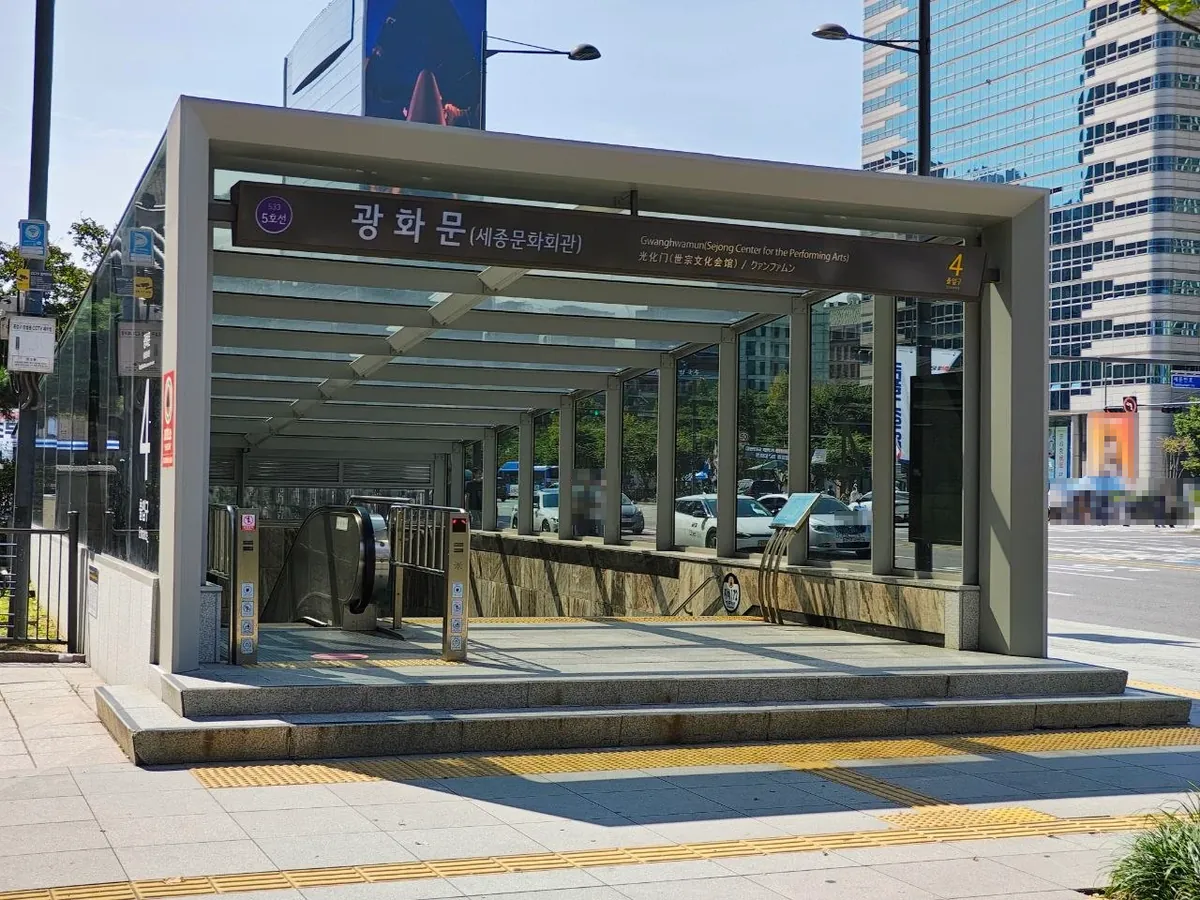
The glass-roofed entrance to exit 4 of Gwanghwamun Station on subway Line 5, with a sign reading 광화문(세종문화회관) Gwanghwamun (Sejong Center for the Performing Arts) and an escalator going down (faces blurred)
Exit 4 of 광화문역 (Gwanghwamun-yeok). 역 (yeok) means "station."

The full guide: Gwanghwamun Square — King Sejong, Admiral Yi and the gate.

종로: Jongno, Bosingak and Cheonggyecheon

종로 (Jongno) means "Bell Street" — Seoul's old downtown, named after the bell at Bosingak.
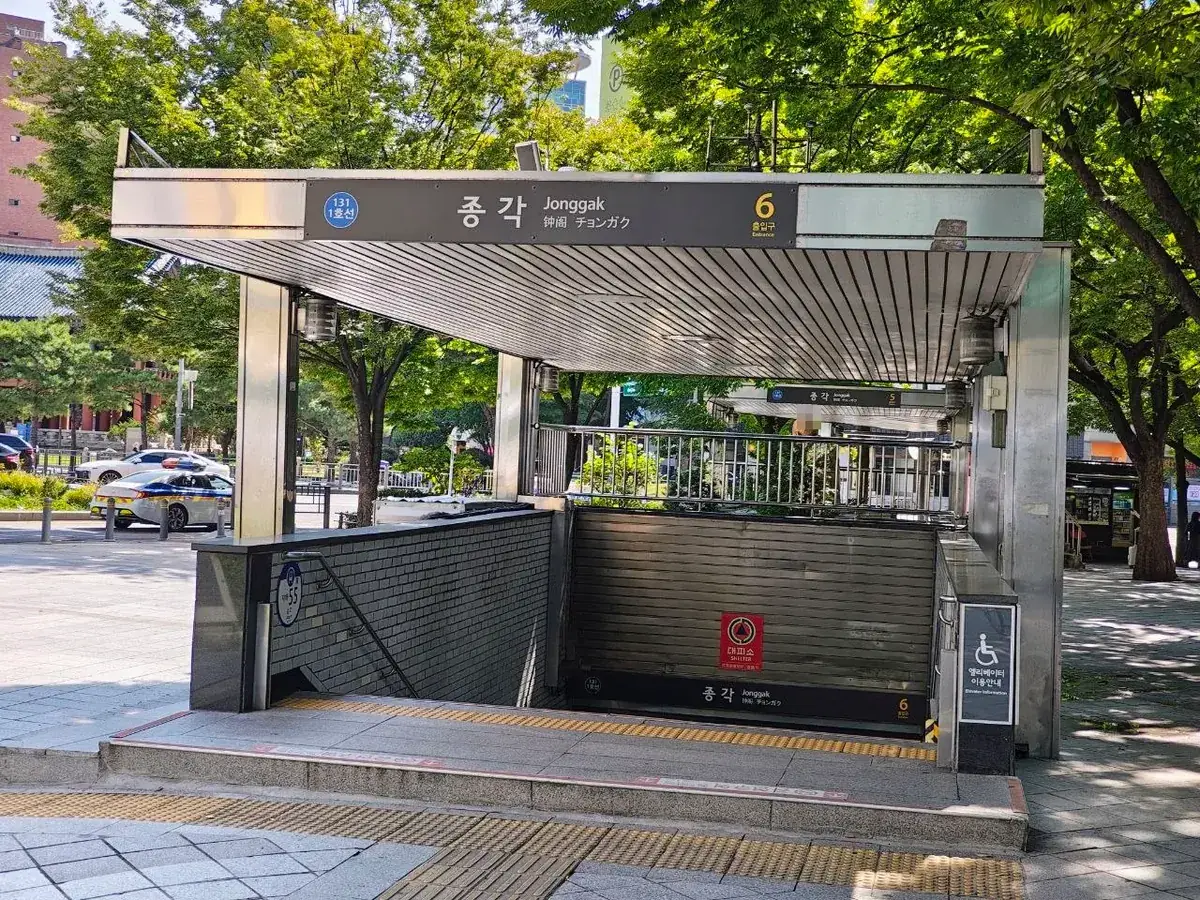
The covered entrance to exit 6 of Jonggak Station on Seoul subway Line 1, with a sign reading 종각 Jonggak 钟阁 チョンガク and the number 6, stairs leading down past a red 대피소 SHELTER sign, and trees and traffic behind
Exit 6 of 종각 (Jonggak) Station. 종각 literally means "bell pavilion" — the station is named after Bosingak.
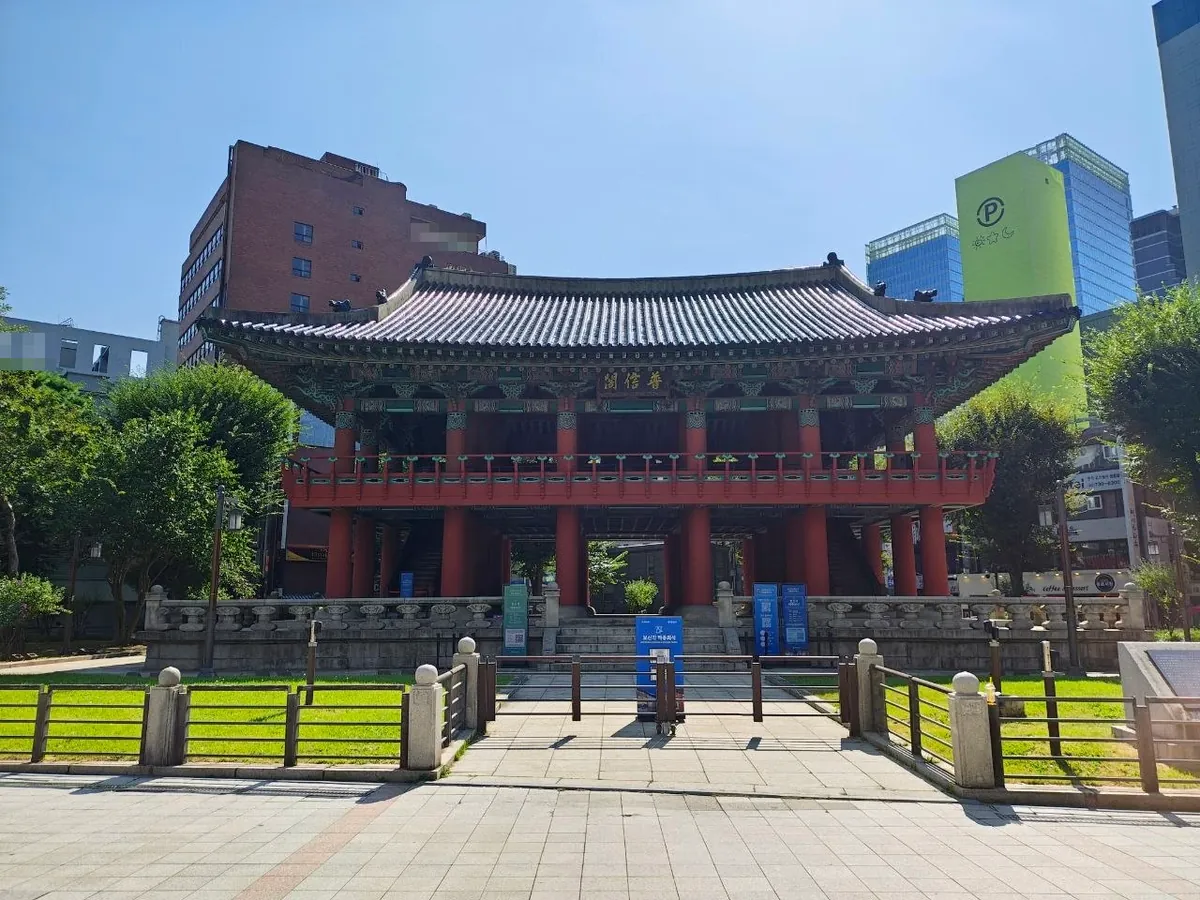
The Bosingak bell pavilion in Jongno, Seoul: a two-story traditional pavilion with red columns, painted beams and a curved tiled roof, behind a low stone fence and lawn, with modern buildings around it
보신각 (Bosingak), where the bell is rung 33 times at midnight every New Year's Eve.
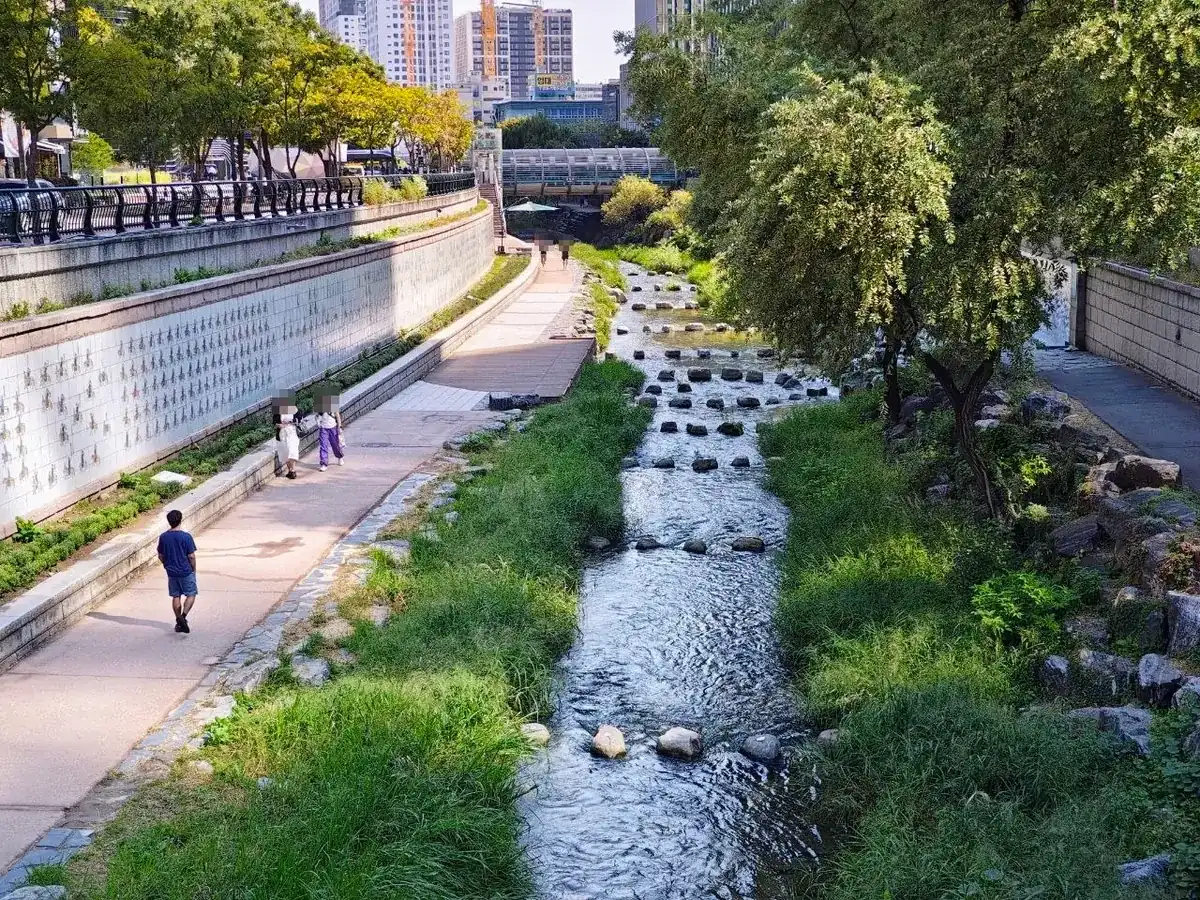
Cheonggyecheon stream in central Seoul seen from a bridge: clear water running over rows of stepping stones between grassy banks, a paved walkway on the left below a tiled wall, and people strolling (faces blurred)
The rows of stones in 청계천 (Cheonggyecheon) are 징검다리 (jinggeomdari), stepping stones — you can cross the stream on them.
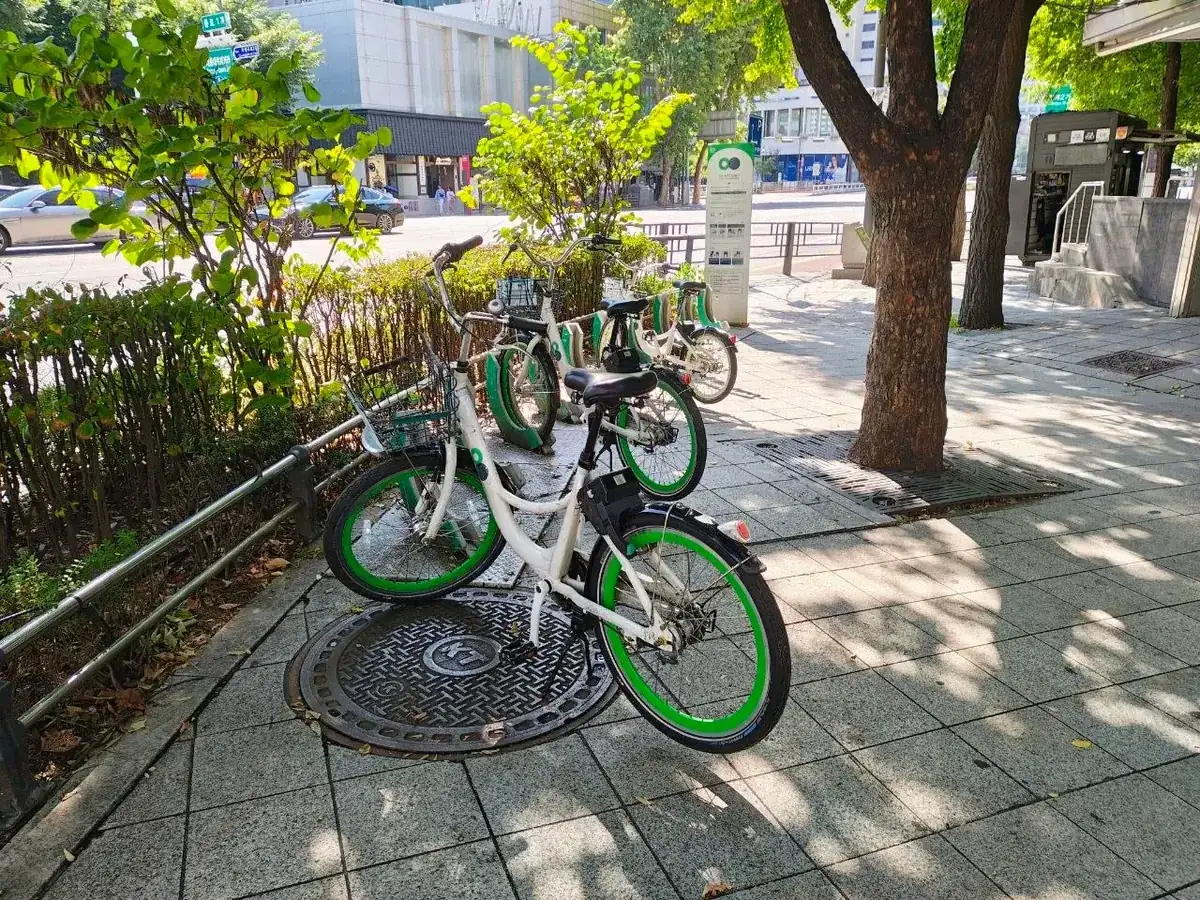
Three white Seoul public bikes with green wheels and front baskets docked at a rental station on a tree-shaded sidewalk near Jonggak Station, with the station's information post behind them
따릉이 (Ttareungyi), Seoul's public bikes: white frames, green wheels, a basket in front.

The full walk: Jongno — Bosingak, Cheonggyecheon and the Korean around them.

시청 to 남대문시장: City Hall to Namdaemun Market

A 15–20-minute walk south from City Hall to the market, past a palace gate and Seoul's old south gate.
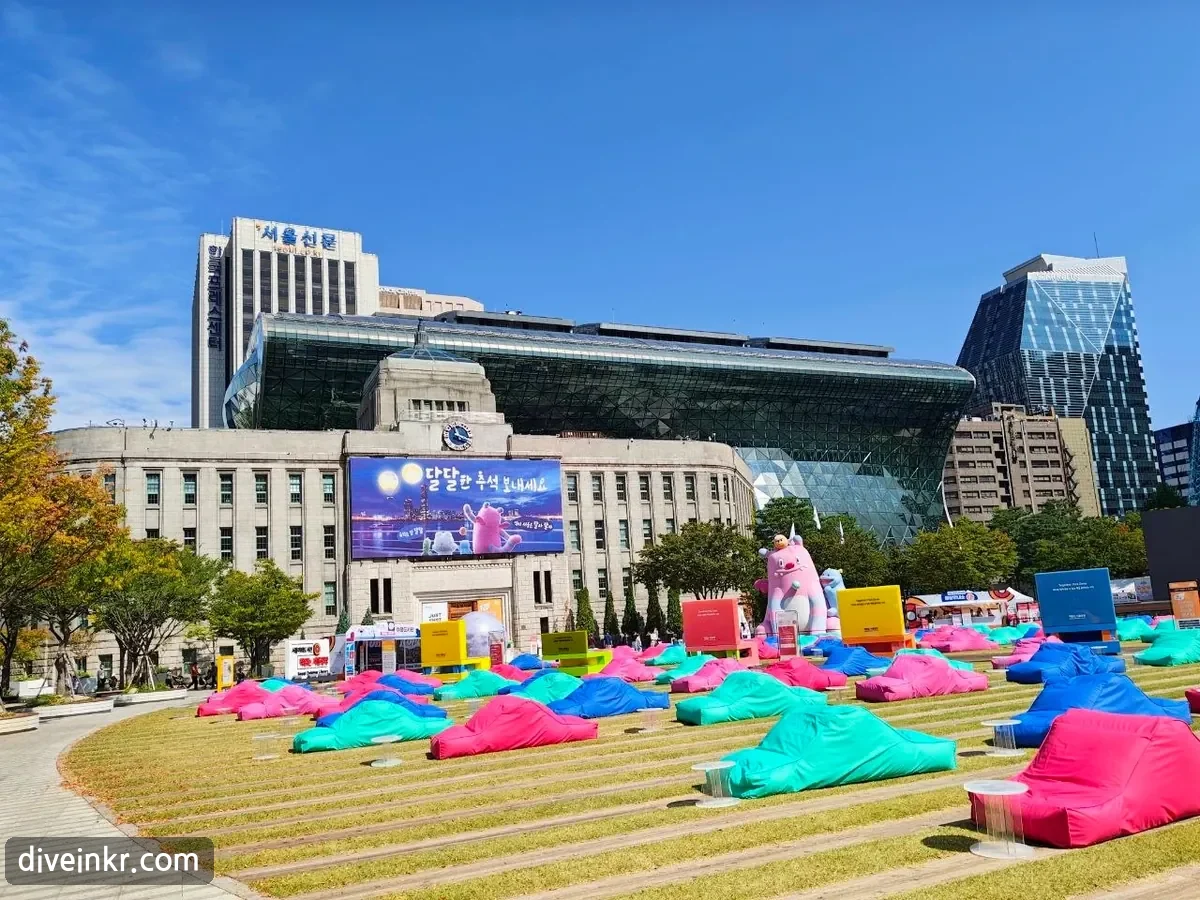
Seoul City Hall: a stone 1920s building with a clock in front of a modern glass building whose curved facade leans forward like a wave. A large screen on the old building shows the message 달달한 추석 보내세요 with a pink cartoon character and a full moon. In front, the lawn of Seoul Plaza is covered with colorful bean-bag cushions, and a large pink inflatable character stands beside a smaller blue one
서울시청 (Seoul Sicheong): 시청 (sicheong) means "city hall." The old stone building in front is now the Seoul Library.
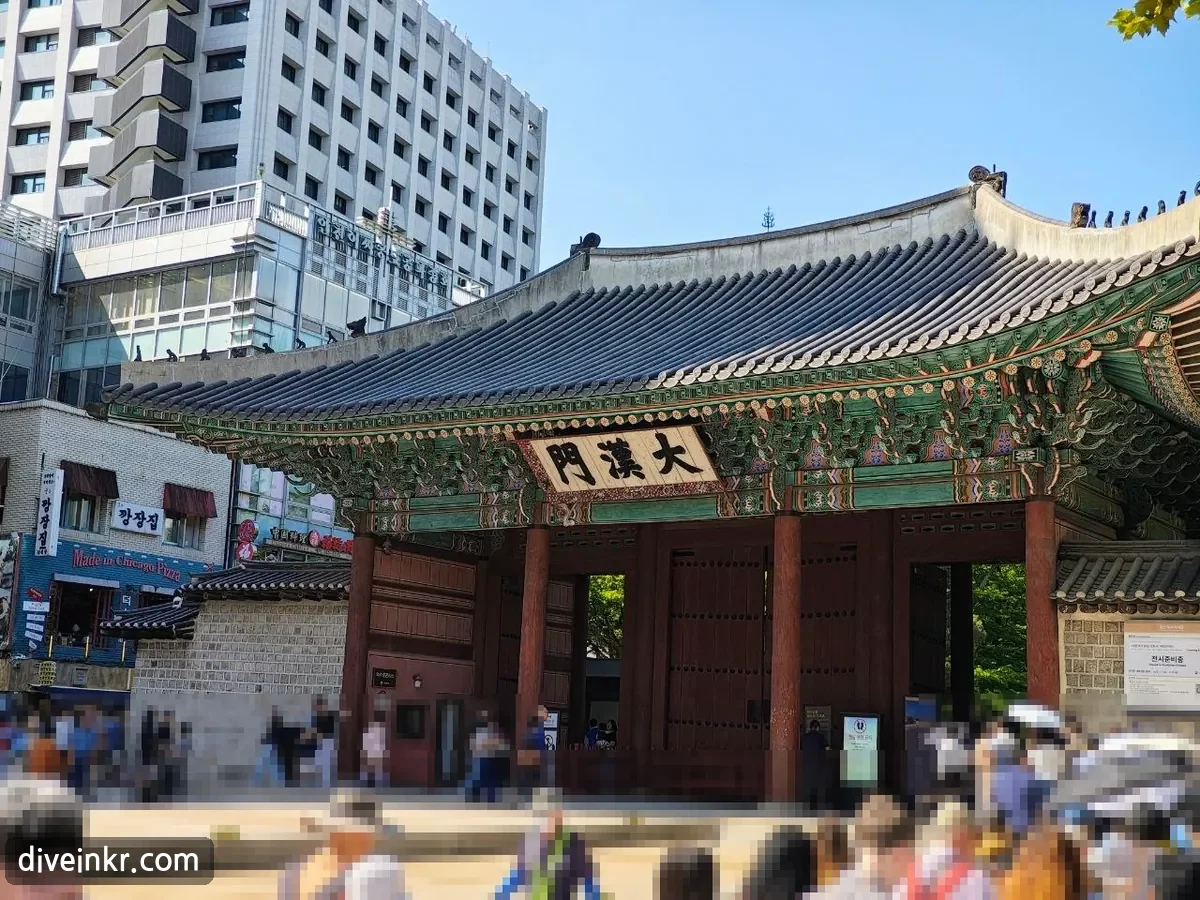
Daehanmun, the main gate of Deoksugung Palace: a wooden gate with a tiled roof, painted eaves, red pillars and doors and a name board reading 大漢門, standing between office buildings, with visitors in front (faces blurred)
대한문 (Daehanmun), the gate of 덕수궁 (Deoksugung), right across the road from City Hall — another 문 (mun).
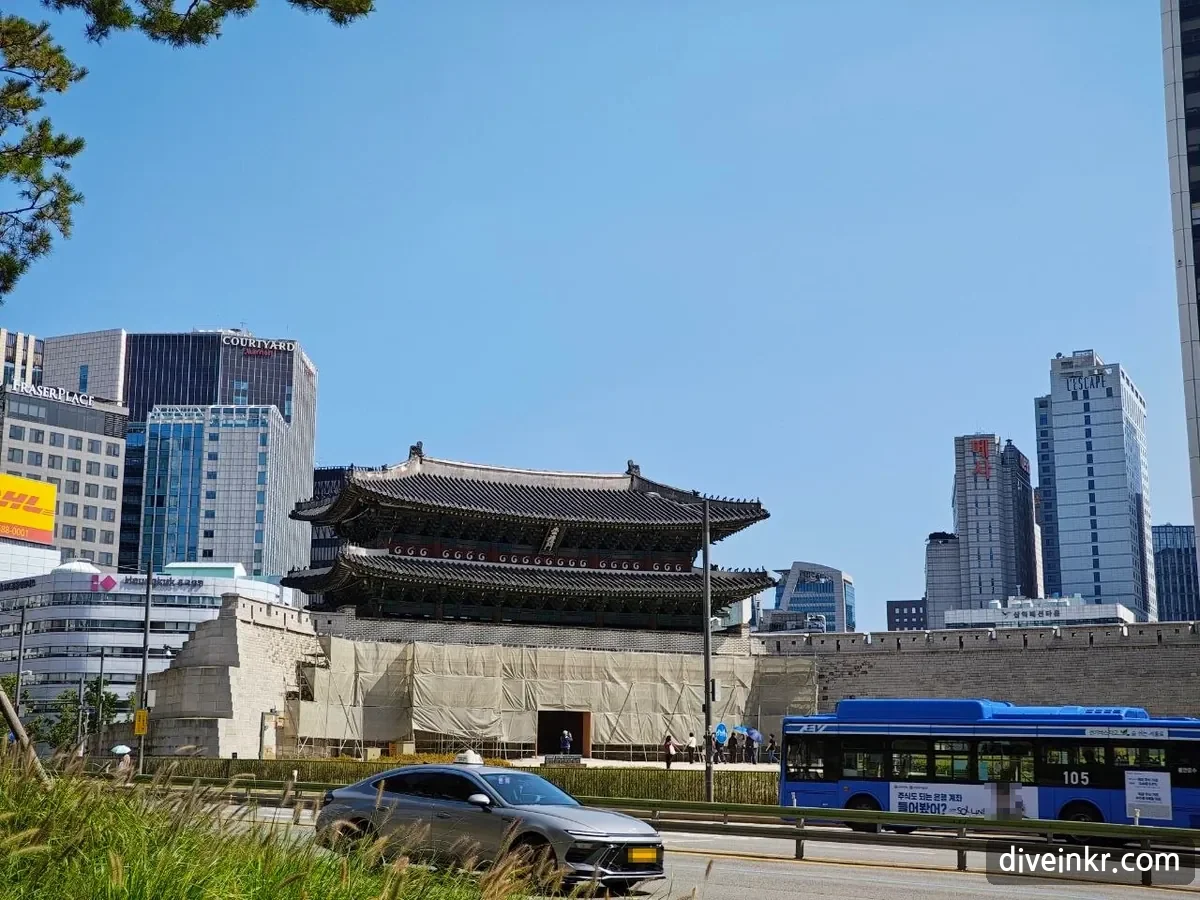
Sungnyemun, a two-story wooden gate on a massive stone base partly wrapped in beige construction screens, with a stretch of old city wall to the right and glass office towers behind, seen across a road with a blue electric city bus and a gray car passing in front and pampas grass in the foreground
숭례문 (Sungnyemun), which most people call 남대문 (Namdaemun), "the South Gate": 남 (nam) is "south," 대 (dae) "great," 문 (mun) "gate."
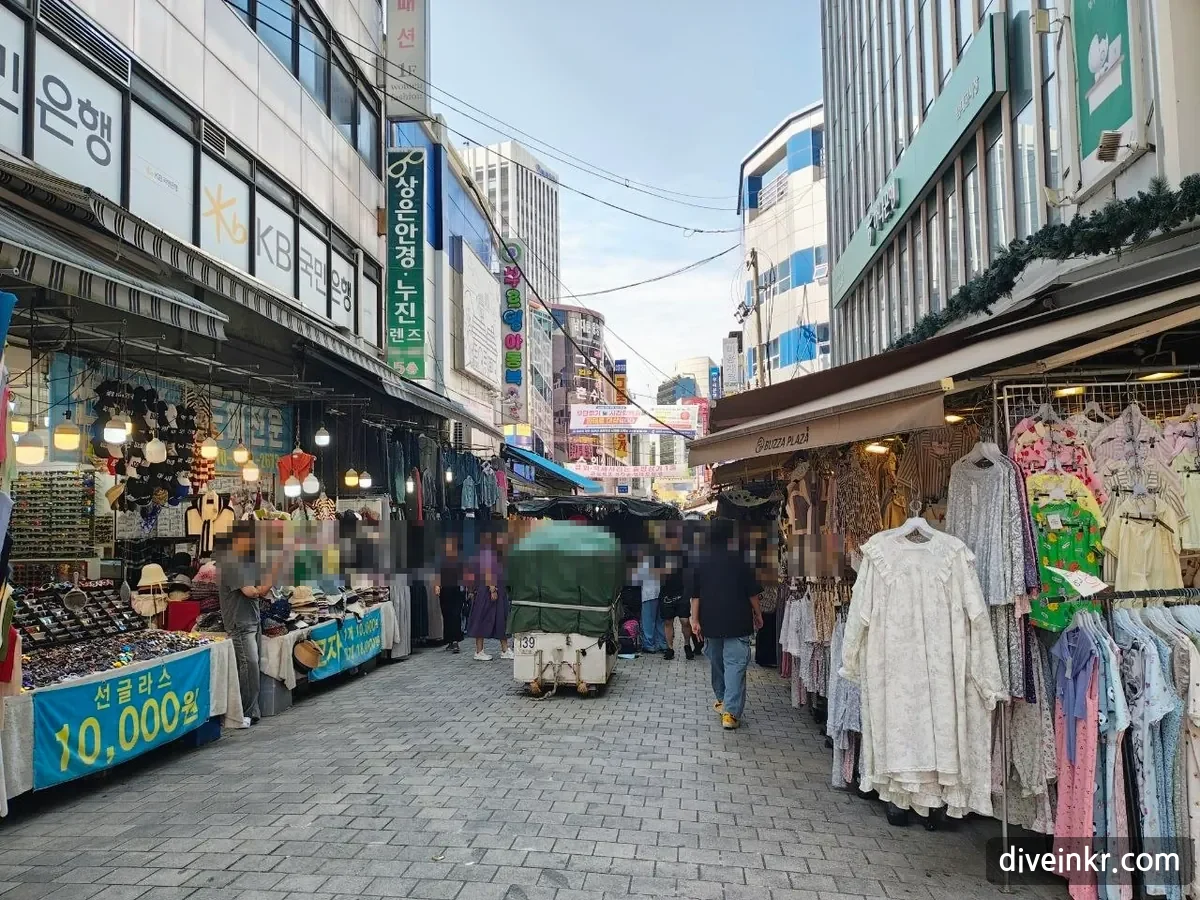
A street in Namdaemun Market lined with stalls selling sunglasses and hats, with a blue banner reading 선글라스 10,000원, racks of dresses on the right, a covered cart in the middle of the lane, a KB Kookmin Bank sign on the building at left and shoppers walking (faces blurred)
Namdaemun Market: 선글라스 10,000원 (seongeullaseu man won) — sunglasses, 10,000 won. 원 (won) is Korea's currency.

The full walk: From Seoul City Hall to Namdaemun Market.

명동과 남산: Myeongdong and Namsan

Central Seoul's busiest shopping district for visitors, with a cathedral on the hill and N Seoul Tower just to the south.
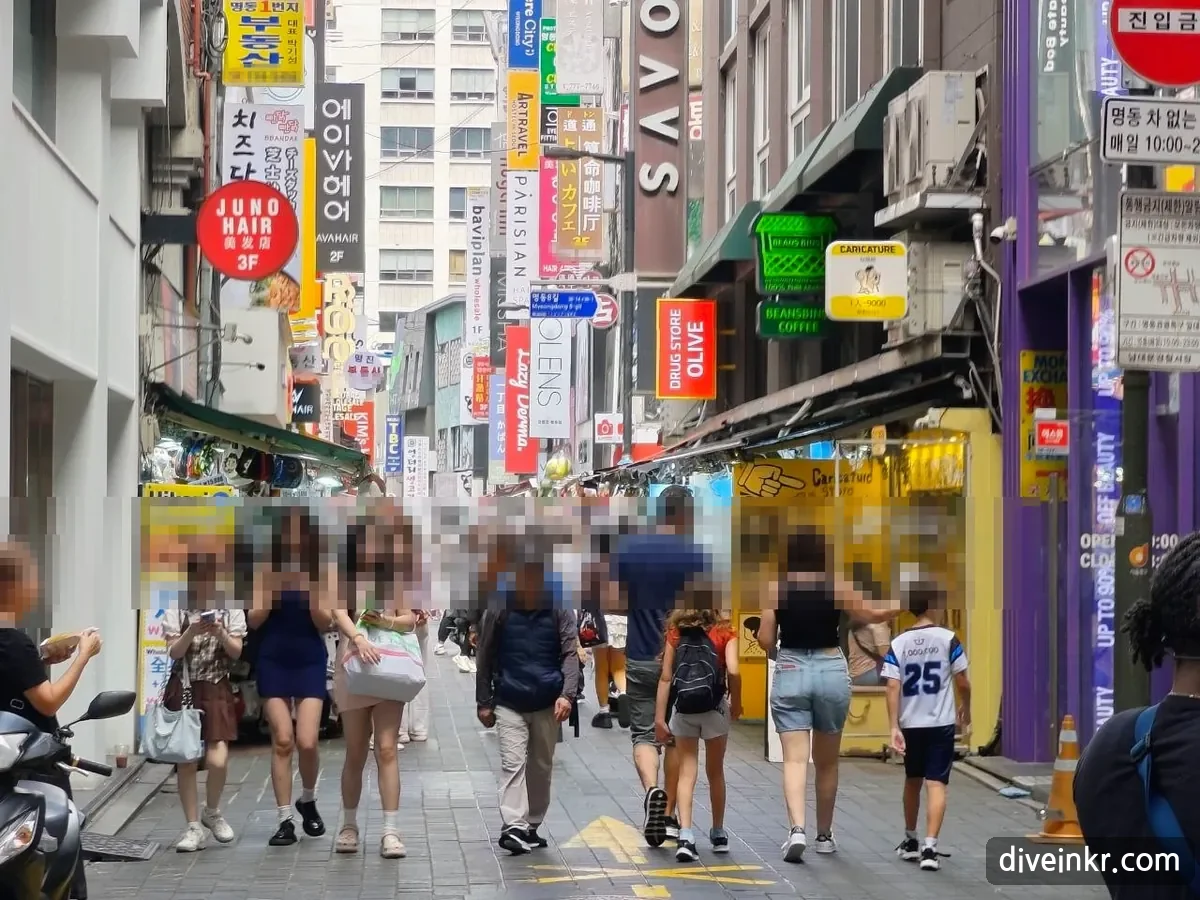
A narrow Myeongdong side street crowded with shoppers under dozens of vertical signs in Korean, English, Chinese and Japanese, including JUNO HAIR 3F, DRUG STORE OLIVE, a caricature shop and a small blue street sign reading 명동8길 Myeongdong 8-gil; on the right, a red no-entry sign reading 진입금지 above a sign reading 명동 차 없는 거리 매일 10:00~23:00 (faces blurred)
명동8길 (Myeongdong 8-gil), a side street. 길 (gil) is the smallest of the three sizes of Korean road names.
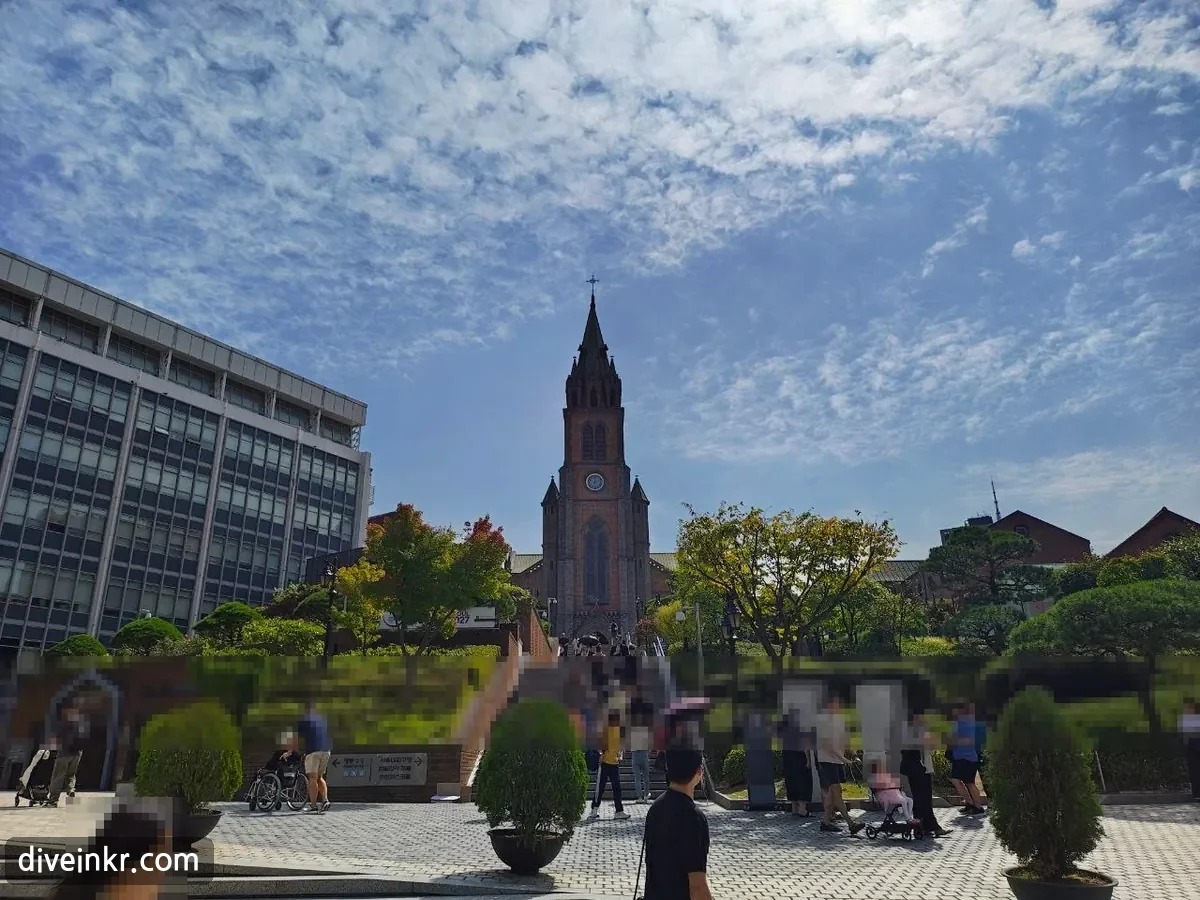
Myeongdong Cathedral, a red-brick Gothic church with a tall pointed bell tower and a clock, at the top of a wide stone staircase lined with trees, with visitors climbing the steps and walking on the plaza below under a blue sky with clouds (faces blurred)
명동성당 (Myeongdong Seongdang), Myeongdong Cathedral, completed in 1898. 성당 (seongdang) is a Catholic church.
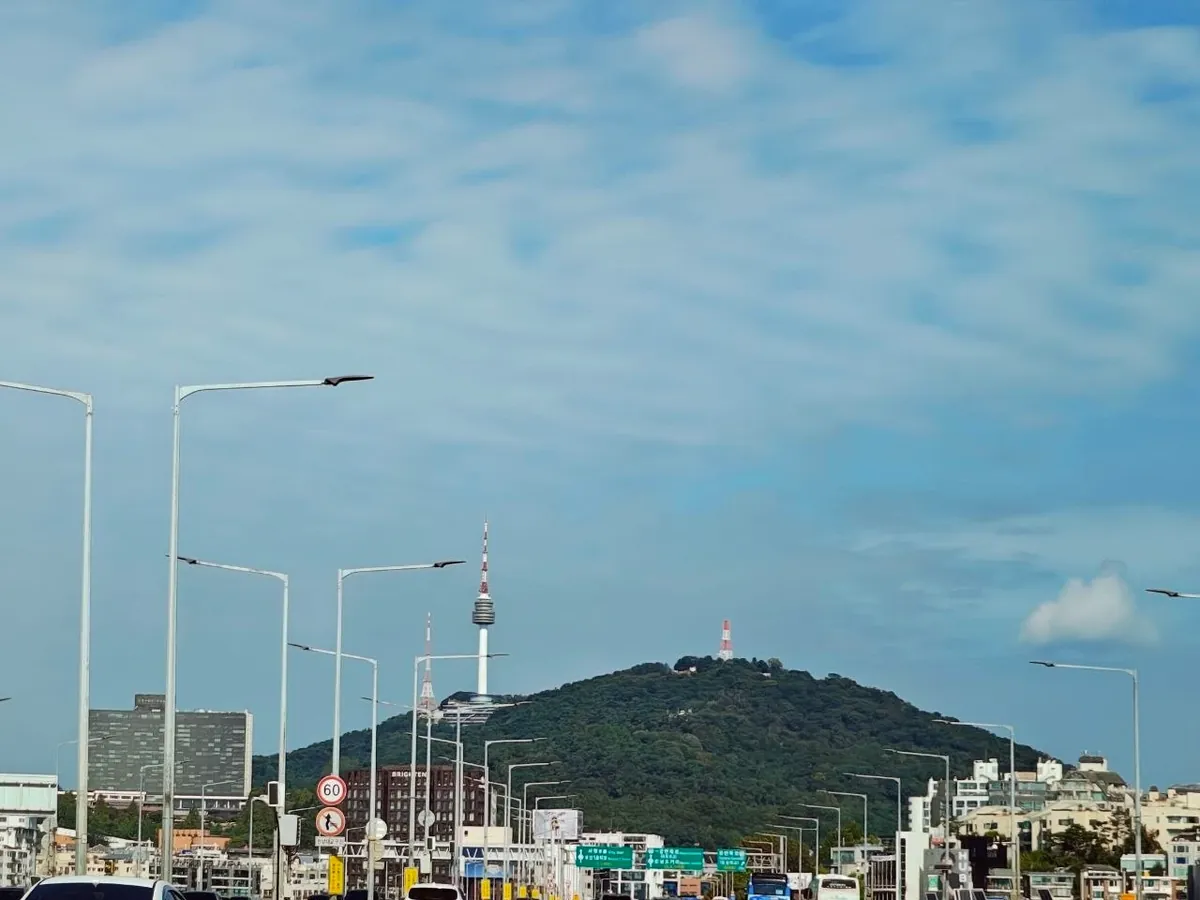
N Seoul Tower standing on the green hill of Namsan under a blue sky with light clouds, seen from a road in Seoul lined with street lamps and road signs
남산 (Namsan), "South Mountain," and N Seoul Tower. 산 (san) means "mountain."

The full guide: Myeongdong — the shopping street, the red-hat guides and the cathedral.

인사동과 조계사: Insadong and Jogyesa

A street of galleries, craft shops and tea houses, with the temple 조계사 (Jogyesa) and Tapgol Park a short walk away.
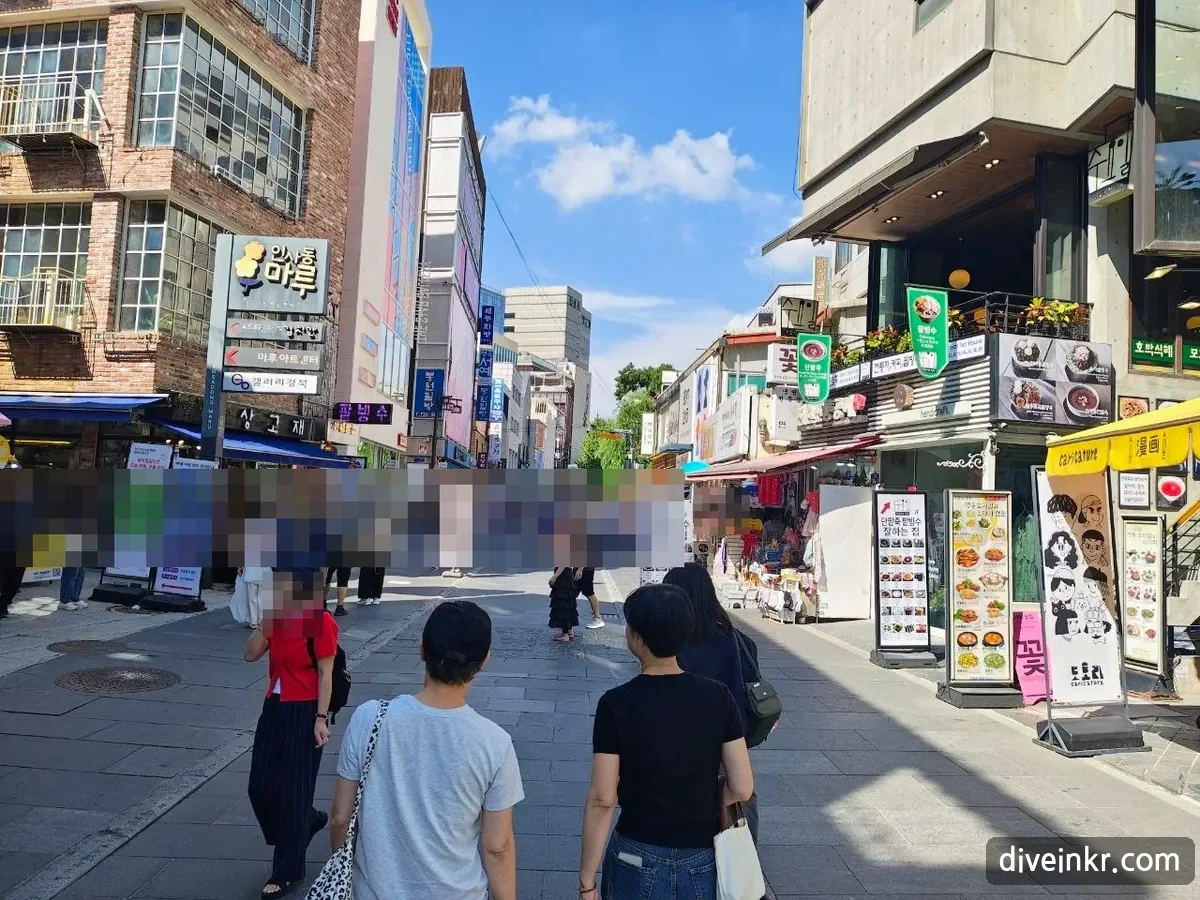
Insadong's main pedestrian street on a sunny day, crowded with walkers between low buildings; on the left a tall sign reading 인사동 마루 with arrows to shops and a gallery, a shop sign reading 상고재 and a small sign reading 팥빙수; on the right standing boards reading 단팥죽 팥빙수 잘하는 집 and a caricature shop with a yellow awning (faces blurred)
The boards say 단팥죽 팥빙수 잘하는 집: 잘하는 집 (jalhaneun jip) is "the place that does it well," a phrase you'll see outside restaurants everywhere.
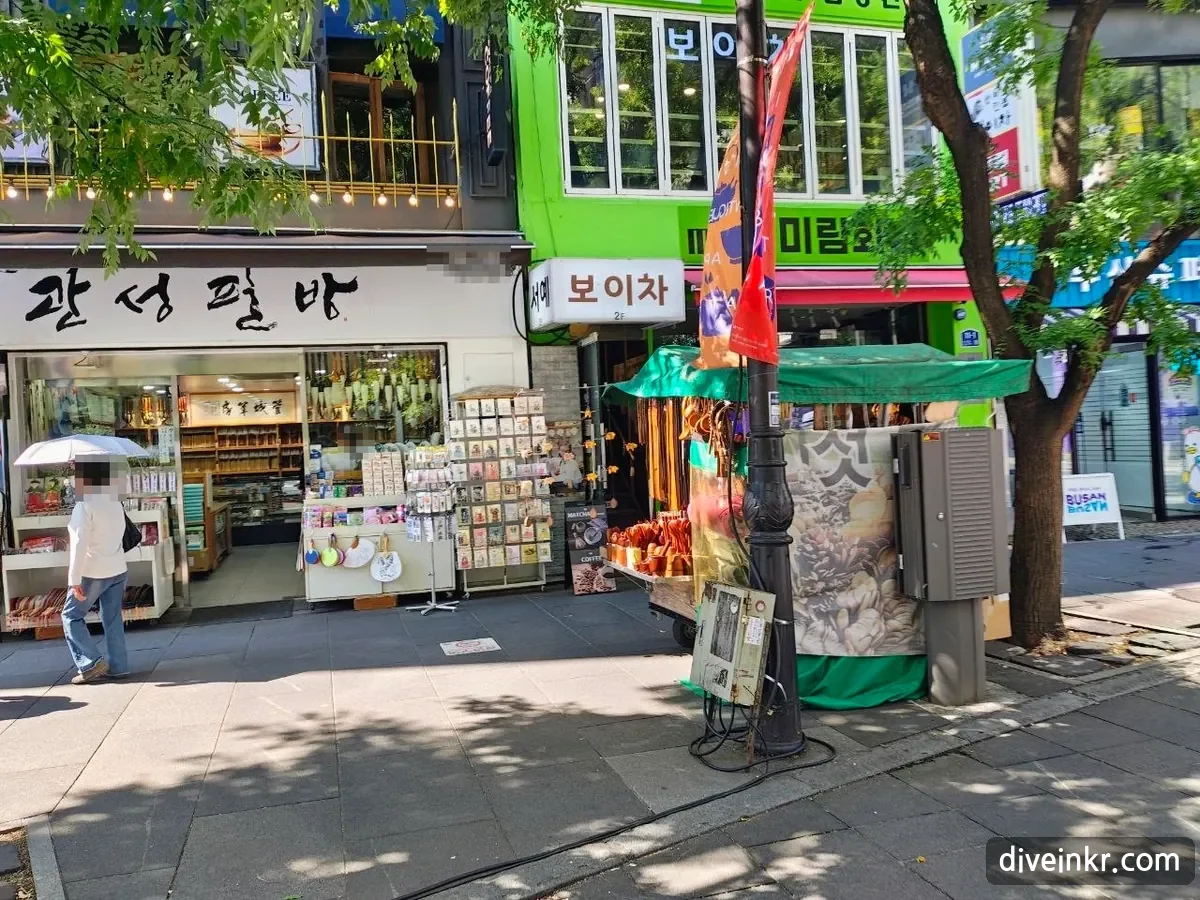
An Insadong shopfront with a white signboard reading 관성필방 in large black brush lettering, a window full of hanging calligraphy brushes and paper goods, a rack of postcards outside, and next door a small white sign reading 서예 and 보이차 2F; a passer-by with a white parasol walks by on the left (face and phone numbers blurred)
관성필방 (Gwanseong Pilbang). 필방 (pilbang) means "brush shop" — Insadong is full of them.
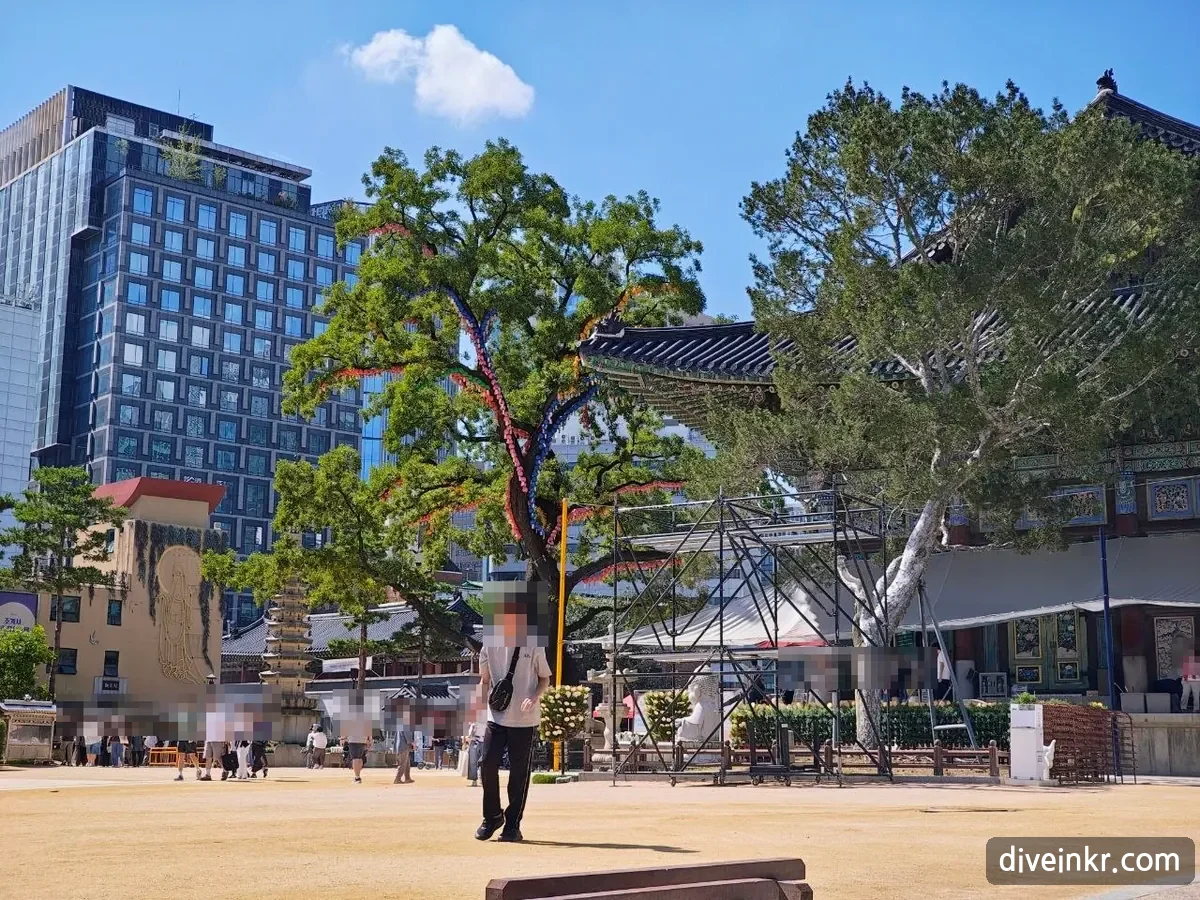
The open sand courtyard of Jogyesa with a big old tree strung with colorful lanterns, the curved tiled roof of the main hall behind a pine tree on the right, a stone pagoda on the left, a metal stage frame in the middle, and a modern glass office tower in the background (faces blurred)
Jogyesa's courtyard. The big tree hung with lanterns is a 회화나무 (hoehwa namu), a Chinese scholar tree more than 450 years old.
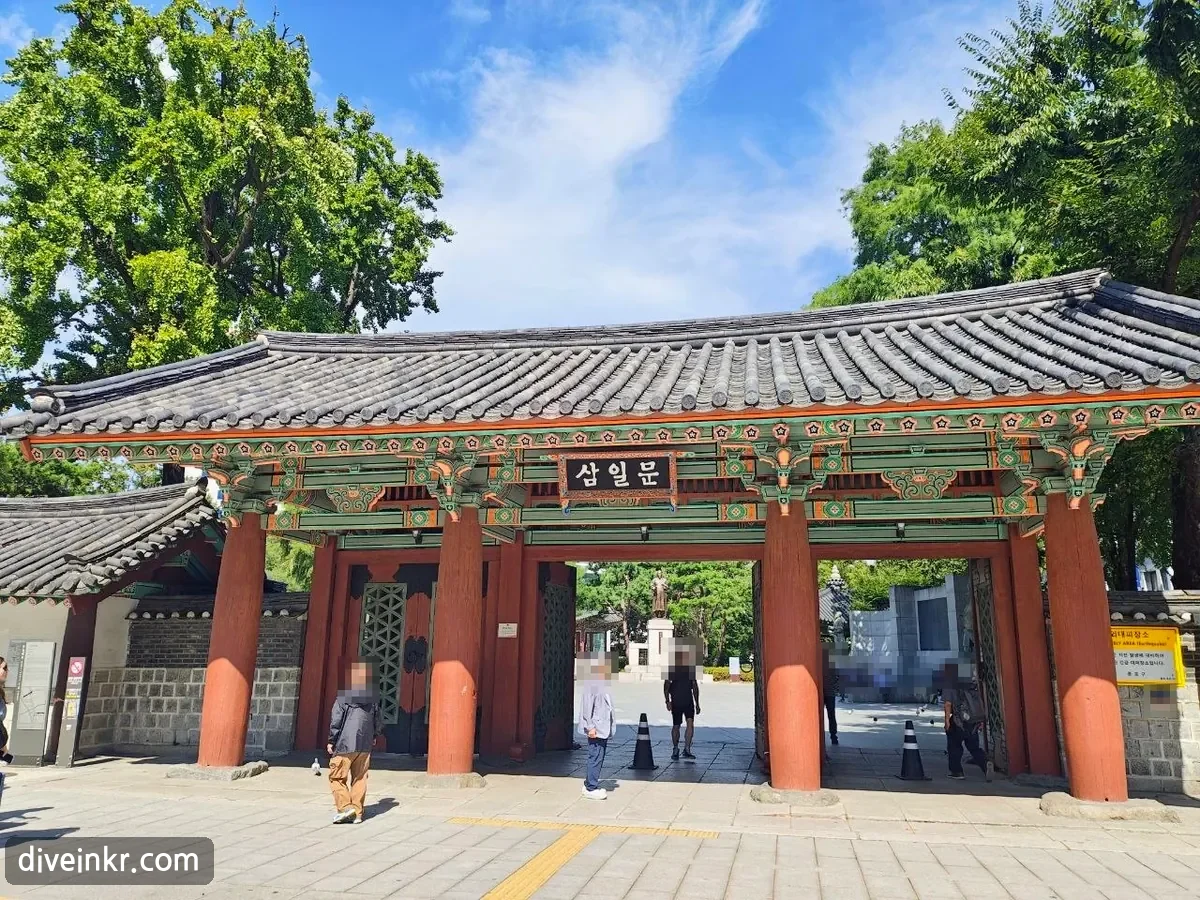
The main gate of Tapgol Park: a wide traditional gate with a grey tiled roof, painted eaves and red pillars, and a black signboard in the middle reading 삼일문 in white Hangeul; visitors walk through the open doors, and a statue and trees are visible inside (faces blurred)
삼일문 (Samilmun), the main gate of Tapgol Park. 삼일 (samil) is "three-one": 3·1, March 1st.

The full guide: Insadong, Jogyesa and Tapgol Park — a photo walk through old Seoul's signs.

광장시장과 종묘: Gwangjang Market and Jongmyo

Between Jongno 3-ga and 5-ga: a famous market, pharmacies and wholesale shops, with the royal shrine 종묘 (Jongmyo) just north.
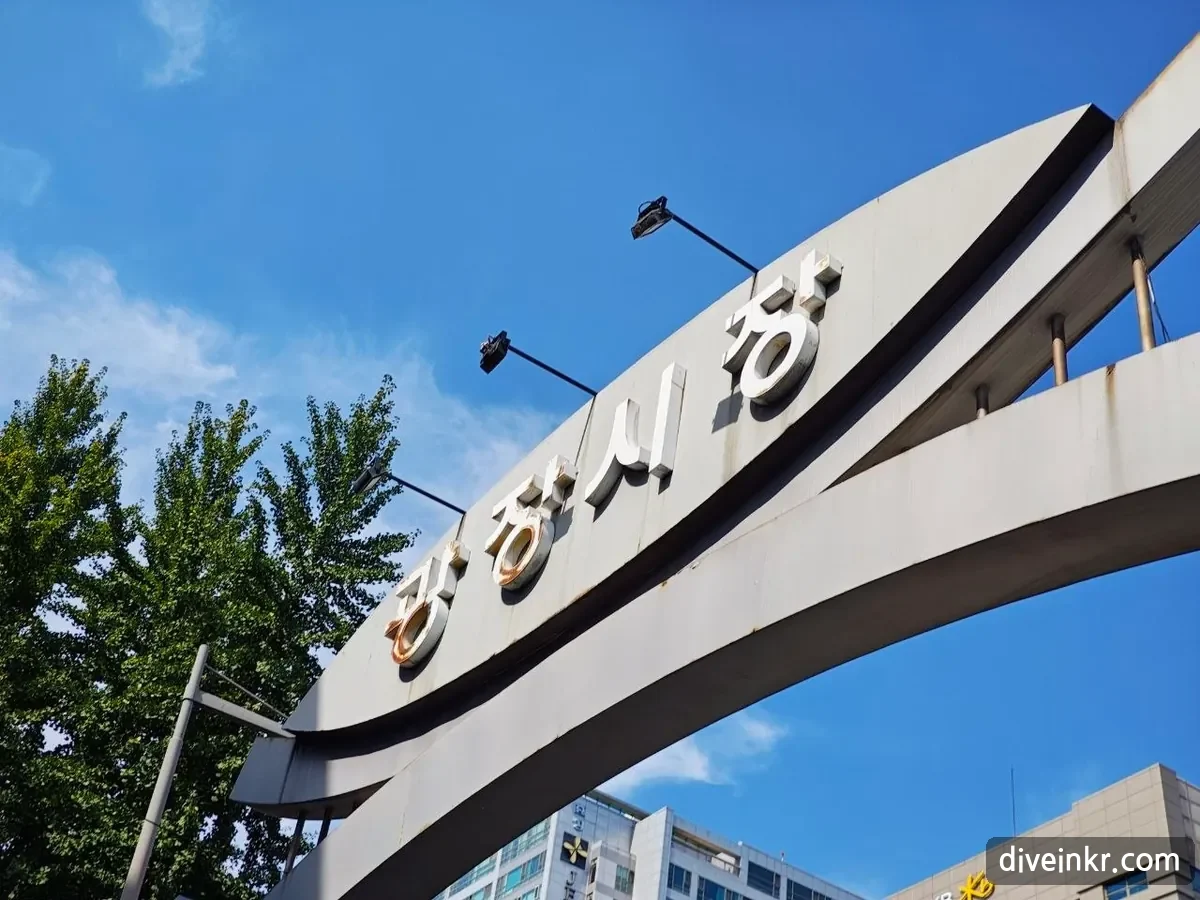
The curved gray arch over an entrance to Gwangjang Market in Seoul, with large raised Korean letters reading 광장시장 against a bright blue sky and a tree on the left
The arch over one of the entrances: 광장시장 (Gwangjang Sijang). 시장 (sijang) means "market."
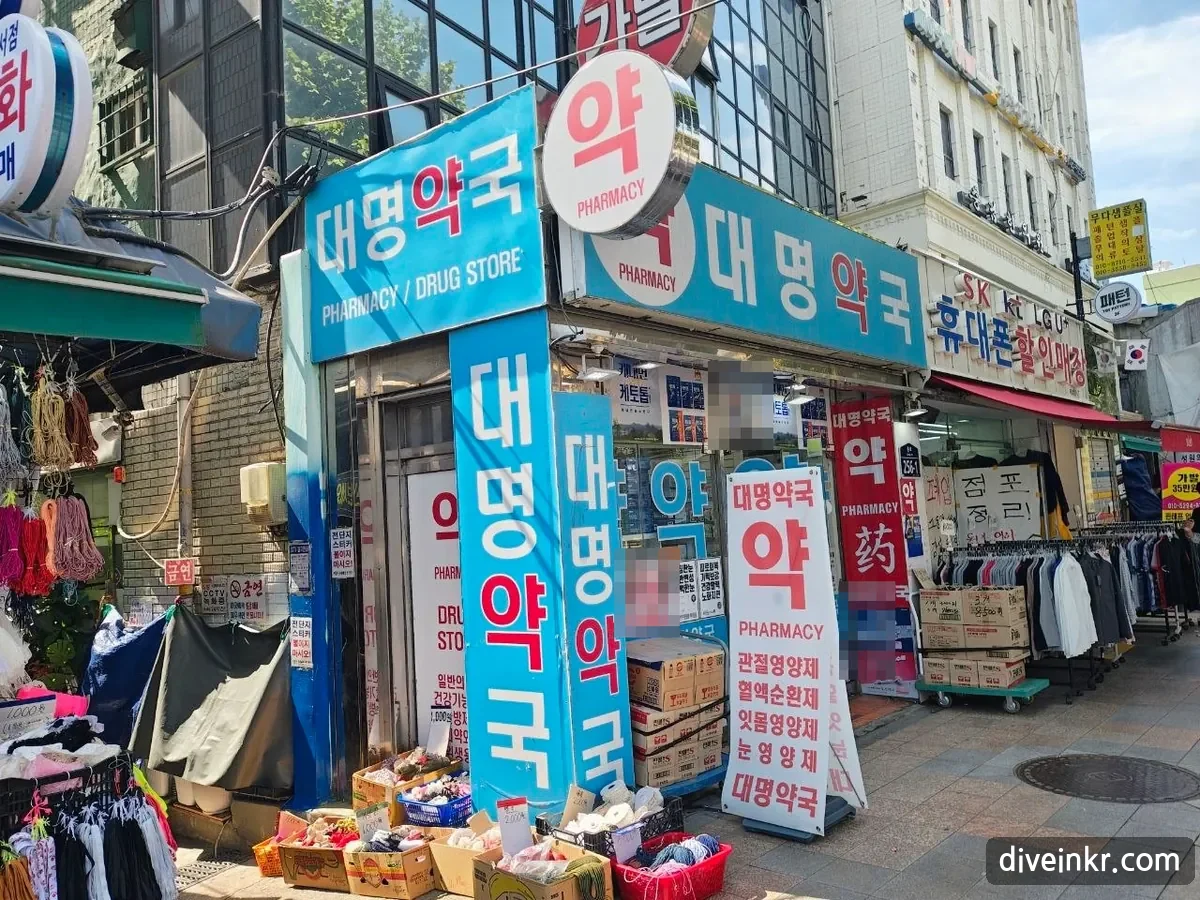
A pharmacy on a Jongno street corner with big blue and white signs reading 대명약국 and PHARMACY / DRUG STORE, a round sign with the single character 약, and vertical banners listing health products (faces on posters blurred)
대명약국 (Daemyeong Yakguk). The round sign with just 약 (yak) means "medicine" — look for it anywhere in Korea.
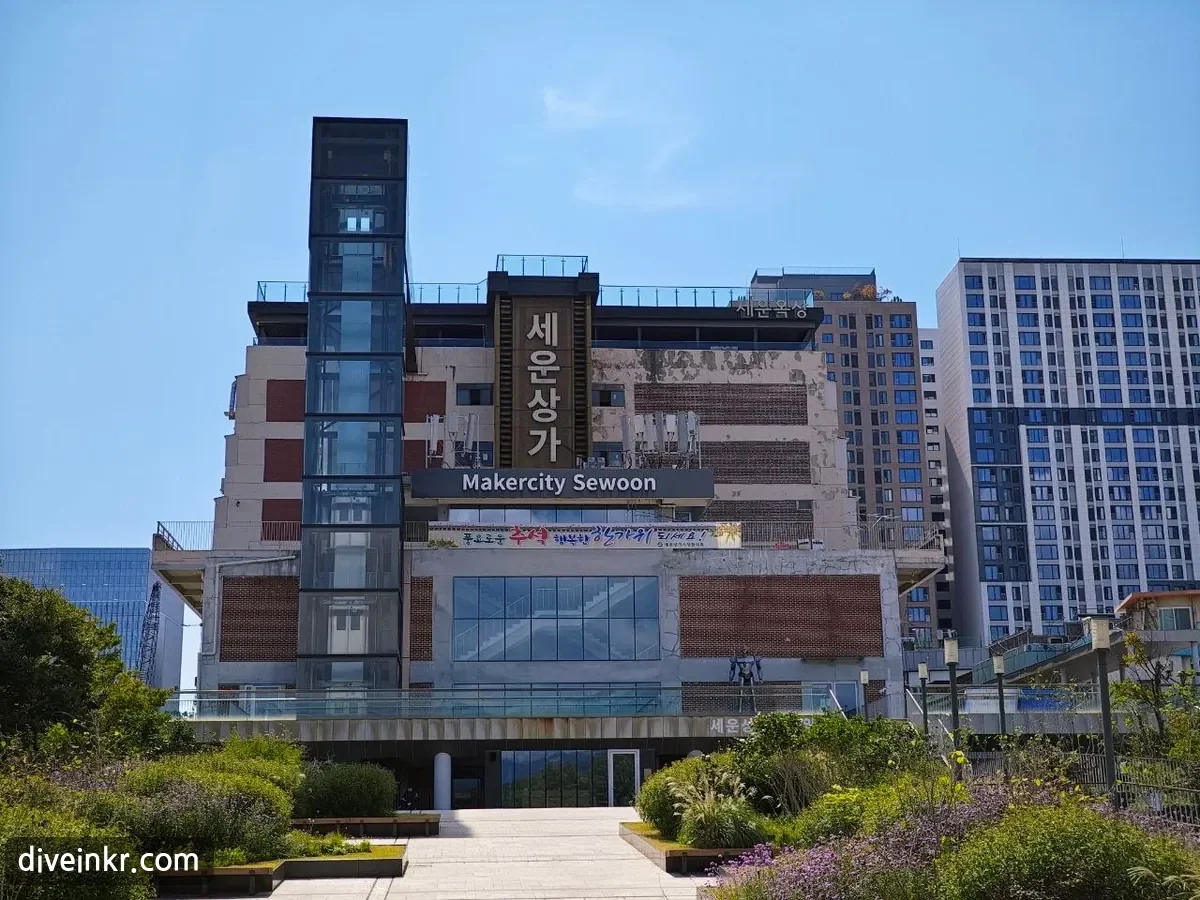
The Sewoon Sangga building seen from the plaza in front: a long concrete block with a glass elevator tower, a vertical sign reading 세운상가 and a horizontal one reading Makercity Sewoon, with apartment towers behind
세운상가 (Seun Sangga). 상가 (sangga) means "shopping arcade."

The full guide: Gwangjang Market to Jongmyo — a Jongno photo walk.

동대문: Dongdaemun

동대문 (Dongdaemun), "East Gate," is the everyday name of 흥인지문 (Heunginjimun), the east gate of Seoul's old city wall — surrounded by markets.
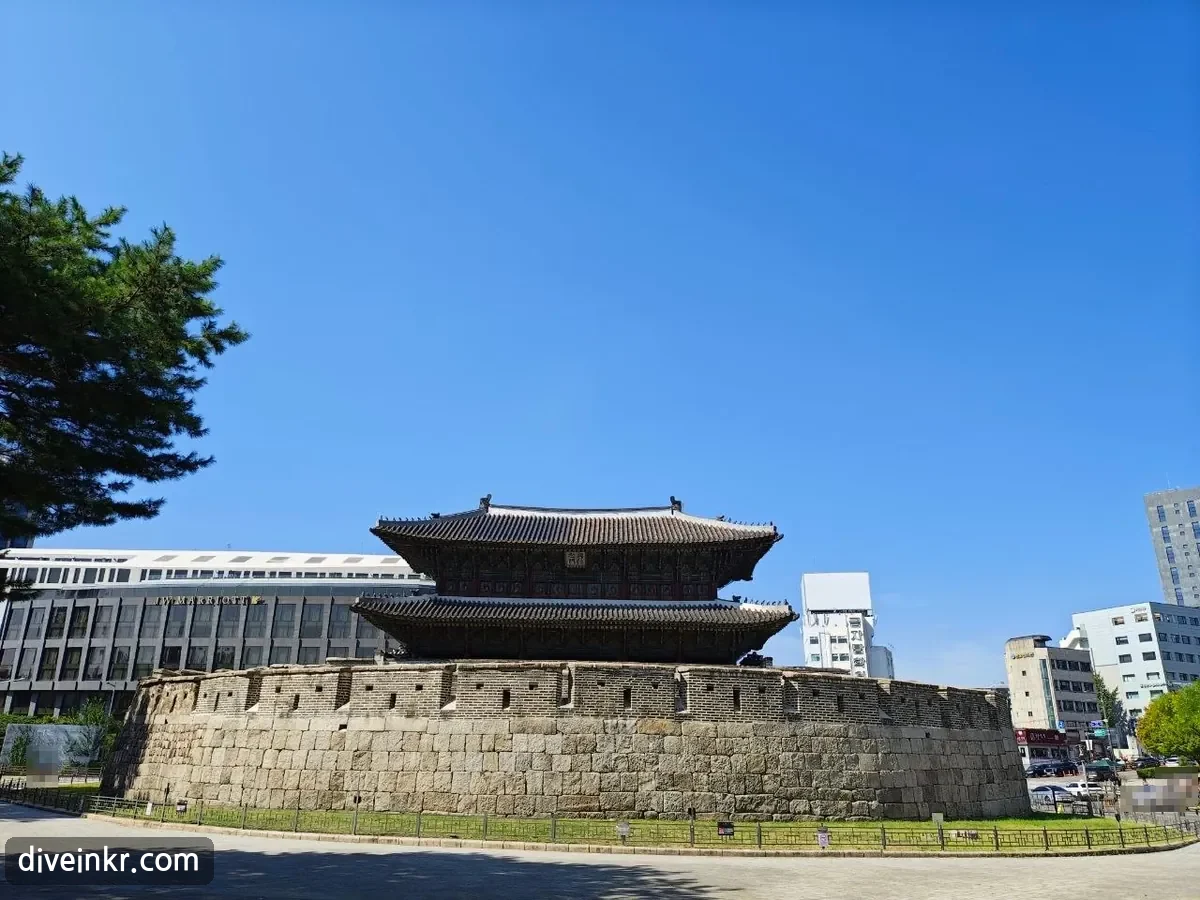
Heunginjimun seen from outside: a two-story wooden gate pavilion with curved tiled roofs rising behind a curved, crenellated stone wall (the ongseong) on a lawn, under a clear blue sky with modern buildings on both sides
The curved stone wall outside the gate is the 옹성 (ongseong), built so attackers couldn't reach the gate door directly.
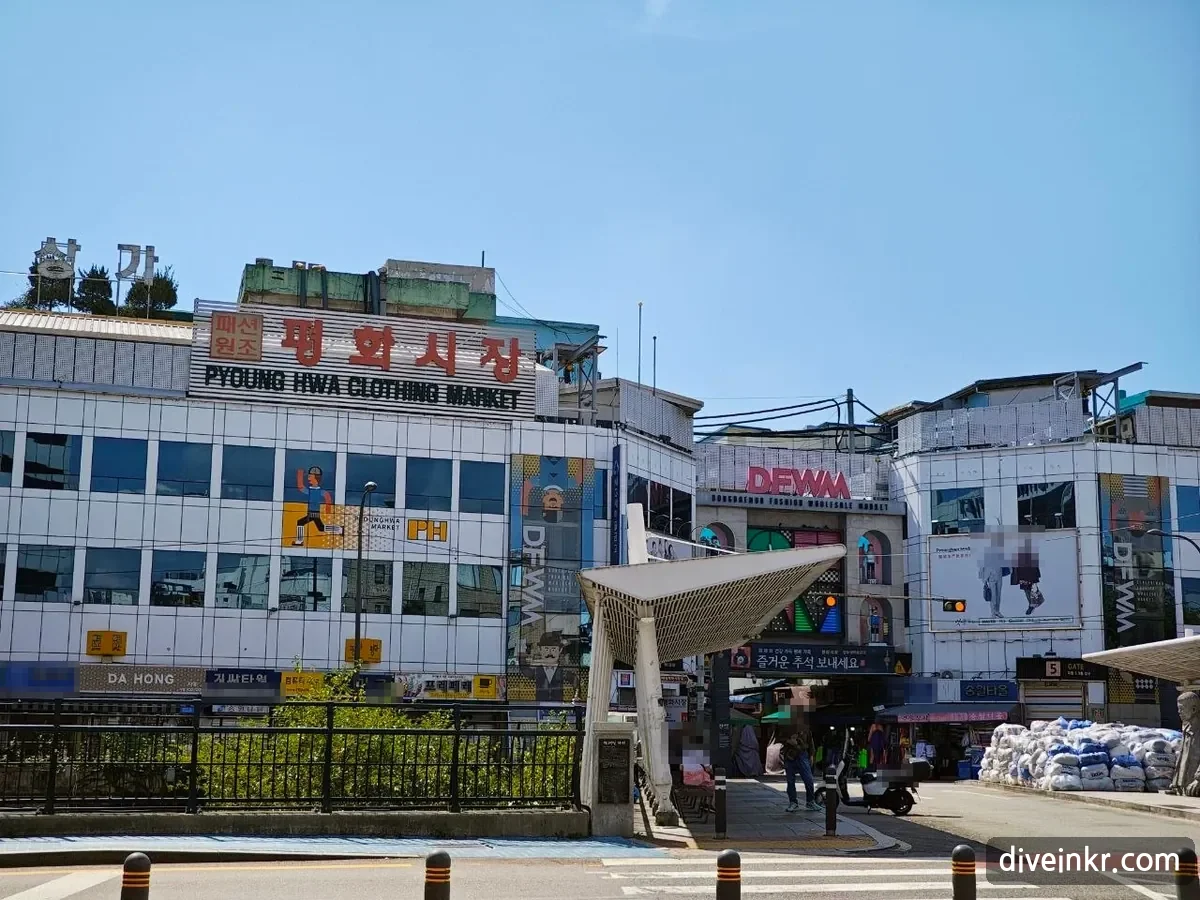
The Pyeonghwa Market building seen from across the street under a clear sky, with signs reading 패션 원조 평화시장 and PYOUNG HWA CLOTHING MARKET and the entrance to the DEWM fashion wholesale market (faces, a license plate and phone numbers blurred)
평화시장 (Pyeonghwa Market) calls itself 패션 원조, "the original of fashion." 원조 (wonjo) means "the original" — restaurants use it too.
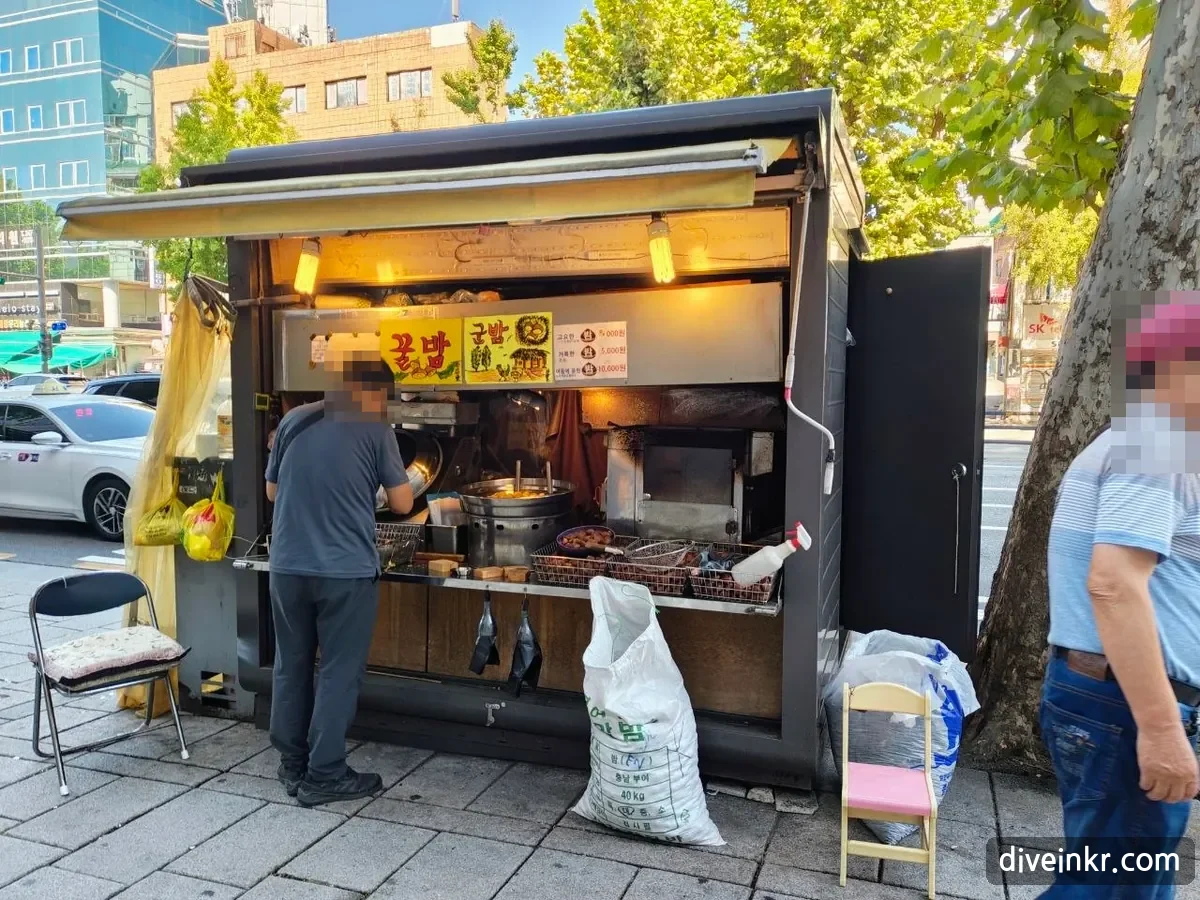
A street stall selling roasted chestnuts with signs reading 꿀밤 and 군밤, a chestnut roaster and a large sack of chestnuts in front, and a handwritten price board (vendor and passer-by blurred)
A roasted chestnut stall. 군밤 (gunbam) is 굽다 (gupda, to roast) + 밤 (bam, chestnut).
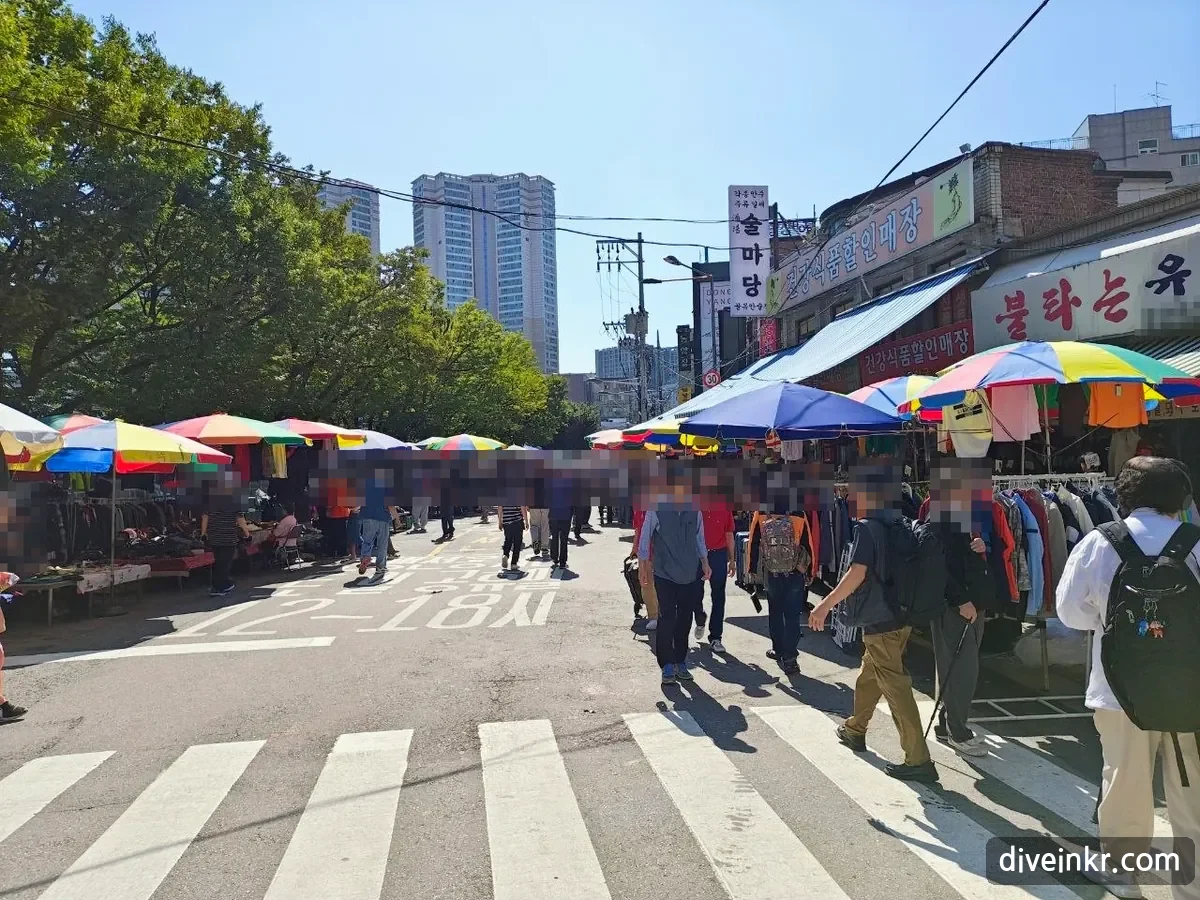
A Dongmyo flea market street on a sunny day, lined with rainbow umbrellas and racks of used clothes, with 12~18시 painted on the road and signs reading 건강식품할인매장 and 술마당 (faces and a phone number blurred)
A Dongmyo street: 12~18시 is painted on the road. 시 (si) means "o'clock" — cars are kept out from noon to 6 p.m.

The full guide: Dongdaemun — the East Gate, the markets and the Korean you'll see.

해질녘과 밤: Seoul at Dusk and After Dark

Most of the photos above were taken by day. These were taken at dusk and after dark, when the gates are lit and the side streets fill with glowing signs.
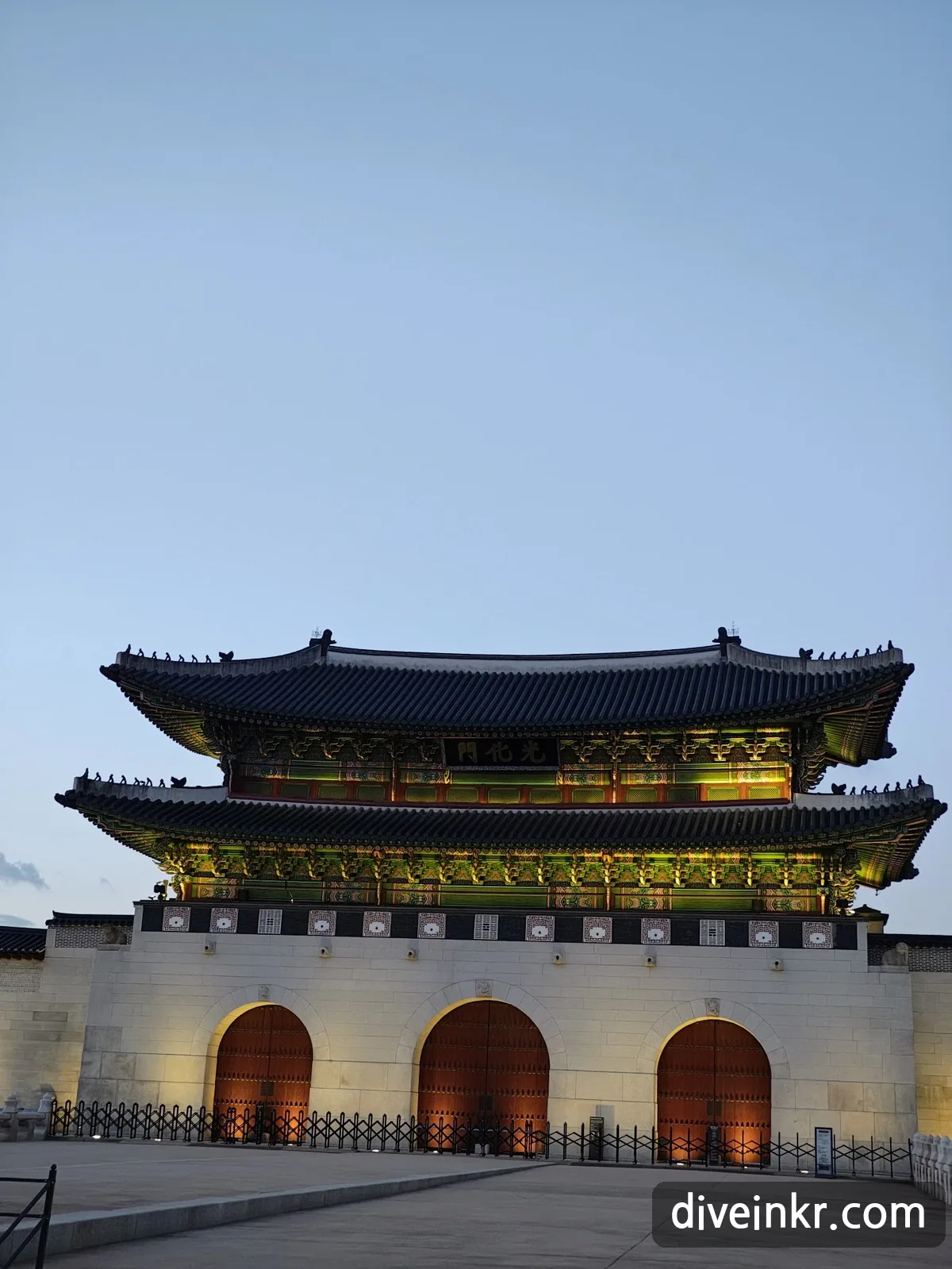
Gwanghwamun at dusk: the two-story gate lit in green and gold above three arched wooden doors, under a pale blue sky
광화문 (Gwanghwamun) after sunset, lit from below. 문 (mun) is "gate" again — the same word as in 동대문 (Dongdaemun).
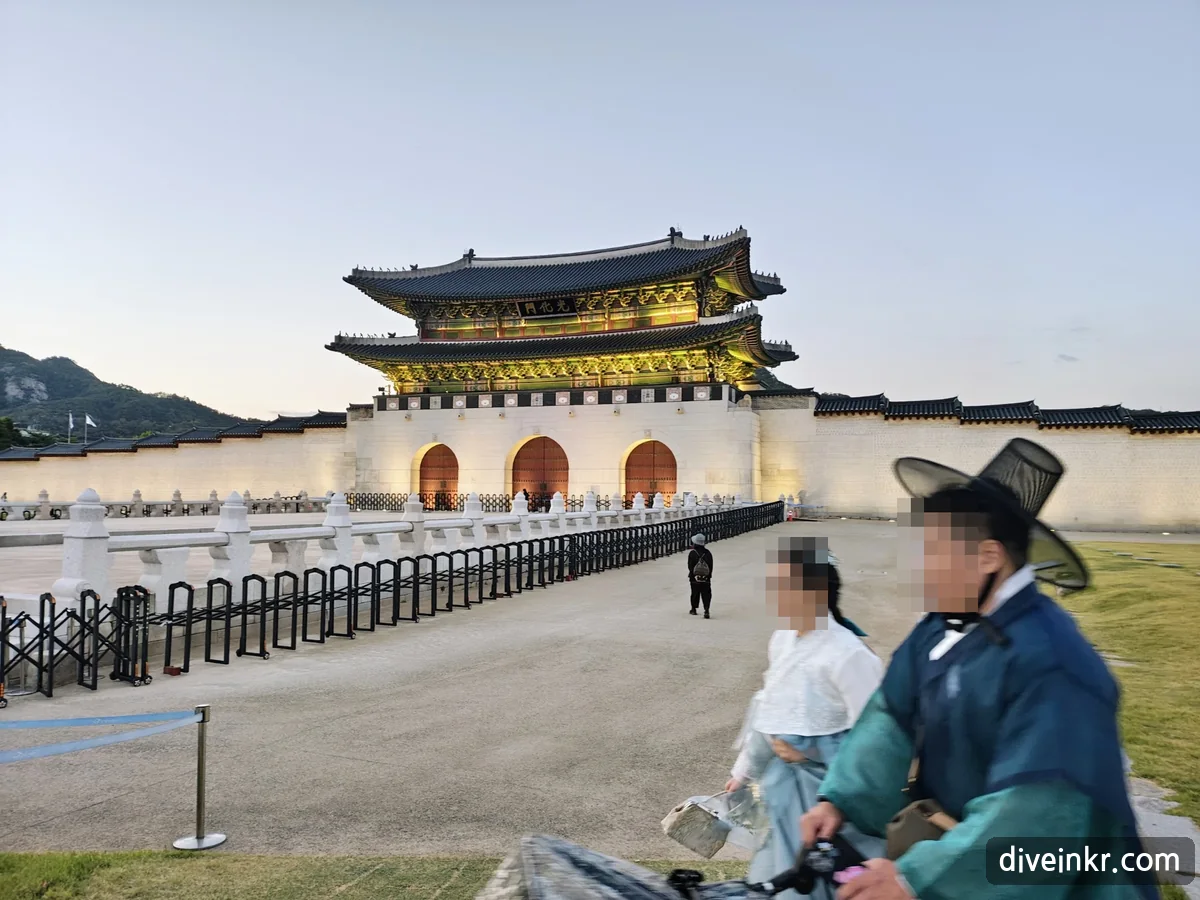
Gwanghwamun at dusk with a woman in a white and blue hanbok and a man in a black traditional hat and teal robe passing in the foreground
한복 (hanbok) is traditional Korean dress. The black hat with the wide brim is a 갓 (gat).
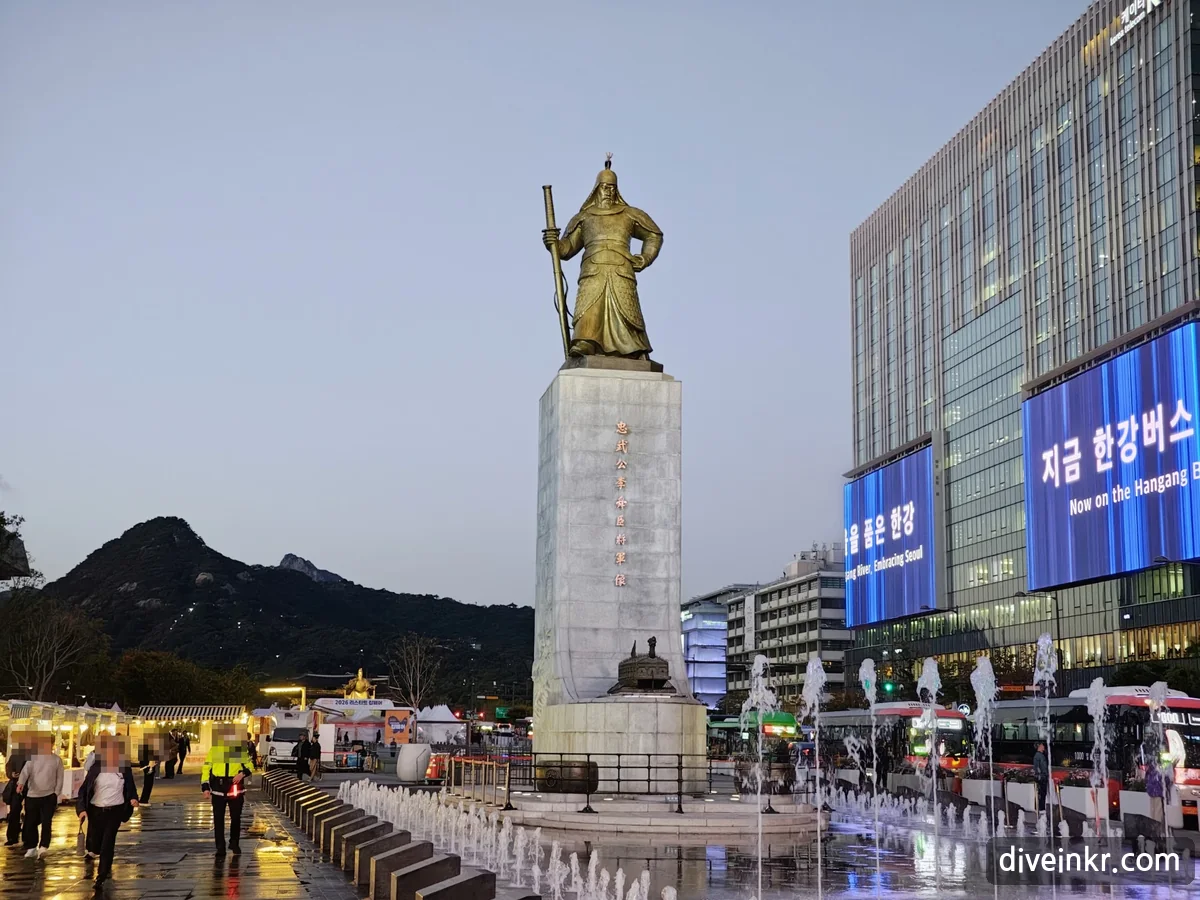
The bronze statue of Admiral Yi Sun-sin on a tall stone pillar at dusk, with fountains in front and a blue LED screen reading 지금 한강버스 behind it
충무공 이순신 장군상: 장군 (janggun) means "general" and 상 (sang) means "statue." The screen at right reads 지금 한강버스, "Now on the Hangang Bus."
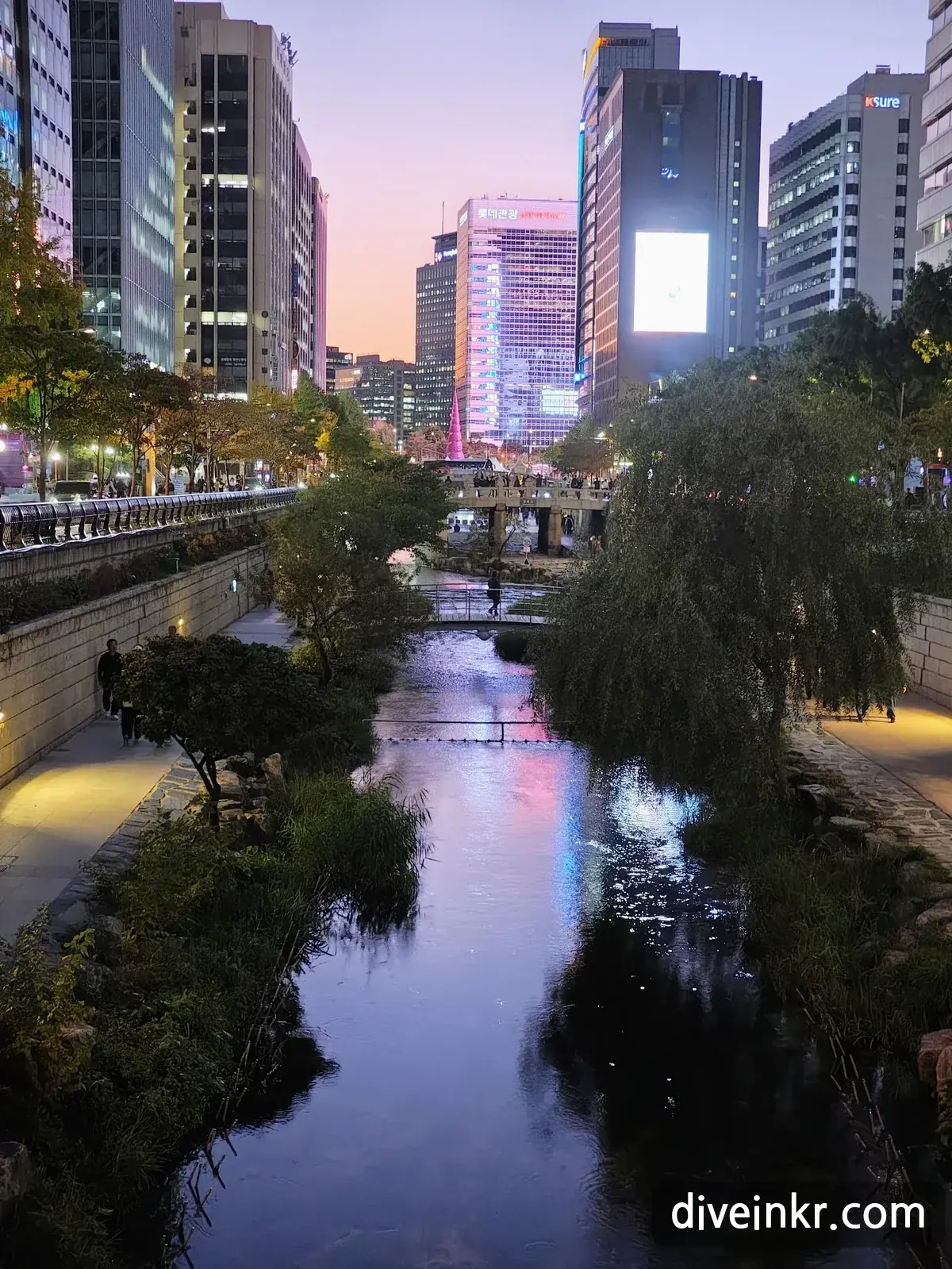
Cheonggyecheon stream at dusk between office towers, with a pink-lit tower at the far end and a stone bridge over the water
청계천 (Cheonggyecheon) at sunset. 천 (cheon) means "stream."
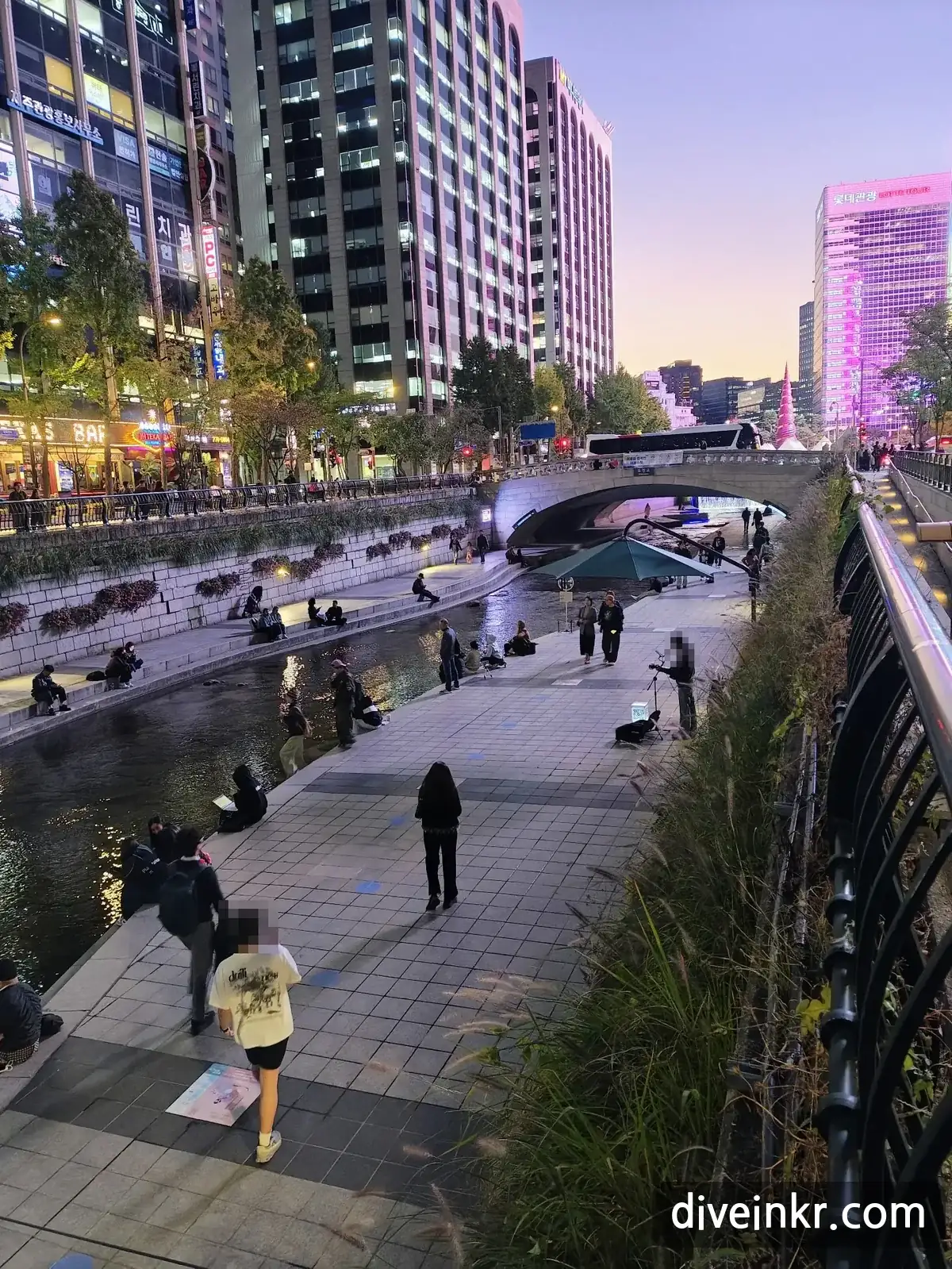
People sitting along the Cheonggyecheon stream at dusk while a street musician plays guitar by the water
A street musician by the stream. Koreans say 버스킹 (beoseuking) for busking.
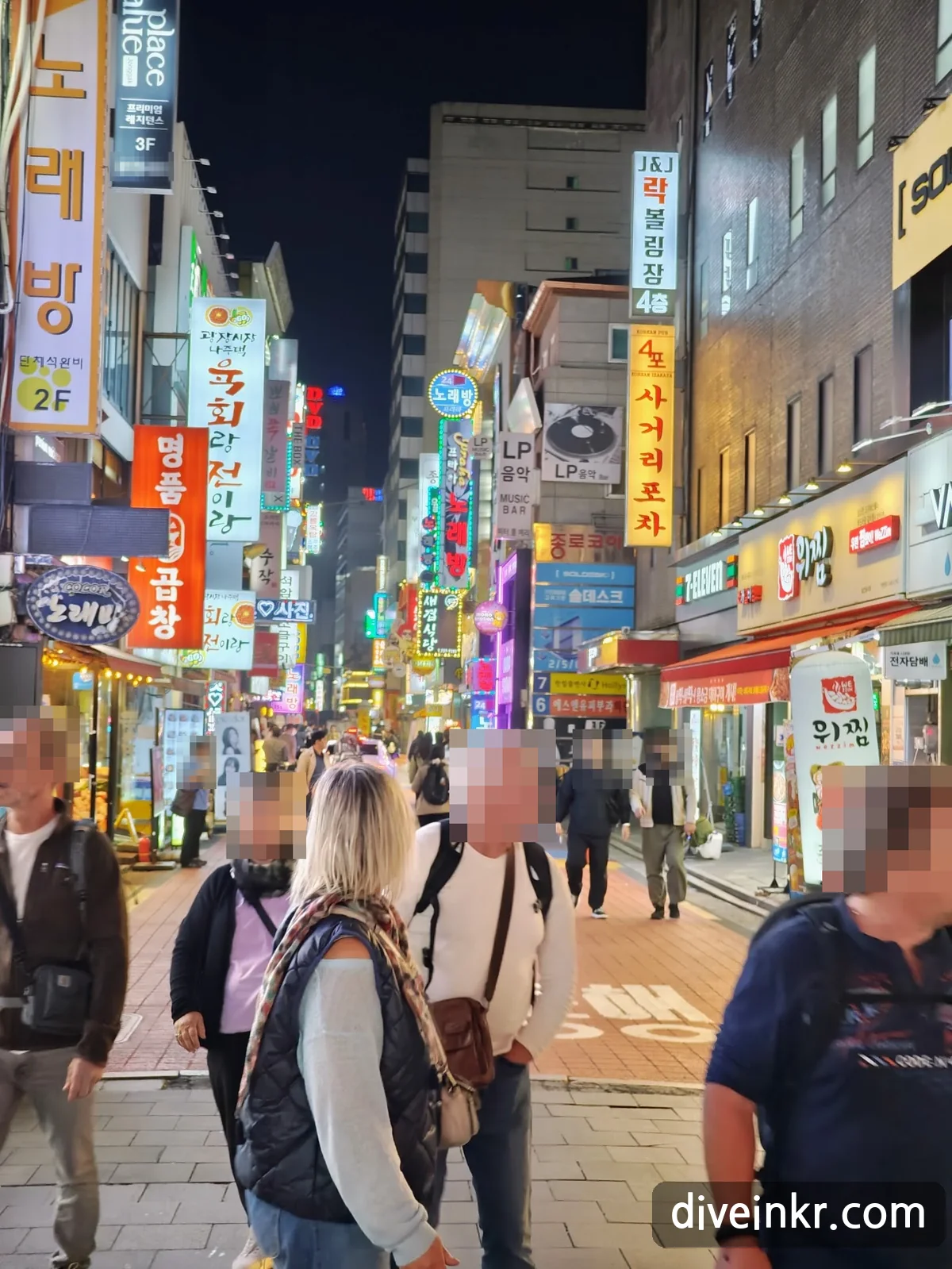
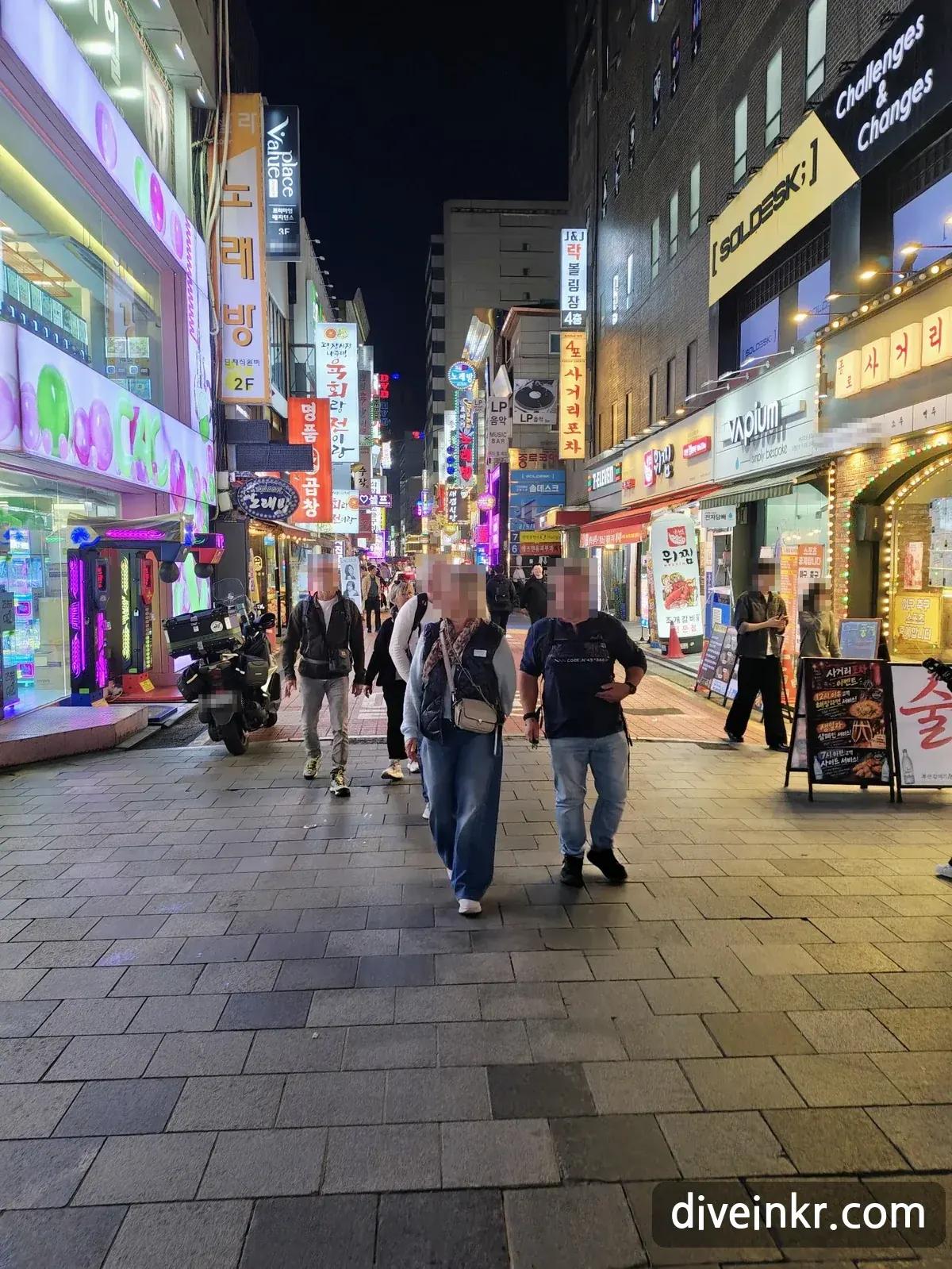
A narrow Jongno side street at night packed with vertical signs, including 노래방, 곱창 and 사거리포차, with people walking
노래방 (noraebang) = 노래 (norae, "song") + 방 (bang, "room"): a private room for singing. 곱창 (gopchang) is grilled or stewed small intestine.
The same Jongno side street seen from the middle of the road at night, with neon signs on both sides and a sandwich board outside a pub
사거리 (sageori) means "crossroads." 포차 (pocha) is short for 포장마차 (pojangmacha), a street-food tent; many casual pubs borrow the name.

The full guides: Gwanghwamun Square and A walk through Jongno.

Words From the Photos

The key words from the captions. Once you know 문, 역 and 시장, many Seoul place names start to make sense.

KoreanRomanizationMeaning
문munGate, door
역yeokStation
종각jonggakBell pavilion
징검다리jinggeomdariStepping stones
시청sicheongCity hall
원wonWon (Korean currency)
길gilStreet (smallest road size)
성당seongdangCatholic church
산sanMountain
잘하는 집jalhaneun jipThe place that does it well
필방pilbangBrush shop
시장sijangMarket
약yakMedicine
상가sanggaShopping arcade
원조wonjoThe original
시siO'clock
노래방noraebangKaraoke room
포차pochaStreet-style tent bar (short for 포장마차)
한복hanbokTraditional Korean dress
천cheonStream

For reading the signs themselves, start with reading Korean street signs; for the stations, see how to ride the Seoul subway.

Mini Quiz

3 short questions — about 2 minute

  1. 2. You see 광화문역 on a sign. What is it?

  2. 3. What does 시장 (sijang) mean, as in 광장시장 and 남대문시장?

  3. 4. Match each Korean word from the photos with its meaning.

Part of Korean Phrases for Travelers

Related Knowledge

2 more related

Learn Next

Gwanghwamun Square: King Sejong, Admiral Yi and the Gate

The gallery starts here — the full guide explains every statue and sign on the square.

Will you remember this tomorrow?

Save it — your daily review brings it back right before you'd forget. No account needed.