Convenience Store Korean Phrases You'll Actually Need
Written and reviewed by Jun and Jin, native Korean speakers
Published · Updated · How we write & review
After this page, you can handle a quick convenience store trip entirely in Korean.
10-second answer
The short answer
Korean convenience stores (편의점, pyeonuijeom) run on a small, predictable set of phrases: asking the price (얼마예요?, eolmayeyo?), whether they'll heat your food, whether you need a bag, and how you're paying. Learn these five or six lines and you can handle almost any 편의점 visit confidently.
Quick check — did that land?
1. You bought a triangle kimbap and want it warm. What happens in a Korean convenience store?
할인, 행사, 일 더하기 일, 이 더하기 일, 신상품, 인기 상품, 유통기한, 결제, 봉투, 영수증.
Full Dialogue Walkthrough
Checking out, then asking about heating your food. Try "Practice as You" and answer each line before checking.
봉투 필요하세요?
bongtu piryohaseyo?
Do you need a bag?
네, 하나 주세요.
ne, hana juseyo.
Yes, one please.
5,500원입니다.
ocheon obaek won-imnida.
That's 5,500 won.
카드로 할게요.
kadeuro halgeyo.
I'll pay by card.
전자레인지 어디 있어요?
jeonjareinji eodi isseoyo?
Where's the microwave?
저쪽에 있어요.
jeojjoge isseoyo.
It's over there.
감사합니다.
gamsahamnida.
Thank you.
See also: How Much in Korean? (얼마예요)
Walking In
Chain names on the sign are read the Korean way: CU is 씨유 (ssiyu) and GS25 is 지에스 이십오 — handy when you ask for directions. More in reading Korean street signs.
In the weeks before November 11, convenience stores fill up with Pepero displays — see Pepero Day.
Spotting One: GS25, 7-Eleven, emart24
In Korea nobody says "let's go to GS25." People say 편의점 가자 (pyeonuijeom gaja, "let's go to the convenience store"), and the brand on the sign hardly matters: they all sell the same kinds of snacks, drinks, lunch boxes and daily goods. Downtown you'll often pass two or three different brands on a single block. These are three we walked past in one afternoon in Jongno.
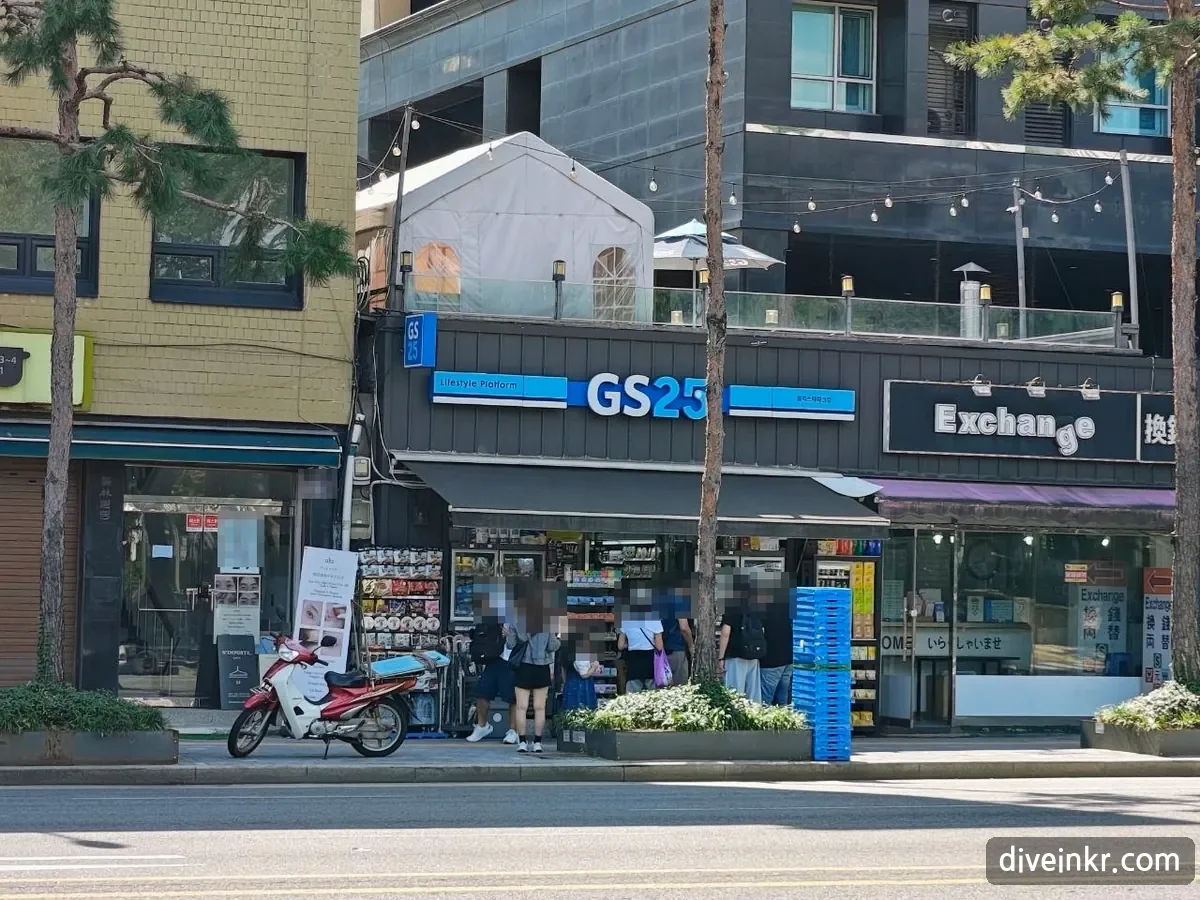
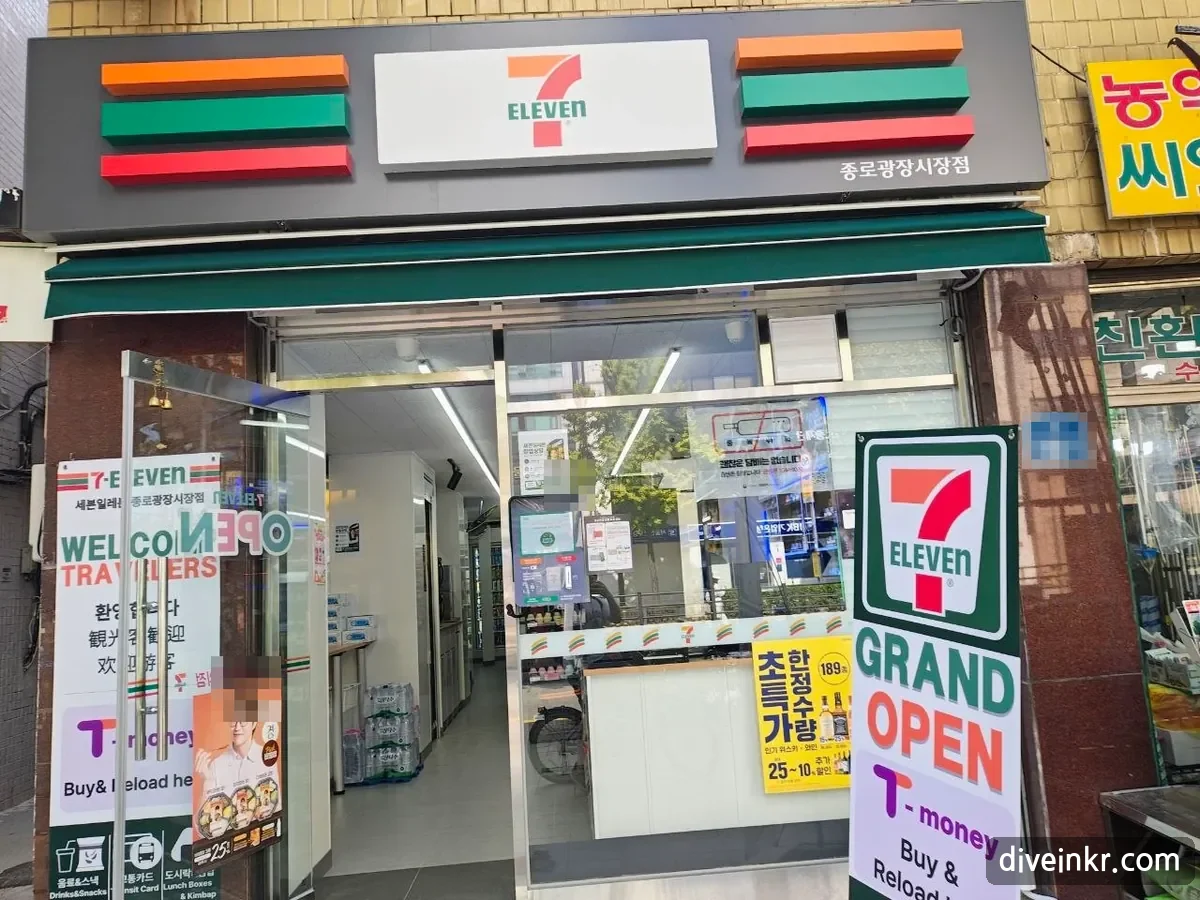
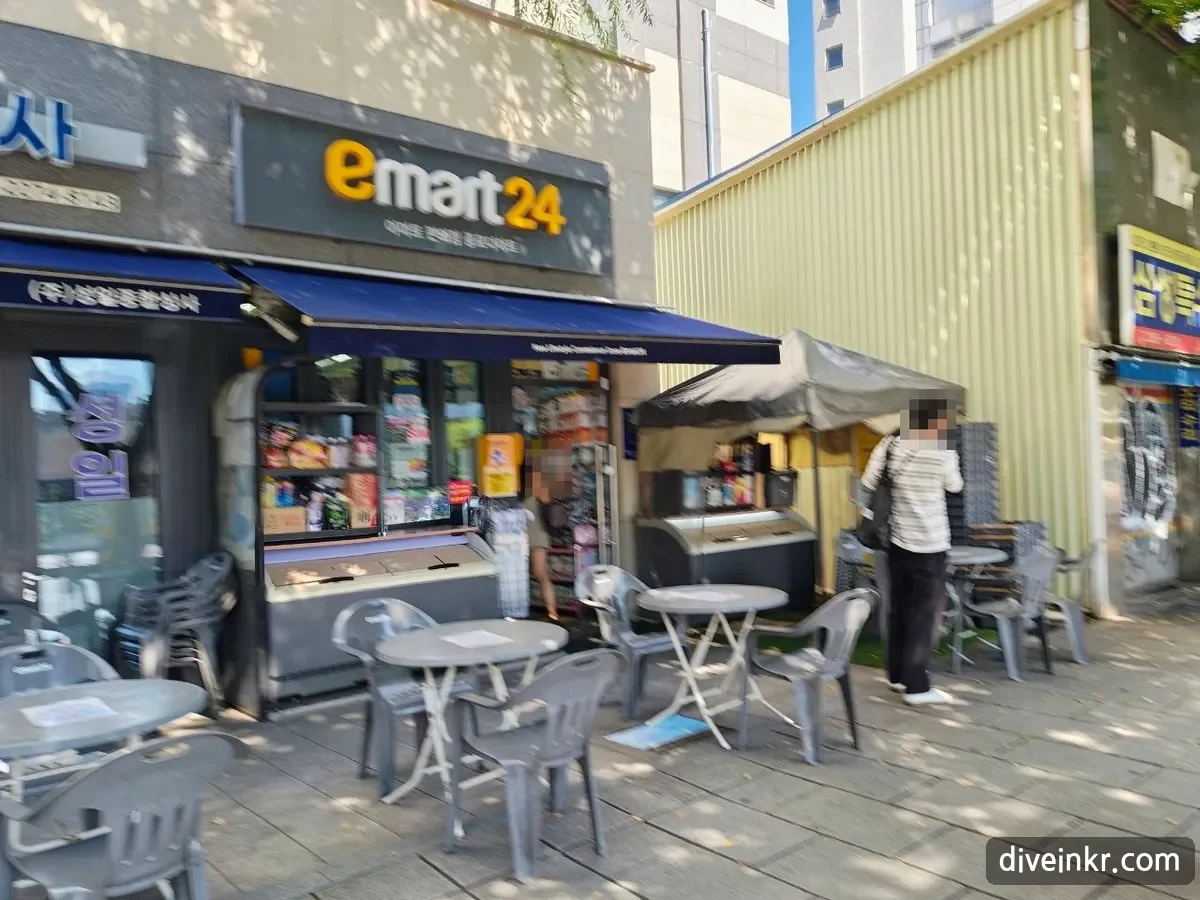
Two words on these signs are worth knowing. 점 (jeom) at the end of a name means "branch," so every store has its own name like 종로광장시장점. And many downtown stores advertise T-money: the transit card you use on buses and the subway can be bought and topped up at the counter. Just say 티머니 충전해 주세요 (timeoni chungjeonhae juseyo, "please top up my T-money") and hand over your card with the amount you want to add. You can pay for the top-up in cash or by credit card. See how to ride the bus in Seoul for how the card works.
Getting Food Heated
In a Korean convenience store, you heat food yourself. There's a microwave (전자레인지) by the counter or in the eating corner, and customers use it on their own — staff don't heat things for you. The package usually prints the heating time, often by microwave wattage.
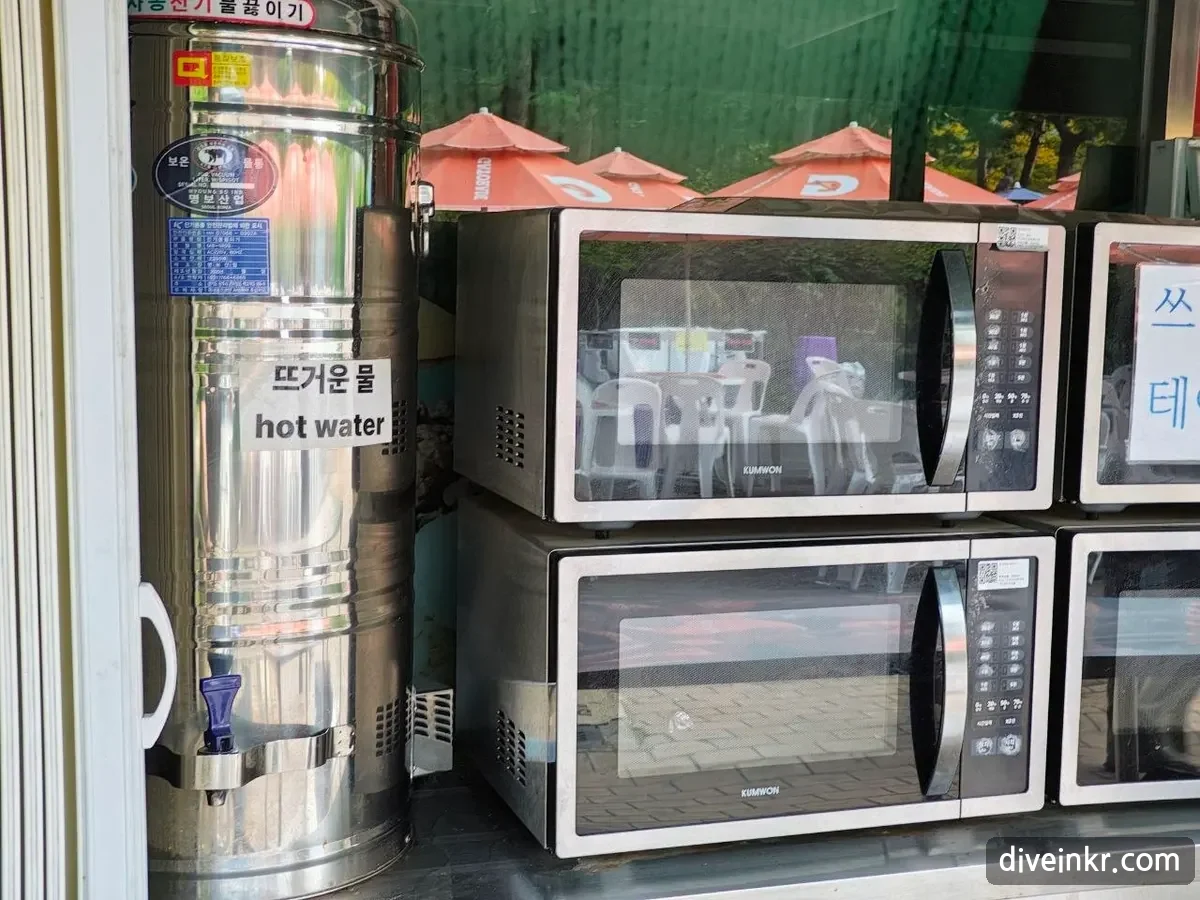
Next to the microwave there's usually hot water for 컵라면 (keomnamyeon, cup ramyeon): peel the lid back halfway, pour hot water up to the line inside the cup, close the lid and wait for the time printed on it. Can't see it? Ask 뜨거운 물 어디 있어요? (tteugeoun mul eodi isseoyo?, "Where's the hot water?").
전자레인지 어디 있어요?
jeonjareinji eodi isseoyo?
Where's the microwave?
The one question you might need — usually it's right next to the counter.
몇 분 돌려요?
myeot bun dollyeoyo?
How long do I heat it?
돌리다 (to turn/run) is the everyday verb for microwaving. The answer is usually on the package: 1분 30초 and so on. Correct, but you rarely need it: the heating time is printed on the package.
By the Han River, some convenience stores even have machines that cook ramyeon for you — see our Yeouido walk.
Bags and Payment
봉투 필요하세요?
bongtu piryohaseyo?
Do you need a bag?
Staff asking you — reply 네, 주세요 (yes please) or 아니요, 괜찮아요 (no, I'm fine — see the gwaenchana page for why that phrasing works).
카드로 할게요.
kadeuro halgeyo.
I'll pay by card.
Even shorter at the counter: 카드요 (kadeuyo).
현금으로 할게요.
hyeongeumeuro halgeyo.
I'll pay in cash.
Or just 현금이요 (hyeongeumiyo) or 현금 드릴게요 (hyeongeum deurilgeyo).
Shelf tags and 2+1 deals are explained in how to read Korean prices.
원플러스원 and 투플러스원: Reading the Deal Tags
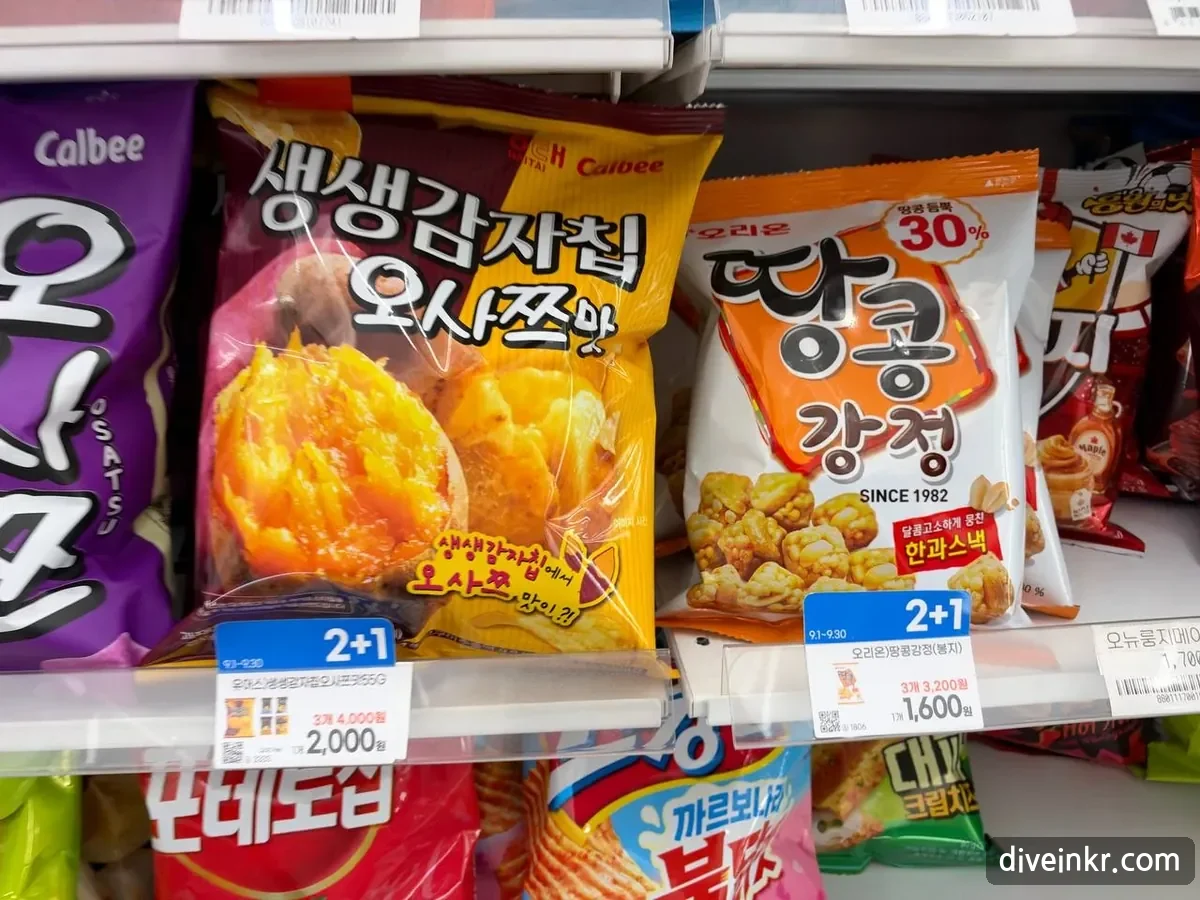
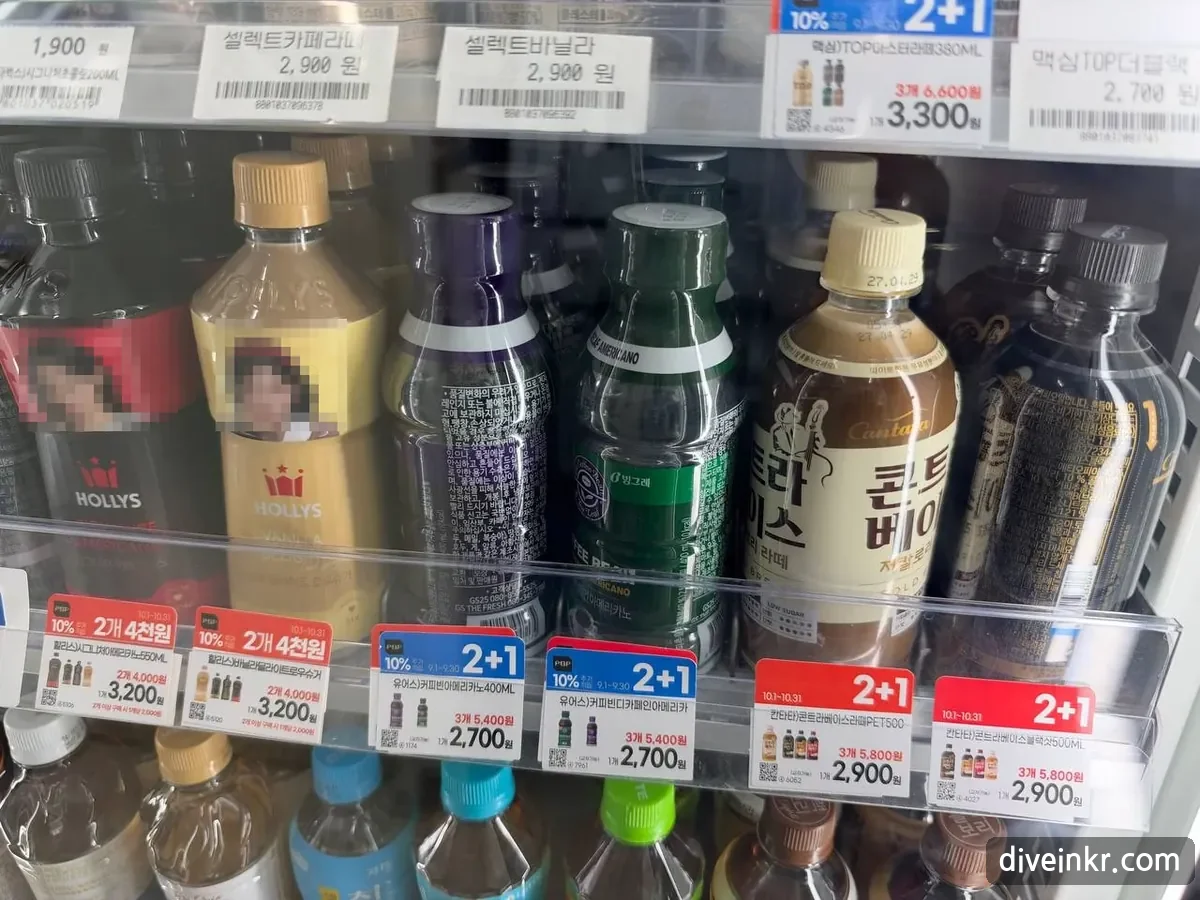
Korean convenience stores are covered in colored tags reading 1+1 and 2+1. In English you'd say "buy one, get one free" or "buy two, get one free," but in Korean they're simply read out as English numbers: 1+1 is 원플러스원 (won-peulleoseu-won) and 2+1 is 투플러스원 (tu-peulleoseu-won). Nobody says 일 더하기 일 here.
| On the tag | Read as | What it means |
|---|---|---|
| 1+1 | 원플러스원 | Buy one, get one free — take two, pay for one |
| 2+1 | 투플러스원 | Buy two, get one free — take three, pay for two |
| 2개 1,800원 · 3개 4,000원 | 두 개 · 세 개 | The price for the whole deal (2 or 3 items), printed next to the single price (1개) |
| 9.1–9.30 | The dates the deal runs — deals usually change every month | |
| 교차 가능 | gyocha ganeung | Mix and match: you can combine different items in the same deal |
| 행사 | haengsa | A promotion or sale event — 이달의 행사 is "this month's deals" |
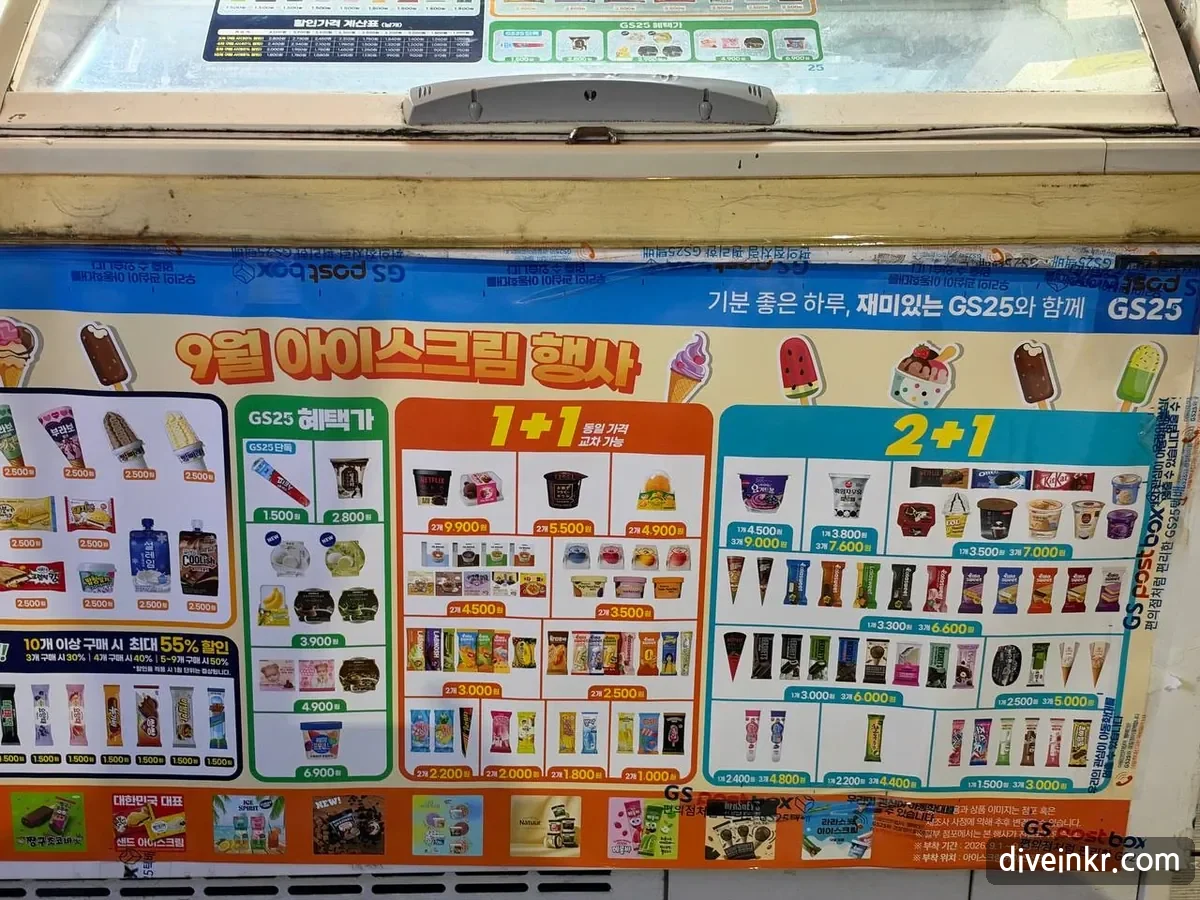
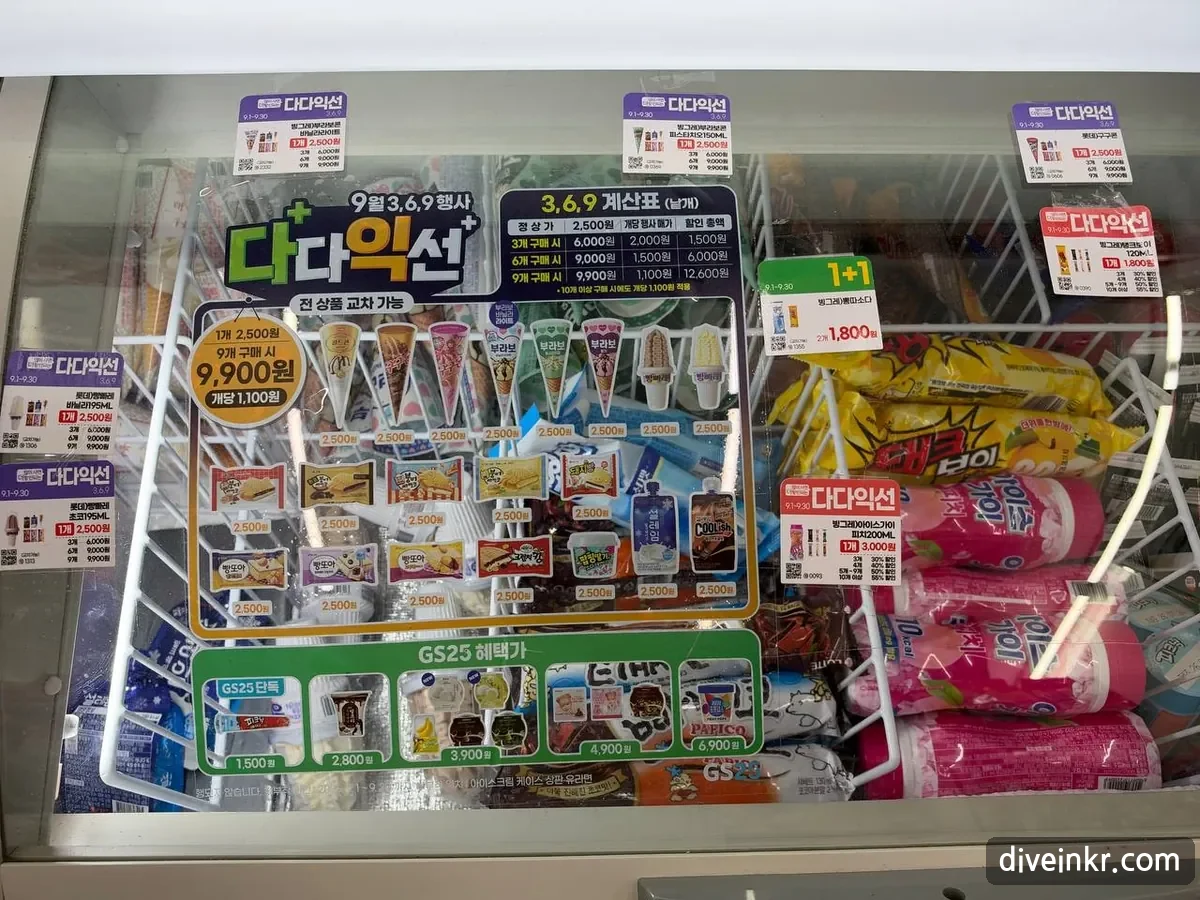
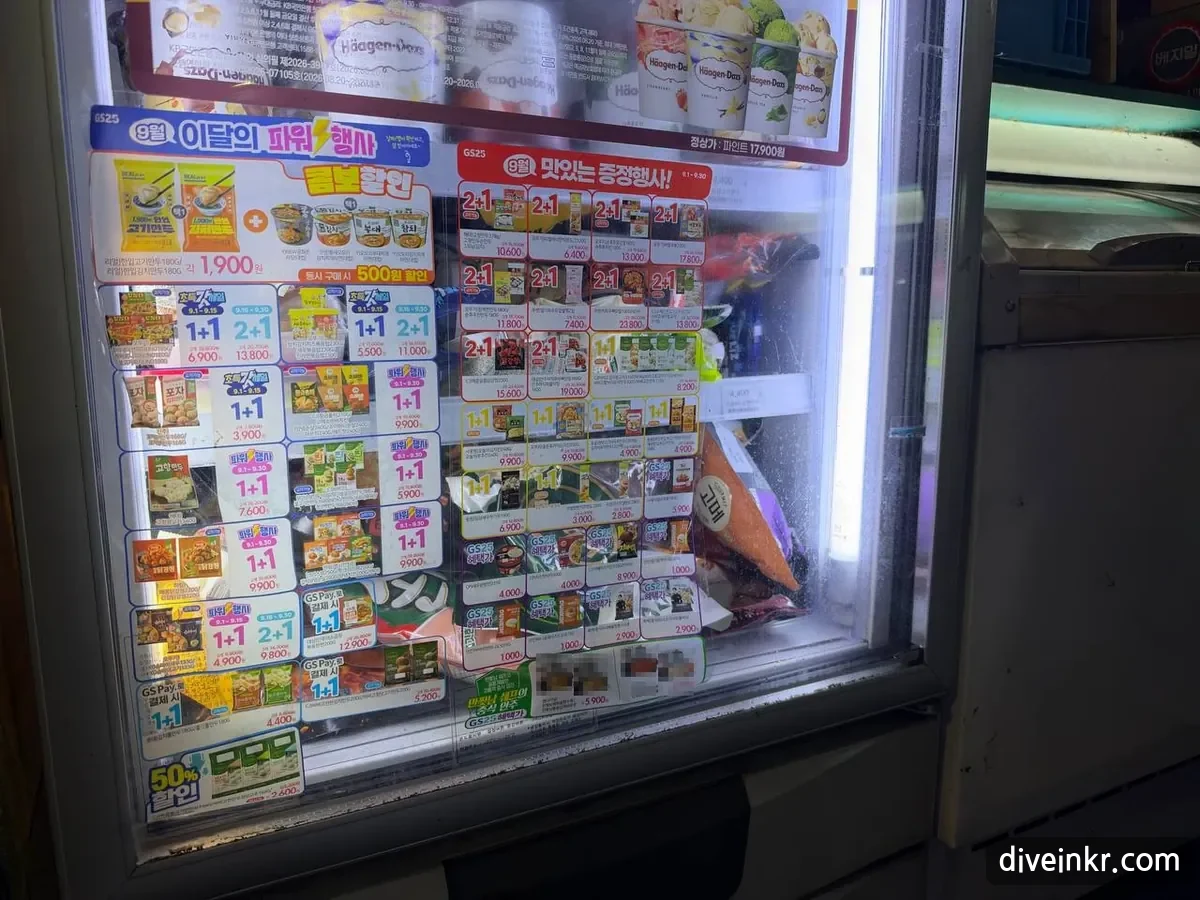
Two practical tips. Bring all the items to the counter — the free one is only free if you actually take it. And watch for 교차 가능: in a mix-and-match deal you can pick, say, two different flavors instead of two of the same.
이거 원플러스원이에요?
igeo wonpeulleoseuwonieyo?
Is this buy-one-get-one-free?
원플러스원이라서 하나 더 가져오시면 돼요.
wonpeulleoseuwoniraseo hana deo gajyeoosimyeon dwaeyo.
It's buy one get one free, so you can grab one more.
What the staff (직원) might tell you if you bring just one.
Asking for Something
이거 얼마예요?
igeo eolmayeyo?
How much is this?
화장실 있어요?
hwajangsil isseoyo?
Is there a bathroom?
Many 편의점 don't have public restrooms — worth asking rather than assuming.
이거 하나 주세요.
igeo hana juseyo.
One of these, please.
Common Mistakes
Mistake #1 — Answering 봉투 필요하세요? with a plain 'yes'/'no' mentality
Remember 괜찮아요 as a reply to an offer usually means "no thanks" — see the gwaenchana page if this still trips you up.
Mistake #2 — Waiting for staff to heat your food
In Korea you heat convenience-store food yourself in the microwave near the counter. Check the package for the time, and take the lid or wrapping off if it says to.
For a sit-down café rather than the convenience-store fridge, see how to order coffee in Korean.
Mini Quiz
2 short questions — about 1 minute
2. Staff asks 봉투 필요하세요? and you don't want a bag. What do you say?
3. How do you say "I'll pay by card"?
Part of Korean Phrases for Travelers
Related Knowledge
Learn Next
Taxi Korean Phrases You'll Actually Need
One everyday situation down — the taxi ride is next on the practical-Korean checklist.
Will you remember this tomorrow?
Save it — your daily review brings it back right before you'd forget. No account needed.