Dive in Korean

Yeouido, Seoul: Seoul Dal, Yeouido Park, the 63 Building and the Korean Around Them

Written and reviewed by Jun and Jin, native Korean speakers

Published · How we write & review

After this page, you can find your way around Yeouido — Yeouido Park, the Seoul Dal balloon, the 63 Building, The Hyundai Seoul and the Han River park — and read the Korean on its signs.

10-second answer

The short answer

Yeouido (여의도, Yeouido) is an island in the Han River in western Seoul, home to the National Assembly, KBS and the finance district. For a day out: ride the Seoul Dal balloon (서울달, Seouldal) over Yeouido Park — 25,000 won for adults, about 15 minutes, noon to 10 p.m. — see the 63 Building and The Hyundai Seoul, then picnic in Yeouido Hangang Park, where food delivery comes to marked delivery zones.

Quick check — did that land?

  1. 1. What was Yeouido Park before it became a park in 1999?

Yeouido: Seoul's Island of Offices, TV and Parliament

여의도 (Yeouido) is a flat island in the Han River (한강, Hangang) in western Seoul. It's where Korea's National Assembly meets, where the public broadcaster KBS has its main building, and where banks and brokerages fill the towers — people call it Korea's Wall Street. It's also one of the easiest places in Seoul to spend a green day out: a big park in the middle, a riverside park along the edge, and a balloon that lifts you over all of it.
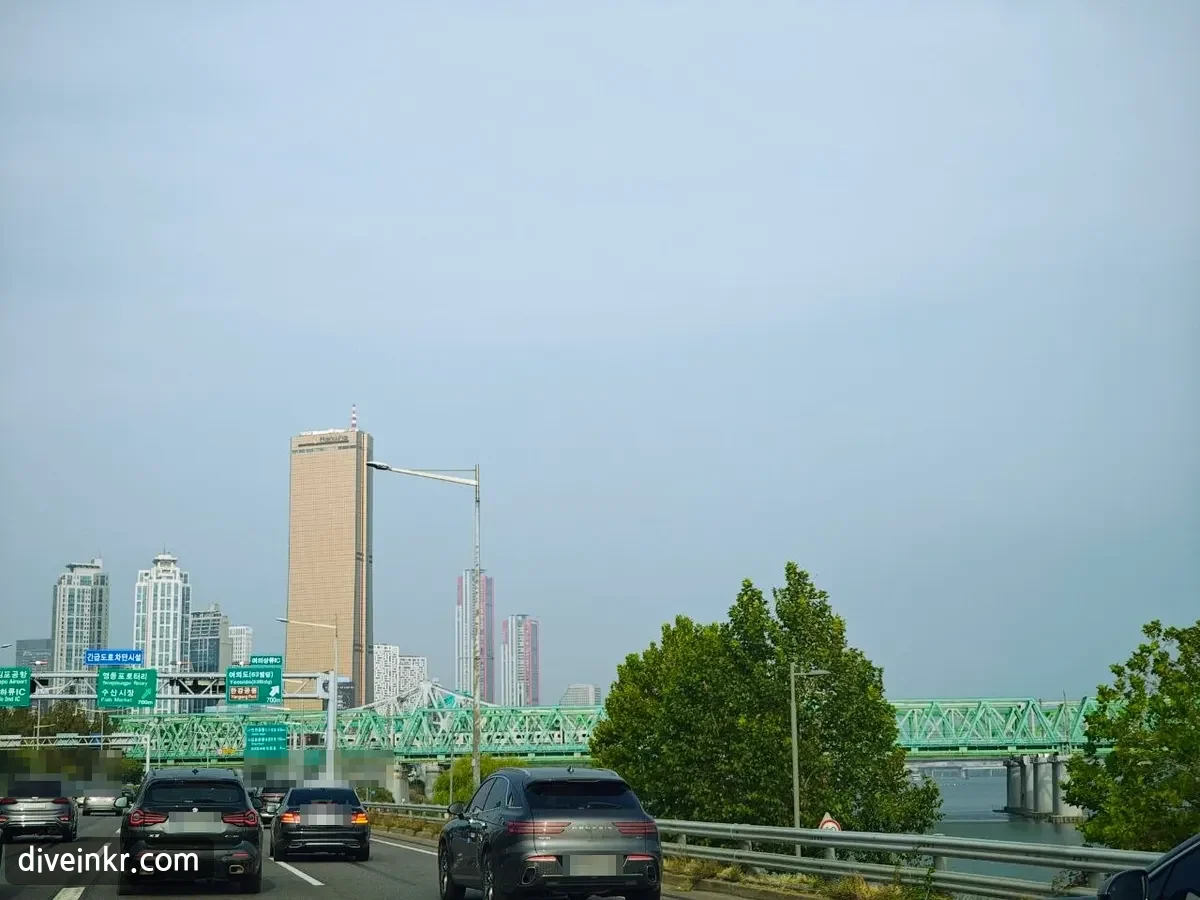
The gold-glass 63 Building rising above Yeouido, seen from a busy riverside expressway in Seoul with a green steel railway bridge over the Han River and road signs pointing to 여의도(63빌딩) (number plates blurred)
Driving into Yeouido along the Han River. The gold tower is the 63 Building, and the green sign on the left points to 여의도(63빌딩) — Yeouido, 63 Building.

The island is walkable end to end. Yeouido Station (여의도역, Lines 5 and 9) puts you between the park and the office towers; National Assembly Station (국회의사당역, Line 9) is at the western end, near the Assembly and KBS; and Yeouinaru Station (여의나루역, Line 5) opens onto the riverside park.

See also: A walk through Jongno

여의도공원: From Airfield to Plaza to Park
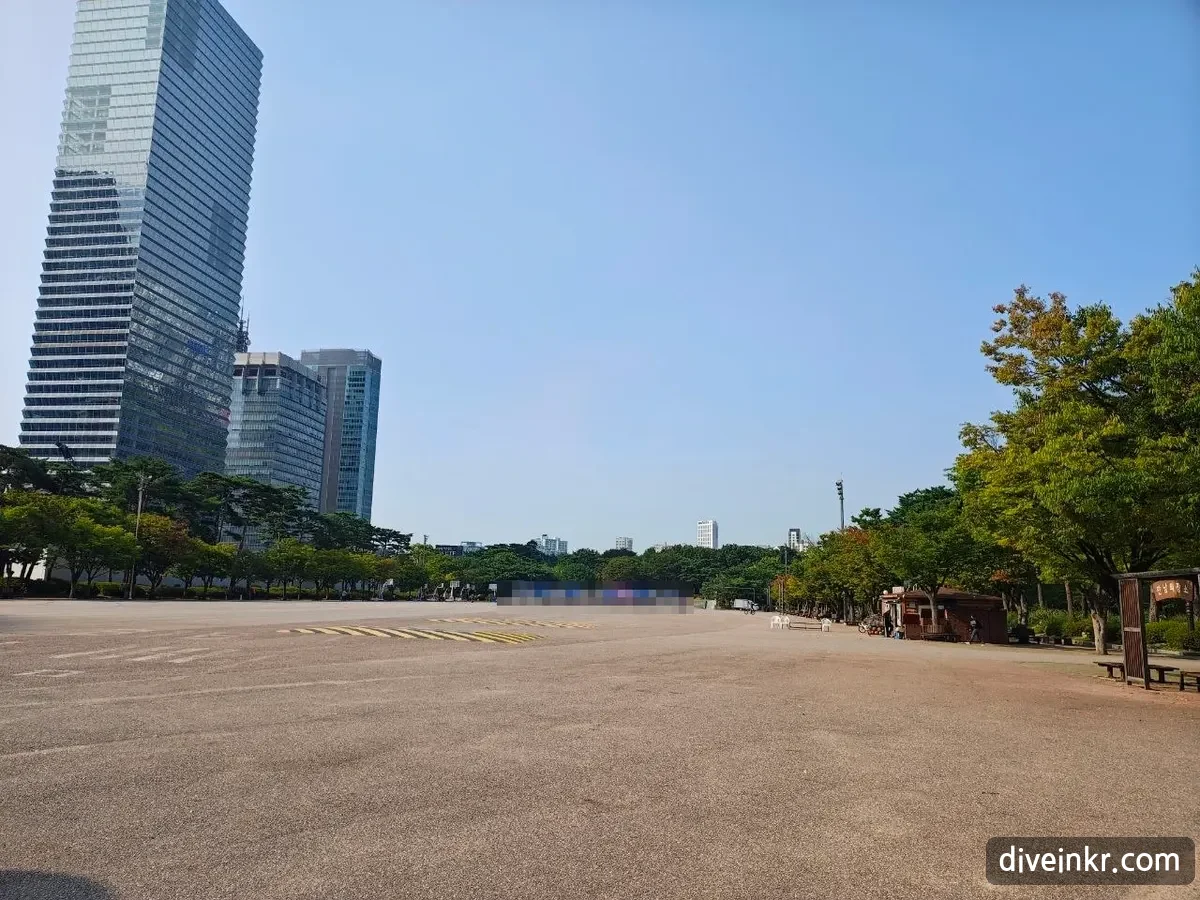
The wide, flat paved plaza of Yeouido Park with office towers on the left, trees on the right and a row of small event tents in the distance
The 문화의 마당 (munhwaui madang, "culture yard") in Yeouido Park — a huge paved space kept open for events. It's a leftover of what the whole park used to be.

Yeouido Park didn't start as a park. In 1916 Korea's first airfield was built on this island, and in 1922 the Korean pilot 안창남 (An Chang-nam) took off from it to fly over Seoul while tens of thousands watched. Civil flights later moved to Gimpo, and the last air force units left in 1971. That same year the old runway became 5·16광장, a vast asphalt plaza that was later renamed 여의도광장 (Yeouido Plaza).

For nearly three decades the plaza hosted the country's biggest gatherings: Armed Forces Day parades, presidential inaugurations, a 1973 Billy Graham crusade reported to have drawn over a million people, and the 1984 Mass at which Pope John Paul II canonized 103 Korean martyrs. In 1997 the city started tearing up the asphalt, and in 1999 it opened as 여의도공원 (Yeouido Park) — woods, lawns, a Korean traditional garden, and one paved plaza kept for events.
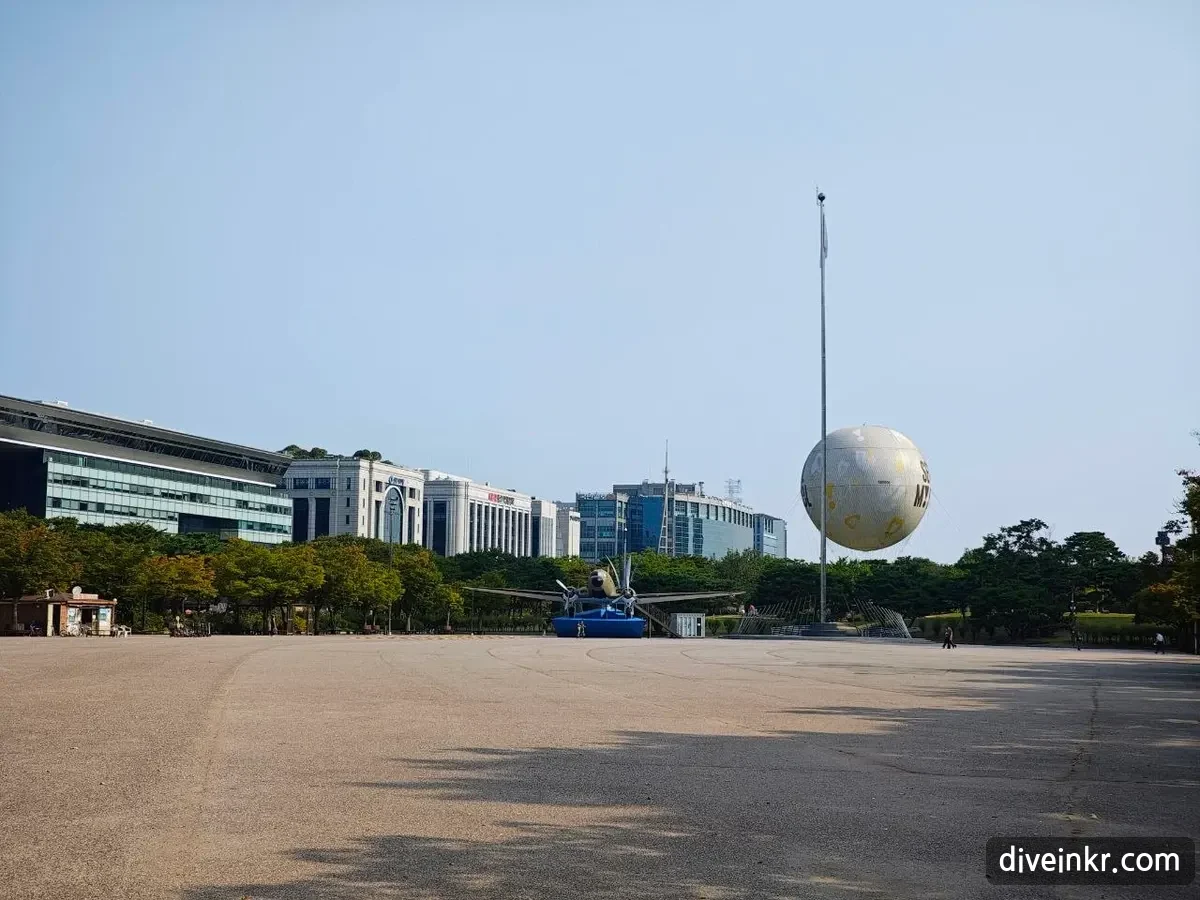
A wide paved plaza in Yeouido Park with a small vintage propeller plane on a blue base in the distance, a tall flagpole and the Seoul Dal balloon on the right
The old propeller plane on the plaza, with the Seoul Dal balloon beside it. It's a C-47 — not the original aircraft but the same model: in 1945, Korean independence fighters and then Kim Gu and other leaders of the Provisional Government came home on C-47s that landed at the Yeouido airfield.

The plane has been on display since 2015, the 70th anniversary of liberation, and in 2018 its inside was turned into a small exhibition about the Provisional Government of the Republic of Korea.

서울달 (Seoul Dal): The Balloon Over the Park
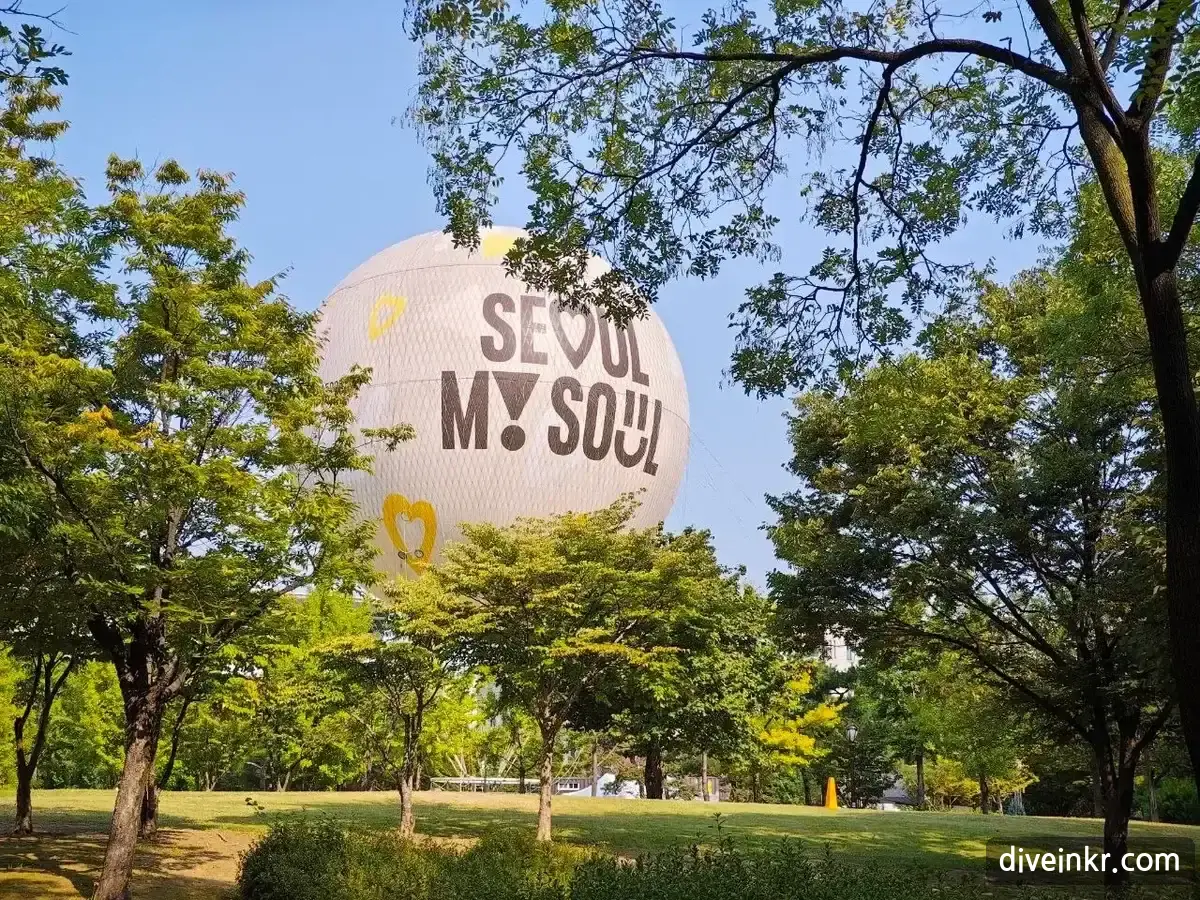
The huge pale-yellow Seoul Dal gas balloon floating above the trees of Yeouido Park against office towers
서울달 (Seoul Dal, "Seoul Moon") hanging over Yeouido Park. It's a tethered balloon: a cable keeps it attached to the ground, and it rises straight up and comes straight back down.

서울달 (Seoul Dal) opened in August 2024. The balloon is 22 meters across, filled with helium, and on a cable, so it goes up to about 130 meters above the park and then winches back down — the whole ride takes about 15 minutes, with up to 20 people in the gondola. From the top you see the Han River, the 63 Building and, on a clear day, the mountains around Seoul.
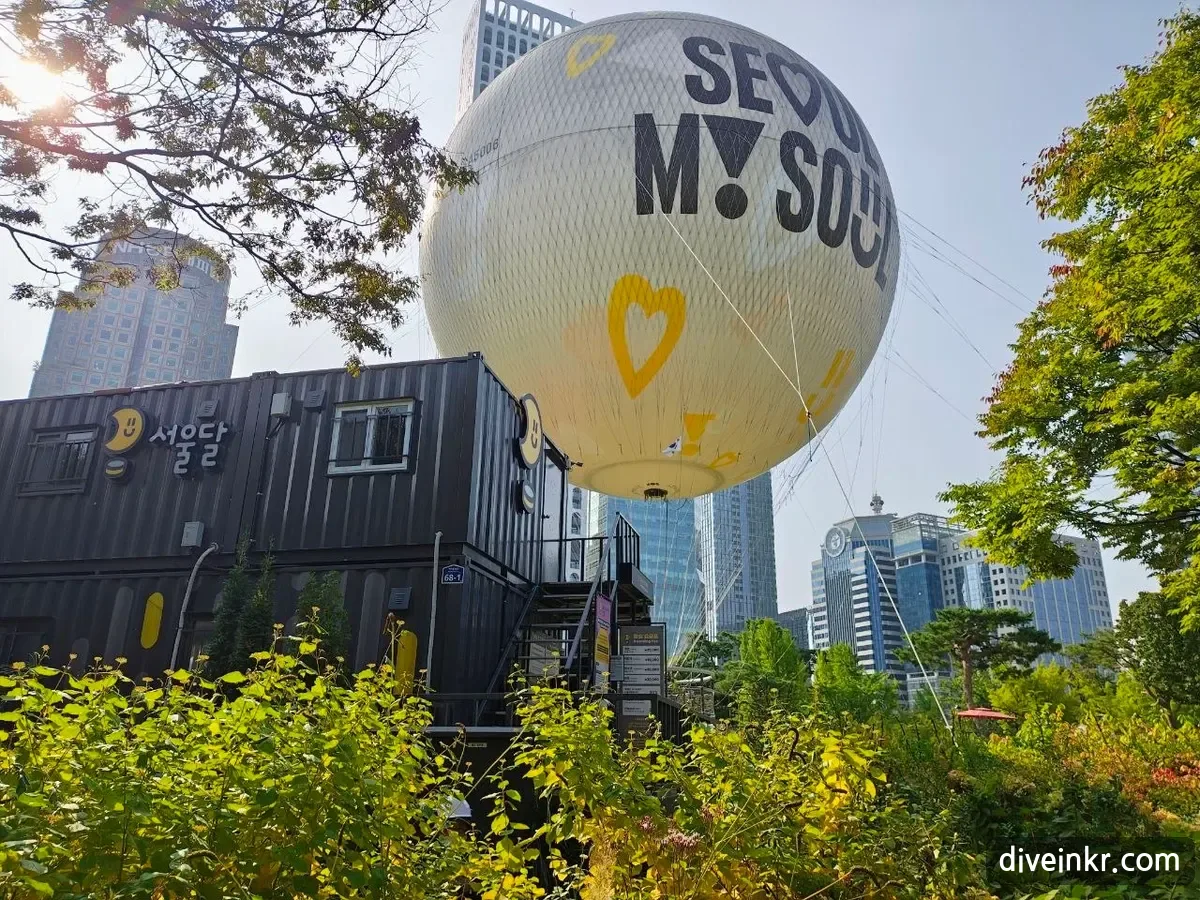
The Seoul Dal ticket office, a black two-story container building with a yellow moon logo and the name 서울달, beneath the big balloon printed with SEOUL MY SOUL
The ticket office is a black container building with the yellow 서울달 logo, right under the balloon.
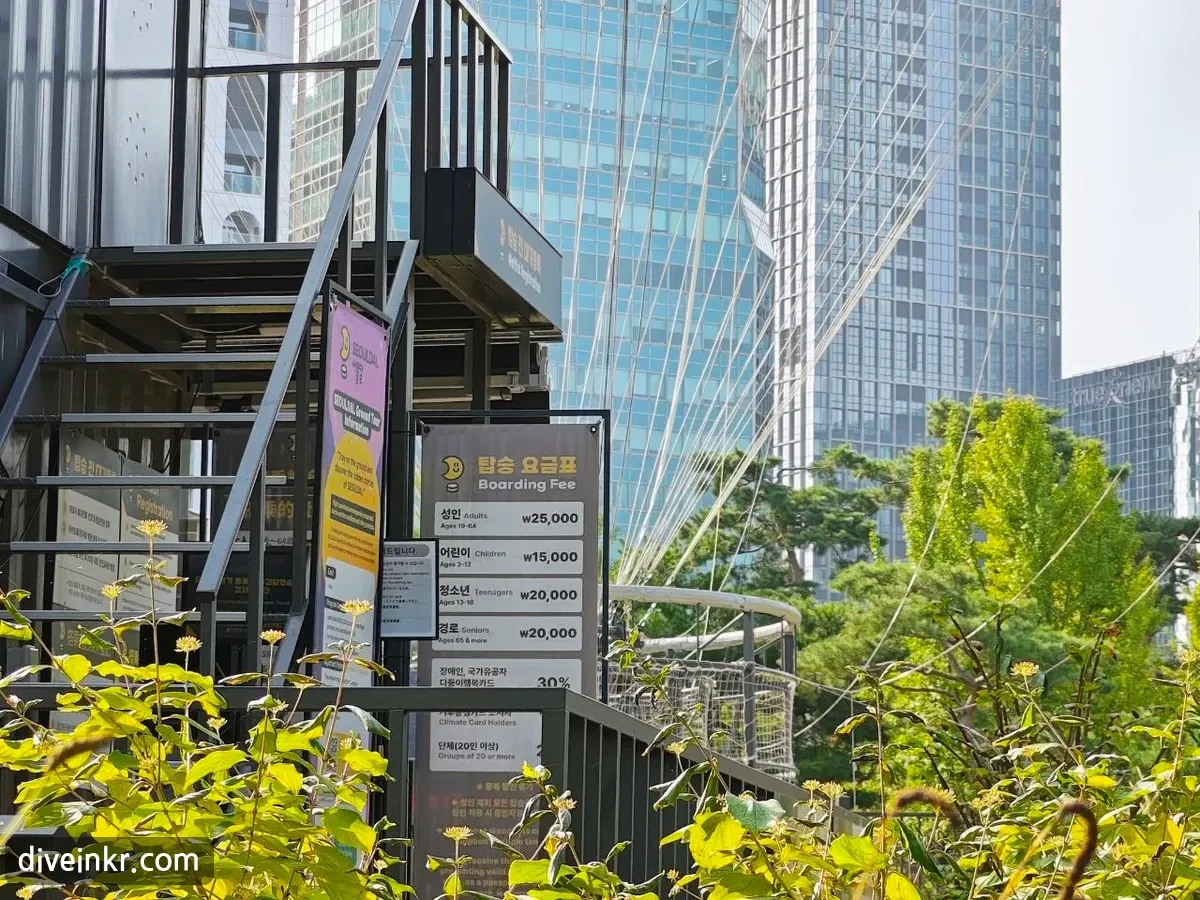
The Seoul Dal boarding fee sign in Korean and English: adults 25,000 won, children 15,000 won, teenagers 20,000 won, seniors 20,000 won, with discounts for people with disabilities, national merit holders, multi-child families, Climate Card holders and groups
The fare board, in Korean and English. 탑승 요금표 (tapseung yogeumpyo) means "boarding fee table."
TicketPrice
성인 Adults (19–64)25,000 won
청소년 Teens (13–18)20,000 won
경로 Seniors (65+)20,000 won
어린이 Children (3–12)15,000 won
장애인·국가유공자·다둥이행복카드30% off
단체 Groups of 20+20% off
기후동행카드 Climate Card holders10% off

Since April 2026 it runs every day, from noon to 10 p.m. (last flight 9:30 p.m.); on spring and autumn weekends it opens at 10 a.m. Sunset is the most popular time, when you get the evening light and then the city lights. You can buy tickets on site, and visitors from abroad can book through international travel sites such as Klook and Trip.com. Wind and rain can stop the flights at short notice; on those days there's a "ground tour" of the gondola instead.

Getting there

The boarding point is inside Yeouido Park (여의공원로 68-1). The closest stop is 국회의사당역 (National Assembly Station, Line 9) exit 3, about a 7-minute walk; from 여의도역 (Yeouido Station) exit 3 it's about 13 minutes.

A Walk Through the Park
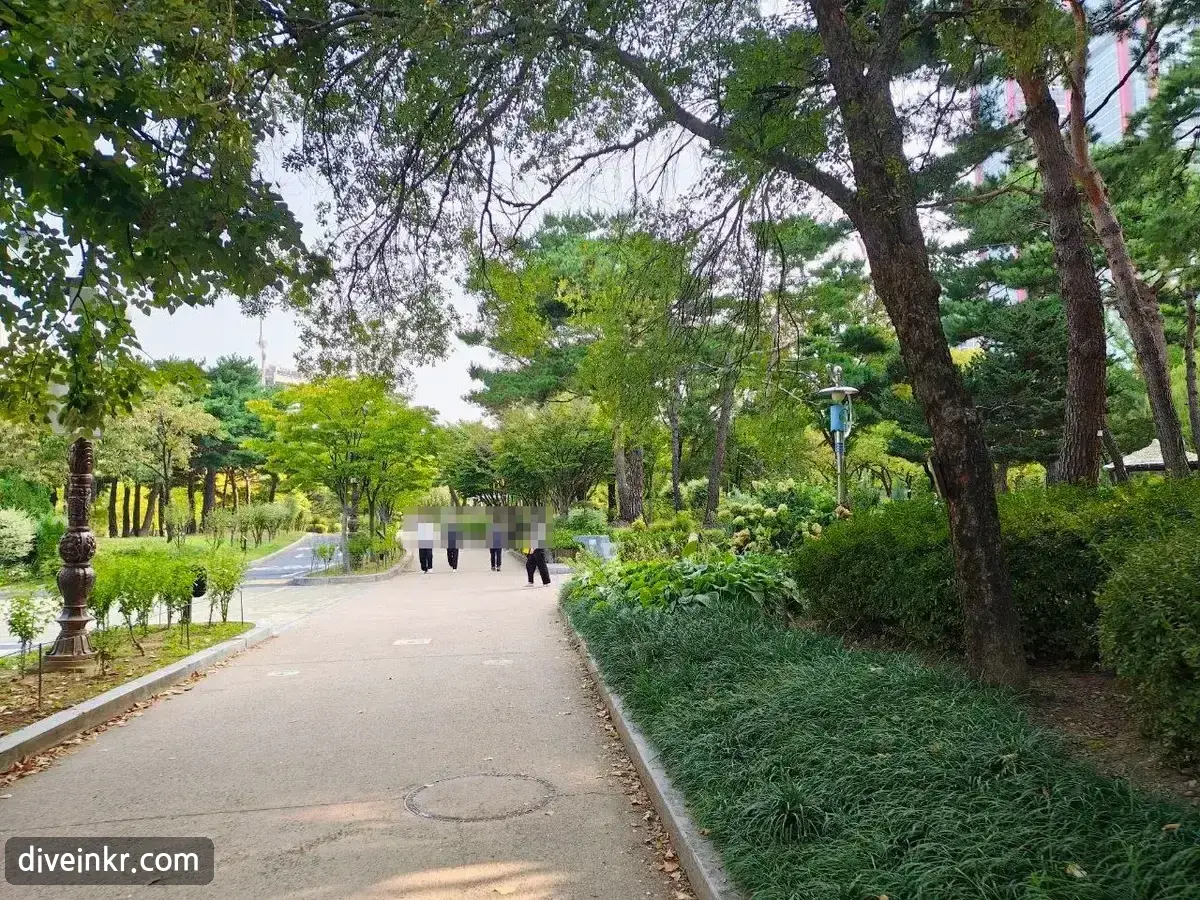
A wide paved walking path in Yeouido Park under tall pine and zelkova trees, with a few people walking in the distance
The main walking path. Yeouido Park has separate paths for walking and for bikes, which is why the painted signs matter.
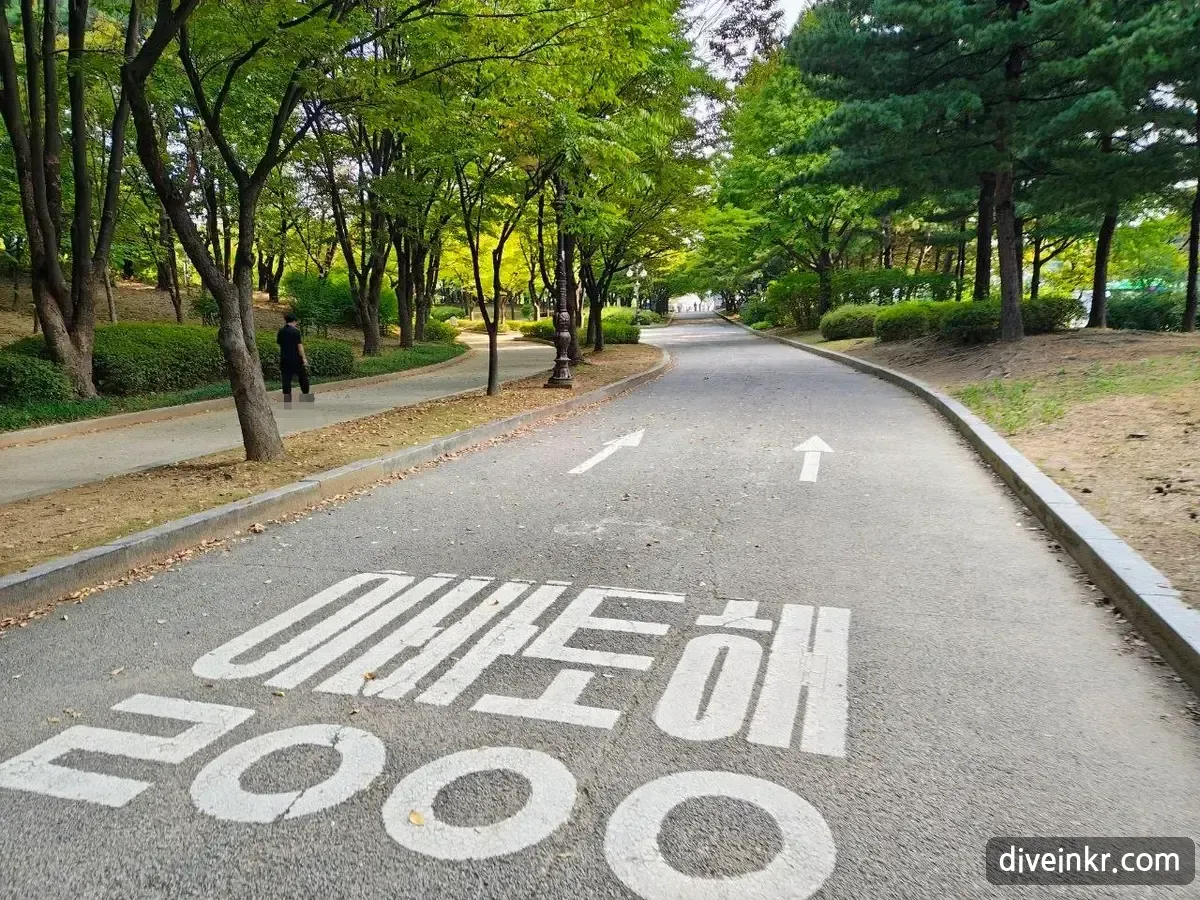
A bike path in Yeouido Park with two white arrows pointing the same way and the words 일방통행 painted on the asphalt, with a separate walking path on the left
A painted 일방통행 (ilbang-tonghaeng, "one way") on the park's bike path: ride in the direction of the arrows only. You'll see the same word on one-way streets all over Korea.
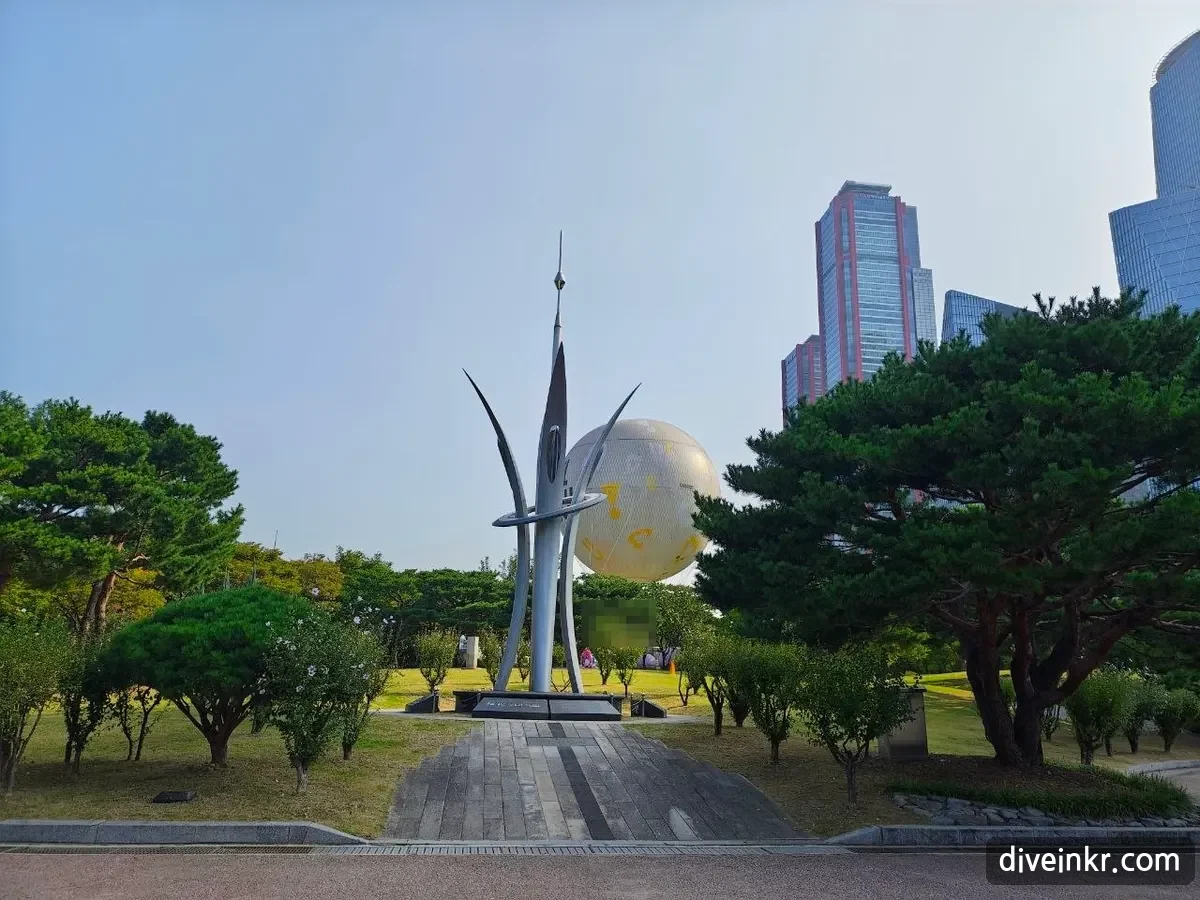
A tall steel sculpture of curved blades around a central spire on a lawn in Yeouido Park, with the Seoul Dal balloon behind it and flowering shrubs in front
A sculpture on one of the lawns, with the balloon behind it.
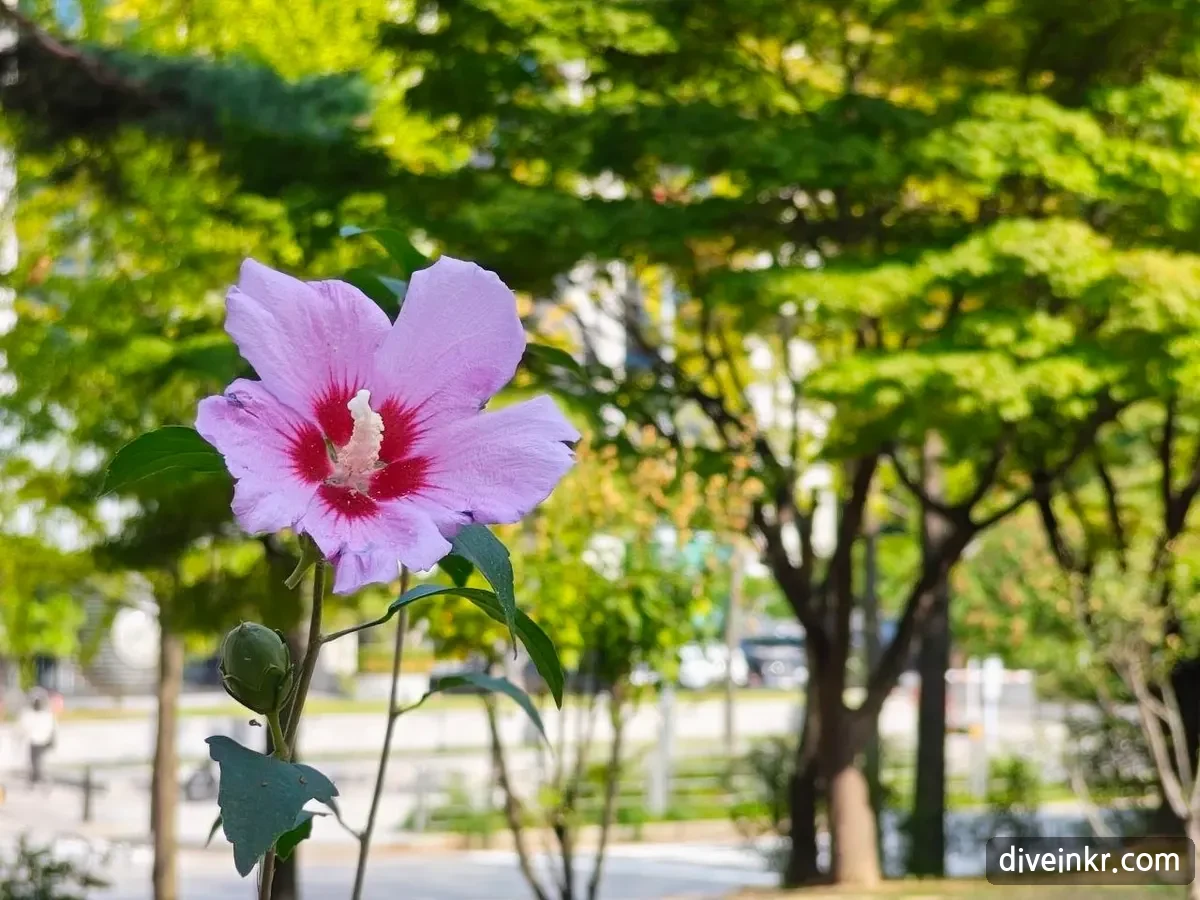
A close-up of a single mugunghwa flower, pale pink-purple with a deep red center and a white stamen, in Yeouido Park
무궁화 (mugunghwa), the Rose of Sharon. Each flower opens in the early morning and drops by evening, but a bush keeps flowering from July to early October.

무궁화 (mugunghwa) is treated as Korea's national flower: it's in the national anthem (무궁화 삼천리 화려강산, "mugunghwa, three thousand ri of splendid rivers and mountains"), on the national emblem and on the country's highest order of merit. The name means "the flower that never ends," after its hundred-day blooming season. Surprisingly, no law actually designates it — it became the national flower by custom after liberation, and a campaign to write it into law is still going in 2026.
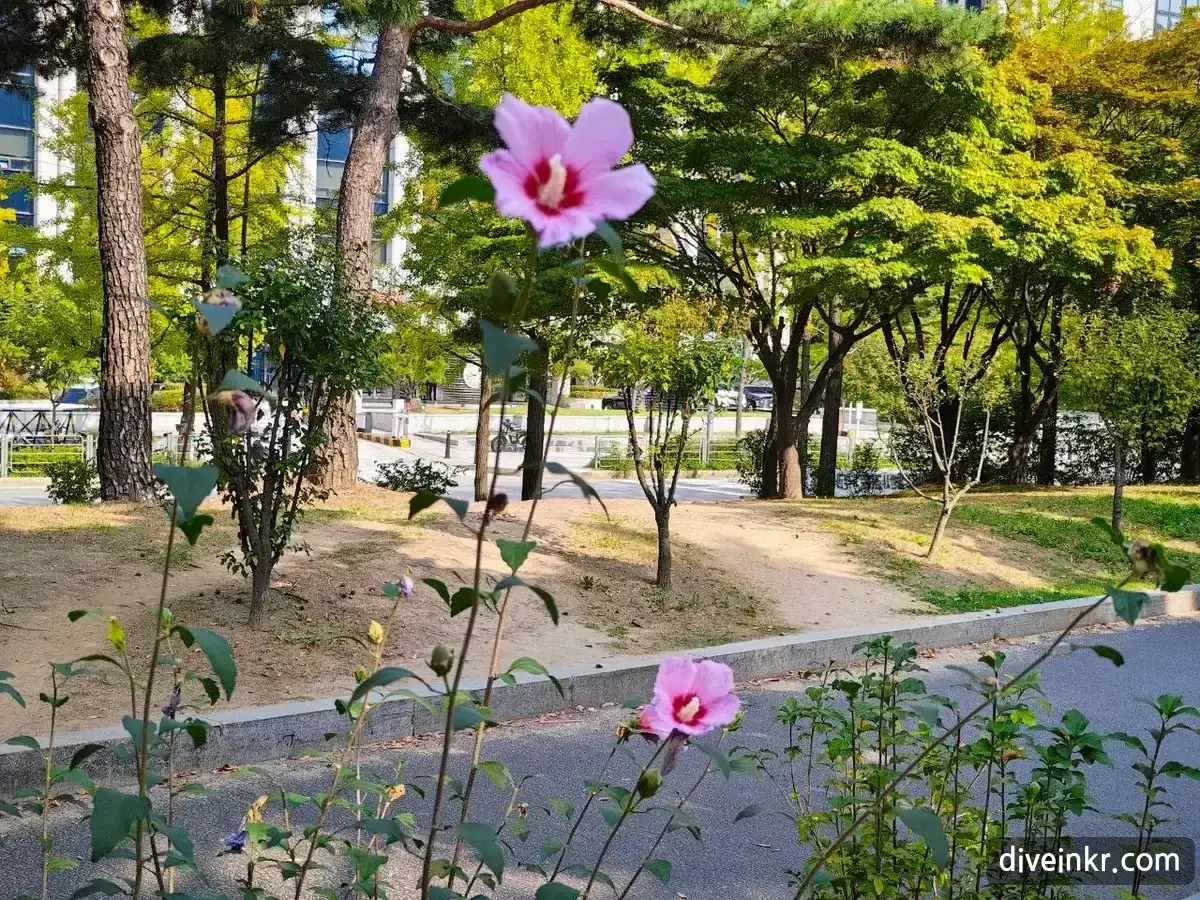
Two pink mugunghwa flowers on tall thin stems beside a park road in Yeouido, with pine trees and sandy ground behind
Mugunghwa planted along a path in the park at the end of September, at the tail end of the season.
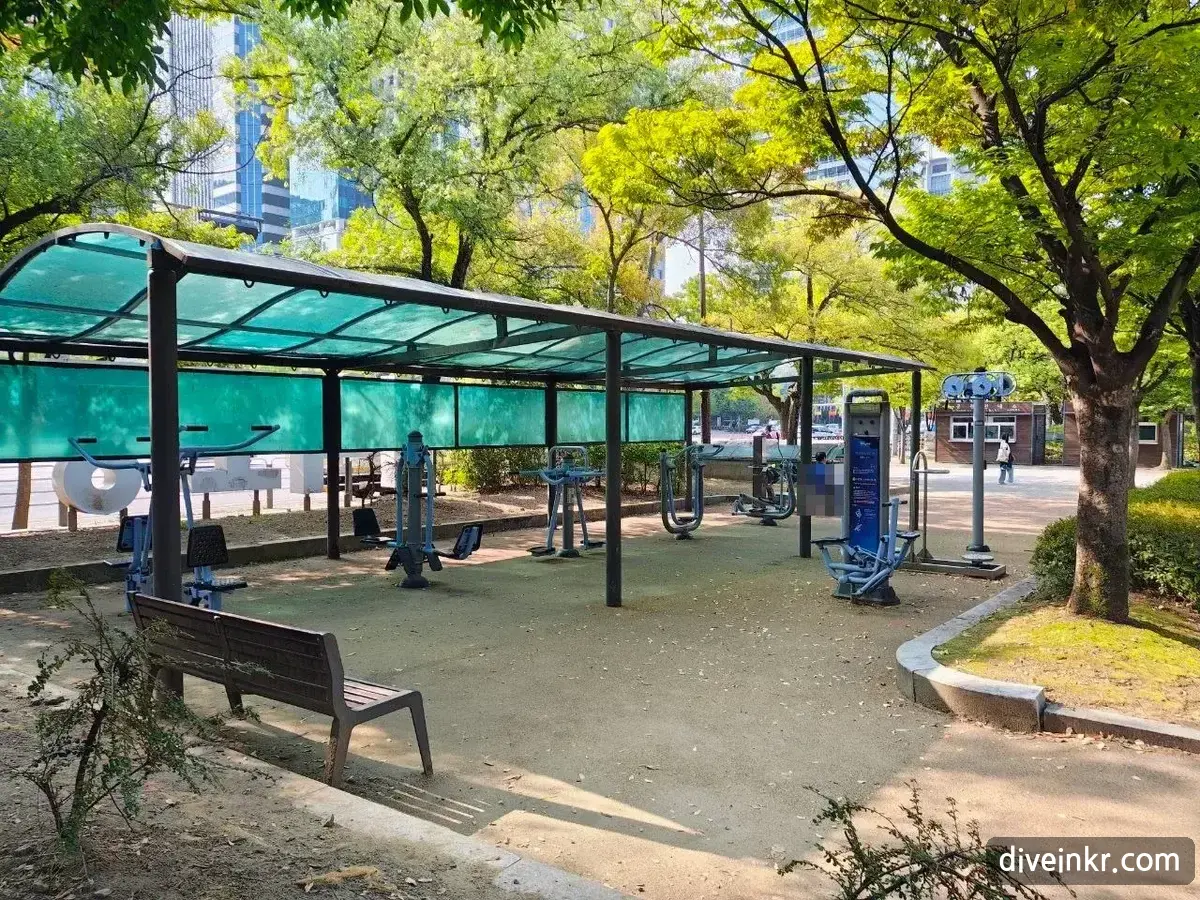
A set of outdoor exercise machines in blue and gray steel under a teal canopy in Yeouido Park, with a bench in front and trees around
Outdoor exercise machines (야외 운동기구, yaoe undong-gigu). Almost every Korean park has a set like this — free to use, and busiest early in the morning.
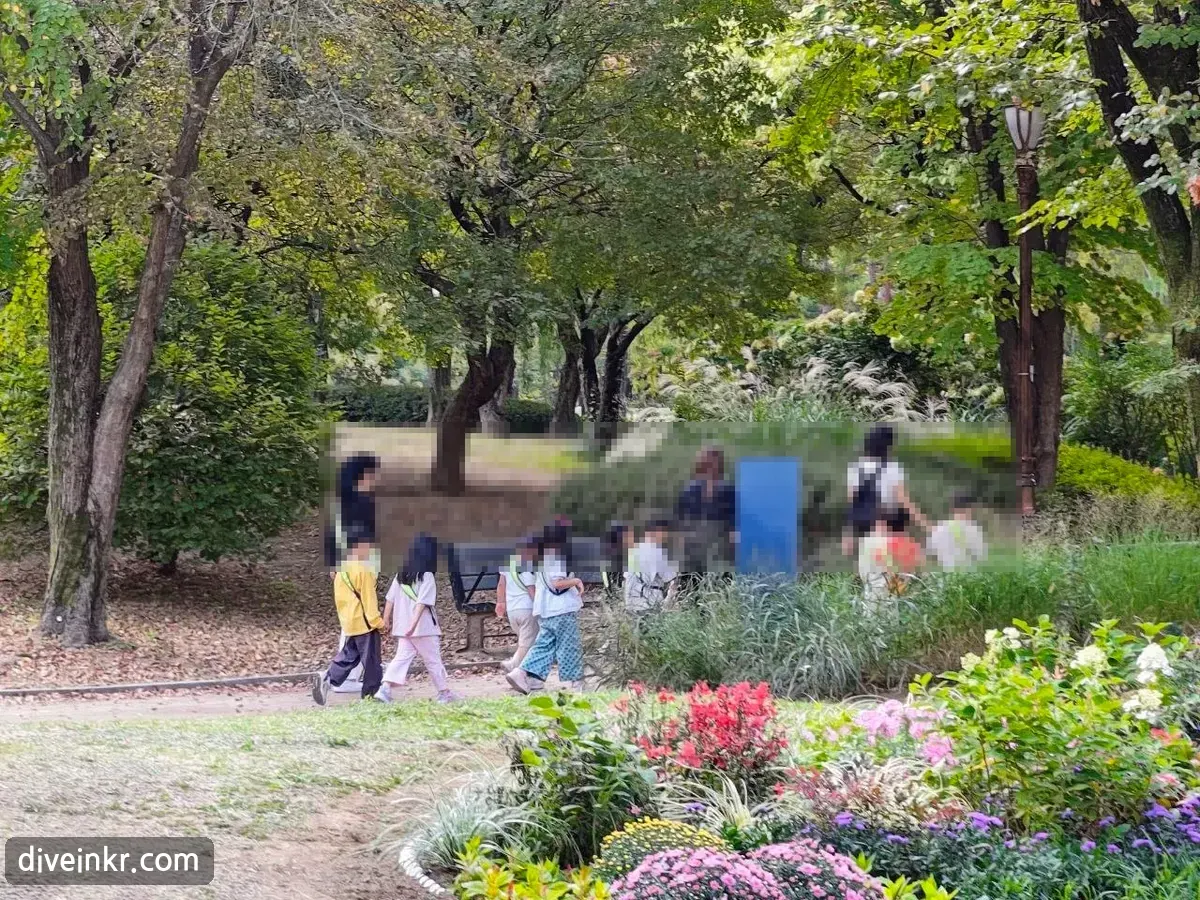
A group of small kindergarten children in yellow safety vests walking along a path in Yeouido Park with their teachers (faces blurred)
A kindergarten class on an outing in the park. In Korean a class trip outdoors like this is a 소풍 (sopung) — the same word as a picnic.

정자 and 초정: The Korean Garden and Its Pavilions

In one corner of the park is 한국 전통의 숲 (hanguk jeontongui sup, "the Korean traditional forest"), planted only with trees that grow in Korea, around a pond with three small islands. This is where the pavilions are.
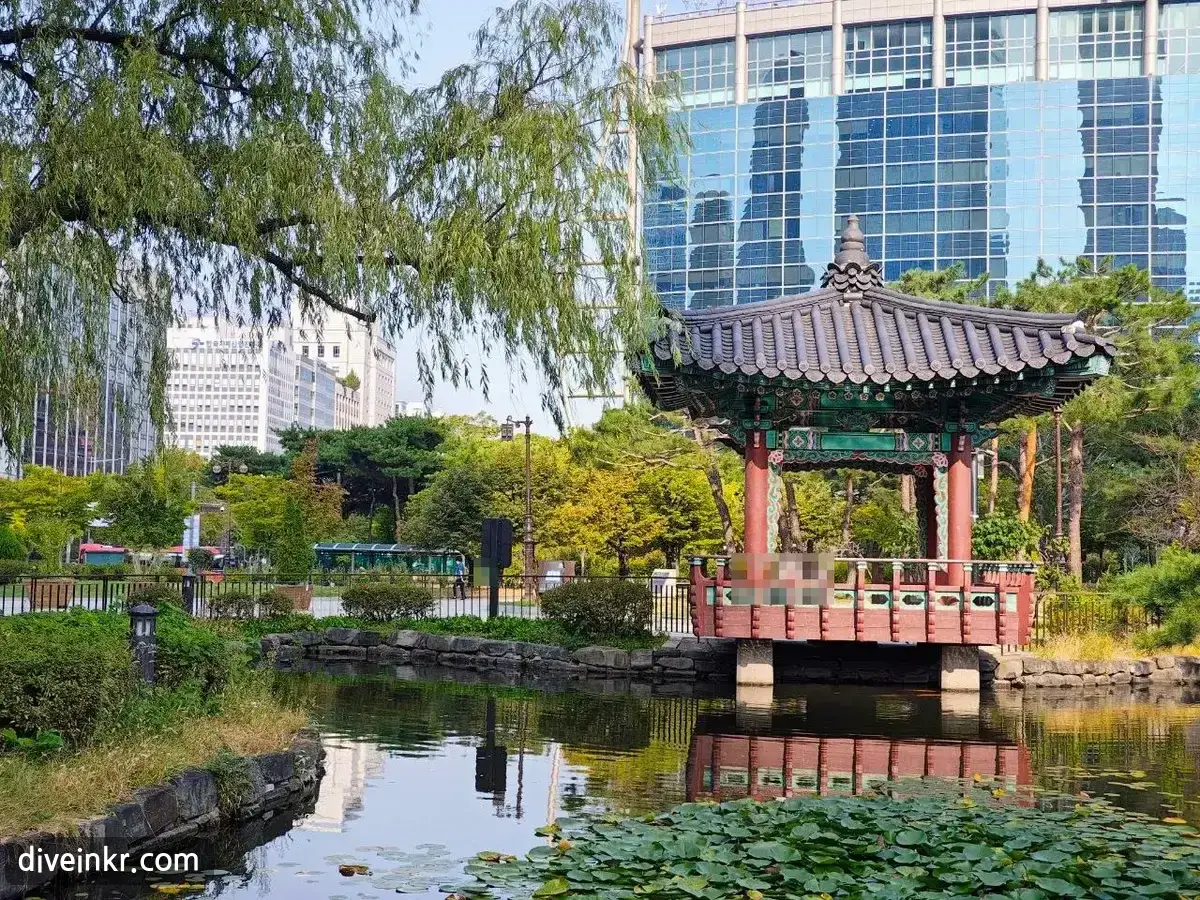
A traditional Korean pavilion with a tiled roof and red-and-green painted beams standing over the edge of a lily pond in Yeouido Park, with a weeping willow and glass office towers behind
A 정자 (jeongja) over the pond. A jeongja is a pavilion for resting and taking in the view: pillars and a roof, no walls.
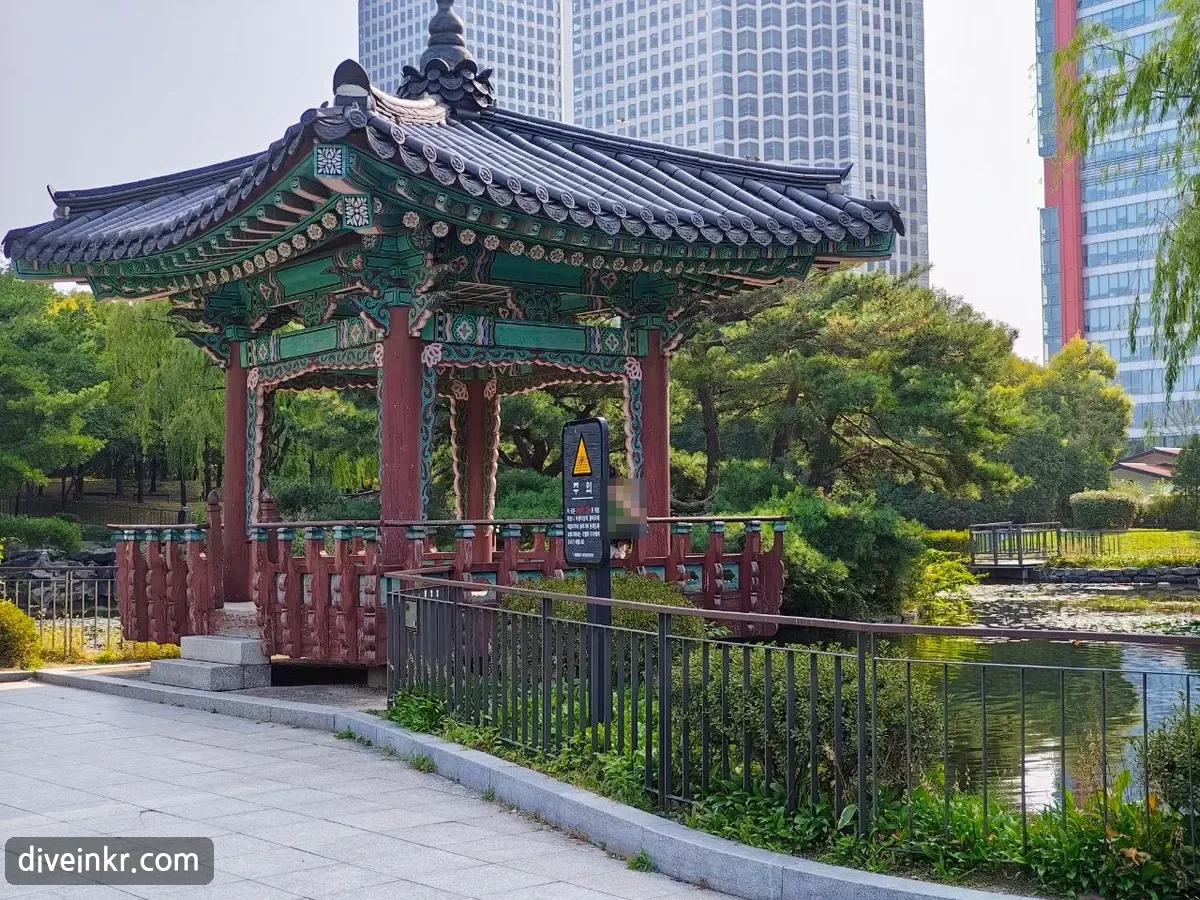
A traditional Korean pavilion with a curved gray tile roof, red pillars and brightly painted green-and-red beams beside a pond, with skyscrapers behind
The painted patterns under the roof are 단청 (dancheong), the same colors you see on palaces and temples.
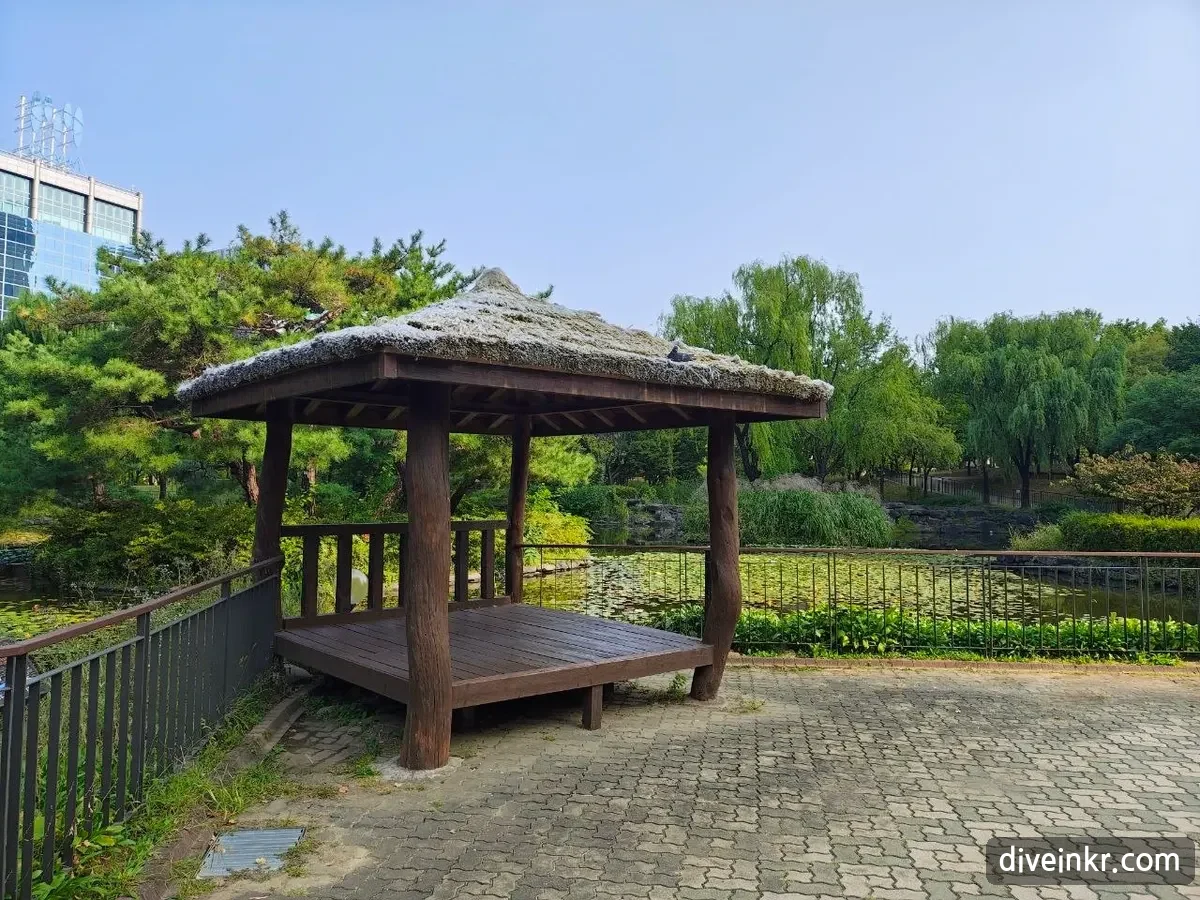
A small square open wooden shelter with a thatched straw roof and a raised wooden floor, beside a lily pond in Yeouido Park
A simpler, thatched shelter by the same pond. Is it still a 정자?

It is, according to the dictionary. A pavilion with a thatched roof is 초정 (chojeong) or 모정 (mojeong) — a kind of 정자. Two words people might reach for don't quite fit: 오두막 (odumak) is a small, humble hut you could live in, and 원두막 (wondumak) is a lookout shelter built at the edge of a melon or cucumber field so someone could guard the crop. In everyday speech, though, most Koreans would just call either one a 정자.

WordRomanizationWhat it is
정자jeongjaAn open pavilion for resting and enjoying the view
초정 / 모정chojeong / mojeongA 정자 with a thatched roof
오두막odumakA small, humble hut (a dwelling)
원두막wondumakA raised lookout shelter for guarding a field
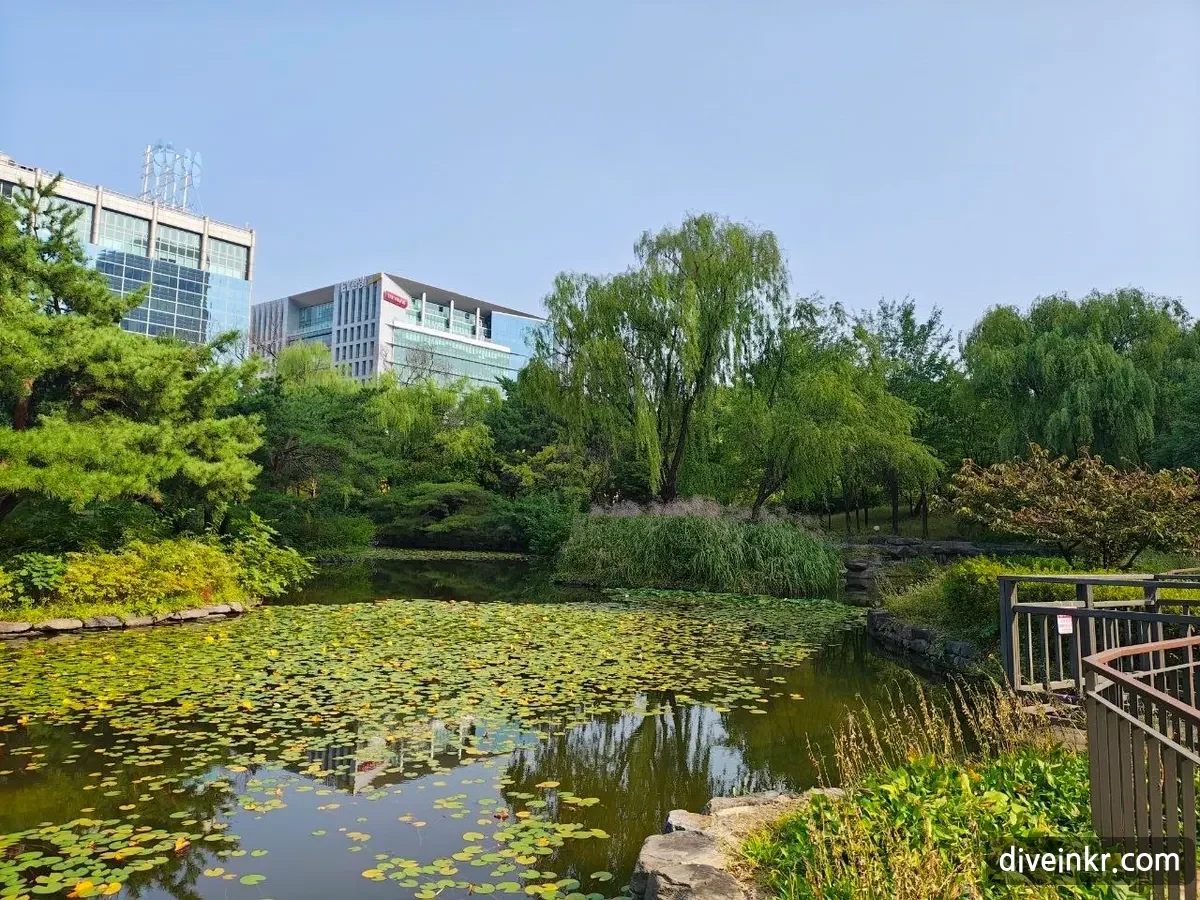
A calm pond covered in lily pads with weeping willows and tall grasses around it, office buildings in the background
The lily pond (연못, yeonmot) in the Korean garden, a few minutes' walk from the office towers.

63빌딩 and the Centre Pompidou Hanwha

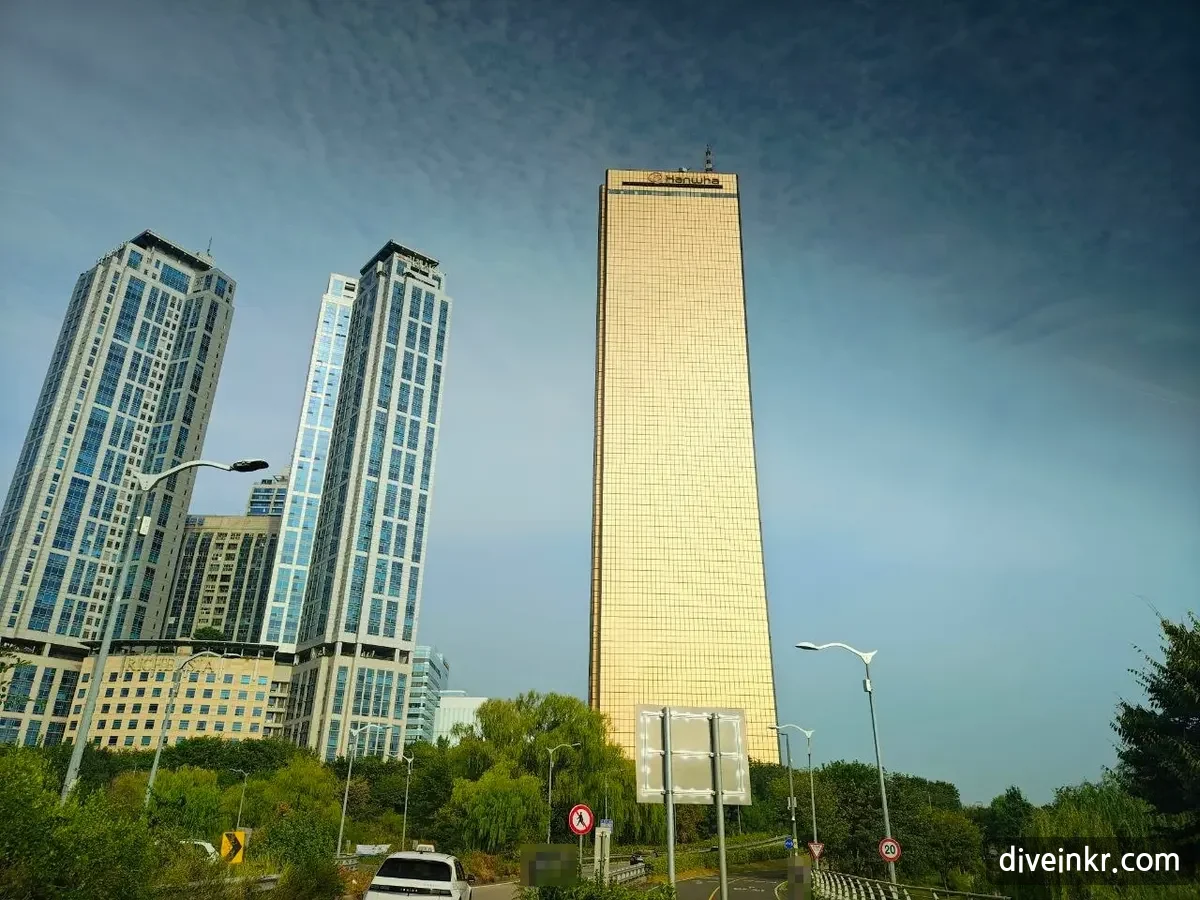
The gold-glass 63 Building next to two tall glass apartment towers, seen from a riverside road lined with willows
63빌딩 (yuksam-bilding), the 63 Building. Its gold-tinted glass makes it easy to spot from anywhere along the river.

When it opened in 1985, the 63 Building was the tallest building in Korea — 249 meters, with 60 floors above ground and 3 below, which is where the name comes from. It held that title until the early 2000s; today the tallest is Lotte World Tower (555 m). For a while it also went by the name 63스퀘어 (63 Square), but everyone old enough to remember it going up has always just said 63빌딩, and the building itself has gone back to that name.
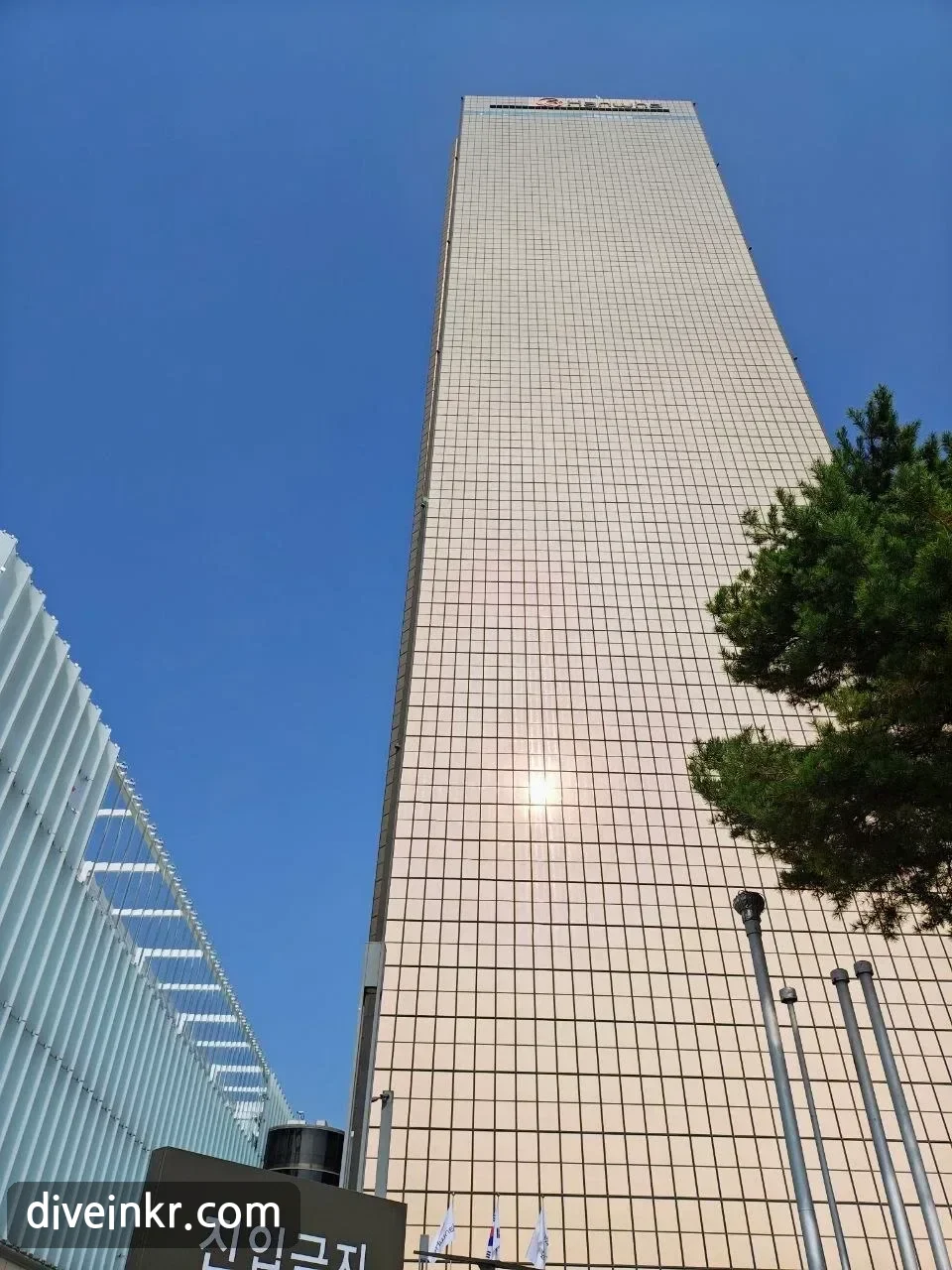
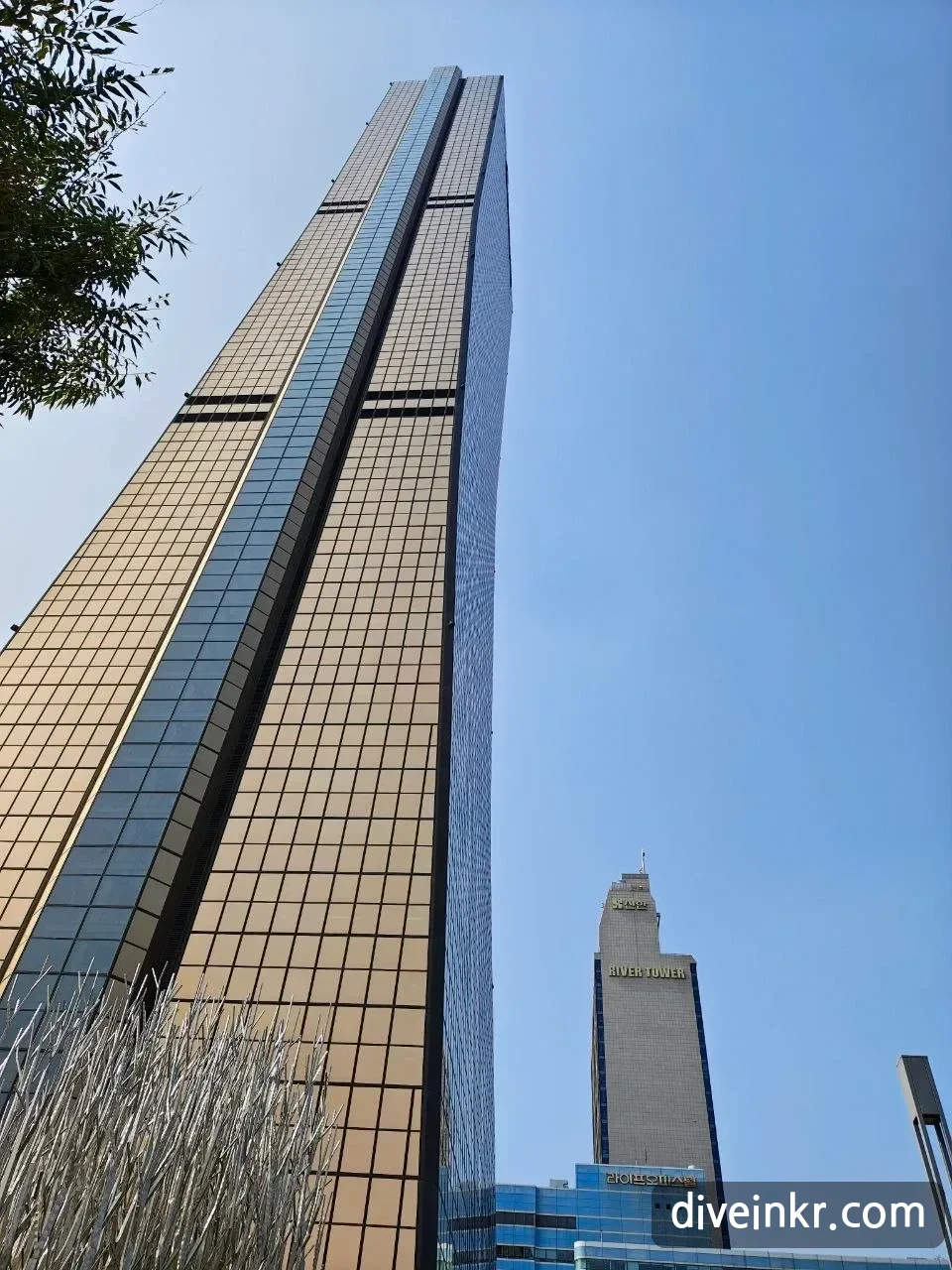
Looking straight up the gold-glass 63 Building from its base against a blue sky
Looking up from the foot of the tower.
The gold-glass side of the 63 Building seen from below at an angle, with another tower in the distance
Up close, the gold glass reflects the sky.

The aquarium and the 60th-floor gallery that generations of school groups visited both closed in June 2024. In June 2026 the building reopened with a new observation deck and, in the annex where the aquarium used to be, the 퐁피두센터 한화 (Centre Pompidou Hanwha) — a branch of the Paris modern art museum, run with the Hanwha Foundation of Culture.
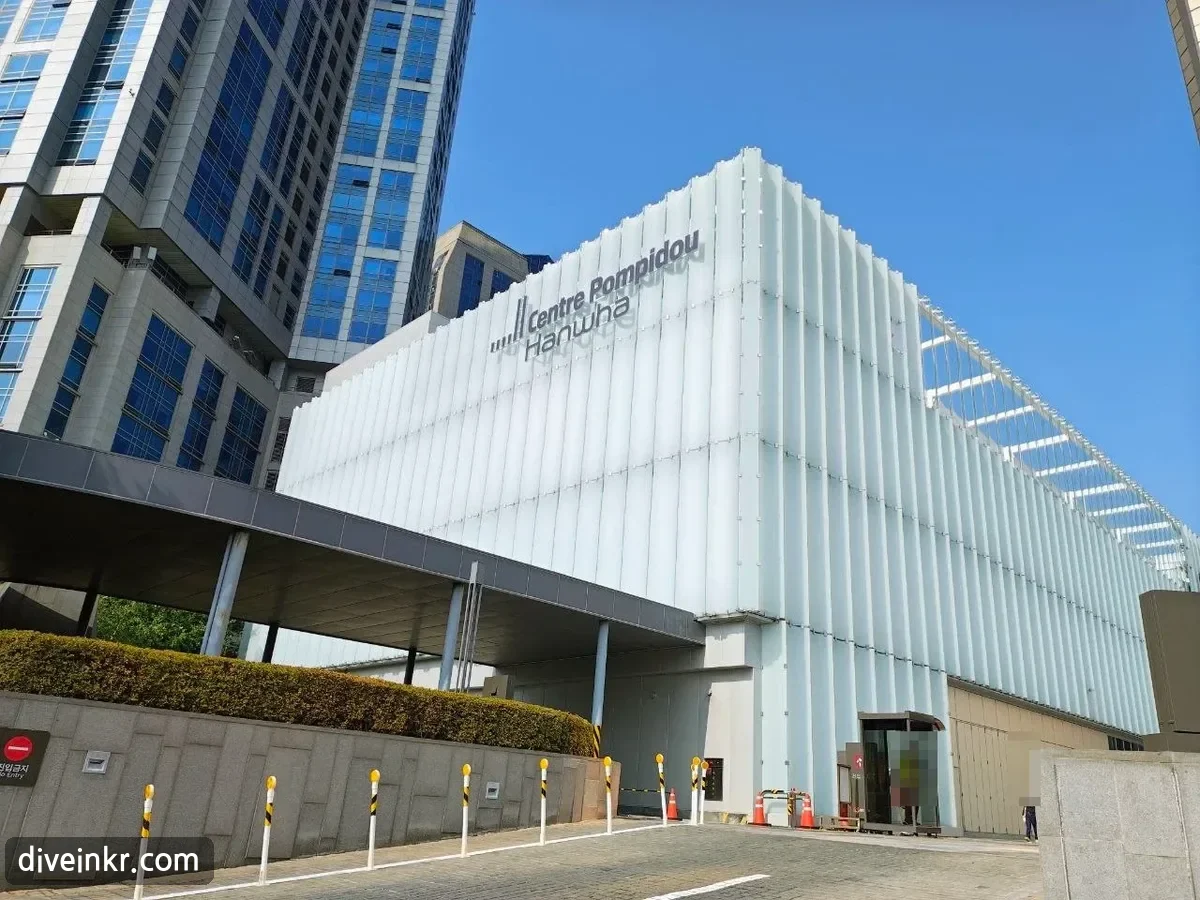
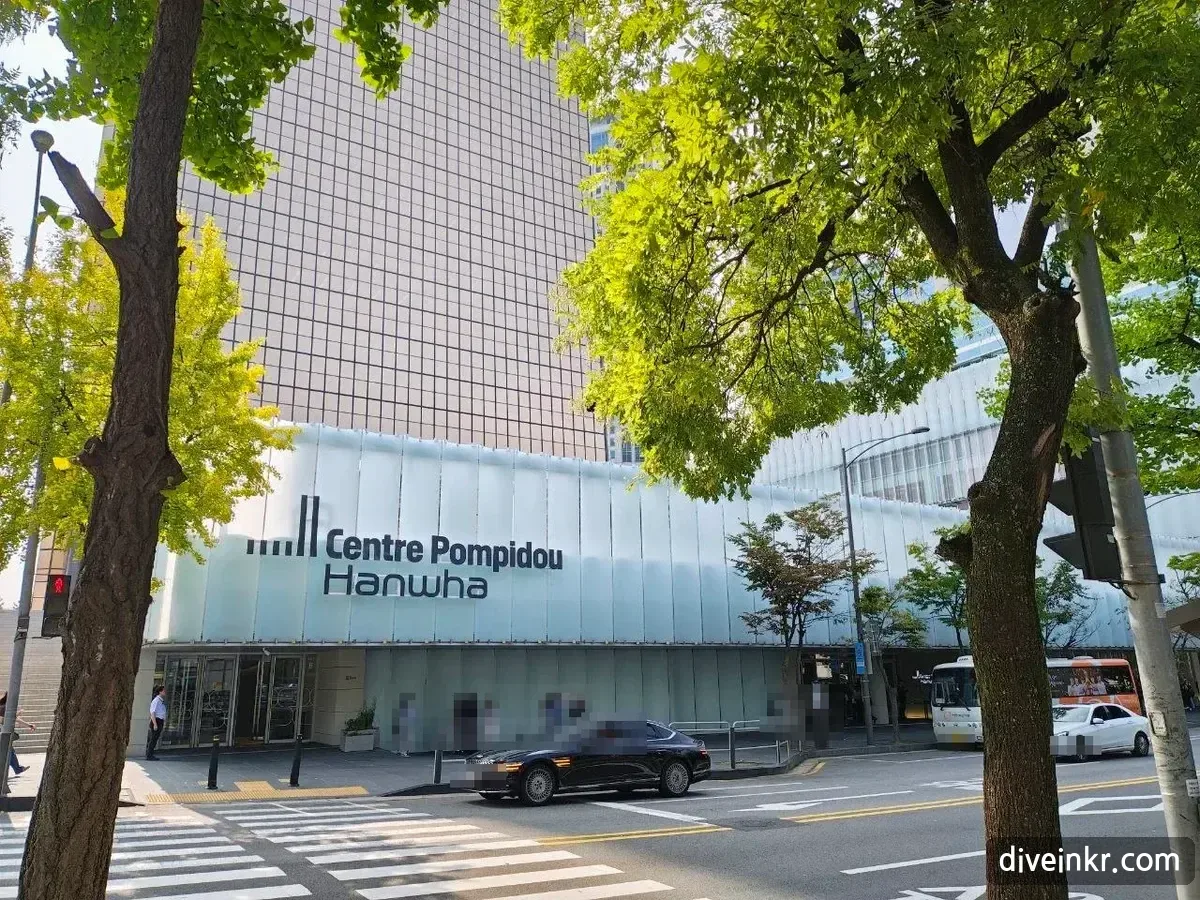
The white ribbed-glass Centre Pompidou Hanwha building with its name near the top, beside the 63 Building
The Centre Pompidou Hanwha, in the 63 Building's annex.
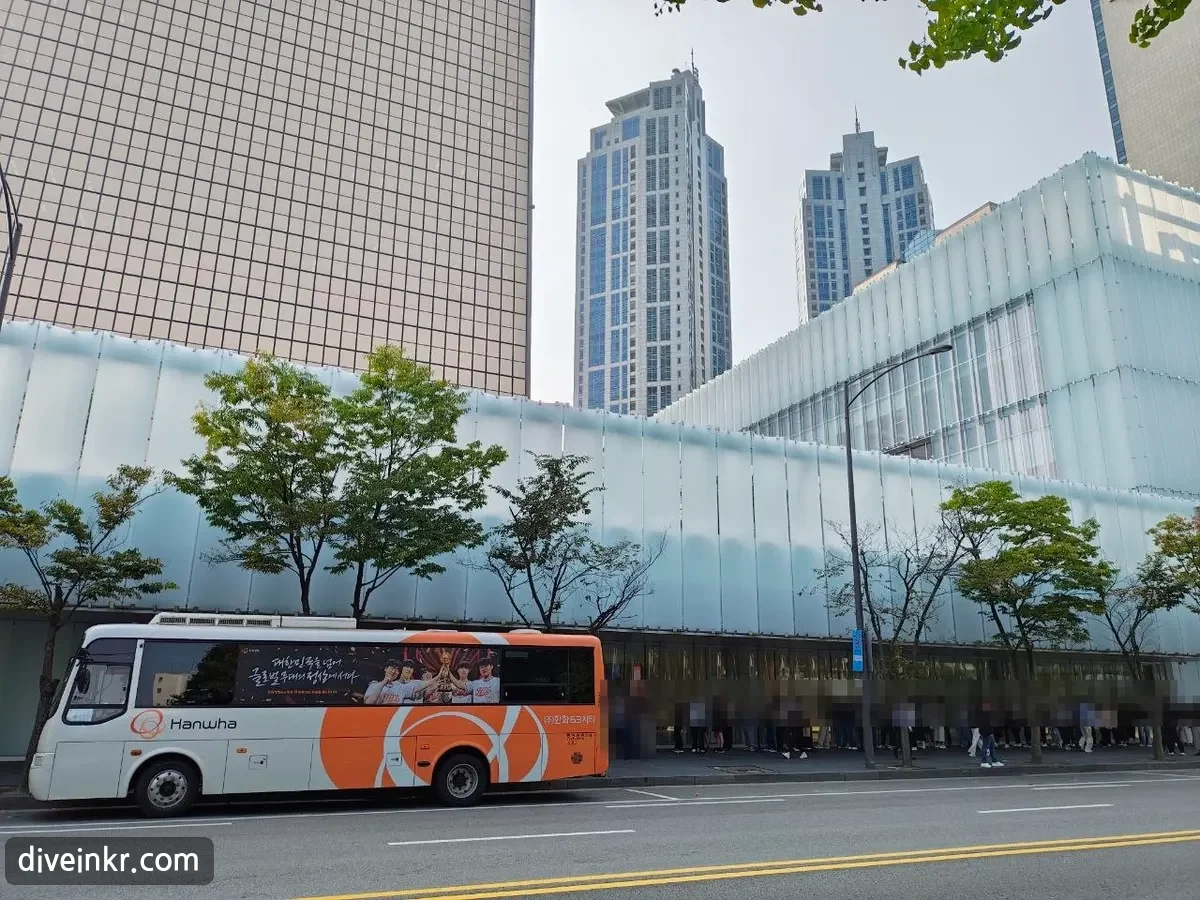
A long line of visitors waiting along the frosted-glass wall of the Centre Pompidou Hanwha, with an orange-and-white Hanwha shuttle bus parked at the curb and apartment towers behind (faces blurred)
A long line outside the museum on a weekday. Tickets for adults were 28,000 won for the opening exhibition; prices change with each show, and it's closed on Mondays.
The frosted-glass Centre Pompidou Hanwha building with its name on the front, seen across a crosswalk, with the 63 Building's tower rising behind it (faces and number plates blurred)
The museum from across the street, with the 63 Building behind it.

더현대 서울: A Department Store With a Forest Inside
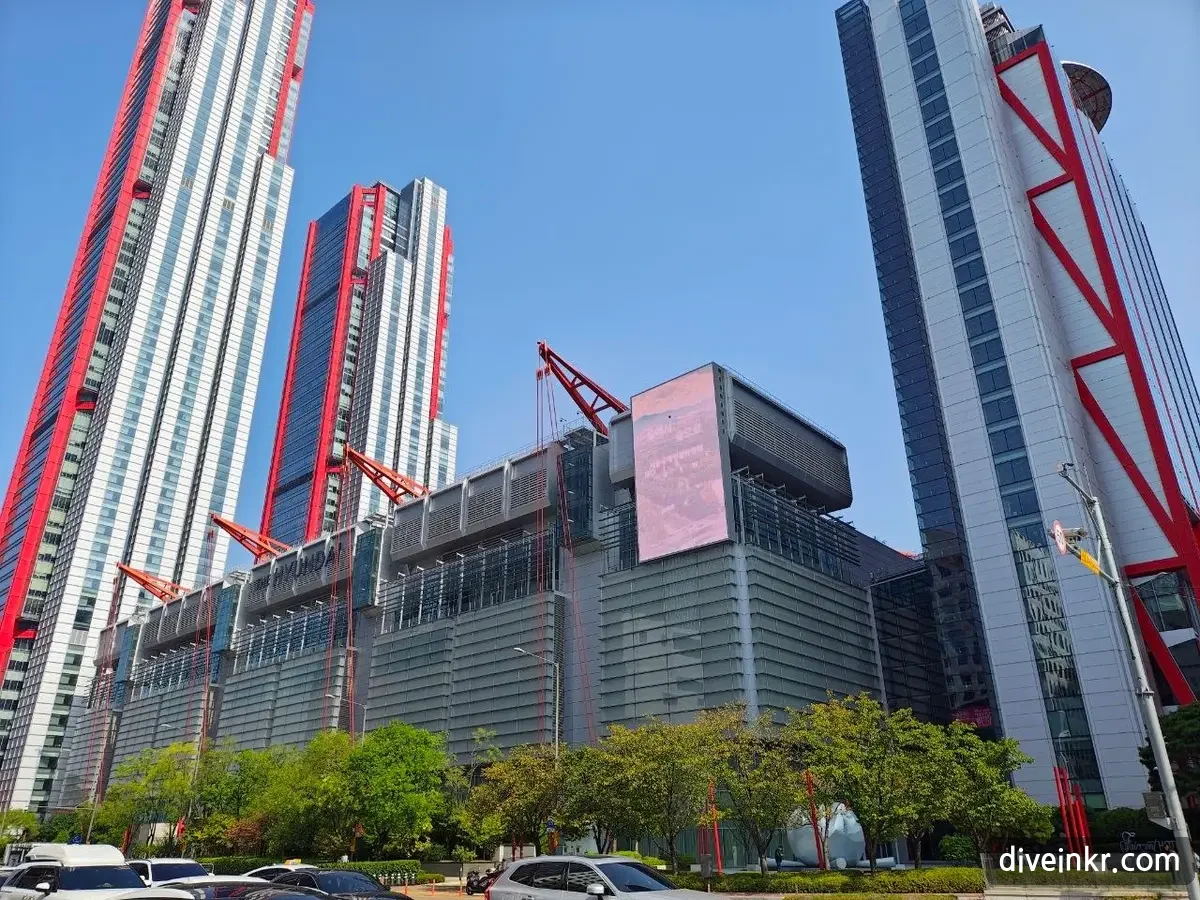
The Hyundai Seoul department store seen from the street: a long gray building with red steel masts on the roof, between tall apartment towers with red frames
더현대 서울 (The Hyundai Seoul) from the street, between the towers of the Parc.1 complex.
Inside 더현대 서울 — the 6th floor, from our channel.
Riding the escalator through the store — also from our channel.

더현대 서울 (deo hyeondae seoul) opened in February 2021 as the biggest department store in Seoul at the time. Almost half of its floor space is given to plants and places to sit, and on the fifth floor there's an indoor park called 사운즈 포레스트 (Sounds Forest), with real grass and about 30 trees under a skylight. It's a ten-minute walk from Yeouido Station — or take the underground walkway from exit 3.
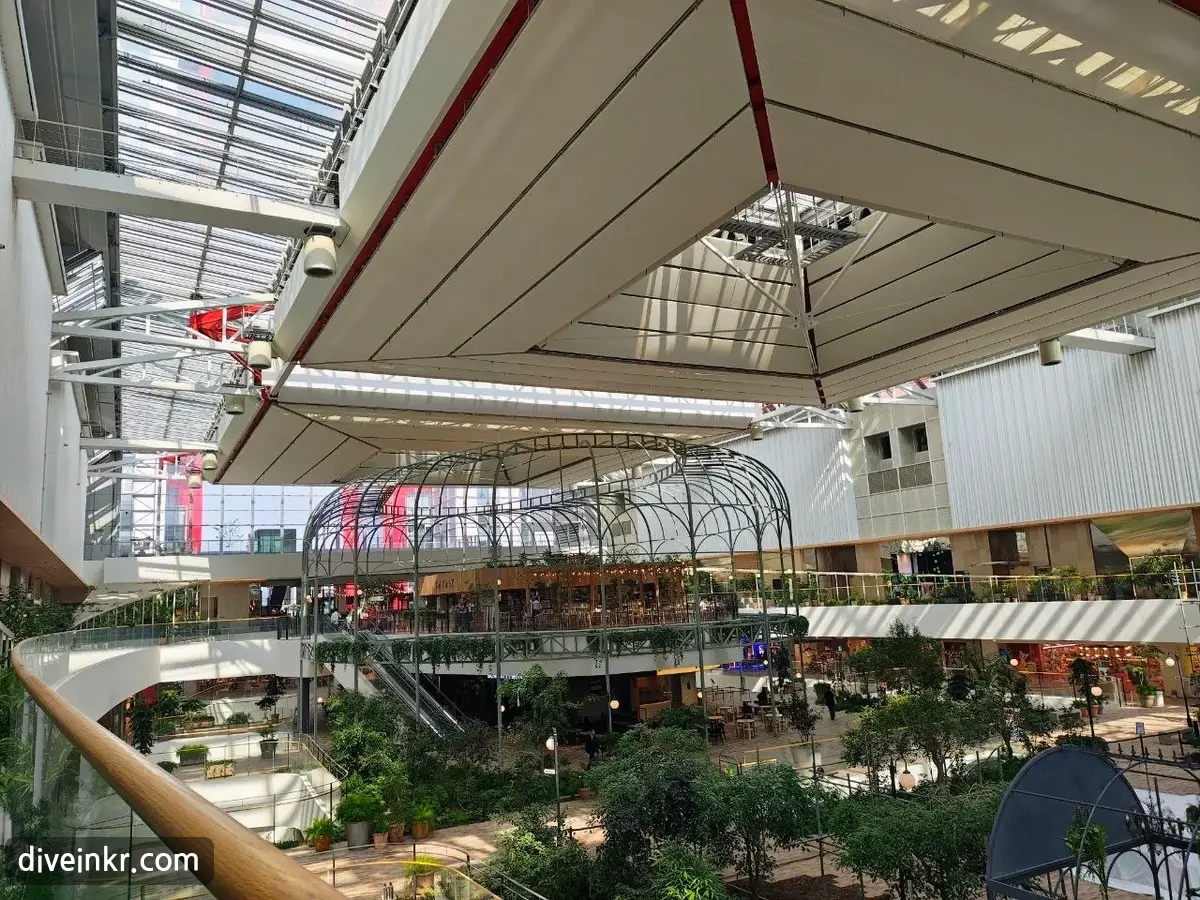
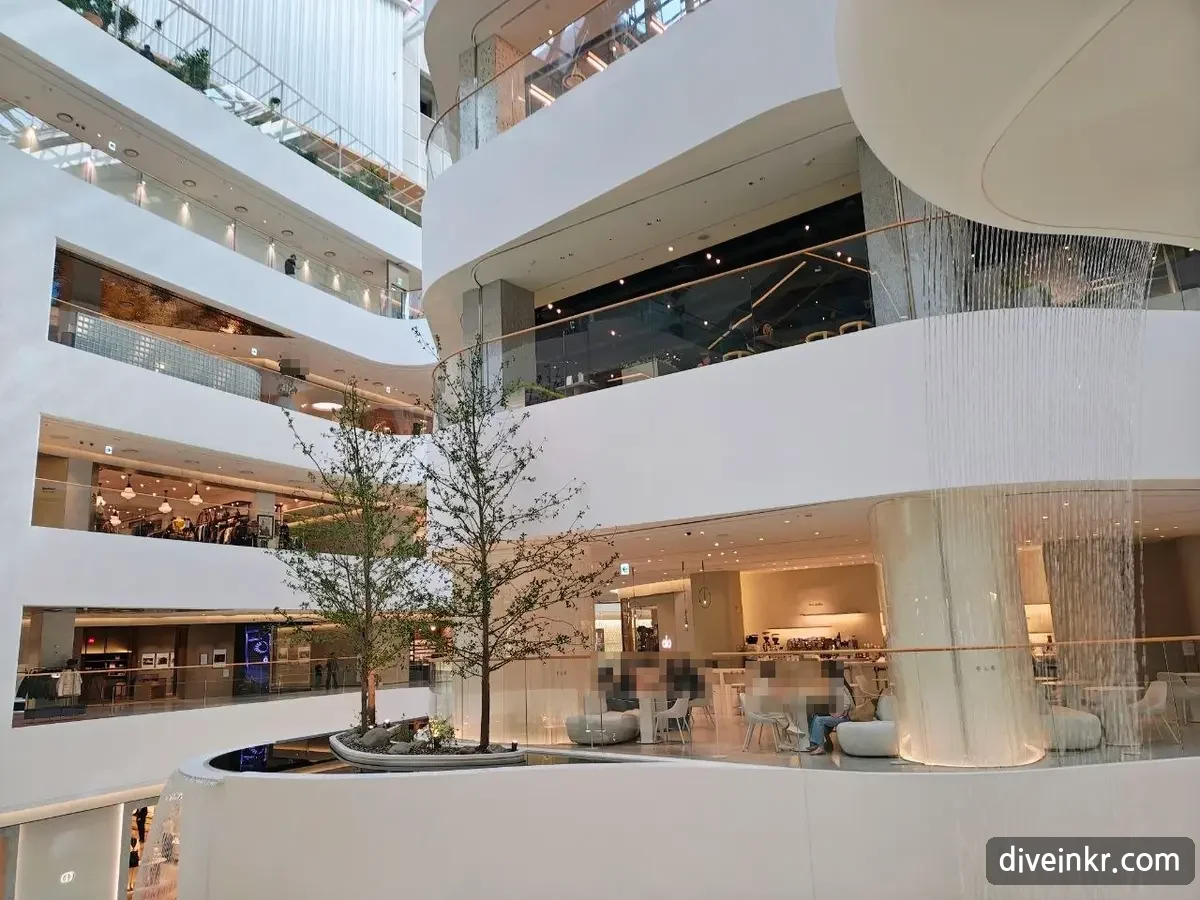
Inside The Hyundai Seoul: a garden of trees and plants on a lower floor under a glass roof, with an iron greenhouse-style frame holding a café and walkways on the floors around it
Inside, the glass roof lets daylight fall all the way down onto trees and planters.
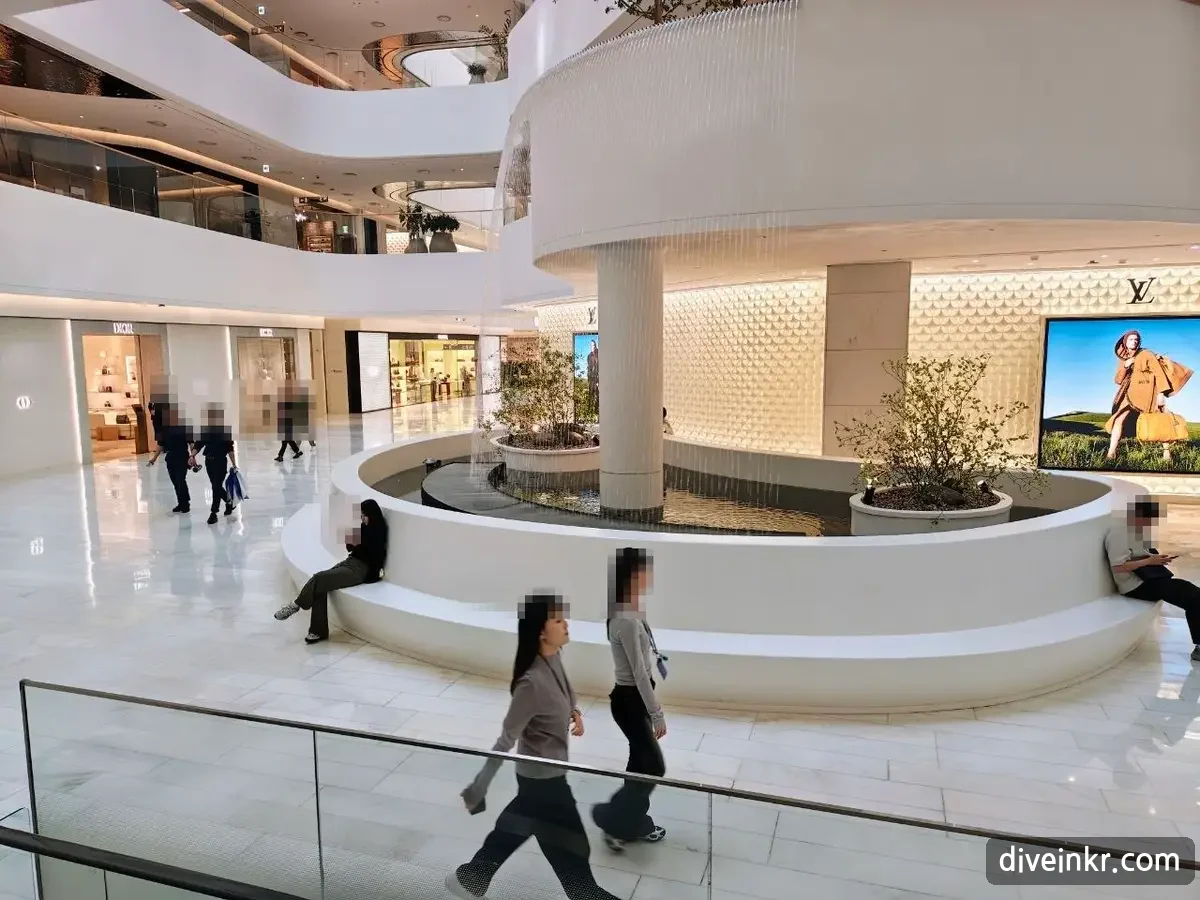
A curved white atrium in The Hyundai Seoul with a round fountain of falling water threads around a pillar, small trees in planters and luxury shop fronts (faces blurred)
A water curtain falls from the upper floors into a round pool — and the pool's edge doubles as a bench.
Curved white balconies rising floor after floor inside The Hyundai Seoul, with a young tree in a planter and a café where people sit at tables (faces blurred)
Floor after floor of curved white balconies, with cafés looking into the atrium.
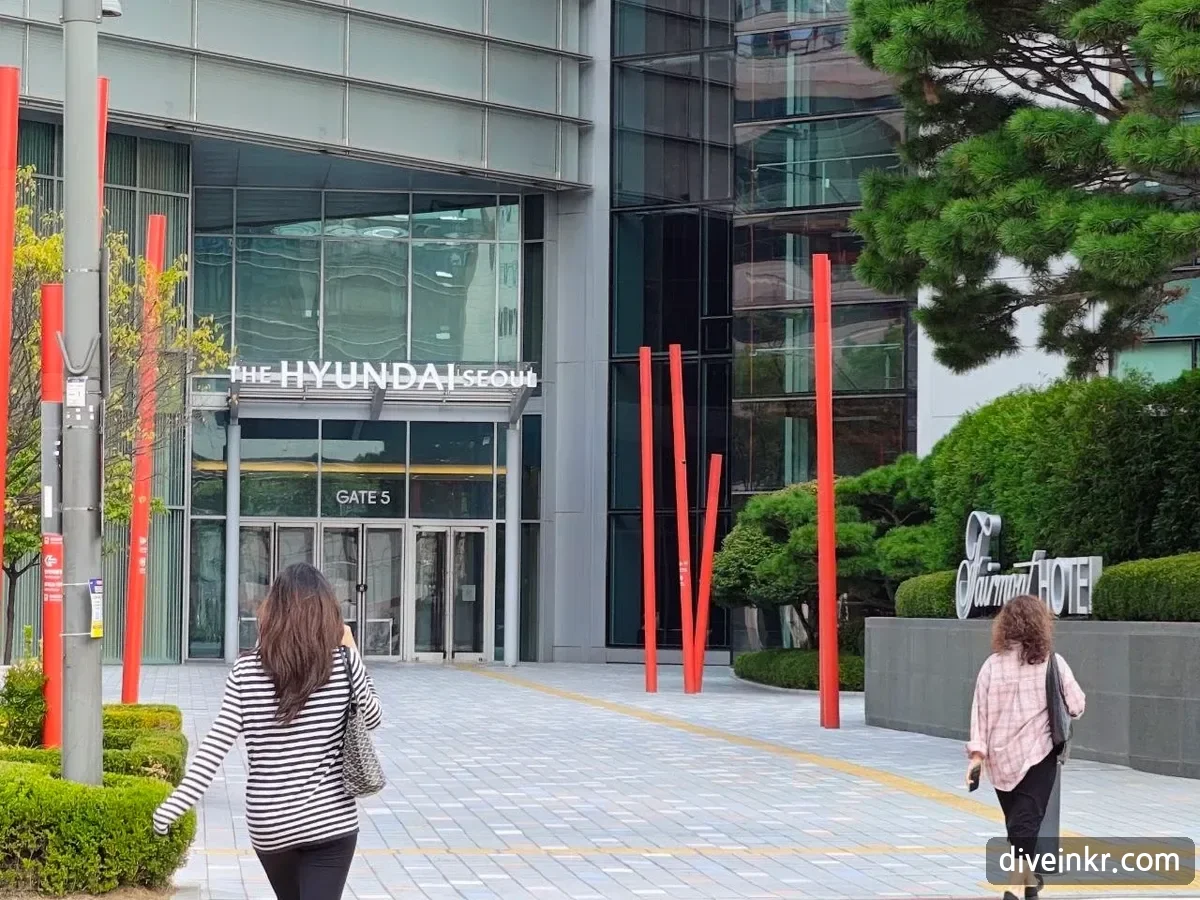
The glass entrance marked GATE 5 under a THE HYUNDAI SEOUL sign, with red poles on the plaza and two people walking toward it
Entrances are numbered: Gate 5 is 5번 게이트 (obeon geiteu) — a handy place to tell a friend to meet you.

The Assembly, KBS and a Megachurch
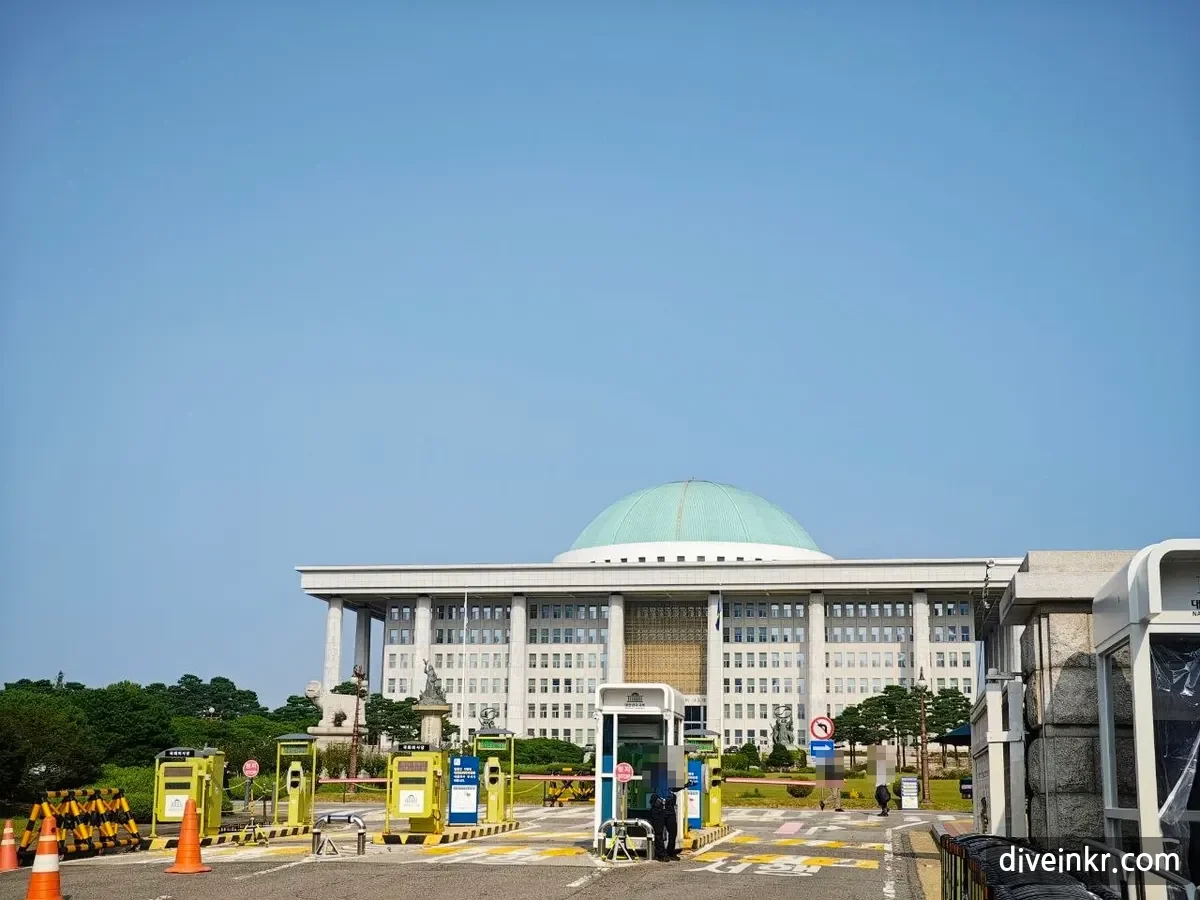
The National Assembly Building in Yeouido, a wide white building with tall columns and a green dome, seen past the entrance gate and security booth (people blurred)
국회의사당 (gukoe-uisadang), the National Assembly Building. The dome is copper: it was reddish when new and has turned green over the decades.

The National Assembly moved here in 1975. The building's 24 columns stand for the 24 solar terms of the traditional calendar, and the dome is meant to show many opinions coming together into one decision. You can go inside for free on a guided visit to the main chamber, booked online in advance (reservation.assembly.go.kr) — bring your passport.
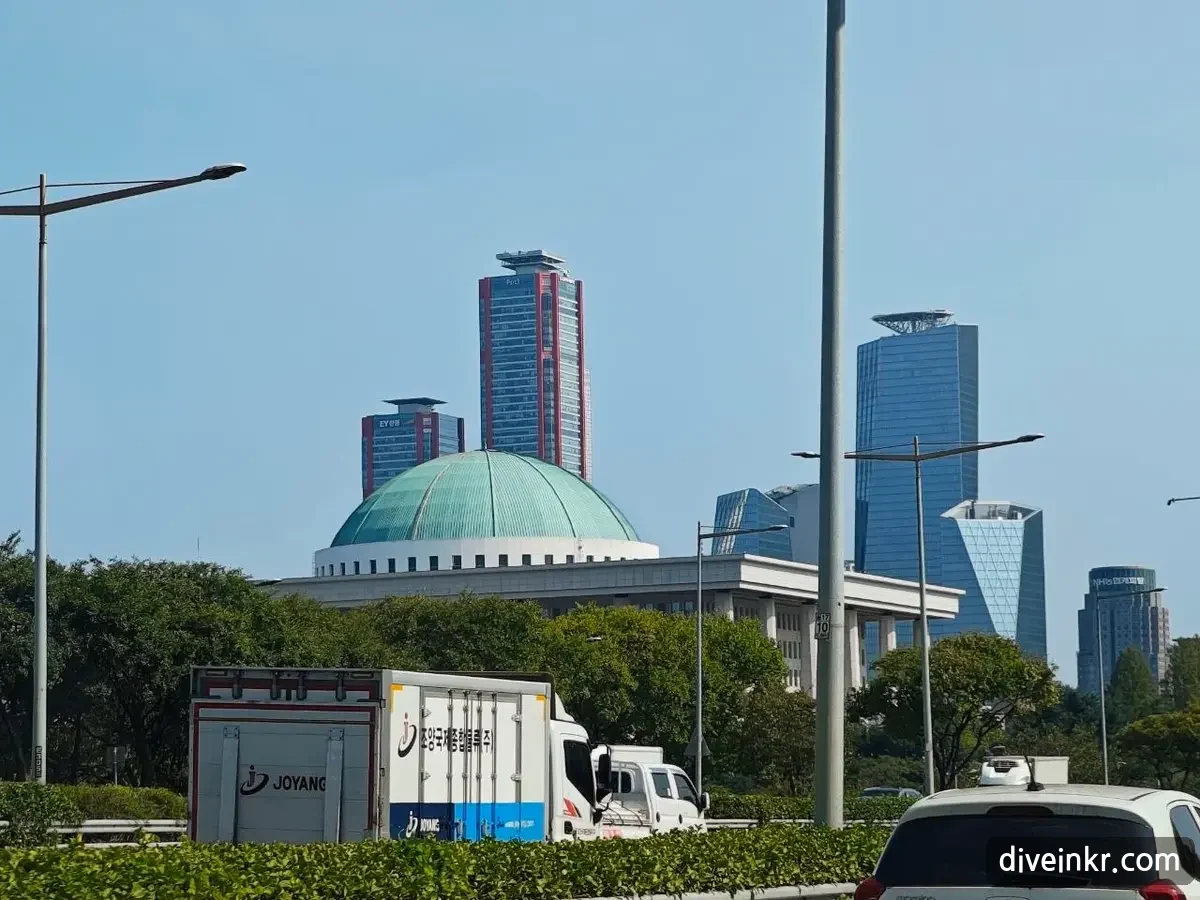
The green dome of the National Assembly Building seen from the road behind it, with office towers of Yeouido rising around it and trucks in the foreground
The dome from the other side, with the towers of Yeouido behind it.

Every Korean of a certain age knows the joke about that dome: if the country is ever in danger, it splits open and 로보트 태권V (Robot Taekwon V) — the giant robot from the 1976 animated film — flies out to save the day.
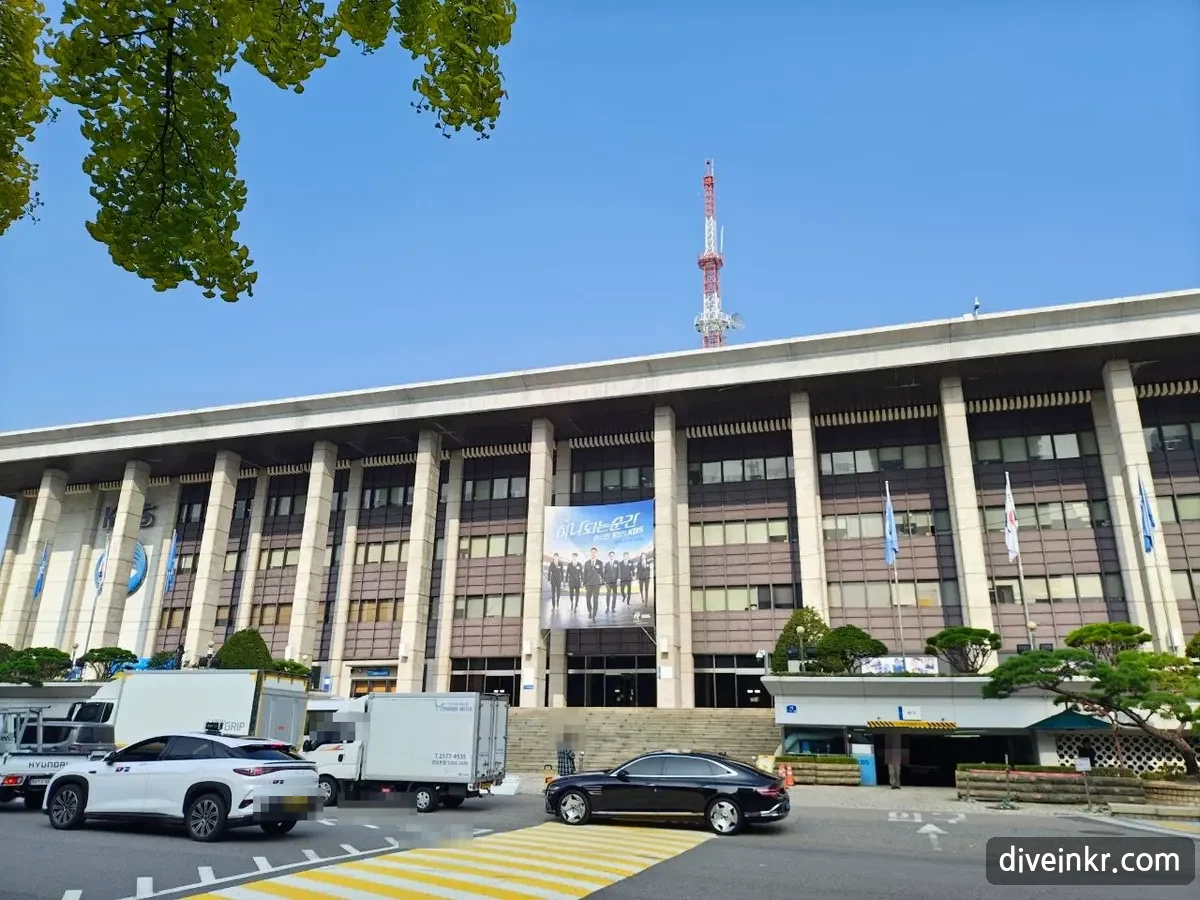
The KBS main building in Yeouido, a long building with tall stone columns and a red-and-white broadcast tower on the roof, with cars parked in front (people and number plates blurred)
KBS 본관 (bongwan, "main building"), home of Korea's public broadcaster, 한국방송공사 (Korean Broadcasting System).
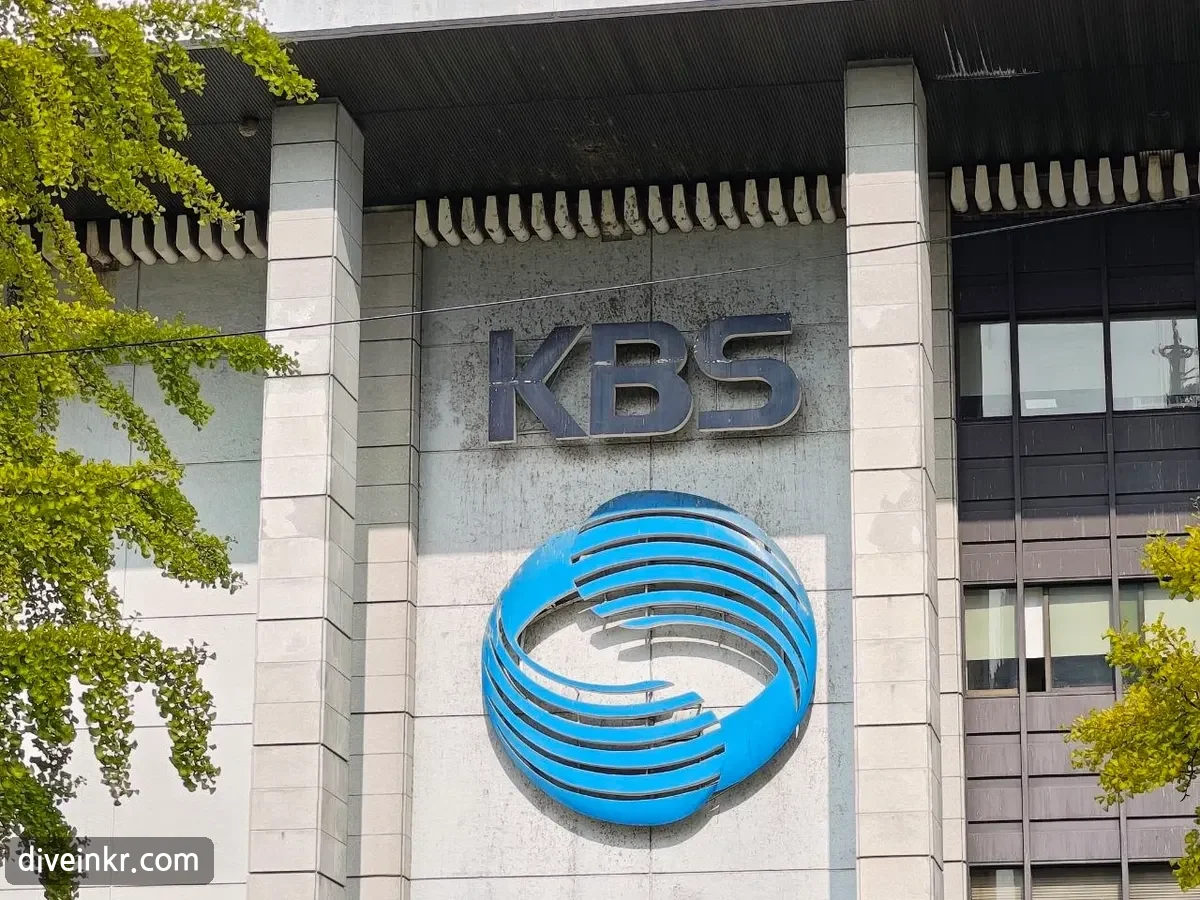
The KBS logo on the side of the KBS main building
KBS runs a free exhibition hall, KBS On, inside the main building, where you can try reading the news or the weather in front of a green screen. Check the opening days before you go.
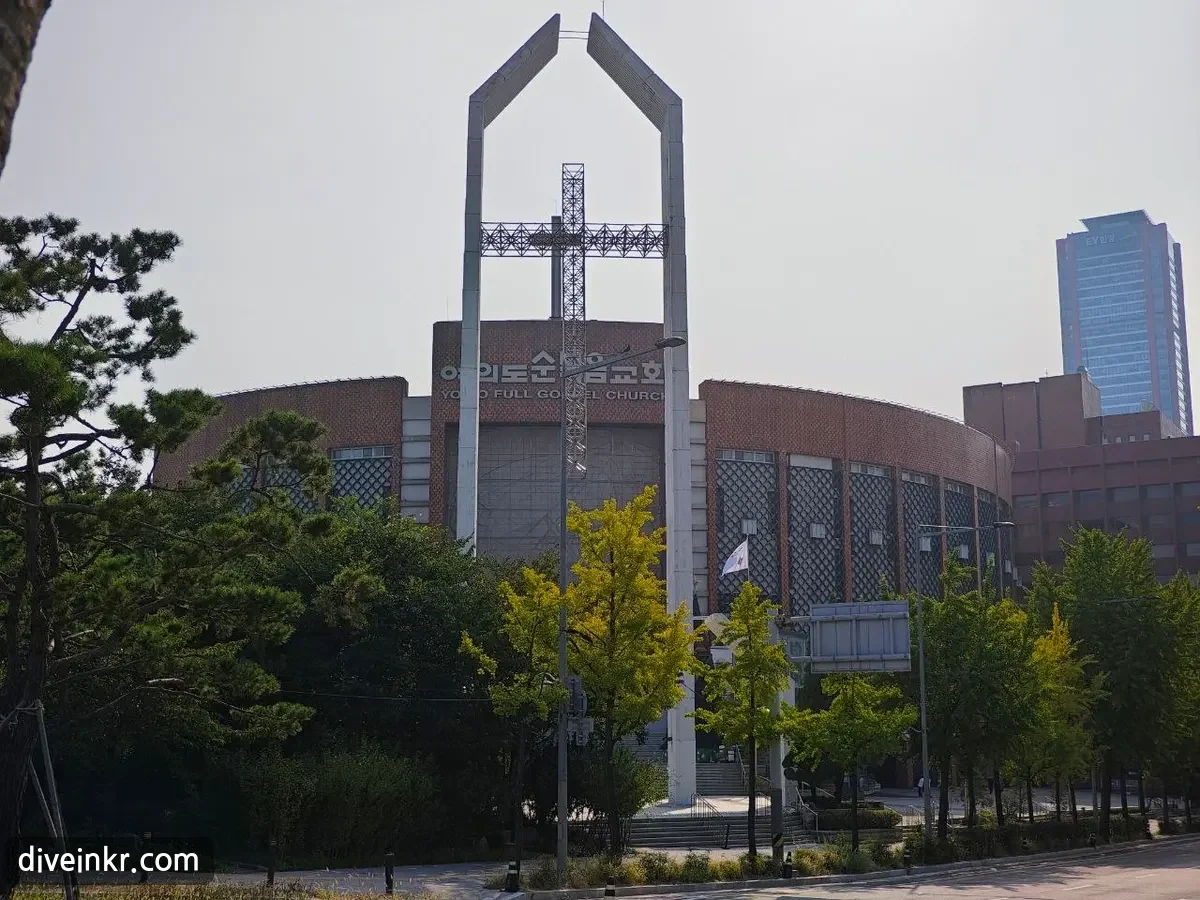
Yoido Full Gospel Church, a large round brick building with its name in Korean and English and a tall white frame holding a lattice cross in front
여의도순복음교회 (Yoido Full Gospel Church).

Korea has small neighborhood churches everywhere — at night you'll see their red neon crosses on rooftops — and it also has a few enormous ones. Yoido Full Gospel Church, founded in 1958 and in Yeouido since 1973, is often described as the largest single church in the world by membership, with hundreds of thousands of registered members. Protestants were the largest religious group in Korea's 2015 census, at 19.7% of the population.
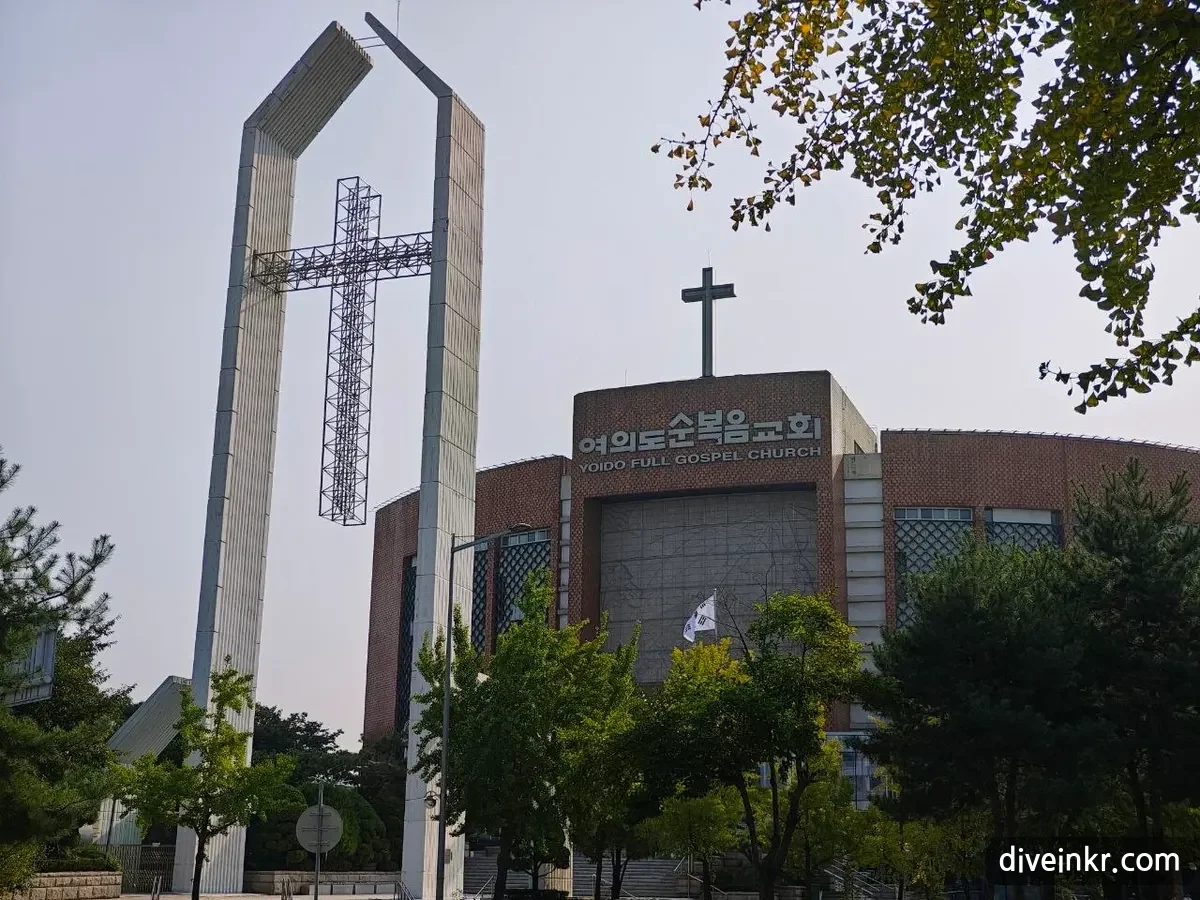
The front of Yoido Full Gospel Church with a cross on the roof and the name 여의도순복음교회 YOIDO FULL GOSPEL CHURCH, with ginkgo leaves overhead
The church's own romanization is "Yoido," an older spelling of Yeouido.

여의도 한강공원: The Riverside

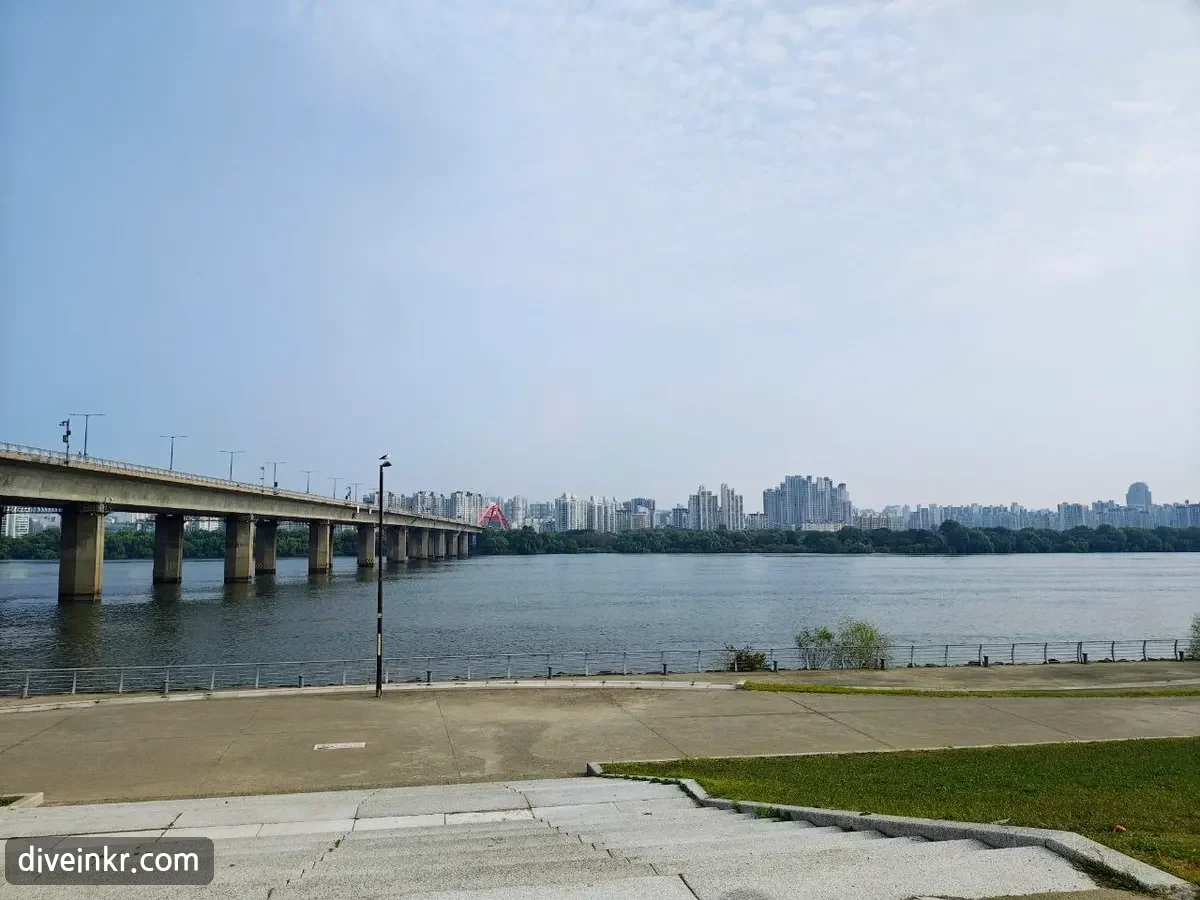
The wide Han River seen from the steps of Yeouido Hangang Park, with a long concrete bridge on the left and apartment blocks on the far bank
The Han River from the steps of Yeouido Hangang Park (여의도 한강공원).
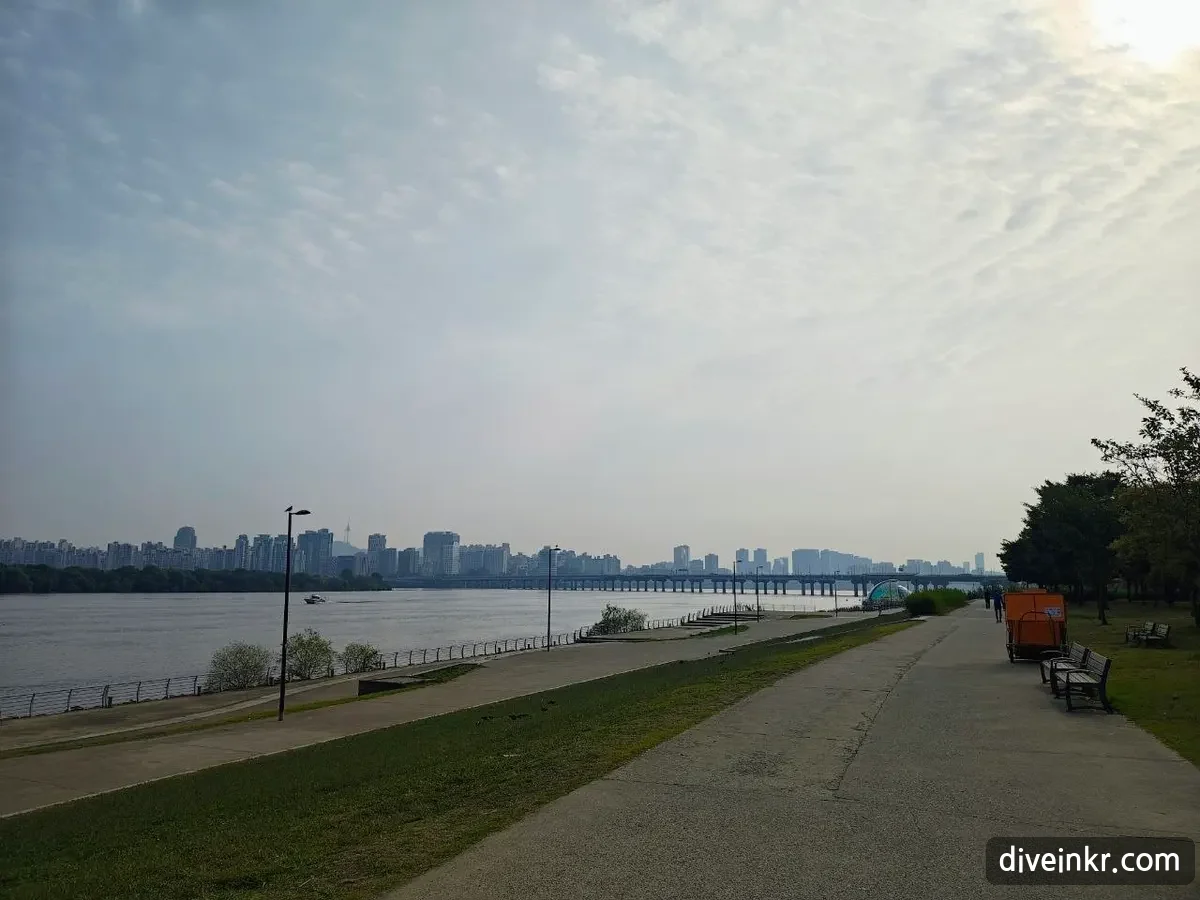
A riverside path and lawn in Yeouido Hangang Park with benches, lamp posts and the city skyline and N Seoul Tower across the river
Looking along the riverside path in Yeouido Hangang Park: lawns, benches and the city across the water.
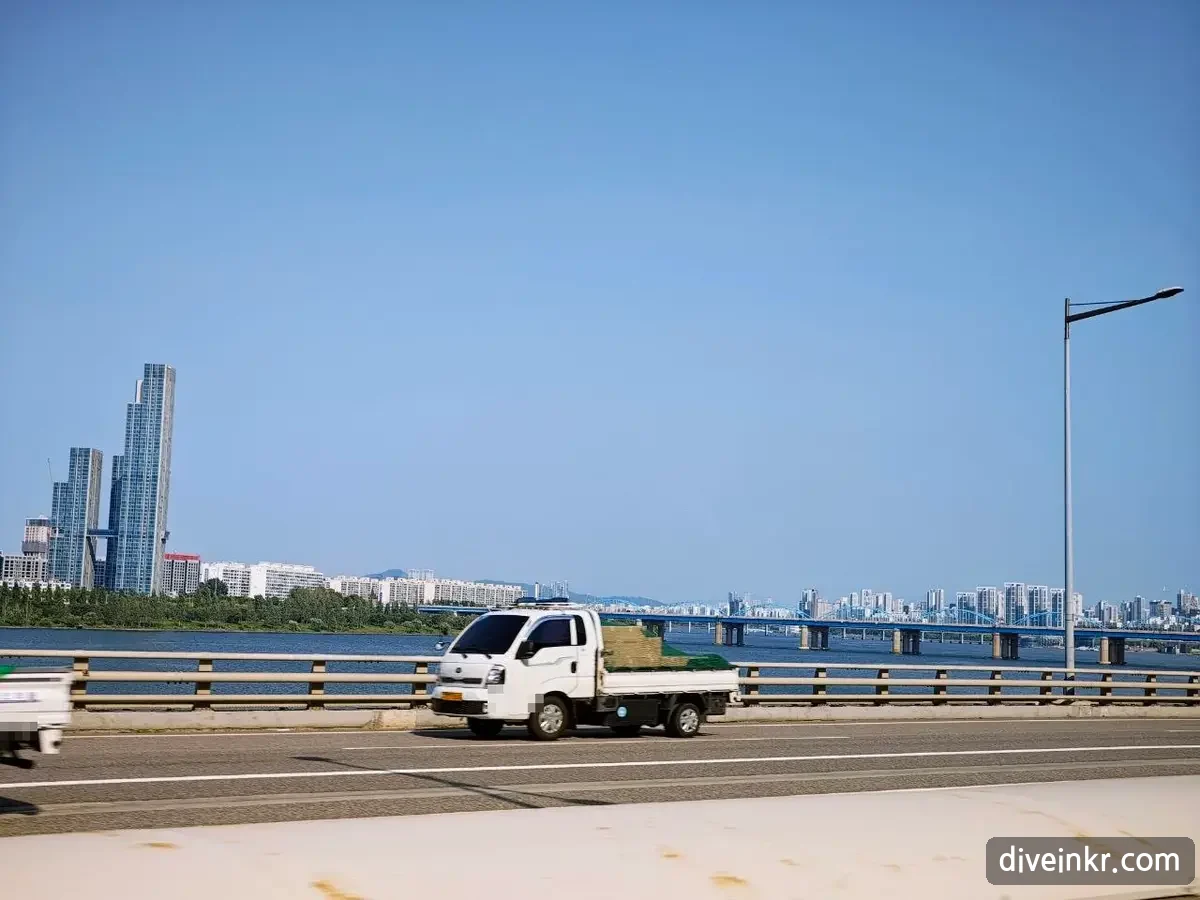
The Han River seen from Olympic-daero, the riverside expressway, with a small truck passing, a blue arch bridge and apartment towers on the far bank (number plates blurred)
The river from 올림픽대로 (Olympic-daero), the expressway along the south bank — most people see the Han like this, through a car window.
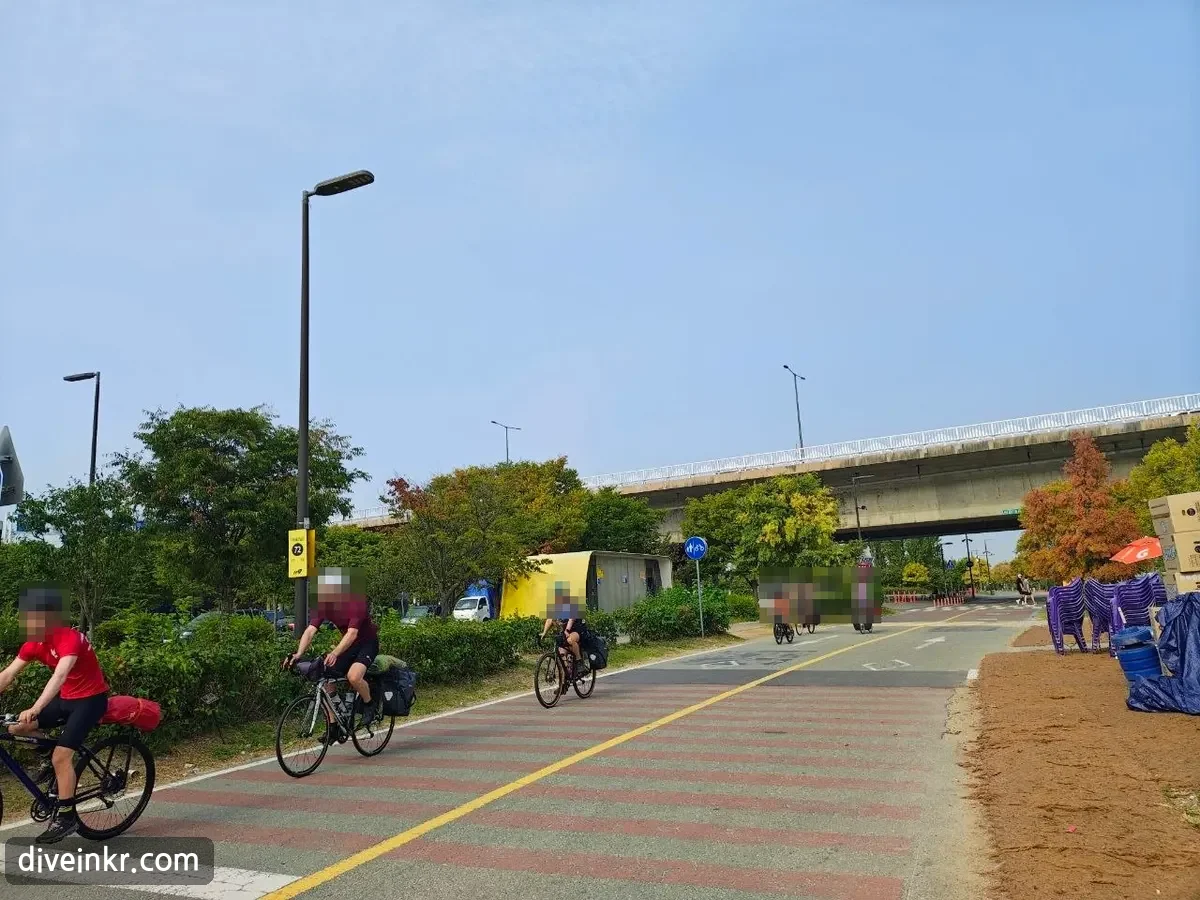
A group of cyclists with loaded touring bikes riding along the painted bike path in Yeouido Hangang Park, under an overpass (faces blurred)
The riverside bike path runs the length of the Han, so you'll see everyone from touring cyclists to people on the city's 1,000-won public bikes.
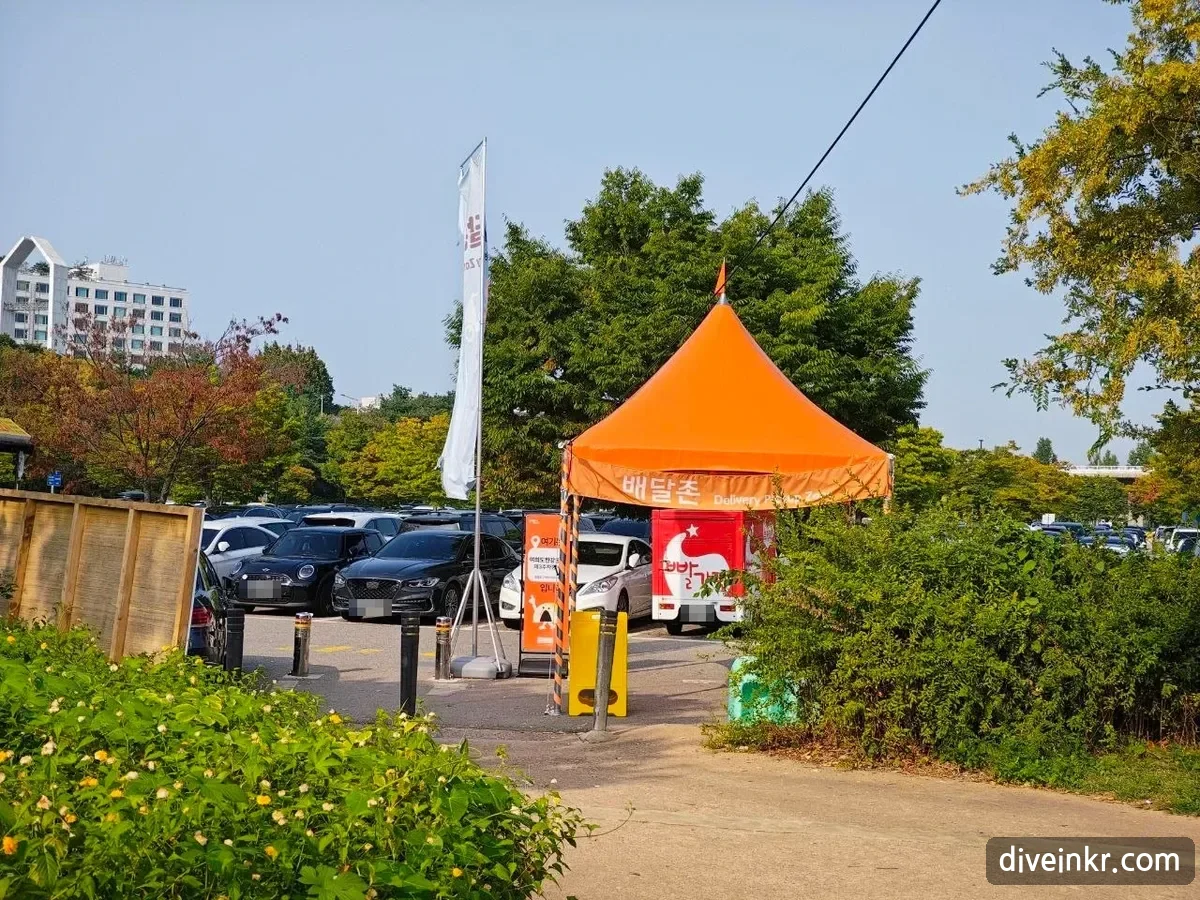
An orange tent marked 배달존 (delivery zone) at the edge of a parking lot in Yeouido Hangang Park, with trees around it (number plates blurred)
A 배달존 (baedal jon, "delivery zone") — the orange tent. Order food to the park and the rider brings it here; you meet them, take it, and carry it back to your spot on the grass.

The delivery zones are a very Korean solution to a very Korean habit: ordering fried chicken (or pizza, or jokbal) to a riverside picnic. There are four in Yeouido and seventeen across the Han River parks. Put the zone in the delivery app as your address and wait there when the rider says they're close.
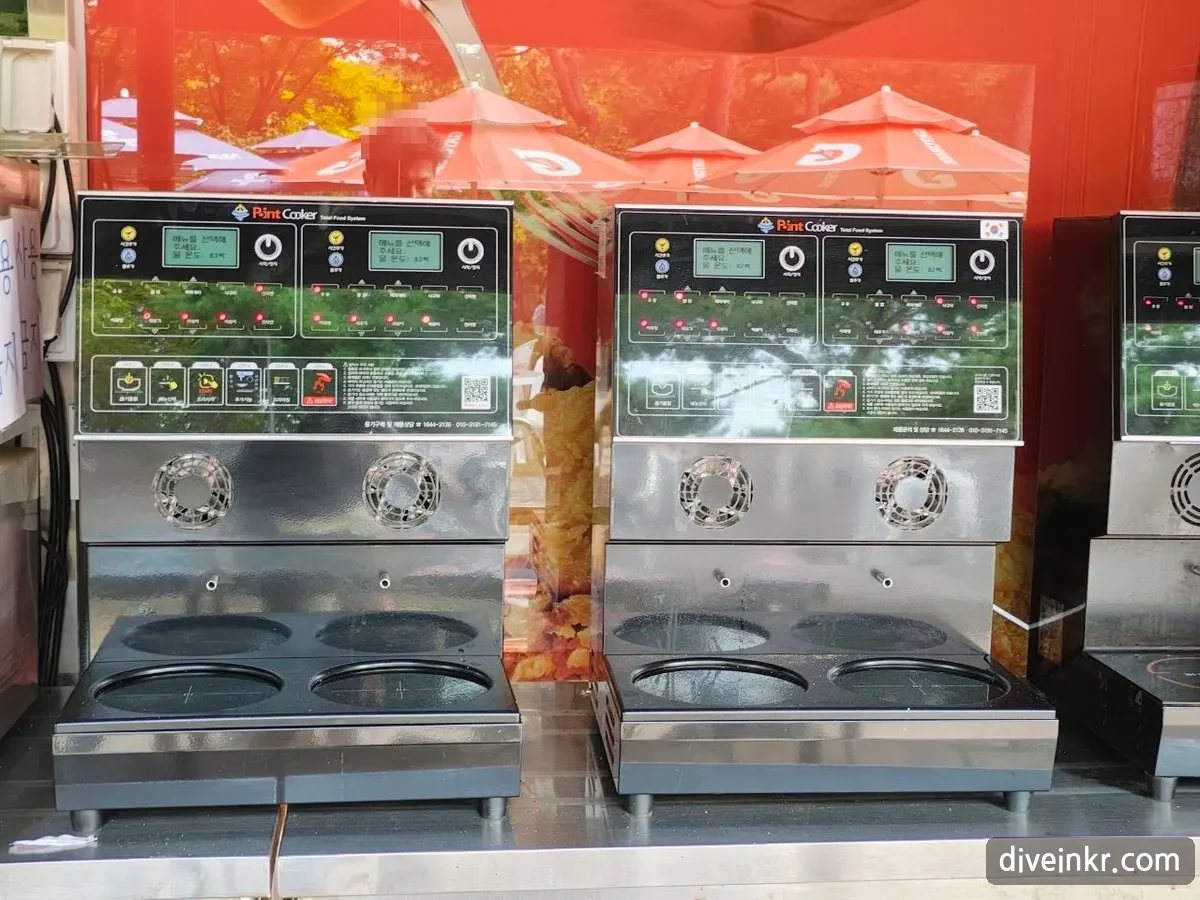
Instant ramyeon cooking machines in a Han River park convenience store: stainless steel units with control panels and round induction plates for paper bowls (a reflection of a person blurred)
The famous 한강 라면 (Hangang ramyeon) machines. Buy a packet of ramyeon in the store, put the noodles and soup into the special bowl, set it on the plate and press the button — the machine adds the water and boils it for you.

Eating ramyeon cooked in these machines by the river is something many visitors try after seeing it in K-dramas. The machine pours the water and cooks the noodles in about three and a half minutes; the instructions on the front say to add the soup powder at the start.
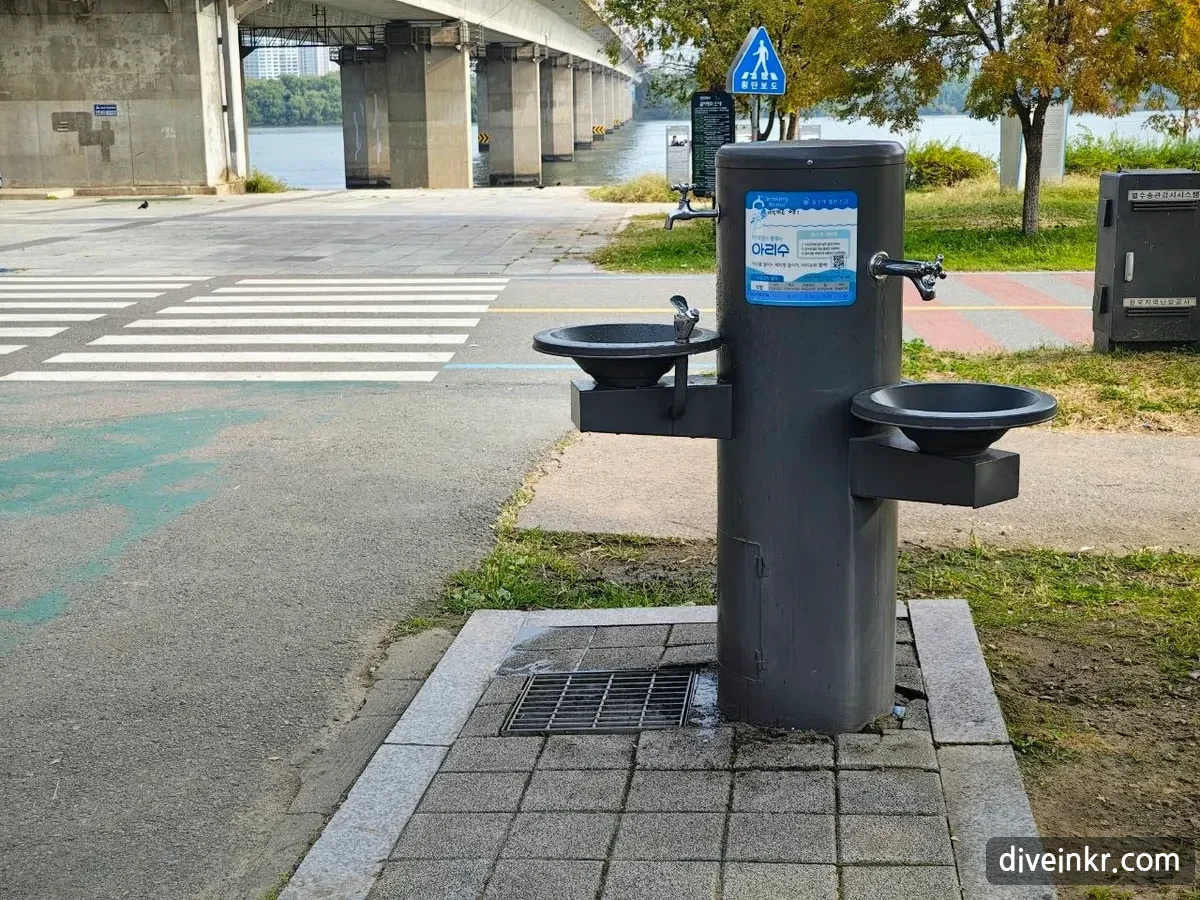
A dark gray outdoor drinking fountain in Yeouido Hangang Park with two bowls and two taps, and a blue label reading 아리수 Drinking Water
An outdoor drinking fountain (음수대, eumsudae). 아리수 (Arisu) is the brand name of Seoul's tap water — an old name for the Han River.

Seoul named its tap water 아리수 in 2004 and tests it far beyond the legal requirements; the city runs about 1,800 outdoor fountains like this one, shut off in winter so the pipes don't freeze.
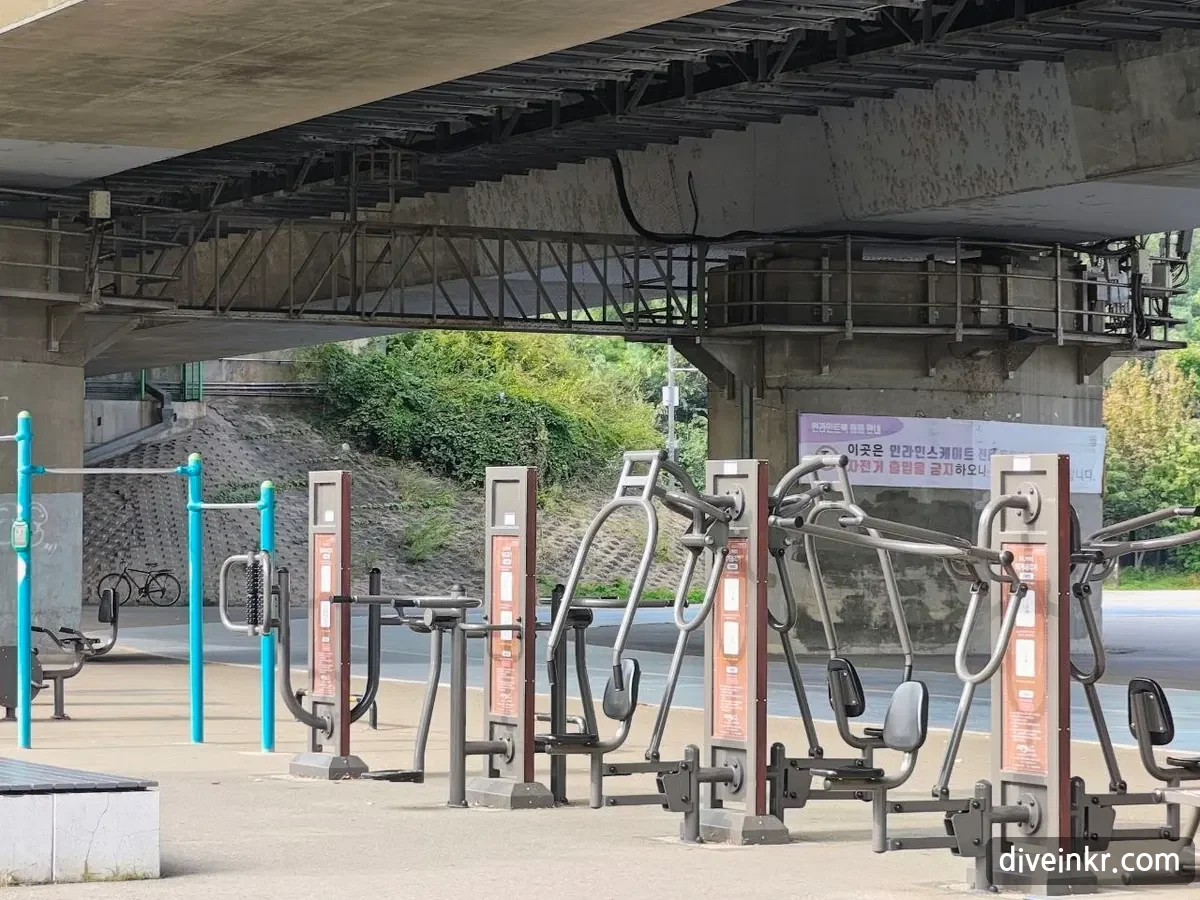
A row of outdoor exercise machines under a concrete bridge in Yeouido Hangang Park, next to pull-up bars
More outdoor exercise machines, tucked under a bridge where they stay in the shade.
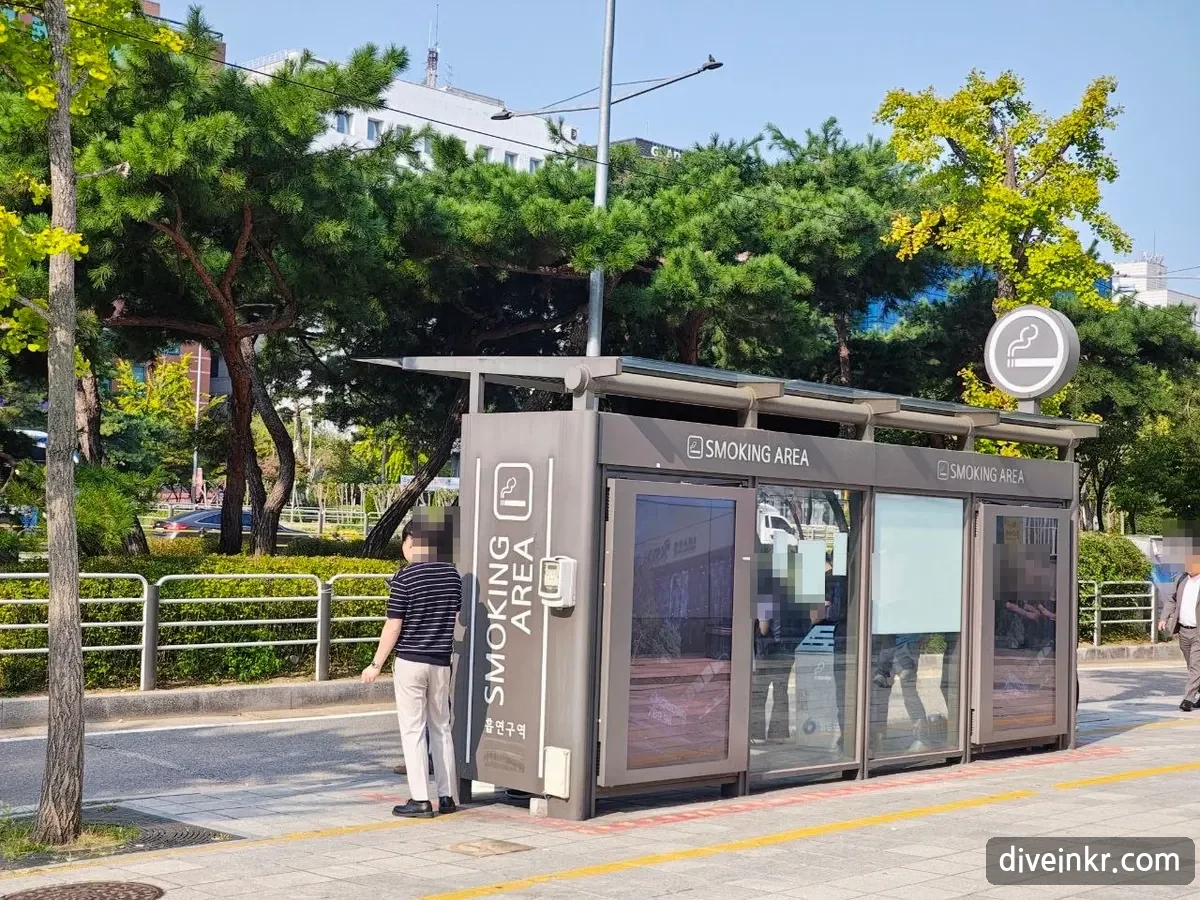
A gray open smoking booth on a Yeouido sidewalk labeled SMOKING AREA 흡연구역, with a round no-smoking-style cigarette sign on a pole (people blurred)
A street smoking booth (흡연구역, heubyeon guyeok) in Yeouido.

Smoking: only at the booths

Yeouido Park is one of the city parks Seoul has made no-smoking (금연구역, geumyeon guyeok), and smoking in a no-smoking area can bring a fine of up to 100,000 won. In the Han River parks and on busy streets, smoke only at booths like this one.

Want to ride along the river yourself? Here's how to rent a 따릉이, Seoul's 1,000-won public bike.

Korean You'll Use in Yeouido

서울달 몇 시까지 해요?

seouldal myeot sikkaji haeyo?

Until what time does Seoul Dal run?

하다 is the everyday verb for a place or event being open or on: 몇 시까지 해요? works for shops, museums and rides.

63빌딩 어떻게 가요?

yuksam-bilding eotteoke gayo?

How do I get to the 63 Building?

63 is read the Sino-Korean way, 육삼 (yuksam), digit by digit.

배달존에서 받을게요.

baedaljoneseo badeulgeyo.

I'll pick it up at the delivery zone.

한강 가서 라면 먹자!

hangang gaseo ramyeon meokja!

Let's go to the Han River and eat ramyeon!

여기 금연 구역이에요.

yeogi geumyeon guyeogieyo.

This is a no-smoking area.

KoreanRomanizationMeaning
공원 / 한강공원gongwon / hangang-gongwonPark / Han River park
광장gwangjangPlaza, square
연못yeonmotPond
정자jeongjaPavilion
음수대eumsudaeDrinking fountain
배달존baedal jonDelivery zone
흡연구역 / 금연구역heubyeon guyeok / geumyeon guyeokSmoking area / No-smoking area
일방통행ilbang-tonghaengOne way
소풍sopungOuting, picnic
탑승tapseungBoarding

Mini Quiz

2 short questions — about 1 minute

  1. 2. Where does the name 63빌딩 come from?

  2. 3. You order chicken to Yeouido Hangang Park. Where do you get it?

Part of Korean Phrases for Travelers

Related Knowledge

1 more related

Learn Next

How to Ride the Seoul Subway

Yeouido is three stations on Lines 5 and 9 — the subway guide covers transfers, exits and the announcements.

Will you remember this tomorrow?

Save it — your daily review brings it back right before you'd forget. No account needed.